
 Lesson 9.1
Lesson 9.1 · Managing the Works
Sequencing the Works
A renovation runs in a fixed order for a reason - dirty and structural work first, hidden services next, fragile finishes last - and reading that order is how a pile of trades becomes a finished home
A renovation looks like chaos - mud, noise, a dozen trades. Underneath it runs a strict order, and knowing that order is how you tell a job on track from a job in trouble.
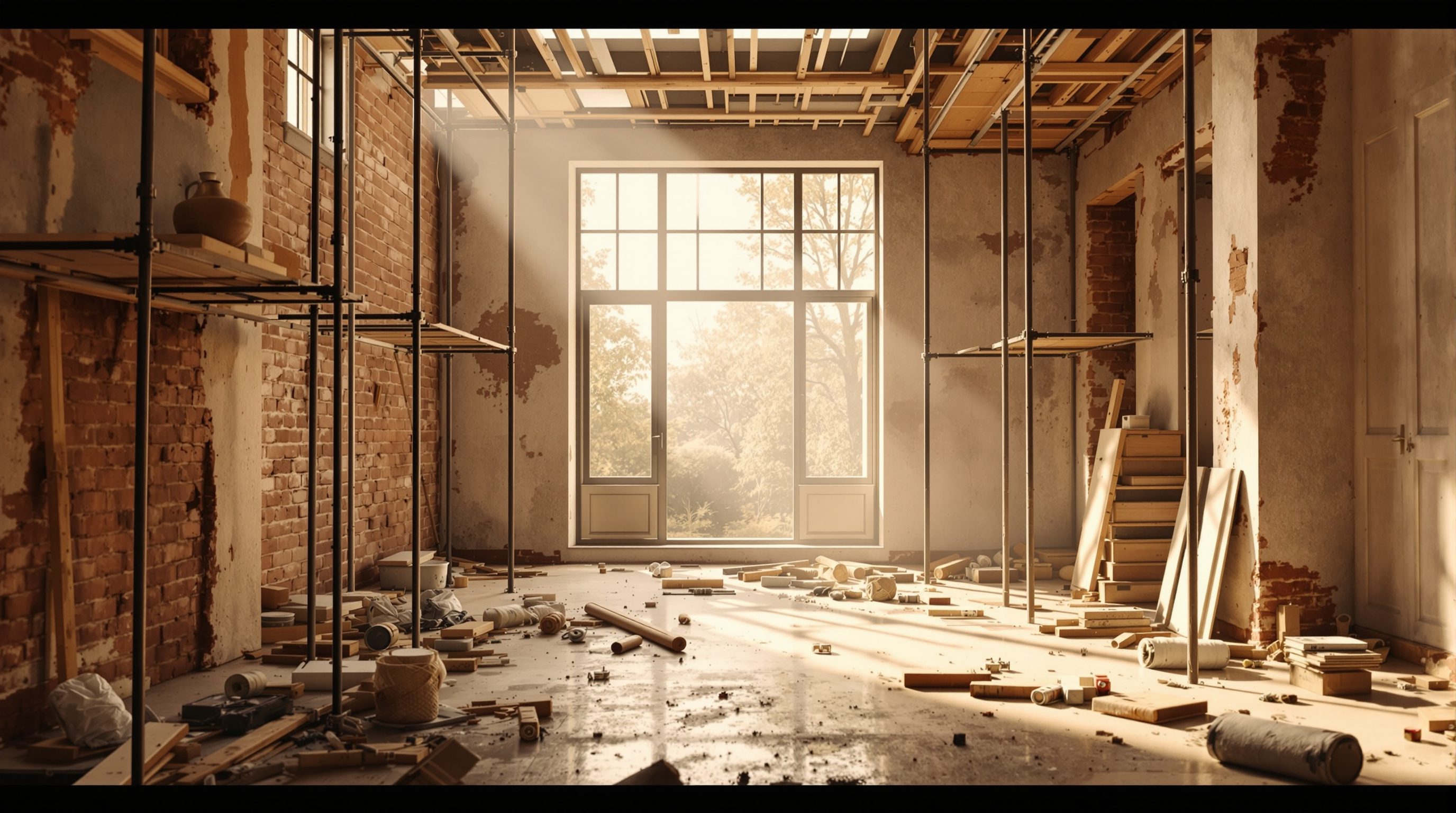
Stand in a house mid-renovation and it looks like pure disorder: walls half-open, cables hanging, a plasterer and a plumber arguing over the same corner, dust on everything. But a good renovation is not chaos at all - it is a carefully ordered sequence, and the apparent mess is simply several stages overlapping in time. Dirty and structural work comes first, the hidden services that must be buried go in next, the building gets closed up, the things that plug into those services are fitted, and only at the very end do the fragile, beautiful finishes arrive. Each stage earns the right to the next.
This order is not a matter of taste or habit; it is dictated by physical dependency. You cannot run a cable through a wall you have not yet built, plaster over a pipe you have not yet laid, or lay a delicate timber floor while labourers are still carting rubble across it. Get the order right and the job flows, each trade handing cleanly to the next. Get it wrong and you pay twice - tearing out finished work to reach something that should have gone in earlier, a cost and a heartbreak that careful sequencing exists to prevent. This lesson teaches the logic of the sequence and the idea of the critical path, so that you can read a renovation programme, see where your job really stands, and understand why 'we cannot start the tiling yet' is usually the honest truth and not an excuse.
You cannot plaster a pipe you have not laid. The order is physics, not opinion.
The natural order of a renovation
Every renovation, however large or small, follows the same underlying arc, and learning its stages lets you make sense of any programme a builder hands you. It begins with strip-out and enabling works: clearing what is being removed - old kitchens, partitions, floor coverings, failed plaster - down to the sound bones of the building, so you can see what you are actually working with. This is also when the worst surprises surface (Lesson 9.4), which is exactly why it comes first, while the budget and plan still have room to absorb them.
Next comes structure: any new beams over openings, repairs to joists or slabs, new or demolished walls, and the foundations of any extension. Structure is first among the constructive trades because everything else hangs off it - you frame the shell before you thread anything through it. Then the first fix of services: the electrician runs cables, the plumber runs pipes, drainage and ducting are set into the floors and chased into the walls, all while those routes are still open and reachable.
Only then does the building close up - plastering, screeding floors, boarding ceilings - sealing the services permanently inside. After close-up comes the second fix: the visible ends of those same services, the switches, sockets, taps, sanitaryware and radiators, connected to what was run earlier. Finally the finishes: tiling, flooring, joinery, painting and decoration - the fragile, showable surfaces that must not be damaged by any rougher trade coming after them, so they come last of all. A snagging and hand-over stage closes the job.
The through-line is simple and worth memorising: dirty and structural work first, hidden services next, fragile finishes last. Remember this course's golden rule too - whether a wall can come out, how an opening is formed and how a circuit is run are decisions for a structural engineer and licensed trades, not for the programme alone. The sequence organises their work; it does not replace their judgement. Treat any duration here as illustrative, as of 2026 - your builder sets the real programme for your building.
Strip-out > structure > first fix > close up > second fix > finishes > snag. Say it like a ladder.
First fix, close up, second fix - the trade language
The phrases 'first fix' and 'second fix' run through every trade conversation on a renovation, and once you understand them the whole programme clicks into place. First fix is everything a trade does before the walls and floors are closed up - the work that will be buried and must therefore happen while it is still reachable. The electrician's first fix is running cables and back-boxes through open walls and floor voids; the plumber's first fix is the pipework for hot, cold, drainage and heating, set to the right falls and fixed in place; the carpenter's first fix is studwork, noggins and door linings. None of it shows in the finished room, but all of it must be right, because the next stage hides it.
Between the two fixes sits close-up - the plastering, screeding and boarding that seal the building. This is a hinge moment in any renovation: before it, the services are open and cheap to change; after it, they are buried and expensive to reach. That is why the inspection before close-up matters so much (Lesson 9.3) and why changing your mind about a socket position is trivial the day before plastering and costly the day after.
Second fix is everything that happens after close-up - the visible, connected ends of the first-fix work. The electrician returns to fit the switches, sockets, light fittings and the board; the plumber fits taps, the WC, the basin, the shower and radiators; the carpenter hangs doors, fits skirtings, architraves and the kitchen. Second fix plugs the showable world into the hidden one built earlier.
In the Indian context the same logic holds, though the labels vary by region - concealed conduit and pipe-laying before plaster is the first fix; fitting modular switches, CP fittings and sanitaryware after tiling is the second fix. The principle is universal: you cannot do a trade's second fix until its first fix is buried and the building is closed up around it. A programme that tries to skip from first fix to finishes without the close-up in between is not a shortcut - it is a mistake waiting to be unpicked.
Dependencies - why you cannot just do it in any order
The reason the sequence is rigid is that renovation tasks are linked by dependency: many jobs simply cannot begin until another has finished, and no amount of willingness or extra labour can change that. Plaster cannot go on until the first-fix cables and pipes are in and signed off, because it would bury work that was not ready. Tiling cannot start until the waterproofing is done and tested, because it would seal an untested layer that might leak. Flooring goes down late because every dusty, heavy trade that could scratch or dent it must be finished first. These are not preferences; they are hard dependencies, and a good builder sequences around them instinctively.
Some dependencies are less obvious and catch people out. A kitchen cannot be fitted until the walls are tiled and the floor is down, but the plumber and electrician need to know the exact kitchen layout months earlier to place the pipes and cables during first fix - so the kitchen design must be frozen long before the kitchen appears. Underfloor heating pipes must be laid before the screed that covers them, which must then cure for weeks before a final floor goes on top. A single late decision or a single slipped delivery can stall a whole chain of trades waiting behind it.
This is why a renovation rewards decisions made early. Every choice you defer - which tiles, where the lights go, what the kitchen looks like - is a decision a trade is waiting on, and a late choice does not just delay its own task but everything that depends on it. The discipline of sequencing is therefore as much about locking your decisions down in the right order as it is about booking trades. A useful habit is to ask, of every outstanding choice, 'what is waiting on this, and when does that trade arrive?' - because the honest answer usually reveals that a decision which feels weeks away is in fact already overdue. Understanding dependency is what turns an anxious client who thinks nothing is happening into an informed one who can see the invisible logic holding the job together.
Every deferred choice is a trade standing still. Freeze decisions in sequence order.
The critical path - in principle
If you take one scheduling idea from this lesson, make it the critical path: the particular chain of dependent tasks that determines the end date of the whole job. In any renovation, some tasks run in parallel and some must run one after another. The longest unbroken chain of must-follow tasks - structure, then plaster, then tiling, then decoration, say - is the critical path, and its total length is the shortest time the renovation can possibly take. Delay anything on that chain and the finish date moves by exactly that much.
The liberating insight is that not everything matters equally to the end date. Tasks that sit off the critical path have 'slack' or 'float' - spare time in which they can start late or run long without pushing completion. Choosing your light fittings, for instance, might have weeks of slack: as long as they arrive before second fix, exactly when you order them does not move the finish. But if the beam over a new opening is late, everything behind it on the chain slips, because the whole sequence is waiting on it. Knowing which is which tells you where to spend your worry.
For a homeowner or designer, you do not need to draw a formal network diagram - but you do need the mindset. Ask your builder: what is on the critical path right now, and what is it waiting on? The answer tells you where the real pressure is and which of your own decisions are genuinely urgent versus merely pending. It also explains why throwing more workers at a renovation rarely speeds it up - you cannot plaster a wall faster by sending two plasterers if the wall is waiting on an electrical inspection; the constraint is the dependency, not the labour.
A well-run renovation protects its critical path fiercely - expediting the long-lead items on it, making the decisions it is waiting on first, and leaving the slack tasks to fill the gaps. Building the programme itself, and committing a builder to it through a contract, belongs to Module 8; here the lesson is to read it. See the job as a network of dependencies with one critical chain running through it, and the daily apparent chaos resolves into a sequence you can follow, question and trust.
Structural hold points before close-up
Beams, bearings, props, openings
New structure must be inspected and signed off by the structural engineer before it is plastered or boarded over. Never close up unseen structural work. Module 3.
First-fix inspection before plaster
Concealed cables, conduit, pipes, falls
Licensed electrician and plumber verify and, where required, test and certify first-fix work before close-up buries it. Lesson 9.3 and Module 6.
Waterproofing tested before tiling
Wet rooms, terraces, balconies
Tanking must be complete and flood-tested before tiles seal it in. A leak found after tiling means removing the tiles. Module 5.
Freeze decisions to sequence
Kitchen, bathroom and lighting layouts
First fix needs exact fitting positions months before they appear - lock these layouts early or the whole chain behind them slips.
Workshop - sequence a real renovation and find its critical path
You understand a sequence best by building one. Take a renovation you can picture - a real or imagined single-room or whole-flat job - and lay out its works in order, then trace the chain that sets the end date. This is planning practice, not a committed programme; a builder sets the real one.
Paper, sticky notes or a spreadsheet. No specialist software needed - the thinking matters more than the tool. Nothing here replaces a builder's detailed programme or a professional's sign-off at the structural and services hold points.
Goal: a sketched works sequence with the critical path identified
Inputs: a renovation to plan + this lesson + paper or a spreadsheet
Time: ~50 minutes
- 1Pick a renovation and list every task you can think of, large and small - strip-out, any structure, first-fix electrics and plumbing, plaster, screed, tiling, second fix, joinery, flooring, decoration, snagging.
- 2Sort the list into the six-stage arc (strip-out, structure, first fix, close up, second fix, finishes) plus snagging. Notice which tasks are dirty/structural, which are hidden services, and which are fragile finishes.
- 3For each task, write down what it cannot start until - its dependency. Mark the hard ones (plaster waits on first fix; tiling waits on tested waterproofing; flooring waits on heavy trades finishing).
- 4Trace the longest unbroken chain of dependent tasks from start to finish. That is your critical path. Mark which tasks sit off it and therefore have slack.
- 5Write one paragraph: what is on your critical path, which decisions it is waiting on, and which choices you had assumed were urgent but actually have slack. Flag any step that needs a structural engineer or licensed trade to inspect before close-up.
You’ll walk away with
A one-page works sequence: tasks sorted into the six-stage arc, dependencies marked, the critical path traced, and a short note on which decisions are genuinely urgent. Keep it beside you when you next talk to a builder - it will make the programme conversation far sharper.
Three altitudes on the same idea
Read the band that fits you — or all three.
Sequencing is where your drawings meet the physics of how a building goes back together, and an architect who cannot read a programme cannot protect the design through construction. Structure and enabling works sit at the head of the critical path, so your decisions about openings, beams and extensions - and the structural engineer's design and inspection of them - set the pace for everything downstream. Coordinate the trades' first-fix requirements against frozen layouts, insist that structural hold points are inspected before close-up, and phase the works so that load paths are never compromised by an out-of-sequence demolition. Your job is to keep the sequence faithful to the design intent while the contractor runs the critical path.
Your finishes live at the fragile end of the sequence, which makes you both the most dependent on everyone before you and the most vulnerable to their delays. Tiling, flooring, joinery and decoration cannot begin until the wet trades, waterproofing and close-up are done, and they are the first things damaged if a rougher trade returns out of order. Freeze your kitchen, bathroom and lighting layouts early - first fix depends on them - and specify finishes with lead times that respect the critical path. The skill is to protect your fragile work by being ruthless about sequence: nothing delicate goes in until the dusty, heavy work above and around it is genuinely complete.
Sequencing is the single most practical piece of construction knowledge you can carry out of a design education, and most studios never teach it. Learn the arc - strip-out, structure, first fix, close up, second fix, finishes - and the trade language of first and second fix, and you will understand site conversations that baffle your peers. Practise spotting dependencies in any building project you pass: why the scaffolding is still up, why the floor is covered, why the painters have not started. Grasp the critical path as an idea - the chain that sets the end date - and you will design more buildably, because you will see how the order you cannot change constrains the changes you want to make.
“The order of a renovation is flexible - a good builder can do the jobs in whatever sequence suits, and if things are running late you just add more workers to the tasks left to catch up.”
Do it yourself
No tools needed - reason it through.
- 1Name the six stages of a renovation in order, and the one-line rule that captures why they run that way.
- 2Explain the difference between first fix and second fix, and why close-up sits between them.
- 3Give two hard dependencies in a renovation and say what would go wrong if you ignored each.
- 4Define the critical path in your own words and explain why adding more workers rarely shortens it.
- 5Why must a kitchen layout be frozen months before the kitchen is fitted?
The one line to carry out
Peer-reviewed journals & authoritative standards
- 01Project management — Wikipedia - Project management, 2026.
- 02Renovation — Wikipedia - Renovation, 2026.
- 03General contractor — Wikipedia - General contractor, 2026.
- 04Bill of quantities — Wikipedia - Bill of quantities, 2026.
A sequence is a plan on paper; living inside it for weeks or months is another matter. Next we look at the human reality of a renovation - whether to stay or move out, and how to keep a household sane while the works run.
The author
Amogh N P
Architect, interior designer, and creative polymath. Studio Matrx began in his notebooks — his vision of design made honest, useful, and open to everyone. Its Academy is written and taught in his memory, and free, forever.
More about Amogh →