
 Lesson 9.4
Lesson 9.4 · Managing the Works
Handling Surprises & Variations
Every renovation opens a wall and finds something no one expected - so the skill is not avoiding surprises but meeting them with a calm process: assess, price, decide, record, and change the plan on purpose rather than in a panic
Open almost any wall in an old building and it will show you something the drawings never did - so the measure of a renovation is not whether surprises come, but how calmly you meet them when they do.
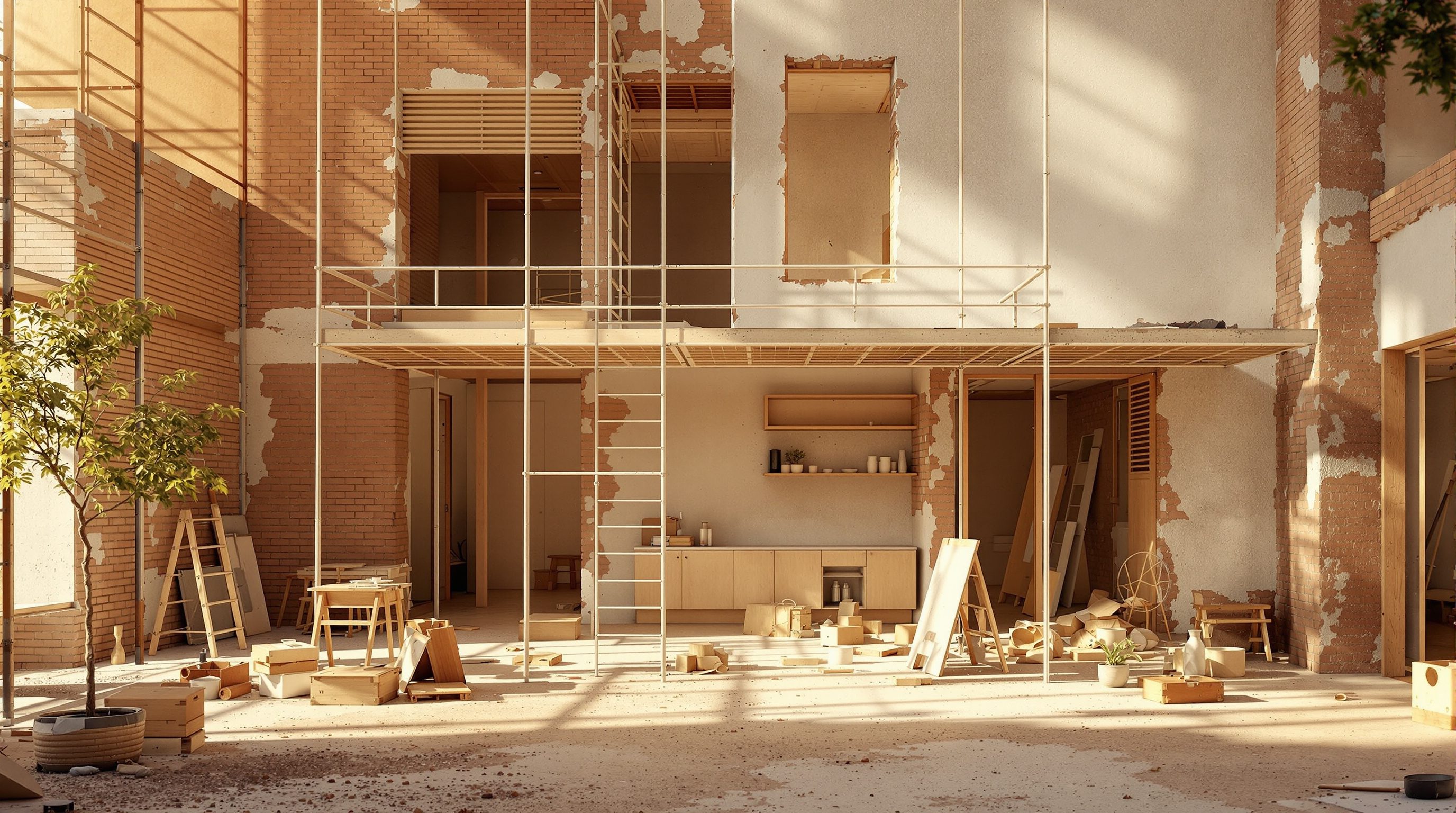
There is a moment in almost every renovation when a trade calls you over, points at something newly exposed, and says the words every client dreads: "you should come and look at this." Behind the wall is a rotten joist, a tangle of dangerous old wiring, a hidden drain, damp that the survey could not see, a lintel that was never really a lintel. This is not a sign that anything has gone wrong; it is the normal, expected condition of working on an existing building. An old house does not give up all its secrets to a survey, however good - some it only reveals when you open it up, which is exactly why Module 0 called renovation surgery and this course has insisted, from the first lesson, on holding real contingency for what you cannot see.
So the skill this lesson teaches is not the impossible one of avoiding surprises. It is the achievable and far more valuable one of meeting them well. A surprise handled calmly - assessed properly, priced honestly, decided deliberately, and recorded clearly - is just a piece of new information that reshapes the plan a little and draws down the contingency you wisely set aside. The same surprise met with panic - a snap decision under pressure, an unpriced instruction to "just sort it," a change no one wrote down - is how renovations spiral into cost overruns, disputes and regret. This lesson gives you the calm process, shows you how variations affect cost and time, explains how to spend the contingency wisely rather than burn it in the first month, and insists that every change to the plan be made on purpose and on paper.
Panic wrecks renovations, not surprises. Assess, price, decide, record - then proceed.
Every renovation uncovers surprises
The first thing to make peace with is that surprises are not a failure of planning; they are the nature of the work. When you build new, the ground and the structure are largely known because you are creating them. When you renovate, you inherit a building assembled by other hands, often decades ago, with choices, repairs, bodges and decay hidden inside walls and floors that no survey can fully see. A good survey (Module 1) reduces the surprises and rules out the worst ones, but it cannot eliminate them - there is always something behind the plaster that only demolition reveals. Expecting surprises is not pessimism; it is realism, and it is what lets you prepare for them instead of being ambushed.
The common surprises fall into familiar families, and knowing them helps you brace for the right ones. There is hidden decay and damage: rotten or insect-damaged timber, corroded reinforcement, failed damp-proofing, decayed mortar. There are dangerous or obsolete services: old wiring that must be replaced on sight, lead or failing pipes, drains that run where no one expected. There is structure that is not what it seemed: a wall thicker or thinner, more or less load-bearing, than assumed; a missing or inadequate lintel; a floor that is not level or not sound. And there are conditions the building was hiding: damp whose true cause only appears once you open up, previous unpermitted alterations, services serving a neighbour.
Most of these surface early, during strip-out and first fix - which is precisely why the sequence (Lesson 9.1) front-loads the dirty, exploratory work, so the budget and plan still have room to absorb what is found. The worst outcome is a major surprise discovered late, after money and time are spent, when there is no slack left to respond. This is also why the course keeps returning to its golden rule: when a surprise touches structure, services or the law - a questionable beam, exposed old wiring, a drain you did not know about - you stop and get the qualified professional, because a surprise in exactly those areas is the most dangerous to guess at. The surprise itself is routine; mishandling a dangerous one is not.
Surprises are not a planning failure. They are the job. Expect them; hold contingency for them.
Responding calmly - assess, price, decide
When a surprise appears, the damage is rarely done by the surprise itself - it is done by the panicked response: a snap decision made on the spot, under pressure, with trades standing around and the clock running. The antidote is to meet every surprise with the same calm, repeatable process, so that emotion does not drive an expensive mistake. That process has four steps, and the discipline is to run them in order rather than leaping to a fix.
First, stop and assess. Do not authorise a solution before you understand the problem. What exactly has been found? How serious is it - must it be dealt with now, or is it merely desirable? Who is competent to judge it? A surprise touching structure, services or safety is one to pause on and bring in the engineer or licensed trade, not to solve by instinct. Resist the pressure, real or imagined, to decide immediately; a few hours or a day to assess properly is almost always available and almost always worth it.
Second, price it - in both money and time. A proper response needs to know what the fix will cost and, just as importantly, how it affects the programme, because a surprise on the critical path (Lesson 9.1) delays everything behind it. Get the cost in writing before the work proceeds, not after; an unpriced "just sort it" is how a small surprise becomes a large bill no one can later dispute honestly.
Third, decide deliberately, with options. There is usually more than one response: the full fix, a lesser repair, a different approach, or deferring the matter to a later phase. Weigh them against your priorities and your remaining contingency (next section), decide consciously, and - crucially - distinguish between what you must do (a safety or structural necessity) and what you are choosing to do because the wall is open anyway. The open wall is seductive: "while we are at it" is how budgets quietly balloon. Decide each surprise on its merits, not on the momentum of being mid-works. Assess, price, decide - and only then proceed, which leads straight to the fourth step, recording it, treated in the final section.
Variations, the contingency, and their cost and time impact
A variation (or change order) is any agreed change to the original scope of works - and it is the formal mechanism through which surprises, and your own changes of mind, flow into the cost and programme. Every variation has two impacts that must be understood together: a cost impact (the price of the changed or additional work) and a time impact (its effect on the programme, which matters most when it lands on the critical path). A variation priced only for cost, with its time effect ignored, is half-understood - and the ignored half is often what causes the job to run late.
Variations come from two very different sources, and it helps to keep them separate in your mind. Necessity-driven variations arise from genuine surprises - the rotten joist that must be replaced, the wiring that must be renewed - and this is exactly what the contingency exists for. A renovation should set aside a contingency sum, commonly something in the order of 12 to 15 percent of the build cost for an older building though your own figure comes from a quantity surveyor or builder and should be higher for an unpredictable property, treated as illustrative as of 2026. The contingency is not spare money or a slush fund; it is pre-committed to absorbing surprises, and the discipline is to draw it down deliberately, logging each surprise against it with a date and a cost, so you always know how much remains to meet the surprises still to come.
Choice-driven variations are different - the upgraded tiles, the extra socket, the "while we are at it" additions - and these are scope creep, not contingency items. The single most common way renovations blow their budgets is by funding a stream of choice-driven changes out of the contingency that was meant for surprises, then meeting a genuine surprise late with nothing left to absorb it. Keep the two streams honestly apart: surprises draw on contingency; choices are new spending you must consciously approve and fund, knowing their cost and time impact. When the contingency runs low, that is the signal to stop and re-plan - to re-prioritise, defer non-essentials, or agree more budget deliberately - never to keep spending blindly and discover the shortfall at the end. Module 8 treats budgeting and contingency in full; here the point is that variations are the controlled channel through which change enters, and the contingency is the buffer that keeps surprises from becoming crises.
Surprises draw the contingency. 'While we are at it' is new spending. Never confuse the two.
Changing the plan deliberately - and keeping records
The final and most neglected step in handling any surprise or variation is to record it and change the plan on purpose - in writing, before the work proceeds. A renovation is a long chain of decisions, many made quickly amid dust and pressure, and the ones that cause disputes and regret months later are almost always the ones that were agreed verbally, in passing, and never written down. "We said you would move that, not replace it"; "that was meant to be included"; "I never agreed to that price" - the paper trail is what prevents these, and it protects the conscientious builder as much as the client.
So every variation, however small, should be captured as a simple written record: what is changing, why, the agreed cost, the agreed time impact, and that both sides have accepted it - before the work is done, not reconstructed afterwards from memory. This need not be bureaucratic; a dated note, an email, an entry in a shared variations log is enough for a domestic job, though a formal contract (Module 8) will specify how variations are instructed and valued. The test is simple: if a dispute arose, could you show what was agreed and when? Keep the running variations log alongside the contingency drawdown, so at any moment you can see every change, what it cost, what it did to the programme, and what contingency remains.
Changing the plan deliberately also means keeping the whole plan coherent as it evolves. A renovation that absorbs a dozen variations without anyone stepping back can drift away from its original intent - the budget creeps, the programme slips, the design loses its thread, one change quietly contradicts another. Periodically, especially after a significant surprise, pause and ask whether the plan as it now stands still makes sense as a whole: does it still meet the brief, does the money still work, does the sequence still hold? Better to re-plan consciously at a sensible moment than to sleepwalk into a scheme no one actually chose.
This brings the whole module home. Managing the works is the disciplined conversion of plans into a finished home: running the right sequence, protecting the household living through it, watching over quality at the moments that matter, and meeting the inevitable surprises with a calm process - assess, price, decide, record - funded by a contingency spent wisely and a plan changed always on purpose and on paper. Do that, and a renovation ends not in a spiral of overruns and arguments but in a home that is better than it was, delivered under control. Surgery, completed well.
Stop for dangerous surprises
Structure, services, safety, the law
A surprise touching a beam, exposed old wiring, a drain or possible asbestos is exactly when to stop and call the engineer or licensed trade. Never guess at the dangerous ones. The course's golden rule.
Price before you proceed
Cost and time impact of every variation
Get the cost and the programme effect in writing before the changed work is done, not reconstructed afterwards. An unpriced instruction is a dispute and an overrun waiting to happen.
Contingency is for surprises, not choices
Necessity-driven vs choice-driven variations
Draw the contingency (illustratively 12 to 15 percent, set with a QS or builder) down only for genuine surprises; fund 'while we are at it' changes as conscious new spending. Module 8.
Write every variation down
What, why, cost, time, both sides agreed
A dated note, email or shared log before the work proceeds. The paper trail protects client and builder alike, and keeps a running record of drawdown and scope.
Workshop - run a surprise through the process, and test your contingency
Handling surprises is a process you can rehearse before you ever need it. Take a realistic renovation surprise, run it through the assess-price-decide-record loop, then stress-test a contingency against a plausible run of surprises. This is decision practice; a real surprise touching structure, services or the law always goes to the professional.
A calculator and a simple spreadsheet or paper log. Figures are illustrative, as of 2026; your real contingency comes from a quantity surveyor or builder, and any surprise touching structure, services or the law goes to the qualified professional.
Goal: a worked surprise response plus a contingency stress-test
Inputs: a renovation scenario + this lesson + a calculator
Time: ~50 minutes
- 1Invent (or recall) a realistic surprise - say, a rotten floor joist found during strip-out. Run it through the loop: assess (what is it, who judges it, must it be done now?), price (cost and time impact), decide (options, and is it necessity or choice?), record (write the variation).
- 2Now imagine three or four surprises arriving across the job - for example rotten timber, then old wiring, then hidden damp. For a build cost you choose, set a contingency of around 12 to 15 percent and draw each surprise down against it, logging date and cost.
- 3Add two choice-driven changes you are tempted to make ('while we are at it' upgrades). Decide honestly whether each is a contingency item or new spending, and keep the two streams separate in your log.
- 4Look at what contingency remains after the surprises and choices. If it is running low, write what you would do - re-prioritise, defer non-essentials, or agree more budget deliberately - rather than spending blindly.
- 5Draft a simple variations log template you would actually use: columns for what changed, why, cost, time impact, contingency remaining, and agreed-by. Note which surprise types you would stop and call a professional for.
You’ll walk away with
A worked example: one surprise taken through assess-price-decide-record, a contingency drawdown across several surprises with choice-driven changes kept separate, a re-plan trigger when it runs low, and a reusable variations-log template. This is a rehearsal of the calm you will want when a real surprise appears.
Three altitudes on the same idea
Read the band that fits you — or all three.
On projects you administer, variations are a formal contractual mechanism, and handling them rigorously is central to protecting both the client and the programme. Establish at the outset how variations are instructed, priced and valued, and insist that none proceeds without a written instruction capturing cost and time impact - an unrecorded variation is a dispute in waiting. When a surprise touches structure or services, bring in the engineer and licensed trades before authorising a response. Guard the contingency against scope creep, track its drawdown, and re-test the scheme's coherence after each significant change. Your judgement about which surprises are necessities and which are choices, and your insistence on the paper trail, is much of what a client is paying for.
Finishes and fit-out are where choice-driven variations multiply fastest, and you are often both the source of the temptation and the person who must manage it. The upgraded tile, the extra detail, the 'while we are at it' addition are your territory, and keeping them honestly separate from genuine surprises - new spending the client consciously approves, not contingency items - protects the budget you are trusted with. Price every finish variation in cost and time before it proceeds, record it, and help the client see the cumulative effect of many small changes. When a surprise under your finishes touches waterproofing, structure or services, defer to the right trade. A designer who manages variations transparently is trusted with bigger projects.
This lesson teaches the emotional and procedural core of real construction, which studio projects never simulate: that surprises are normal, and that process beats panic. Internalise the assess-price-decide-record loop, because it is how competent people handle the unexpected on any project, not just renovations. Understand the difference between a contingency - pre-committed to absorbing surprises - and scope creep, the choice-driven changes that quietly blow budgets. Learn why every change must be written down before it happens. And see how this lesson completes the module's arc: sequencing, the human reality, quality and surprises are the four disciplines that turn a design on paper into a finished building under control. That is what managing the works means.
“If the planning and survey are thorough enough, a well-run renovation should not throw up expensive surprises - and if it does, something was done wrong. The contingency is really just spare money you will probably get back at the end.”
Do it yourself
No tools needed - reason it through.
- 1Why are surprises the normal condition of renovation rather than a sign of poor planning?
- 2State the four-step process for meeting a surprise, and what goes wrong if you skip straight to a fix.
- 3Explain the difference between a necessity-driven variation and a choice-driven one, and why it matters for the contingency.
- 4What two impacts does every variation have, and why is ignoring one of them a common cause of delay?
- 5Why must every variation be recorded in writing before the work proceeds, and what does the paper trail protect?
The one line to carry out
Peer-reviewed journals & authoritative standards
- 01Cost overrun — Wikipedia - Cost overrun, 2026.
- 02Project management — Wikipedia - Project management, 2026.
- 03Quantity surveyor — Wikipedia - Quantity surveyor, 2026.
- 04Renovation — Wikipedia - Renovation, 2026.
That completes Module 9 and the management of a standard renovation. Module 10 turns to the special cases - flats and apartments, heritage and old buildings, the green retrofit - and to finishing well and looking after what you have made.
The author
Amogh N P
Architect, interior designer, and creative polymath. Studio Matrx began in his notebooks — his vision of design made honest, useful, and open to everyone. Its Academy is written and taught in his memory, and free, forever.
More about Amogh →