
Romanesque
The round arch returns — massive walls, barrel vaults and the fortress-church of feudal Europe.
After the architecture of antiquity — Greece and Rome, where the last course (History of Architecture II) left off — Western Europe spent the early Middle Ages relearning how to build in stone. What it produced, from about 1000 to 1150, is the Romanesque: “Roman-like”, because it revived the round arch and the vault. Driven by monastery and pilgrimage and shaped by a fearful, feudal world, it is an architecture of mass — thick walls, small windows, solemn dim interiors — and it holds the structural problem the Gothic would soon solve.
Learning objectives
By the end of this lesson, you will be able to — mapped to the course outcomes for History of Architecture III:
Explain the factors — monasticism, pilgrimage, feudalism and the memory of Rome — that shaped Romanesque architecture.
Describe the Romanesque building system: the round arch, barrel and groin vault, pier, buttress and the bay.
Explain why the barrel vault forced thick walls and small windows, and how the groin vault began to free them.
Distinguish the Italian, French and Norman-English character through Pisa, Caen and the Tower of London.
The Romanesque building system
Romanesque spans space the Roman way — with the round arch, the barrel vaultand the groin vault. The barrel vault thrusts outward along its whole length, so walls had to be massive; cross two barrel vaults and the groin vault gathers thrust onto four corner points, beginning to free the wall.[1, 2] Hold that shift — continuous to point support — it is the seed of the Gothic.
The semicircular arch
Romanesque is named 'Roman-like' for its revival of the Roman semicircular arch. Its height is fixed by its span — a wide arch must be tall — which constrains how a builder can roof a rectangular bay evenly. This single geometric limit is the problem the Gothic pointed arch would later solve.[1, 2]
Italy, France and England
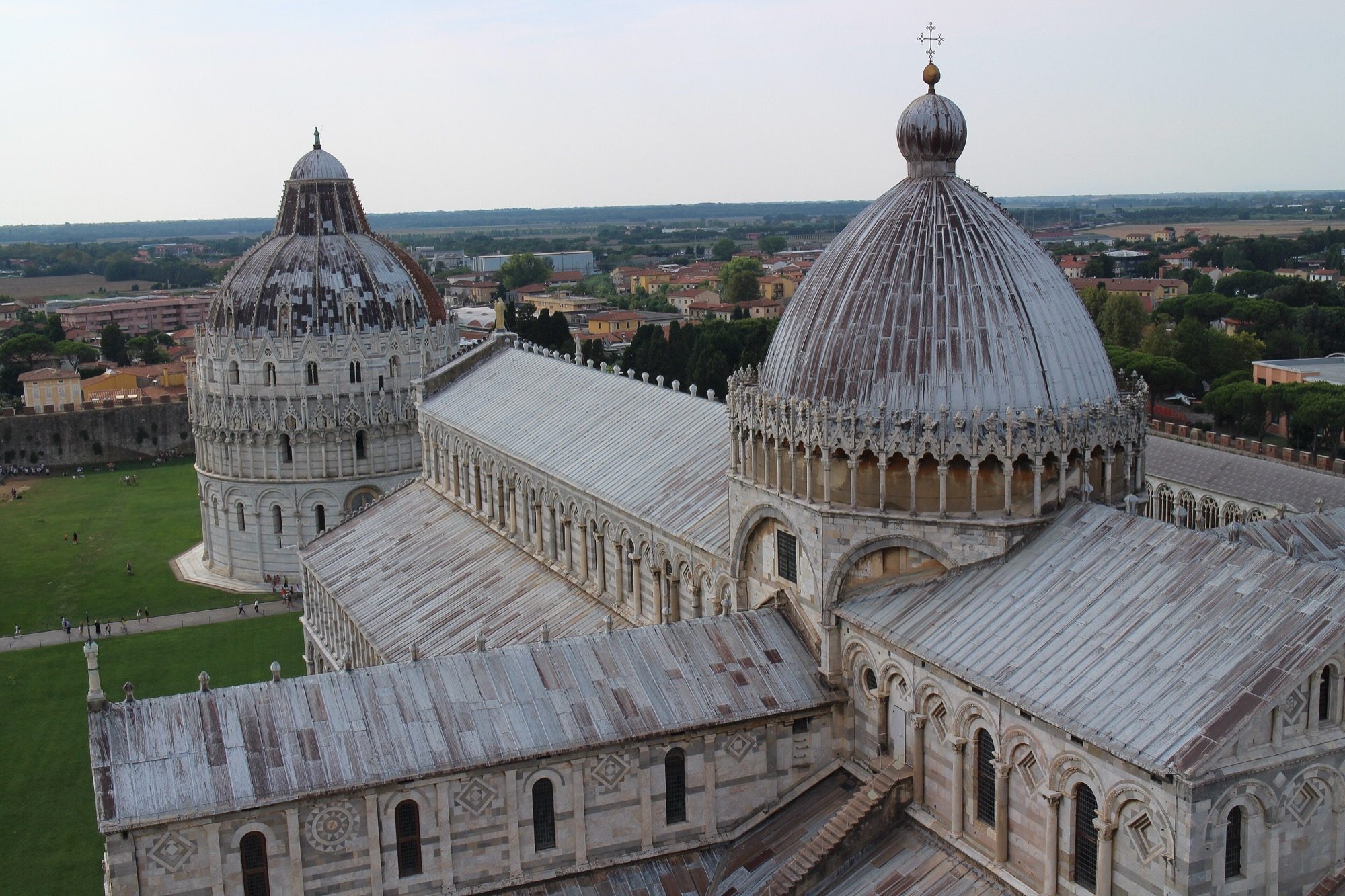
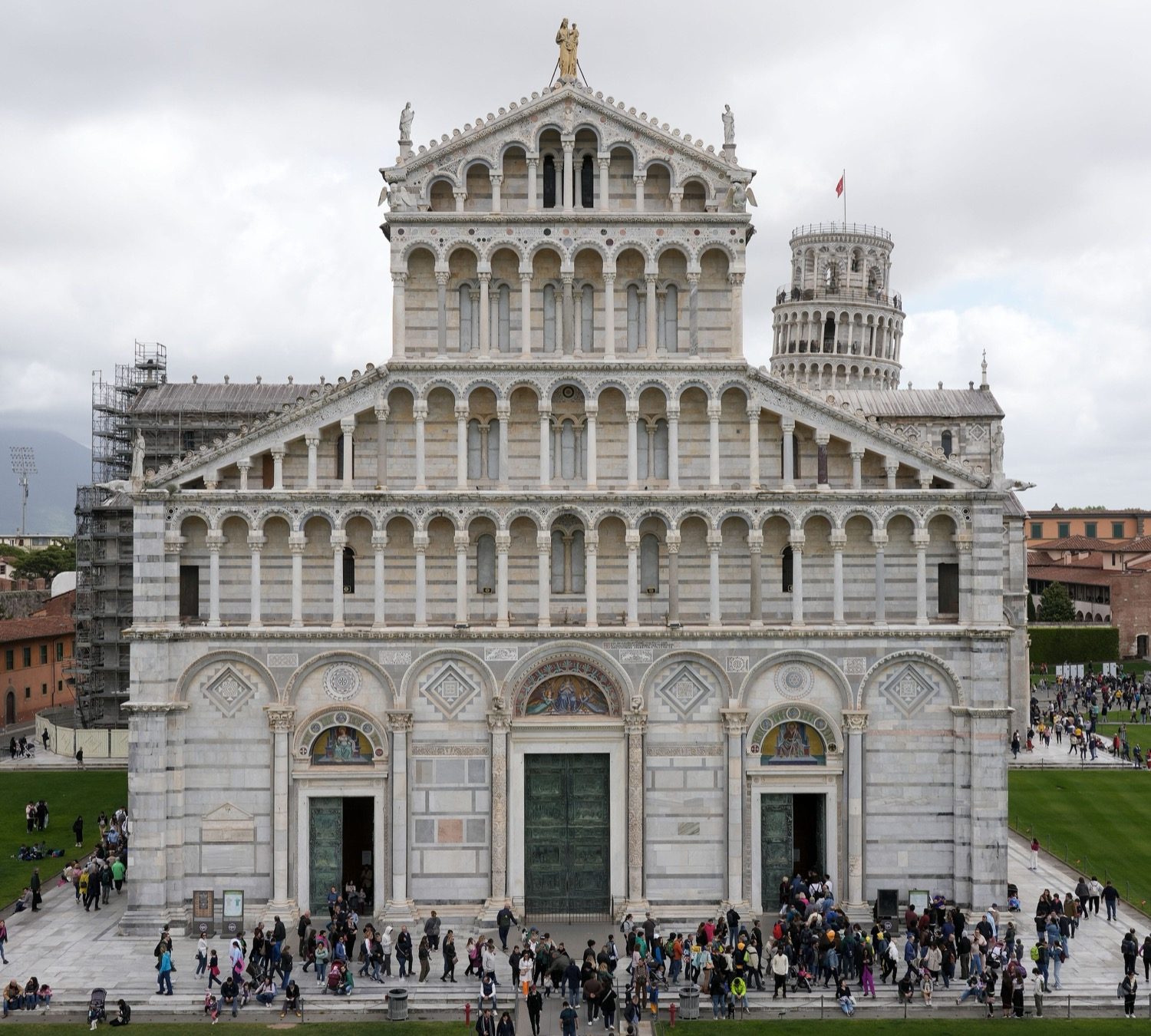
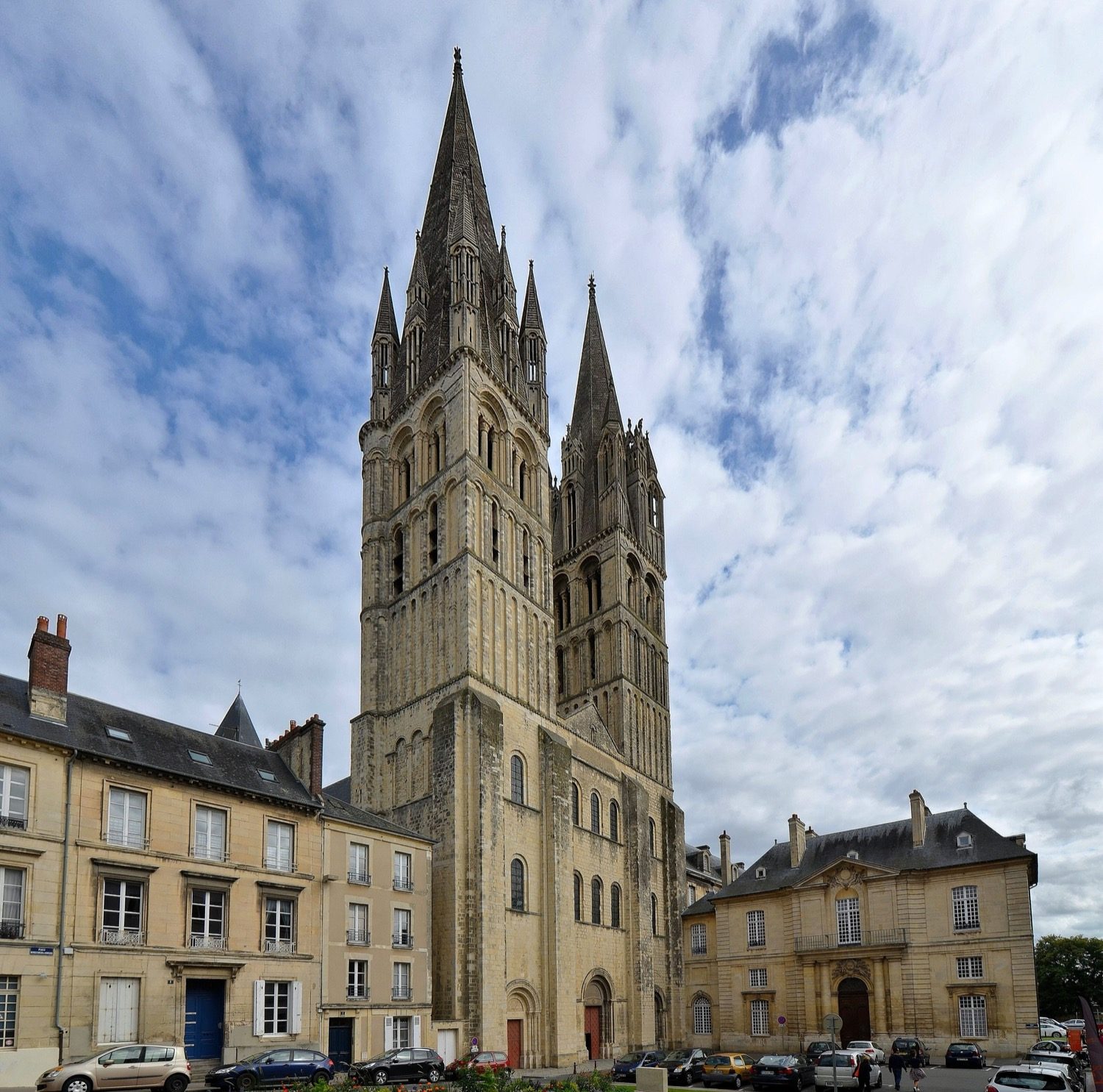
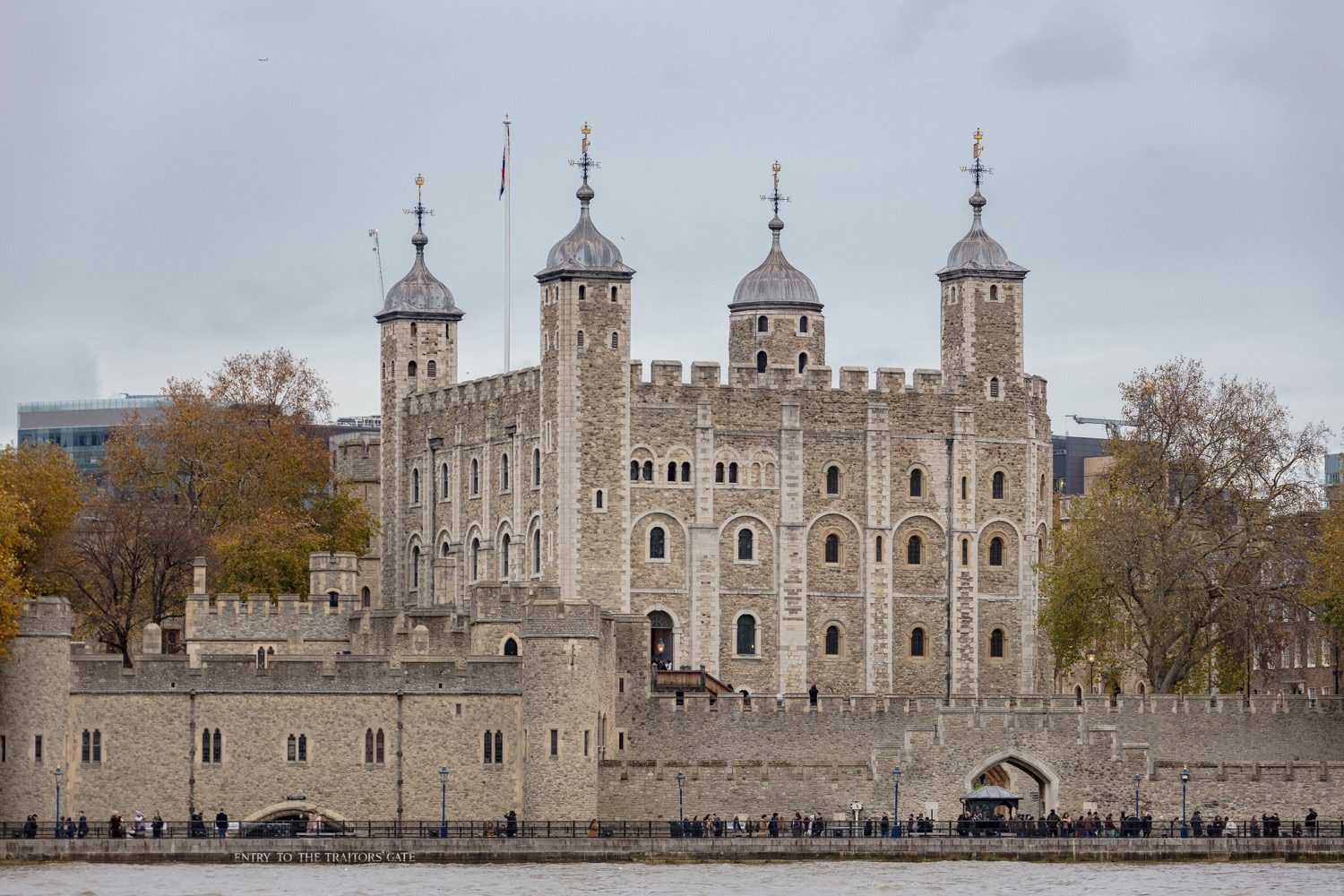
Romanesque looks different in each land: Italy keeps the marble-banded, timber-roofed basilica with its detached baptistery and campanile (the Pisa complex); France raises the vaulted Norman abbey (the Abbaye aux Hommes at Caen); and England fills with massive cylindrical piers and the fortress keep (the White Tower).[1, 3]
Marble, arcades and the detached tower
Italian Romanesque kept Early-Christian habits: flat timber-roofed naves, detached baptisteries and campaniles, and polychrome marble. Pisa Cathedral (begun 1064, consecrated 1118) is the type-piece — tier upon tier of blind arcading in banded white-and-grey marble, with its detached Baptistery and the famous leaning Campanile. NOTE: the Baptistery's upper parts (finished 1363) are Gothic, and the Camposanto is later — only the cathedral is purely Romanesque.[1, 4]
Barrel vault vs groin vault
| Aspect | One | The other |
|---|---|---|
| Spanning along its length | Barrel vault — continuous outward thrust | Groin vault — thrust onto four corners |
| Consequence for the wall | Thick wall, small window, dim interior | Corners take the load → wall can open up |
| Italian character | Marble banding, detached baptistery & campanile, timber roof | Norman: cylindrical piers, twin west towers, vaulting trials |
| Arch geometry | Round arch — height fixed by span | (Gothic to come) pointed arch — height free of span |
| Patron | Church & monastery — abbeys, pilgrimage churches | Feudal lord — the castle keep (White Tower) |
Key terms
The defining Romanesque arch — a half-circle whose height is tied to its span.
A continuous semicircular vault; it thrusts outward along its whole length.
Two barrel vaults intersecting at right angles; thrust collects at four corner points.
A massive masonry support, often compound, carrying arches and vaults.
One repeating structural compartment of a nave, defined by piers and a vault unit.
A row of arches applied decoratively against a solid wall — the signature of Pisan Romanesque.
The strongest central tower of a Norman castle, both stronghold and residence (the White Tower).
A bell tower, in Italy often free-standing — as at Pisa.
Study task
Sketch a barrel vault and a groin vault side by side, and with arrows show where each one pushes. Then in two lines explain why the groin vault — not the barrel vault — pointed the way toward the Gothic.
Self-assessment
1. Why did Romanesque walls have to be thick and windows small?
2. The 'Pisan Romanesque' style is best recognised by —
3. The White Tower at the Tower of London is —
Recap
References & further reading
- [1]Banister Fletcher's A History of Architecture (20th ed.), ed. Dan Cruickshank. Oxford: Architectural Press, 1996.
- [2]Francis D.K. Ching, Mark Jarzombek & Vikramaditya Prakash, A Global History of Architecture (3rd ed.). Hoboken: John Wiley & Sons, 2017.
- [3]Spiro Kostof, A History of Architecture: Settings and Rituals (2nd ed.), rev. Gregory Castillo. Oxford University Press, 1995.
- [4]UNESCO World Heritage Centre — Piazza del Duomo, Pisa (inscribed 1987). https://whc.unesco.org/en/list/395/
- [5]Abbey of Saint-Étienne (Abbaye aux Hommes), Caen — Normandy Tourism. https://en.normandie-tourisme.fr/
- [6]Tower of London — UNESCO World Heritage Centre (inscribed 1988). https://whc.unesco.org/en/list/488/
Further reading
- Banister Fletcher's A History of Architecture — the Romanesque chapters.
- Nikolaus Pevsner, An Outline of European Architecture. Penguin.
- Rolf Toman (ed.), Romanesque: Architecture, Sculpture, Painting. Könemann / h.f.ullmann.
Sources gathered and fact-checked June 2026. Published values vary by source, sample and method — treat as indicative and confirm against the cited standard before structural use.
The author
Amogh N P
Architect, interior designer, and creative polymath. Studio Matrx began in his notebooks — his vision of design made honest, useful, and open to everyone. Its Academy is written and taught in his memory, and free, forever.
More about Amogh →