
Gothic
Pointed arch, ribbed vault, flying buttress — the wall dissolves into stained glass.
Take the Romanesque problem — a heavy vault that pushes outward and demands thick walls — and solve it three ways at once, and you get the Gothic. Born in the Île-de-France around 1140, it married the pointed arch, the ribbed vault and the flying buttress to turn solid stone into a soaring skeleton. With the thrust thrown outward, the wall could fall away into stained glass. This is architecture as light — and a structural revolution.
Learning objectives
By the end of this lesson, you will be able to — mapped to the course outcomes for History of Architecture III:
Describe the architectural character of Gothic and how it evolved out of Romanesque.
Explain how the pointed arch, ribbed vault and flying buttress work together to raise height and open the wall.
Trace the evolution of vaulting from sexpartite to quadripartite, and on to the English fan vault.
Compare the French, English, Venetian and Italian Gothic through Notre-Dame, Westminster, the Doge's Palace and Milan.
The three inventions
The pointed arch frees height from span; the ribbed vault carries loads on a stone skeleton with a light web; the flying buttress throws the vault's thrust across the aisle to an external pier. Together they make a skeletal frame, and the wall becomes a cage of glass.[1, 2]
Height freed from span
A round arch's height is locked to its width; a pointed arch can be drawn tall or narrow at will, so arches of different spans can all reach the same crown height. That let masons vault rectangular bays evenly and push the whole building upward — verticality is the essence of Gothic. (The pointed arch is not a pure Gothic invention; it has earlier Islamic precedent.)[1, 2]
The great examples
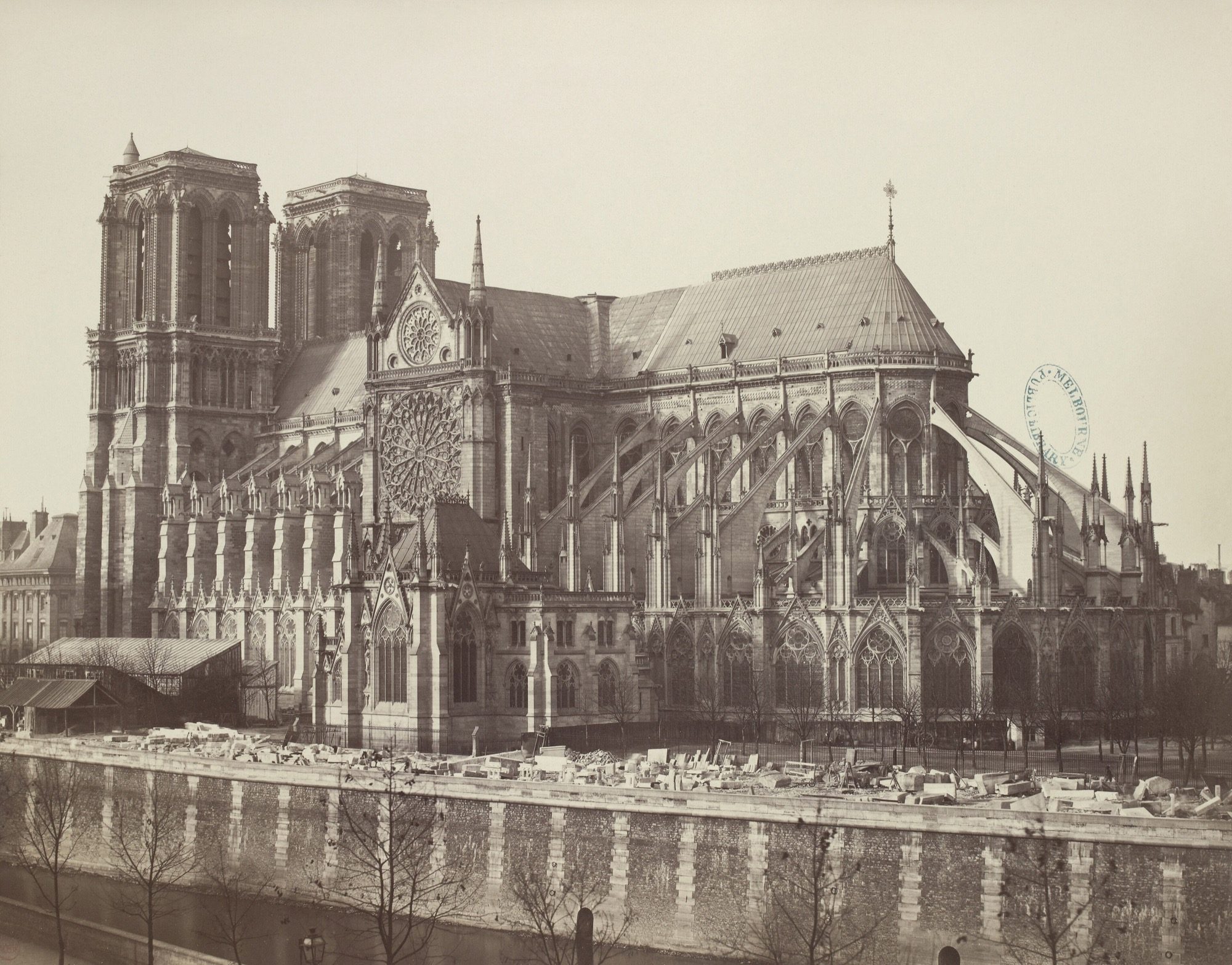
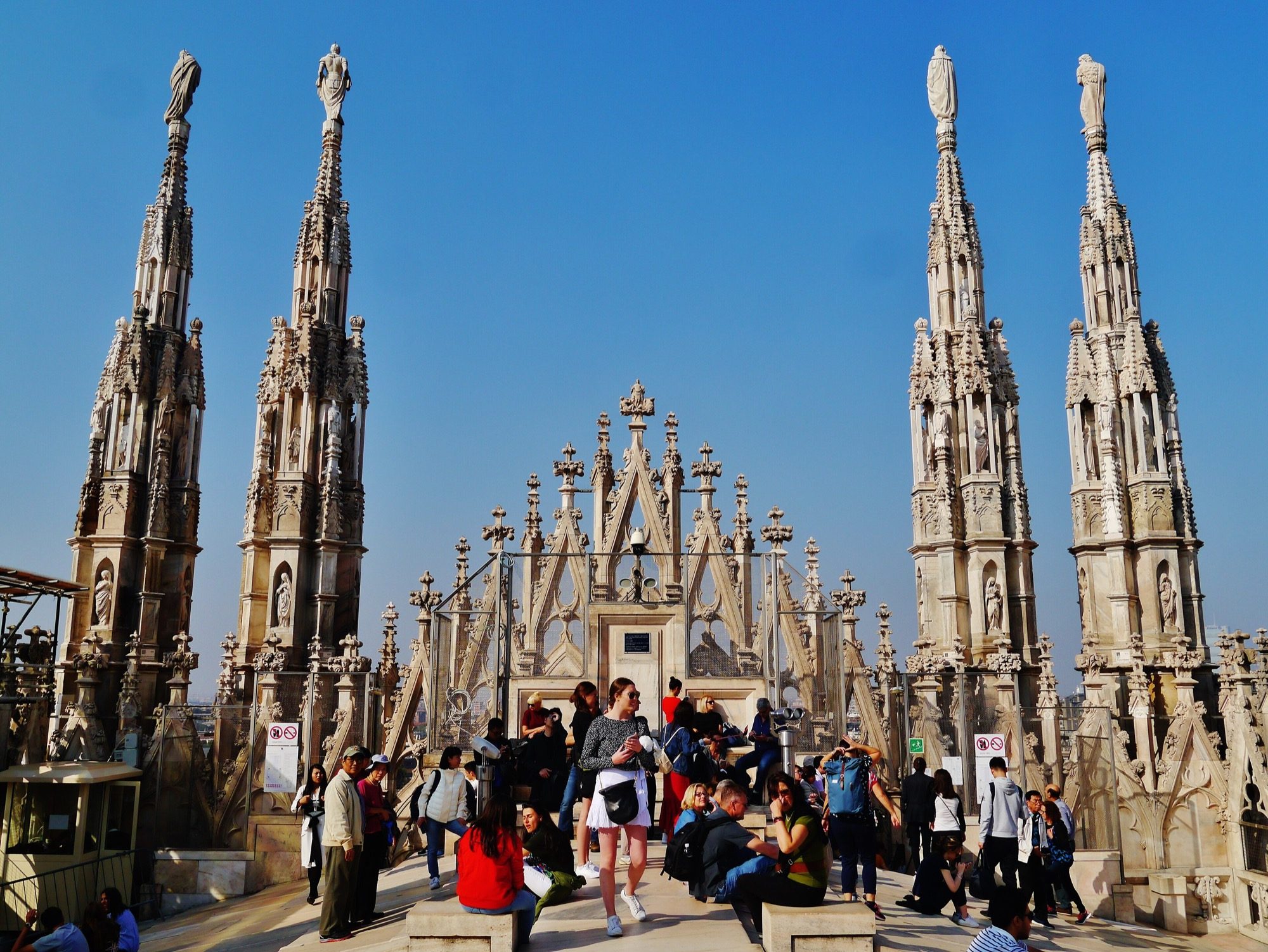
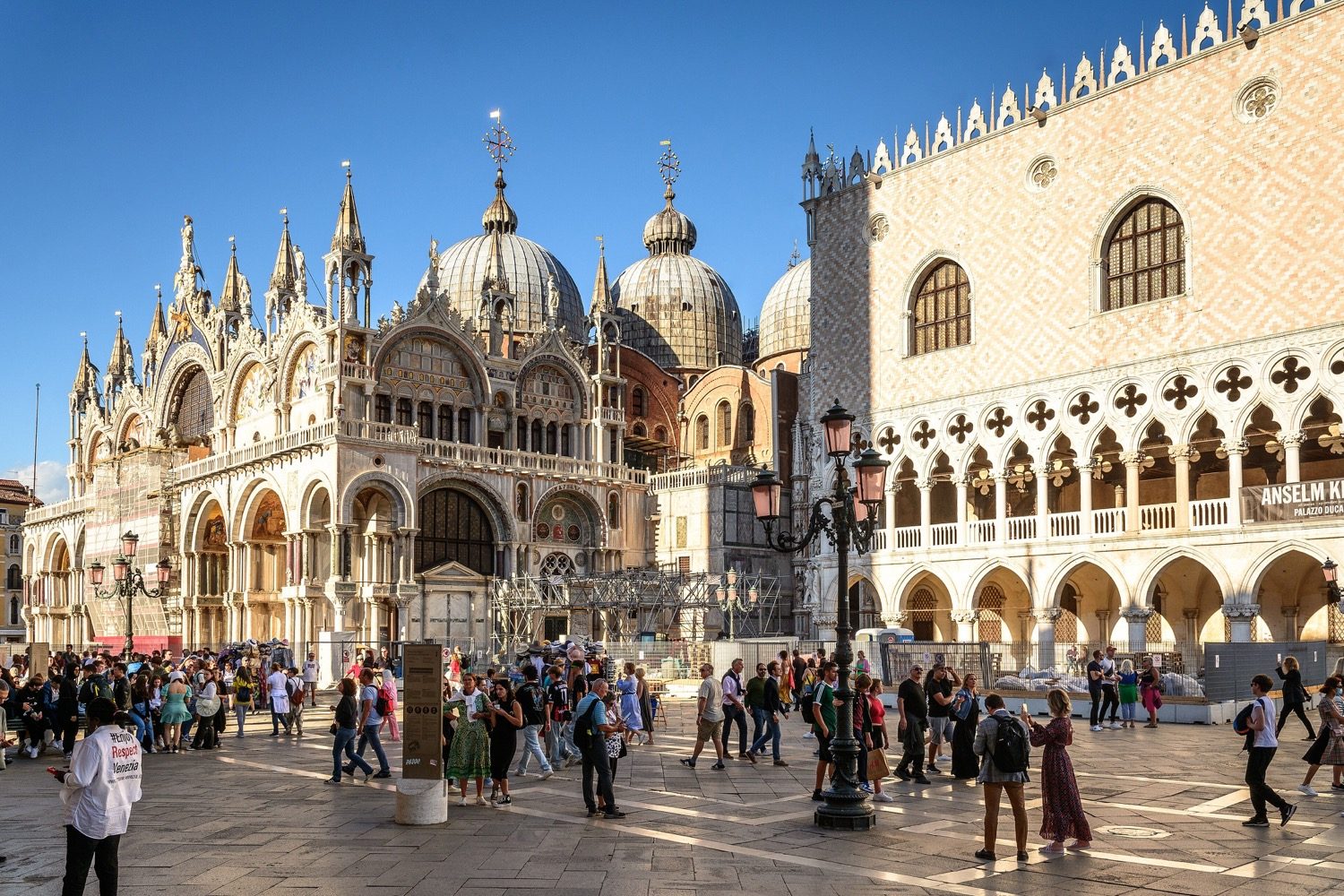
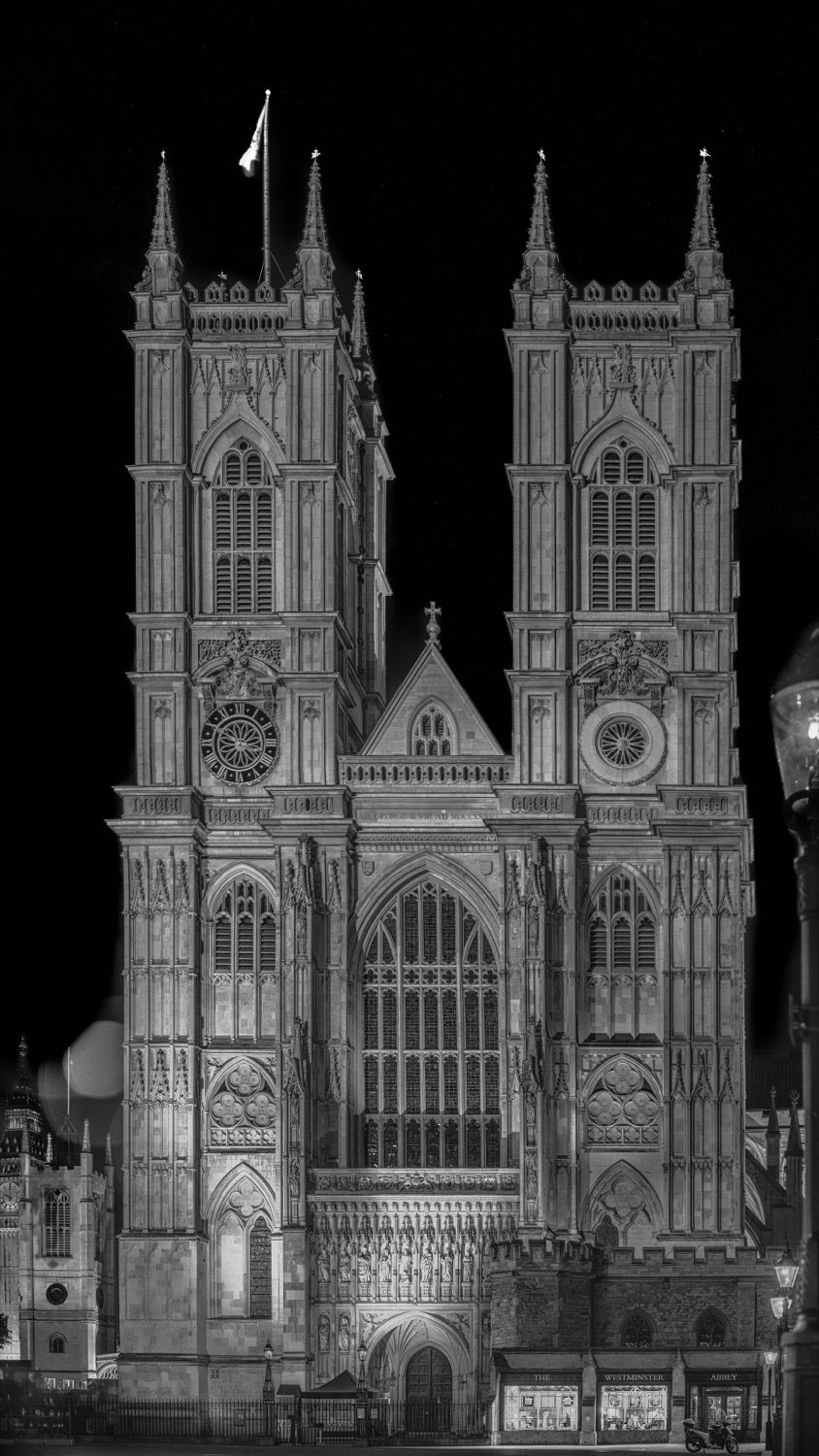
Read the regional accents through four buildings: French verticality at Notre-Dame de Paris, French-modelled English Gothic at Westminster Abbey, the patterned lightness of the Venetian Doge's Palace, and the marble pinnacle-forest of Milan Cathedral.[1, 4] (A caveat: Hampton Court, on the syllabus list, is Tudor brick, not high Gothic.)
The early Gothic benchmark
Begun in 1163 under Bishop Maurice de Sully, Notre-Dame de Paris pioneered the rib vault, the flying buttress and giant rose windows. (Note: the originality of its flyers is a genuine scholarly debate, and all surviving flyers are later replacements.) The 2019 fire destroyed the timber spire and roof, but the three 13th-century rose windows survived; the cathedral reopened in December 2024.[1, 4]
Romanesque vs Gothic
| Aspect | One | The other |
|---|---|---|
| Arch geometry | Romanesque round arch — height tied to span | Gothic pointed arch — height free of span |
| Wall | Romanesque: thick, dim, small windows | Gothic: skeletal frame, stained-glass cage |
| Vault | Early Gothic: six-part (sexpartite) | Mature Gothic: four-part (quadripartite) → fan vault |
| Buttressing | Romanesque: internal mass | Gothic: external flying buttress |
| Regional accent | French (Notre-Dame): verticality, flyers, glass | Venetian/Italian (Doge's Palace, Milan): pattern, marble, pinnacles |
Key terms
An arch meeting at a point; its height is independent of its span.
A vault carried on a skeleton of stone ribs, with a thin web between.
An external half-arch transmitting vault thrust to a freestanding buttress pier.
The upper, window-pierced level of the nave wall above the aisle roofs.
The arcaded middle storey between the nave arcade and the clerestory.
Ornamental stone ribwork dividing a window or applied to a wall or loggia.
A large circular stained-glass window with radiating tracery.
A late-English vault of concave conoid fans of identical ribs (Henry VII Chapel).
Study task
Draw a section through a Gothic nave and trace, with a single arrow, the path of the vault's thrust from the crown of the vault out to the ground. Label the pointed arch, the rib, the flying buttress and the buttress pier — and explain in one line why the wall no longer has to be thick.
Self-assessment
1. Which trio of innovations defines structural Gothic?
2. The Henry VII Chapel at Westminster Abbey is famous for its —
3. On the syllabus list, which building is actually Tudor brick rather than high Gothic?
Recap
References & further reading
- [1]Banister Fletcher's A History of Architecture (20th ed.), ed. Dan Cruickshank. Architectural Press, 1996.
- [2]Francis D.K. Ching, Mark Jarzombek & Vikramaditya Prakash, A Global History of Architecture (3rd ed.). Wiley, 2017.
- [3]Spiro Kostof, A History of Architecture: Settings and Rituals (2nd ed.). Oxford University Press, 1995.
- [4]Cathédrale Notre-Dame de Paris — official site (reopened December 2024). https://www.notredamedeparis.fr/en/
- [7]Westminster Abbey (with the Palace of Westminster) — UNESCO World Heritage Centre. https://whc.unesco.org/en/list/426
- [8]Duomo di Milano — Veneranda Fabbrica del Duomo (official site). https://www.duomomilano.it/en/
Further reading
- Banister Fletcher's A History of Architecture — the Gothic chapters.
- Rolf Toman (ed.), Gothic: Architecture, Sculpture, Painting. Könemann / h.f.ullmann.
- Marvin Trachtenberg & Isabelle Hyman, Architecture: From Prehistory to Postmodernity (2nd ed.). Prentice Hall, 2002.
Sources gathered and fact-checked June 2026. Published values vary by source, sample and method — treat as indicative and confirm against the cited standard before structural use.
The author
Amogh N P
Architect, interior designer, and creative polymath. Studio Matrx began in his notebooks — his vision of design made honest, useful, and open to everyone. Its Academy is written and taught in his memory, and free, forever.
More about Amogh →