
Heavy facades: precast, ACP, masonry & stone
Not every skin is light glass and aluminium. When the facade is concrete, composite, brick or stone, weight and how you fix it become the engineering - and the difference between a panel that lasts a century and one that falls.
Lesson byAmogh N P· Architect & interior designer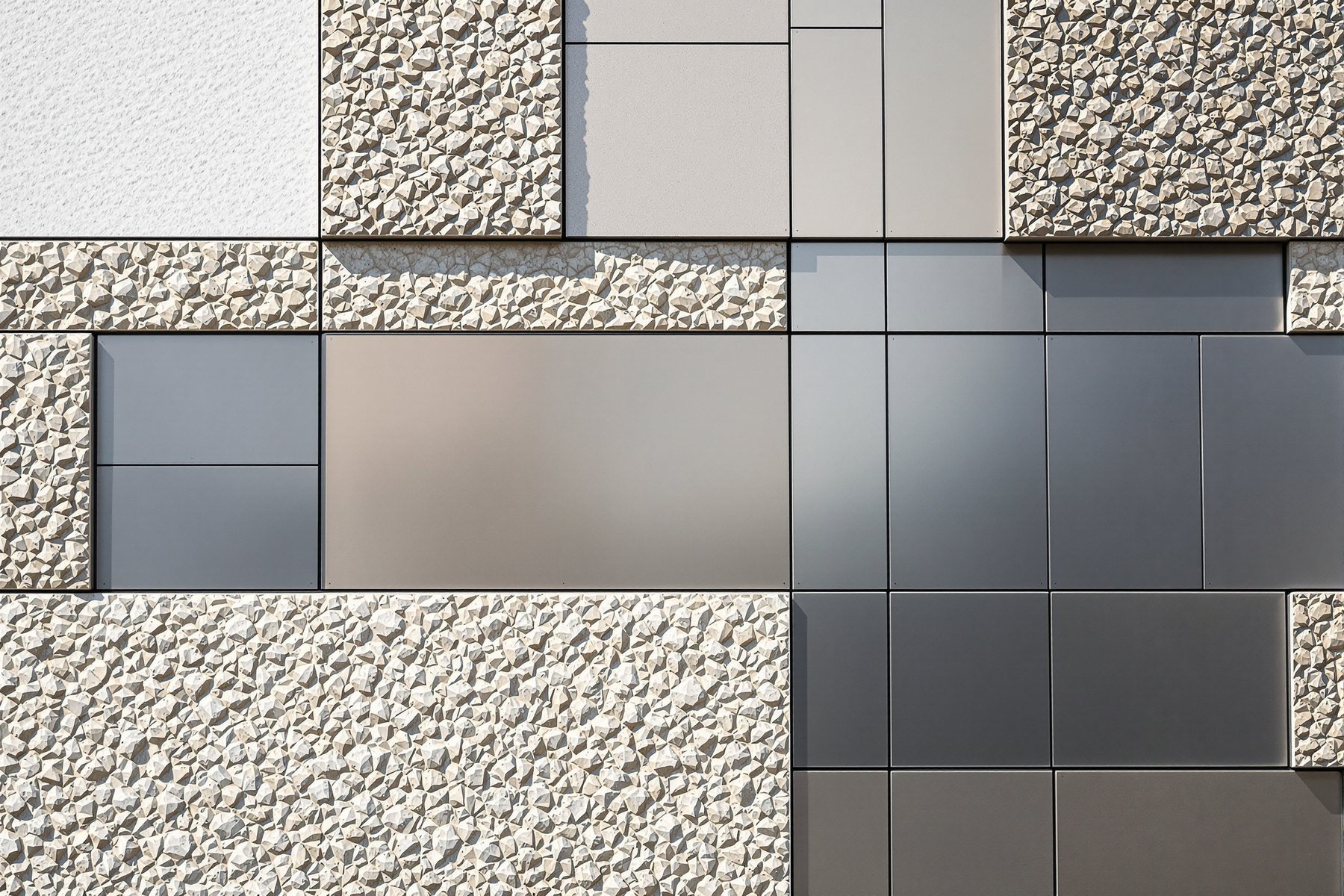
A glass panel weighs what a person can carry. A precast spandrel weighs what a crane is rated for - and that single number reshapes the structure, the fixing and the risk.
Strip away the all-glass tower and most of the world's facades are still heavy: precast concrete, fibre-reinforced cement, brick, and stone hung on a steel frame. These read as solid, permanent, grounded - and they bring a different engineering problem to the front. The dominant variable is no longer transparency or silicone bite; it is **weight** and **how you fix it**. A heavy panel's dead load, its anchors back to the structure, and its tolerance for movement decide whether it lasts a century or works loose and falls. From the lightest ACP rainscreen to a hand-set stone soffit, the heavy facades are a family defined by mass and fixing.
Four heavy families, ranked by weight and fixing
Factory-cast panels: the heaviest skin, hung off the frame
Precast concrete facade panels are cast in a factory - often as full storey-high architectural units with the finish, reveals and even windows built in - then craned to site and bolted back to the structure. They are heavy: a solid reinforced panel can run 250-400 kg/m2 or more, so the building frame, the crane and the connections are all sized around that mass. The payoff is speed (large finished units go up fast), durability, fire resistance and a wide range of cast-in finishes.
GFRC (glass-fibre-reinforced concrete) is the lightweight cousin: a thin concrete shell reinforced with alkali-resistant glass fibre instead of heavy steel, typically only 15-20 mm thick and often built on a light steel stud frame. A GFRC panel can weigh as little as a fifth to a third of an equivalent solid precast unit, which means lighter fixings, smaller crane loads and a lighter primary structure - while still giving a moulded, stone-like or sculptural concrete finish. The trade is that GFRC is a skin, not a structural panel, so its frame, connections and movement joints carry it.
The shared engineering theme: these are big, heavy, factory-made units whose dead-load and wind connections back to the frame, and whose movement joints (concrete shrinks, moves thermally and the building deflects), are the whole game. The weight is what makes them either a fast, durable facade or a structural liability.
Light composite and metal skins - and the fire lesson written into ACP
ACP (aluminium composite panel) is two thin aluminium skins bonded to a plastic or mineral core - light (a few kg/m2), flat, cheap, easy to fabricate into crisp cassettes, and for two decades the default rainscreen cladding worldwide and across India. As a system it is usually a drained, back-ventilated rainscreen on a sub-frame, so most of Module 1.3 applies.
But ACP carries the most important safety lesson on this list. The polyethylene (PE) core is combustible, and a ventilated cavity behind combustible panels is a chimney - the mechanism behind the Grenfell Tower fire and a string of facade fires. The non-negotiable response is to specify fire-rated cores: FR (fire-retardant, limited-combustibility) or A2 (non-combustible, mineral-filled) ACP, never plain PE core on any building where fire spread matters, plus cavity fire barriers. After Grenfell and India's own high-rise fires, plain-PE ACP is being driven off taller buildings, and getting the core grade right is a life-safety decision, not a finish choice (Module 8 goes deep on this).
Other metal cladding - aluminium, zinc, copper, weathering steel, profiled or standing-seam sheet - behaves as a light rainscreen or sheet skin: low weight, easy fixing, but driven by thermal movement (metals expand a lot), corrosion/galvanic detailing and oil-canning of flat sheets. Light and versatile, but the ACP fire lesson governs the composites.
Brick cavity walls and stone cladding: mass, anchors and the open joint
Masonry is the oldest facade and still everywhere in India. The modern engineered form is the cavity wall: an outer brick (or block) leaf, a drained-and-vented cavity with insulation, wall ties bridging to an inner structural leaf, and weeps to drain the cavity - essentially the rainscreen principle in brick. On taller buildings the outer brick leaf is not self-supporting over height; it is carried at each floor on shelf angles (stainless or galvanised steel) bolted to the slab, with movement joints to let brick (which expands over its life) and concrete (which shrinks) move past each other without cracking. Forget the shelf angles and movement joints and a tall brick facade cracks and bows.
Natural stone cladding - granite, sandstone, limestone, marble - is used today as a relatively thin (30-40 mm typical) skin hung off the structure, not stacked as load-bearing blocks. Each stone is held by mechanical anchors: stainless-steel cramps, dowels, kerf rails or undercut anchors engaging the stone's edge or back, fixing it to a sub-frame or the wall while allowing it to move. It is almost always detailed as a ventilated rainscreen with open joints - the stone is a screen, the WRB behind is the waterproof line. The engineering risks are specific: stone is strong in compression, weak in tension and bending, so the anchor edge-distances and the stone's own flexural strength govern (a thin marble can bow or fail at the anchor), and stainless fixings are essential because a rusting anchor stains and splits the stone. Heavy, durable, prestigious - and entirely dependent on the anchor and the open-jointed cavity behind it.
Heavy facades buy you permanence, depth and materials glass cannot fake - real stone, cast concrete, brick - but you pay in weight, structure and fixing depth, so bring the structural and facade engineers in early because a stone or precast skin sizes the frame and the slab edges. Choose the material honestly: GFRC gives a precast look at a fraction of the weight; thin stone gives the prestige but needs anchors and ventilated detailing; brick reads as grounded but on a tower needs shelf angles and movement joints you must leave room for. And on any composite, the **ACP fire-core grade is your decision to insist on** - never let plain PE core onto a building.
Weight and fixing are your design drivers. Calculate the **dead load** of every panel and design the **anchors and brackets** back to the structure for dead plus wind plus seismic, with the movement built in - precast and stone both move relative to a deflecting frame. For stone, the anchor edge-distance and the stone's **flexural strength** govern; test the stone, use stainless fixings and never rely on a single point. For brick, design shelf angles at each floor and the horizontal/vertical movement joints. For ACP and metal, thermal movement and the **fire-core grade** plus cavity barriers govern. The recurring failure is a heavy panel whose fixing was undersized, corroded, or given nowhere to move - and that failure can fall on people.
Heavy means rigging, sequencing and connections done exactly as drawn. Precast and stone are craned, so lifting points, support angles and bracket bolts must match the design and be torqued and checked - a heavy panel on a wrong or loose anchor is a falling-object risk. For stone, handle thin slabs as fragile (they bow and chip), set the anchors to the right edge-distance, and never substitute plain steel for the specified **stainless** fixings - a rusting cramp will split the stone in a few monsoons. For brick, keep the cavity clear of mortar, install the wall ties and weeps, and never bridge or omit a movement joint. And for ACP, install only the **fire-rated core grade specified** with its cavity barriers - the core is a life-safety item, not a finish.
NBC 2016, Part 4 (Fire) (India)
Combustible cladding & ACP cores
Frames the fire and life-safety limits on combustible cladding (PE-core ACP) and the cavity-barrier provisions for ventilated heavy facades in India - tightened post-Grenfell, but enforcement and core-grade verification on site remain the weak link.
NBC 2016 Part 6 / IS 875-3 / IS 1893 (India)
Dead, wind & seismic load on panels
Set the dead-load, wind (IS 875-3) and seismic (IS 1893) actions a heavy panel and its anchors must carry - the loads behind precast and stone fixing design; they give the actions, not the proprietary anchor capacities, which need test data.
ASTM C1242 / stone-anchorage guidance
Dimension-stone cladding anchors
Guidance for selecting, designing and detailing anchors for dimension-stone cladding (edge distance, stainless fixings, allowing movement) - the de-facto reference for thin-stone facades; it guides anchorage but project stone must still be strength-tested.
IS 875 (Part 3): 2015
Design wind loads
Fixes the wind pressure (with the higher edge/corner cladding coefficients) that sizes panel anchors and brackets; using an average rather than the local edge coefficient undersizes the worst fixings on the building.
“ACP is just a lightweight metal cladding panel - one panel is much like another, pick the cheapest.”
ACP panels look identical but their cores are not equivalent: a plain polyethylene (PE) core is combustible and, behind a ventilated cavity, was the fuel that drove the Grenfell Tower fire and other facade fires. Fire-retardant (FR) and especially non-combustible A2 mineral-cored panels behave completely differently in a fire. Choosing the core grade is a life-safety decision governed by fire codes and cavity-barrier detailing, not a cost or finish choice - and plain PE core is now rightly being driven off taller buildings.
Worked example - size the dead-load anchors for a precast panel
Heavy facades live or die on the fixing. Let's size the dead-load demand on the anchors of one precast concrete panel and see why weight is the design driver.
The panel dimensions and concrete weight below, plus the anchor layout. A dead-load check; wind and seismic are added separately.
GIVEN - a solid precast concrete spandrel panel:

  Panel size           = 3.0 m (w) x 1.5 m (h)
  Panel thickness      t = 150 mm = 0.15 m
  Reinforced concrete  density = 25 kN/m3
  Support (load-bearing) anchors = 2 (carry the weight)
  Restraint anchors    = 2 (resist wind/out-of-plane only)

  FIND: the panel weight and the dead load per support anchor.
- 1Panel volume: 3.0 x 1.5 x 0.15 = 0.675 m3.
- 2Panel weight: 0.675 x 25 = 16.9 kN (about 1,720 kg - roughly a small car hanging on the wall, which is why the crane and frame are sized for it).
- 3Weight per m2: 16.9 / (3.0 x 1.5) = 3.75 kN/m2 (~375 kg/m2) - confirming solid precast sits at the heavy end of the facade range, an order of magnitude above glass.
- 4Dead load per support anchor: the two bottom support anchors carry the weight, so 16.9 / 2 = 8.45 kN each at the serviceability (unfactored) dead load.
- 5Factor it for design: apply a dead-load factor (~1.5) for ultimate design = 8.45 x 1.5 = ~12.7 kN per anchor - the capacity each support anchor and its embedment into the slab must develop, before wind and seismic restraint demands are added to the restraint anchors.
- 6Read the limits: this is dead load only. The two restraint anchors are then sized for the IS 875-3 wind and IS 1893 seismic out-of-plane forces, and every anchor must allow the panel to move thermally and as the frame deflects - a rigidly fixed heavy panel cracks. The weight set the support anchor; the wind, seismic and movement finish the design.
You’ll walk away with
A dead-load anchor demand (~8.5 kN unfactored, ~12.7 kN factored per support anchor) from a ~1.7-tonne precast panel - showing why weight is the design driver for heavy facades and why the anchor and its embedment, not the panel face, are where the engineering and the risk sit.
Two quick field reads.
- 01Find a stone- or precast-clad building and look at the joints: thin open joints with no sealant usually mean a ventilated rainscreen on hidden anchors, while wide sealed joints suggest a face-sealed panel. Then look for a horizontal line at each floor - on tall brick that is often the shelf angle and movement joint.
- 02Look at an ACP-clad building and ask the one question that now matters: is that core fire-rated? You usually cannot tell by eye - which is exactly why the specification and the certificate, not the look, decide whether it is safe.
Heavy facades - precast and GFRC, ACP and metal, masonry and stone - are defined by weight and fixing rather than transparency. Precast is the heaviest, hung on designed anchors with movement built in; GFRC gives the look at a fraction of the weight; ACP and metal are light rainscreens where the ACP fire-core grade is a life-safety decision; brick needs shelf angles and movement joints; thin stone hangs on stainless anchors as a ventilated rainscreen. The anchor and the open joint, not the panel face, are where the engineering lives.
Precast concrete = heavy (250-400+ kg/m2), fast, durable, hung on designed dead/wind/seismic anchors with movement joints; GFRC = thin glass-fibre concrete on a stud frame at a fraction of the weight. ACP/metal = light rainscreens - but the ACP core must be FR or A2, never combustible PE (the Grenfell lesson). Brick cavity walls need shelf angles and movement joints on towers; thin natural stone hangs on stainless anchors as a ventilated rainscreen, governed by anchor edge-distance and the stone's flexural strength.
What is the difference between precast concrete and GFRC facade panels?
Precast concrete panels are solid reinforced-concrete units, often storey-high, that are heavy (around 250-400 kg/m2 or more) and craned into place on designed anchors. GFRC (glass-fibre-reinforced concrete) is a thin (15-20 mm) concrete shell reinforced with glass fibre instead of heavy steel, usually built on a light steel stud frame, weighing as little as a fifth to a third of solid precast. GFRC gives a similar cast or stone-like finish at far lower weight, meaning lighter fixings, smaller cranes and a lighter primary structure.
Why is ACP cladding a fire risk and which core is safe?
Standard aluminium composite panel (ACP) has a polyethylene (PE) core that is combustible, and behind a ventilated cavity it can spread fire vertically - the mechanism in the Grenfell Tower fire and other facade fires. Safe specification uses fire-retardant (FR, limited-combustibility) or, better, A2 non-combustible mineral-filled cores, together with cavity fire barriers. The core grade, verified by certificate, is a life-safety decision, and plain PE-core ACP is now being driven off taller buildings by tightened codes.
How is thin natural stone cladding fixed to a building?
Modern stone cladding is a relatively thin (typically 30-40 mm) skin hung off the structure, not stacked as load-bearing blocks. Each stone is held by mechanical stainless-steel anchors - cramps, dowels, kerf rails or undercut anchors - engaging the stone's edge or back and fixing it to a sub-frame, usually as a ventilated rainscreen with open joints over a weather barrier. The anchor edge-distance and the stone's flexural strength govern the design, and stainless fixings are essential because a rusting anchor stains and splits the stone.
Peer-reviewed journals & authoritative standards
- 01Material Selection and Characterization for a Novel Frame-Integrated Curtain Wall. (PMC8069006). — Materials / NCBI-PMC, 2021.
- 02Ventilated facade system: A review (review of ventilated/rainscreen heavy-cladding families). — ScienceDirect (Elsevier), 2025.
- 03Su, Z. et al. Multi-Disciplinary Characteristics of Double-Skin Facades for Computational Modeling Perspective and Practical Design Considerations. Buildings, 12(10):1576. — Buildings (MDPI), 2022.
- 04NBC 2016, National Building Code of India, Part 4 Fire and Life Safety. — Bureau of Indian Standards, 2016.
The author
Amogh N P
Architect, interior designer, and creative polymath. Studio Matrx began in his notebooks — his vision of design made honest, useful, and open to everyone. Its Academy is written and taught in his memory, and free, forever.
More about Amogh →_That completes the system families - light and heavy, framed and bonded, sealed and drained. Module 2 goes one layer deeper, into the materials themselves: the glass, aluminium, stone, composites and the gaskets, sealants and fixings every one of these systems is actually made from._