
Rainscreen, ventilated & double-skin facades
Add a gap. That single cavity behind the cladding turns a wall that fights water with sealant into one that defeats it with physics - and at the extreme, builds a second glass skin that pre-conditions the air.
Lesson byAmogh N P· Architect & interior designer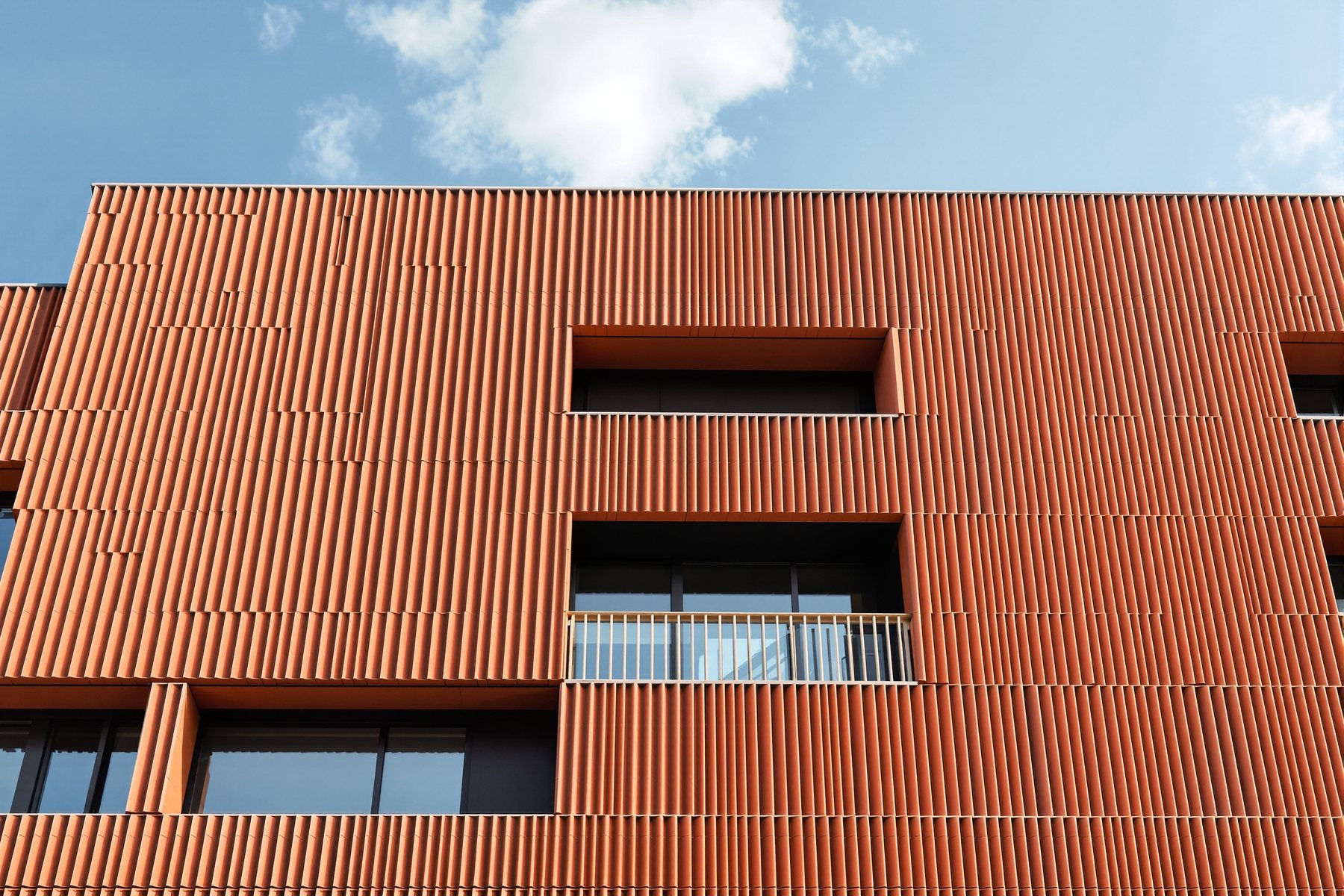
Stop trying to make the outer skin perfectly watertight. Let it leak a little, drain what gets through, and let air pressure do the work the sealant can't.
The most important idea in modern weatherproofing is counter-intuitive: the best way to keep water out is to stop pretending you can seal the outer face perfectly. Put a **gap** behind the cladding, accept that some water and air will get past the outer screen, and design the cavity to **drain** what enters and **equalise pressure** so the wind has no reason to push water inward. That is the **rainscreen**. Open the cavity to ventilation and you get a **ventilated facade** that also sheds heat. Make the outer skin a full sheet of glass and the cavity a walk-in space and you get a **double-skin facade** - a second envelope that pre-conditions the air. One idea, scaled from a 25 mm gap to a metre-wide buffer.
The cavity, scaled from rainscreen to double skin
Drained and back-ventilated: defeat water with a cavity, not a perfect seal
A rainscreen is a two-layer wall: an outer cladding screen (stone, terracotta, metal, fibre-cement, ACP) with open or baffled joints, then a cavity, then the real waterproof line - a weather-resistant barrier (WRB) on the structural backing wall, where the insulation and air barrier live. The outer screen is not the waterproof layer. It breaks the force of the rain and takes the wind, the cavity catches and drains any water that gets through, and the WRB behind it stays dry.
The physics that makes it work is pressure equalisation. Rain is driven through a joint by an air-pressure difference across it (wind pushes high pressure outside, lower inside). If the cavity is compartmented and vented to the outside so its pressure rises to match the outside, that driving force largely disappears - there is no pressure pushing water in, so it falls and drains instead. This is the pressure-equalised rainscreen (PER), the gold standard. A simpler drained-and-back-ventilated (DBV) rainscreen relies mainly on the cavity draining and a little ventilation drying it, without strict compartmentation. Either way the strategy is defence in depth: a screen, a drained cavity and a barrier - not one perfect seal that fails the day it cracks.
The outer skin is a screen, not a seal. Let it leak; drain the cavity; equalise the pressure so wind has nothing to push the water in with.
Open the cavity to airflow and it sheds heat as well as water
A ventilated facade is a rainscreen whose cavity is deliberately open to continuous airflow - vented top and bottom so a stack effect drives air up the gap. Now the cavity does two jobs. It still drains and dries (the rainscreen benefit), and it also carries away heat: solar radiation absorbed by the outer cladding warms the cavity air, which rises and exhausts, reducing the heat reaching the insulation and the inside. The insulation sits on the warm side of the WRB, continuous and unbridged, while the vented cavity buffers the sun.
For the Indian climate this is genuinely useful. On hot, sunny elevations a ventilated cladding (terracotta, stone, fibre-cement, metal cassettes) can cut the solar heat reaching the wall and keep the structure cooler, and the same airflow that cools also dries out monsoon-driven moisture fast. The trade-offs are honest: the cavity, brackets and outer skin add cost, depth and weight, the brackets through the insulation are thermal bridges to detail out, and at the top the cavity must be fire-detailed with cavity barriers (a Module 8 lesson, and a Grenfell-era non-negotiable for combustible cavities). Used well, a ventilated facade is a passive cooling layer; used carelessly, it is an expensive chimney.
A second glass skin and a habitable cavity: box, corridor, multi-storey
Push the cavity idea to its limit and you get a double-skin facade (DSF): an outer glazed skin, a cavity wide enough to walk in (typically 200 mm to over a metre), and an inner glazed skin that is the real environmental envelope. The cavity is ventilated - naturally, mechanically or both - and can hold solar shading (blinds) protected from weather, while the buffer of warmed or cooled air pre-conditions the inside, cuts heat loss in winter and, when vented, exhausts solar heat in summer. It can also greatly improve acoustic performance on noisy sites and allow natural ventilation in tall, windy buildings.
The DSF comes in types, defined by how the cavity is partitioned:
Box-window - the cavity is boxed into small cells, one per window/storey, each independently vented; best acoustic separation, no smoke/sound travel between cells. Corridor - the cavity runs horizontally along each floor as a continuous storey-high band, vented per floor. Multi-storey (shaft/buffer) - one tall, continuous cavity over several storeys, vented at the very bottom and top, driving a strong stack effect.
The research is candid that DSFs are climate-sensitive: they shine in temperate and cold climates and can overheat in hot climates if the cavity is not aggressively vented or shaded - so in much of India a DSF must be designed as a vented, shaded buffer (or used selectively for acoustics on noisy urban sites), never a sealed greenhouse. They are also costly and complex to model. Powerful, but not a default.
These systems let you use heavy, rich materials - stone, terracotta, metal - as a ventilated rainscreen and get both the look and a passive cooling benefit, which is a strong move on a hot Indian elevation. Budget the **depth**: a ventilated cavity adds 50-150 mm-plus, a double skin adds a whole walk-in zone, and both eat plan area and add weight. With a DSF, decide honestly _why_ - acoustics on a noisy site, a winter buffer, an expressed double-glass aesthetic - because in a cooling-dominated climate an un-vented DSF can overheat and backfire. The cavity is the design idea; do not let it become an unmanaged greenhouse.
Own the **cavity** as a designed space, not a void. For a pressure-equalised rainscreen, compartment the cavity and size the vents so it equalises faster than the gust loads it - that is the whole performance. Detail **drainage** (weeps, flashing, no ledges that pond), **continuous insulation** on the backing wall with the brackets' thermal bridging quantified, and **cavity fire barriers** at compartment lines. For a DSF, the cavity airflow is a thermal and condensation problem you must model: under-ventilation overheats it and risks condensation; the literature flags condensation and ventilation in DSF units as real, modellable phenomena. Pick the DSF type (box/corridor/multi-storey) for the acoustic, fire and stack-effect behaviour you need - they are not interchangeable.
The cavity only works if it is kept clear and the hidden layers are right. Do not let mortar droppings, offcuts or insulation bridge and block the drained cavity - a blocked cavity ponds water and defeats the whole rainscreen. Install the WRB and its laps properly (it, not the pretty outer screen, is the waterproof line), keep insulation continuous and tight around brackets, and never omit the **cavity fire barriers** - they are life-safety, not optional trim. On a double skin, the cavity is often accessed for cleaning and blind maintenance, so set out the gap and access as drawn. The screen you can see is the easy part; the drained, vented, barriered cavity behind it is the system.
CWCT Standard & Test Methods (UK)
Rainscreen / cavity wall performance & test
Sets the air/water/wind performance and pressure-equalisation expectations for rainscreen and ventilated facades widely specified on Indian premium projects - a benchmark spec, not Indian statute.
NBC 2016, Part 4 (Fire) (India)
Cavity fire spread & barriers
Frames fire and life-safety provisions that drive cavity fire barriers and combustible-cladding limits in ventilated/rainscreen facades in India - post-Grenfell a critical constraint, but cavity-barrier detail still relies on the system test and spec.
Eco-Niwas Samhita 2018 / ECBC 2017 (India)
Envelope thermal performance
Set the U-value/RETV and SHGC targets a ventilated or double-skin facade is judged against; they reward the continuous insulation and solar buffering these systems give but do not themselves credit cavity airflow - you model that separately.
IEA-EBC Annex 43/44
Double-skin facade behaviour
The international literature review of DSF types and performance - the authoritative reference on box/corridor/multi-storey behaviour and the climate-sensitivity (overheating) warning, though it is research guidance, not a design code.
“A rainscreen's outer cladding is the waterproofing - the open joints are just a design style.”
The outer screen is deliberately not the waterproof layer - its open or baffled joints are functional, letting the cavity equalise pressure so wind cannot drive water inward. The real waterproof line is the weather-resistant barrier on the backing wall, kept dry by the drained, ventilated cavity in front of it. This 'let it leak, then drain and equalise' approach is the rainscreen principle, and it is far more reliable than a single face-sealed outer skin, which fails the moment one bead of sealant cracks.
Worked example - is a ventilated cavity worth it on a west elevation?
Ventilated and double-skin facades earn their keep by shedding solar heat through cavity airflow. Let's estimate the heat a vented cavity removes from a hot west wall and judge whether the depth and cost are justified.
The solar and cavity figures below, the stack-effect idea, and a calculator. A simplified energy-balance check, not a full CFD model.
GIVEN - a west-facing ventilated terracotta facade, Indian summer afternoon:

  Solar irradiance on wall  G   = 600 W/m2
  Cladding solar absorptance a   = 0.6
  So heat into cavity air     ~ a x G = 360 W/m2 of wall
  Cavity air rise (stack)   dT  = 6 K assumed
  Cavity airflow per m width  V = 0.10 m3/s.m (vented top/bottom)
  Air density x cp          rcp = ~1,200 J/m3.K

  FIND: heat carried away by the cavity airflow, and the share of
absorbed solar it removes before it reaches the insulation.- 1Heat the cladding dumps into the cavity: a x G = 0.6 x 600 = 360 W/m2 of wall - this is the load the cavity must deal with before it reaches the WRB and insulation.
- 2Heat the rising cavity air can carry (per m2 of wall, for a ~3.5 m storey): Q_air = rcp x V x dT = 1,200 x 0.10 x 6 = 720 W per metre of facade width.
- 3Spread over the storey height (3.5 m of wall per metre width): 720 / 3.5 = ~205 W/m2 of wall removed by the airflow.
- 4Share of absorbed solar removed: 205 / 360 = ~0.57, so the ventilated cavity is sweeping away on the order of half the absorbed solar heat before it can conduct inward - a real, passive reduction in the cooling load on a brutal west wall.
- 5Sanity / limits: this is a simplified steady balance - actual performance depends on vent sizing, cavity depth, wind and the stack temperature, and a poorly vented cavity carries far less (and can overheat). Treat ~50% as an optimistic order-of-magnitude, not a guarantee, and confirm with proper simulation.
- 6The decision: removing ~half the absorbed solar load justifies the cavity on a hot west or south elevation in India - but only if the vents, drainage and fire barriers are detailed so the cavity actually flows. The same wall un-vented would just store and conduct that heat inward.
You’ll walk away with
An order-of-magnitude estimate that a well-vented cavity sweeps away roughly half the solar heat absorbed by the outer skin on a hot Indian elevation - the back-of-envelope case for a ventilated facade, and the reminder that the benefit lives entirely in the cavity actually being vented and clear.
Two ways to see the cavity.
- 01Find a stone- or terracotta-clad building with thin open joints between panels and no visible silicone - that is almost certainly a ventilated rainscreen, and those open joints are the pressure-equalisation slots, not a defect.
- 02Look at a double-skin glass facade (airports, premium offices). Try to spot the vents at the top and bottom of the cavity and any blinds inside the gap - then ask whether, in your climate, that cavity needs to dump heat or trap it.
A cavity behind the cladding changes everything: the rainscreen defeats water by draining and pressure-equalising instead of perfectly sealing, the ventilated facade adds airflow that also sheds solar heat, and the double-skin facade scales the cavity to a habitable buffer that pre-conditions air. The real waterproof and thermal lines sit on the inner/backing wall; the outer skin is a screen. In hot India these cavities are powerful passive coolers - but a double skin must be vented and shaded, never a sealed greenhouse.
Rainscreen = outer screen + drained cavity + WRB behind; pressure equalisation (PER) removes the wind force that drives rain in - defence in depth, not a perfect seal. Ventilated facade = an open, airflowing cavity that also sheds solar heat (good for hot India). Double-skin facade = outer glass + walk-in cavity + inner glass, in box, corridor or multi-storey types; powerful but climate-sensitive and prone to overheating if un-vented. The cavity is the system; the screen is just the front.
What is the rainscreen principle?
The rainscreen principle is to stop relying on a perfectly sealed outer face and instead use a two-layer wall: an outer cladding screen with open or baffled joints, a drained cavity behind it, and the real waterproof barrier (the WRB) on the backing wall. Some water gets past the screen, the cavity drains it, and - in a pressure-equalised rainscreen - venting the cavity removes the air-pressure difference that drives rain inward. It is defence in depth, far more reliable than a single face seal.
What are the types of double-skin facade?
Double-skin facades are classified by how the cavity is partitioned: box-window (the cavity is divided into small independently vented cells, best for acoustic separation), corridor (the cavity is a continuous storey-high horizontal band vented per floor), and multi-storey or shaft/buffer (one tall continuous cavity over several floors vented at bottom and top for a strong stack effect). The choice affects acoustics, fire/smoke separation and how the cavity ventilates.
Do double-skin facades work in India's hot climate?
They can, but only if designed as a vented, shaded buffer. Double-skin facades perform best in temperate and cold climates; in hot, cooling-dominated climates an un-vented cavity can overheat and increase the cooling load, the opposite of the intent. In India a double skin is usually justified for acoustics on noisy urban sites, or as an aggressively ventilated and internally shaded buffer - never a sealed glass greenhouse. Ventilated single-cavity rainscreens are often the more reliable passive-cooling choice.
Peer-reviewed journals & authoritative standards
- 01Su, Z. et al. Multi-Disciplinary Characteristics of Double-Skin Facades for Computational Modeling Perspective and Practical Design Considerations. Buildings, 12(10):1576. — Buildings (MDPI), 2022.
- 02Pomponi, F. et al. Thermal, Energy and Daylight Analysis of Different Types of Double Skin Facades in Various Climates. Journal of Facade Design and Engineering. — Journal of Facade Design and Engineering, 2021.
- 03Ventilated facade system: A review (review of ventilated/double-skin/rainscreen families). — ScienceDirect (Elsevier), 2025.
- 04IEA EBC Annex 43/44. Double Skin Facades: A Literature Review. — International Energy Agency (IEA-EBC), 2008.
The author
Amogh N P
Architect, interior designer, and creative polymath. Studio Matrx began in his notebooks — his vision of design made honest, useful, and open to everyone. Its Academy is written and taught in his memory, and free, forever.
More about Amogh →_Rainscreens and double skins lean on light outer screens and glass. But facades can also be heavy - precast concrete, ACP, masonry and stone - where weight and fixing dominate the engineering. That is the last system family._