
Glass: float, toughened, laminated, IGU
It looks like one clear material. It is really a family of engineered products, each made by heating, cooling, gluing or sealing ordinary float glass into something stronger, safer or smarter.
Lesson byAmogh N P· Architect & interior designer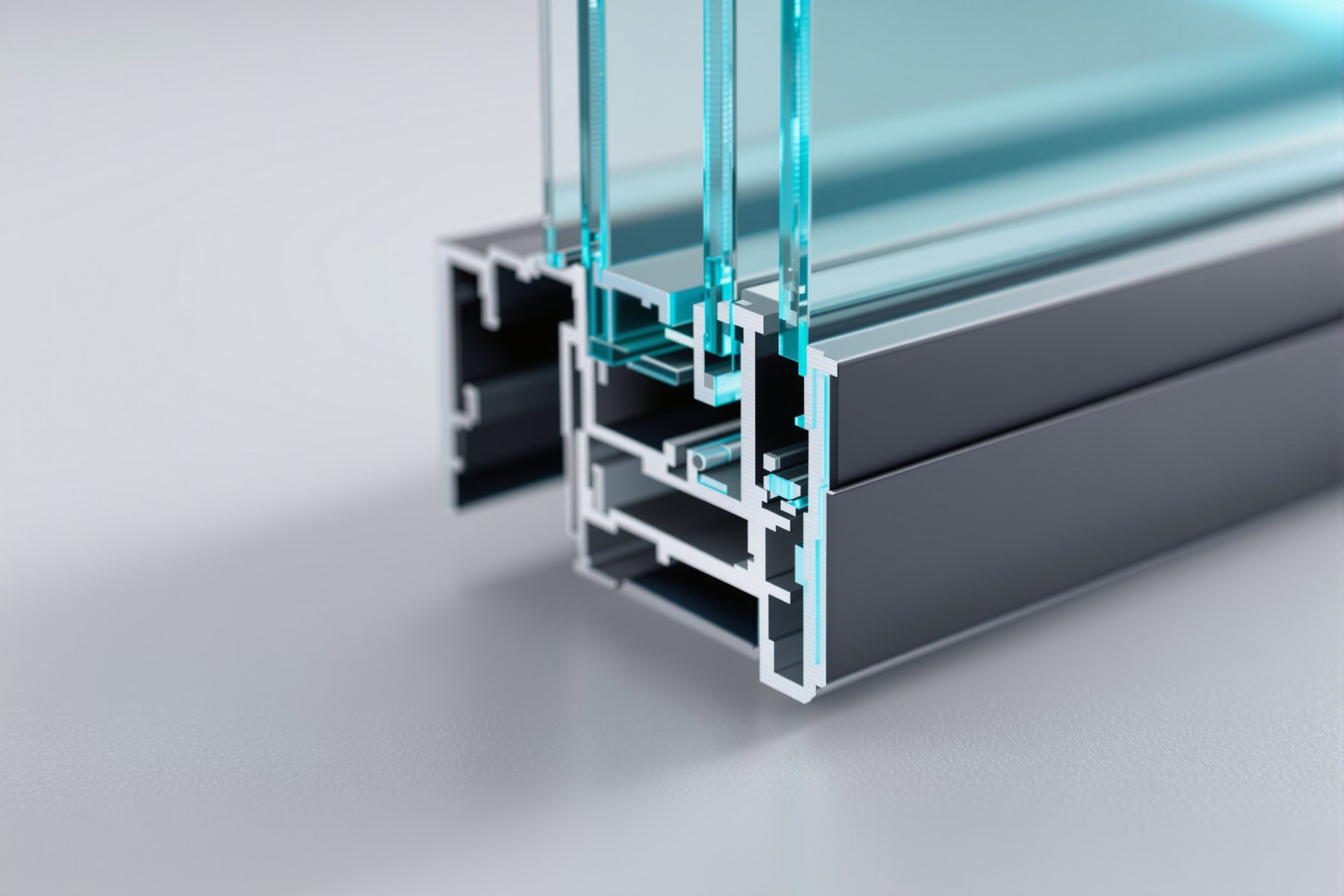
Every pane in a glass tower started life as the same ribbon of float glass — what happens next is the whole engineering.
Glass is the most demanding material on a facade. It is brittle, it shatters, it bends in the wind, and it cracks when one corner is hot and the other is in shade. Yet it is also the material clients want most: the view, the daylight, the gleaming skin. The way the industry tames glass is not by inventing new glass but by **processing** ordinary float glass - heating it, quenching it, gluing two panes together, sealing two panes apart. A 24 mm insulated unit on a Gurugram tower is float glass that has been toughened, coated, laminated and sealed into something that resists wind, holds together when struck, blocks heat and survives the sun. Learn the family, and you can read any glass spec on earth.
From the float line to the engineered pane
Float glass is the base; annealed glass is float glass left to cool slowly
Nearly all flat glass on earth is float glass - molten glass floated on a bath of liquid tin to make a perfectly flat ribbon, then cooled. Cooled slowly and stress-free, it is annealed glass: the cheapest, most workable form, and the base material for every product that follows.
Annealed glass has two problems on a facade. It is weak - it breaks at a low stress - and it breaks dangerously, into large jagged shards. So annealed glass is rarely used unbroken on a serious facade except in protected, low-stress spandrel zones. Its real role is to be the feedstock that gets heat-treated or laminated into something better.
The single most important idea here is that the glass type is a process, not a recipe. The same float glass becomes annealed, heat-strengthened or fully toughened depending only on how fast it is cooled after re-heating - and that choice sets its strength, its safety and its failure mode.
Float glass is the parent. Annealed, heat-strengthened and toughened are the same glass cooled at three different speeds.
Heat-strengthened resists thermal stress; fully toughened breaks safe
Re-heat annealed glass to about 620 C and cool it with controlled air jets and you lock a compression skin onto its surface. Cool it moderately and you get heat-strengthened (HS) glass - roughly twice as strong as annealed, with low residual stress. It breaks into large pieces that stay roughly in plane, which is why HS is the preferred substrate for laminated glass.
Cool it fast - a hard quench - and you get fully toughened (tempered) glass: about four to five times the bending strength of annealed, the workhorse of the curtain wall. Its signature is the failure mode: when it does break, it dices into thousands of small, blunt cubes - safety glass. That is its great virtue and its great risk. Toughened glass carries a tiny population of nickel sulphide (NiS) inclusions that can expand years later and cause spontaneous breakage with no warning. Heat-soak testing (IS 18361 / EN 14179) bakes the panels to provoke and weed out most NiS-prone lites before they reach the facade.
A hard rule: toughened glass cannot be cut, drilled or edge-worked after tempering. Every hole and notch must be in the glass before it is heat-treated. Get a dimension wrong and the whole lite is scrap.
Laminated holds together when broken; the IGU traps a sealed cavity of dry gas
Laminated glass is two or more glass panes bonded by a tough plastic interlayer - usually PVB (polyvinyl butyral) or, where higher strength and stiffness are needed, SGP (SentryGlas ionoplast). When laminated glass breaks, the shards stay stuck to the interlayer: it holds together, keeps the opening closed, and offers fall protection, security, acoustic damping and UV control. SGP is roughly five times stiffer and a hundred times more rigid than PVB at the same thickness, so it keeps a cracked pane far more load-bearing - the reason it dominates overhead, structural and balustrade glass.
An insulated glass unit (IGU) - a double-glazed unit (DGU) has two panes - seals two (or three) lites apart with a perimeter spacer to create a sealed cavity of dry air or, better, argon. The cavity is the insulation: it cuts the U-value roughly in half versus single glazing and, with a low-emissivity (low-e) coating on the right surface, slashes solar heat gain (SHGC) while keeping daylight. The spacer holds desiccant to keep the cavity bone-dry so it never fogs, and a dual seal (primary butyl for gas-tightness, secondary silicone or polysulphide for structure) keeps it sealed for decades. A modern Indian facade IGU is typically 6 mm low-e toughened outer + 12-16 mm argon cavity + 6 mm clear inner, often with the inner pane laminated for safety.
Your glass choice is a four-way decision in disguise: **strength** (can it take the wind on this span?), **safety** (does code require it to break safe or stay in the opening?), **performance** (what SHGC and VLT does the climate demand?) and **appearance** (clarity, colour, reflectivity, low-e tint). Resist specifying 'toughened glass' as a default - it dices and can break spontaneously; heat-strengthened laminated is often safer and quieter. And remember the IGU make-up drives both the energy bill and the bracket loads, because a sealed unit is heavy.
Pick the heat treatment from the load and the thermal-stress check, not by habit. Specify **heat-soak testing** for every fully toughened lite that can injure people if it fails. For laminated glass, match the interlayer to the duty - PVB for general safety and acoustics, SGP where post-breakage capacity or stiffness matters (overhead, balustrade, structural). On the IGU, own the **edge seal**: dual-seal construction, correct desiccant, certified to EN 1279 / ASTM E2190 for fog and gas-retention life. The unit fails at its edge long before its centre.
Glass is the one material you cannot fix on site. **Toughened glass is cut and drilled before tempering** - a mis-measured hole means a re-order, not a re-cut. Handle lites by their faces with suction cups, never let an edge knock the frame (an edge nick is where every fracture starts), and keep IGUs upright and shaded - heat on a stacked unit can stress the seal. Check the stamp in the corner: it tells you the type, the standard and whether it is heat-soaked. If the stamp is missing, so is your evidence.
IS 2553 (Part 1): 2018 / EN 12150
Safety glass - toughened
Indian and European specs for thermally toughened soda-lime safety glass - fragmentation, strength and dimensional limits. They classify glass; they do not size it for your wind load.
IS 18361 / EN 14179
Heat-soak testing
Heat-soak test for toughened glass to reduce nickel-sulphide spontaneous breakage. It reduces, but does not eliminate, NiS risk - so specify it but still detail for fall-out.
EN 1279 / ASTM E2190
Insulated glass units (IGU)
Edge-seal durability, gas-retention and fogging-resistance tests for sealed units. They prove the unit survives, not that the cavity gas fill or low-e coating hits your energy target.
ECBC 2017 / Eco-Niwas Samhita 2018 (India)
Glass performance (SHGC, VLT, U)
Set the SHGC, VLT and U-value limits the IGU must meet for Indian commercial and residential envelopes - the performance brief your glass make-up has to satisfy.
“Toughened (tempered) glass is the strongest and safest glass, so it is always the right choice for a facade.”
Toughened glass is strong and breaks into harmless cubes, but it has two real weaknesses: it can break **spontaneously** from nickel-sulphide inclusions (which is why heat-soak testing exists), and once it breaks it leaves the opening entirely - no fall protection, no security. For overhead glazing, balustrades, fall-risk areas and acoustic work, **laminated** glass (often heat-strengthened, not toughened) is safer because it stays in the frame when broken. Strongest is not the same as right.
Worked example - size and weigh a facade IGU make-up
A facade IGU is specified by its make-up - the panes, the cavity and the coatings - and that make-up sets both the U-value class and the dead load on every bracket. Let's build and weigh a real unit.
A calculator, the 2.5 kg/m2/mm glass-weight rule, and the project's ECBC/ENS SHGC and U-value targets.
GIVEN a vision IGU for a Hyderabad office, panel 1.5 m x 1.5 m:

  OUTER  : 6 mm fully toughened, low-e coated (surface #2)
  CAVITY : 16 mm, argon-filled, warm-edge spacer
  INNER  : 6.38 mm laminated (3 + 0.38 PVB + 3), heat-strengthened
  TOTAL build-up: 6 + 16 + 6.38 = 28.38 mm

  Glass mass rule: 2.5 kg/m2 per 1 mm of GLASS thickness
  Panel area A = 1.5 x 1.5 = 2.25 m2
- 1Add up the glass thickness only (the cavity and PVB carry almost no weight): outer 6 mm + inner glass 3 + 3 = 6 mm, so 12 mm of glass total. The 16 mm cavity is gas - ignore it for weight.
- 2Compute the area weight: 12 mm x 2.5 kg/m2/mm = 30 kg/m2. (A single 6 mm lite is 15 kg/m2; the rule of thumb 'about 2.5 kg per mm per square metre' is worth memorising.)
- 3Compute the panel dead load: 30 kg/m2 x 2.25 m2 = 67.5 kg per unit - call it 68 kg. Add roughly 2-3 kg for the PVB, spacer, desiccant and sealant: about 70 kg lifted and hung per panel.
- 4Sanity-check against handling: at ~70 kg a unit is a two-person or vacuum-lifter lift, and the bracket and slab fixing must carry that dead load plus the wind - this number flows straight into Module 4's anchor design.
- 5Read the energy half: outer low-e on surface #2 + argon cavity typically lands this unit near U ~ 1.6-1.8 W/m2K and SHGC ~ 0.25-0.35 - in the ballpark ECBC/ENS demand for a hot Indian city. Confirm the exact figures with the glass-maker's certified data, never a catalogue average.
You’ll walk away with
A fully specified IGU make-up (6 toughened low-e / 16 argon / 6.38 HS laminated = 28.38 mm) weighing about 70 kg per 2.25 m2 panel - the dead load that drives your bracket design and the performance class that satisfies the energy code.
Two quick checks to anchor the glass family.
- 01Find a glass facade near you in low evening sun and look for faint **roller-wave distortion** or a slight quilting in the reflection - that ripple is the fingerprint of horizontally heat-treated (toughened or HS) glass passing through the tempering furnace.
- 02Read any glass spec you can find (a window quote works) and decode the make-up: which pane is toughened, which is laminated, how wide is the cavity, and is the coating on the right surface for keeping heat out in India?
Facade glass is one base material - float glass - engineered by process. Cooling speed sets the strength and failure mode (annealed, heat-strengthened, fully toughened); lamination makes it hold together when broken; the sealed IGU traps a dry gas cavity that does the thermal work. Choose by strength, safety, performance and appearance together - never by habit, and never 'toughened by default'.
Float glass is the base. Annealed = slow-cooled, weak, breaks jagged. Heat-strengthened = ~2x, stays in plane, best laminating substrate. Fully toughened = ~4-5x, dices safe, but risks NiS spontaneous breakage (heat-soak it) and leaves the opening. Laminated (PVB/SGP) holds together. The IGU/DGU seals two panes apart with a desiccant spacer and dual seal, argon and low-e, halving U-value and cutting SHGC.
What is the difference between toughened and laminated glass on a facade?
They solve different problems. Toughened (tempered) glass is heat-treated for strength and, when it breaks, dices into small blunt cubes - but it leaves the opening entirely. Laminated glass is two panes bonded by a PVB or SGP interlayer, so when it breaks the shards stay stuck to the plastic and the pane holds together in the frame. Many facade lites are both: a toughened or heat-strengthened glass that is also laminated, getting strength and post-breakage retention together.
What does the make-up of an IGU mean - for example 6-16-6?
It describes the layers of an insulated glass unit from outside to inside: a 6 mm outer pane, a 16 mm sealed cavity (usually argon-filled), and a 6 mm inner pane, giving a 28 mm total build-up. The cavity, the gas fill and a low-emissivity coating do the thermal work - roughly halving the U-value versus single glazing and cutting solar heat gain. A perimeter spacer holds desiccant to keep the cavity dry, and a dual edge seal keeps it sealed for decades.
Why does toughened glass sometimes break by itself?
Fully toughened glass can contain tiny nickel-sulphide (NiS) inclusions that slowly expand over years. Because toughened glass holds a high internal stress, a growing inclusion at the core can trigger spontaneous fracture with no impact and no warning. Heat-soak testing (IS 18361 / EN 14179) bakes finished panels to force most NiS-prone lites to fail in the factory rather than on the building - it greatly reduces, but does not fully eliminate, the risk, so fall-out is still detailed for.
Peer-reviewed journals & authoritative standards
- 01Li, X. & Wu, Y. A review of complex window-glazing systems for building energy saving and daylight comfort. Journal of Building Physics. — Journal of Building Physics (SAGE), 2025.
- 02Material Selection and Characterization for a Novel Frame-Integrated Curtain Wall. (PMC8069006). — Materials / NCBI-PMC, 2021.
- 03Eco-Niwas Samhita 2018 (ECBC for Residential Buildings), Part I: Building Envelope. — Bureau of Energy Efficiency, Govt. of India, 2018.
The author
Amogh N P
Architect, interior designer, and creative polymath. Studio Matrx began in his notebooks — his vision of design made honest, useful, and open to everyone. Its Academy is written and taught in his memory, and free, forever.
More about Amogh →_Glass needs a frame to hold it, hang it and seal it - and that frame is almost always aluminium or steel, which is where Lesson 2.2 turns next._