
NBC fire, safety glazing & fall protection
Indian code packs a building's life-safety rules into one part. Read it well and the facade keeps people in, keeps fire compartmented, and keeps glass from cutting or dropping anyone.
Lesson byAmogh N P· Architect & interior designer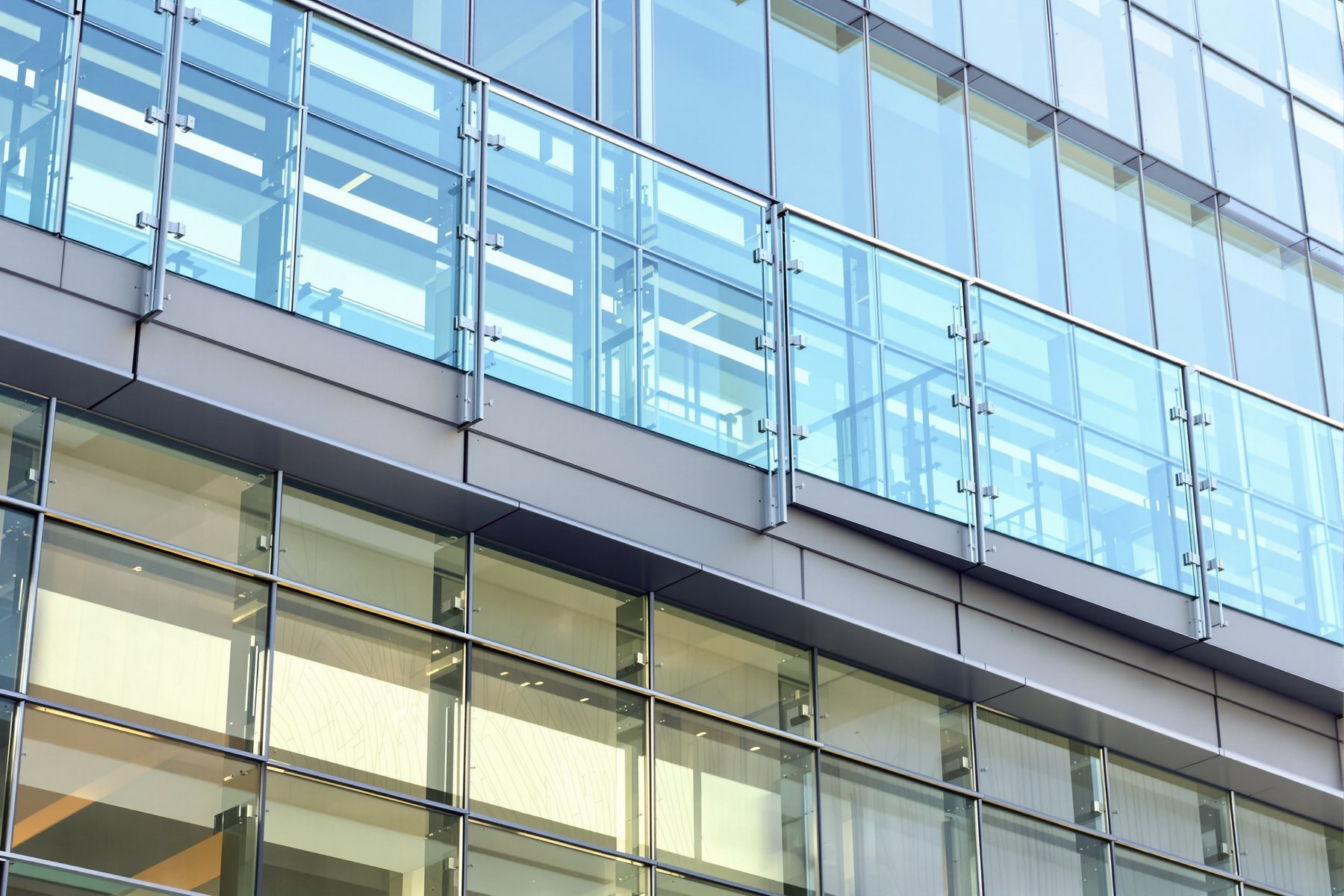
The same glass wall that frames a city view can, if it breaks the wrong way, become a sheet of falling blades or a missing barrier above a 40 m drop.
A facade does two life-safety jobs the public never thinks about. It must not let fire jump floor to floor - so the code demands spandrel fire-stopping and intact compartments. And it must not let a person fall, or be cut by breaking glass - so the code demands safety glazing and guarding of a minimum height wherever there is a drop. In India these rules live mostly in **NBC 2016 Part 4 (Fire and Life Safety)** and the fenestration and glazing standards it references. This lesson reads the code as a facade engineer must: knowing what it requires, why each number exists, and - honestly - where the Indian code is softer than it should be.
Fire compartments, safe glass, and not falling
NBC Part 4: compartmentation, fire-resistance and the spandrel that stops leapfrogging
NBC 2016 Part 4 is India's fire-and-life-safety code. For the facade engineer its key demands are compartmentation (the building divided into fire cells, usually floor by floor), fire-resistance ratings for separating elements, and the requirement that the external wall must not undo the floor compartments. That translates into two facade details from Lesson 8.1, now code-mandated: perimeter fire-stopping at the slab edge, and an adequate fire-resisting spandrel between the vision glass of one floor and the next.
The spandrel is the opaque band of facade at each floor level, covering the slab edge and the space above and below it. Code (and good practice) gives it a minimum height and fire rating so that a flame plume bursting from a window below cannot simply leapfrog into the window above - the spandrel is the fire-rated gap that breaks the climb. A common benchmark is a spandrel providing on the order of a metre or more of fire-rated separation between openings; the taller and better-rated the spandrel, the harder it is for fire to jump. The vision panel admits the view; the spandrel keeps the fire honest.
Where breakage is a hazard, the glass must break safely - toughened vs laminated
Glass is brilliant and treacherous: it fails suddenly and its shards can kill. Safety glazing means glass that, when it breaks, does so in a way that minimises injury - and code requires it wherever breakage is a foreseeable hazard (low-level glazing people can walk into, doors, balustrades, overhead glazing, large facade panels above occupied areas).
Two safety types matter. Toughened (tempered) glass is heat-treated to roughly 4-5x the strength of annealed float and, when it does break, shatters into small blunt dice rather than long shards - good for impact but it all falls at once, so it is poor where retained glass is needed (overhead, balustrades). Laminated glass bonds two or more plies with a tough interlayer (PVB or SGP); when it breaks, the fragments stay stuck to the interlayer - it holds together, so it is the safety choice for overhead glazing, structural balustrades and any fall-protection panel, because a broken laminated pane is still a barrier. The engineering rule: use toughened for strength, laminated where the glass must keep doing its job after it breaks - and toughened-laminated where you need both. ASTM E1300 (and IS codes) size the glass; the safety type is a separate, life-safety decision.
Wherever there's a drop, there's a guard - of a minimum height and barrier strength
Anywhere a person could fall - the edge of a balcony, an openable window above ground, a terrace, a stair - the facade must provide a guard / barrier of a minimum height, designed to resist a horizontal barrier load (people leaning and crowding against it). The classic guarding height is around 1.0-1.1 m for residential and higher for some occupancies and where the drop is large; the exact figure comes from NBC Part 4 and the relevant occupancy rules, and rises with the fall height and crowd risk.
Where that barrier is glass (a frameless glass balustrade, a glass-fronted balcony), two things must both be true: the glass must be laminated (so a break still leaves a barrier, not a gap above a drop), and the assembly must resist the code barrier line load (a horizontal force at handrail height - typically expressed in kN per metre run) without excessive deflection or failure. A glass balustrade is a structural fall-protection element first and a view second. Get the height, the load and the laminated build-up right, and the elegant frameless rail is safe; get any one wrong and it is a fall waiting to happen.
The poetic frameless glass balustrade and the floor-to-ceiling vision wall are exactly the moves that trigger life-safety rules - so design them knowing the rules from the start. Give the spandrel real height; specify laminated glass for every balustrade and overhead panel; set guard heights to code, not to what looks sleek. The most beautiful detail is the one that is also safe by design - and retrofitting safety into a too-short balustrade or a non-fire-rated spandrel after the fact is ugly and expensive.
You translate NBC Part 4 and the glazing standards into specific numbers: spandrel height and fire rating, perimeter fire-stop rating, the safety-glass type for each location, the guard height by occupancy, and the barrier line load the balustrade must carry. Size the glass to ASTM E1300 / IS for the wind and barrier loads, then make the separate life-safety call: laminated wherever retained glass protects against a fall or overhead breakage. Document where Indian code is silent or soft and apply international good practice (CWCT, ASTM) to close the gap.
Three checks save lives on a facade: is the balustrade the right height, is its glass laminated (not just toughened), and is the slab-edge fire-stop continuous? Toughened and laminated glass look identical - read the stamp / certificate, because a toughened balustrade that should be laminated is a real hazard. Confirm guard heights with a tape, not by eye. And never sign off a spandrel or perimeter barrier you cannot see is complete - once the panel is on, the gap is buried.
NBC 2016 Part 4 (India)
Fire & life safety
Sets compartmentation, fire-resistance ratings, spandrel/fire-stop requirements and references guarding and glazing - the umbrella, but its external-wall and combustibility provisions are less prescriptive than post-Grenfell international codes.
IS 2553 (safety glass) / IS 16231
Safety glazing & fenestration
IS 2553 governs safety glass (toughened/laminated) and IS 16231 covers window/fenestration performance in India - what defines a compliant safety pane, though they do not by themselves dictate where laminated must be used.
ASTM E1300 / EN 1991-1-1 (barrier loads)
Glass thickness & guarding loads
ASTM E1300 sizes glass for load; barrier/guarding line loads (a horizontal kN/m at handrail height) come from loading codes - the structural basis for a compliant glass balustrade; verify the Indian load case from NBC/IS.
“Toughened (tempered) glass is the safety glass, so it is fine everywhere - including balustrades and overhead glazing.”
Toughened glass is a safety glass for impact - it shatters into blunt dice instead of long shards - but it all falls at once when it breaks, leaving nothing behind. For balustrades, overhead glazing and any fall-protection panel you need glass that holds together after breaking: laminated (or toughened-laminated) glass, where the broken fragments stay bonded to the interlayer and the pane remains a barrier. Using plain toughened glass where laminated is required is a classic, dangerous facade error - the right safety type depends on the consequence of breakage, not just on impact strength.
Worked example - guarding height & a glass balustrade barrier load
Two life-safety numbers every facade engineer must be able to produce: the minimum guard height for a location, and whether a frameless glass balustrade survives the code barrier load. We will check a residential balcony.
The occupancy guard height and barrier line load from NBC Part 4 / the loading code, ASTM E1300 (or IS) glass charts, and the balustrade geometry and laminated build-up.
GIVEN a frameless glass balustrade to a 12th-floor residential balcony:

  OCCUPANCY        : residential balcony, drop ~36 m
  GUARD HEIGHT REQ : >= 1.1 m (residential, large drop)
  BARRIER LINE LOAD: w = 0.74 kN/m horizontal at top of barrier
  PANEL            : frameless laminated glass, cantilevered, height h = 1.1 m
  GLASS            : 2 x 10 mm toughened + 1.52 mm SGP interlayer (laminated)

  CHECK: height OK?  and  does the laminated panel resist 0.74 kN/m at 1.1 m?
- 1Check the height first: design height 1.1 m meets the >= 1.1 m residential requirement for a large drop. (Had this been 0.9 m it would fail outright - the cheapest possible error to avoid.)
- 2Confirm the glass type is correct: a fall-protection barrier MUST be laminated so a broken pane is still a barrier - here 2 x 10 mm toughened laminated with an SGP interlayer. Plain monolithic toughened would be non-compliant for a balustrade, however thick.
- 3Find the moment at the base: a cantilevered balustrade takes the line load at the top, so the bending moment at the fixing is M = w x h = 0.74 kN/m x 1.1 m = 0.814 kN.m per metre run of balustrade.
- 4Check the laminated build-up resists it: the two 10 mm toughened plies with a stiff SGP interlayer act largely compositely; verify the glass bending stress under M stays within the allowable for toughened glass to ASTM E1300 / IS, AND that tip deflection is within the serviceability limit (commonly ~25 mm or h/65 for balustrades) so the rail does not feel alarmingly springy.
- 5State the result and the fixing: if stress and deflection both pass, the 1.1 m, 2 x 10 mm SGP-laminated panel is compliant - but the load then goes into the base shoe / fixing, which must itself be designed for the same 0.814 kN.m/m. The glass is only as safe as the bracket holding it.
You’ll walk away with
A checked glass balustrade: guard height >= 1.1 m, laminated (not monolithic toughened) build-up, base moment 0.814 kN.m/m from the 0.74 kN/m barrier load, glass stress and deflection within ASTM E1300 / IS limits, and a fixing designed for the same moment. The full fall-protection check in one page.
Two quick code-reading reflections.
- 01Stand at a glass balcony or stair you can reach and estimate the guard height with your hand (your hip is about 1.0 m). Then ask: is this glass laminated? A frameless balustrade that is monolithic toughened is a hazard hiding in plain sight.
- 02Look at any fully-glazed facade and find the spandrel band at each floor - the opaque strip covering the slab. That strip is the code's anti-leapfrog gap; a facade with almost no spandrel is one with little defence against vertical fire spread.
NBC 2016 Part 4 makes the facade's life-safety jobs explicit: compartmentation and spandrel/perimeter fire-stopping so fire cannot jump floors, safety glazing (laminated where retained glass must keep being a barrier), and guarding of a minimum height and barrier strength wherever there is a drop. Read the code for the number, understand why each exists, and apply international good practice where the Indian code is soft.
NBC Part 4 demands compartmentation, fire-resistance ratings, perimeter fire-stops and a fire-rated spandrel that breaks window-to-window leapfrogging. Safety glazing: toughened for strength (all falls at once), laminated where the pane must stay a barrier after breaking (overhead, balustrades) - per IS 2553. Fall protection: guard ~1.0-1.1 m+ high, designed for a horizontal barrier line load (kN/m); glass balustrades must be laminated and the fixing must carry the same load.
What does NBC 2016 Part 4 require for facades?
NBC 2016 Part 4 (Fire and Life Safety) requires that the building be divided into fire compartments (usually floor by floor) with rated separating elements, and that the external wall not undo those compartments. For the facade this means perimeter fire-stopping at every slab edge and a fire-resisting spandrel of adequate height between the vision glazing of one floor and the next, so flame cannot leapfrog window to window. It also references safety glazing and guarding requirements. Its external-wall combustibility provisions, however, are less prescriptive than post-Grenfell international codes.
When must facade glass be laminated rather than toughened?
Use laminated glass wherever the pane must keep doing its job after it breaks: overhead glazing (so broken glass does not fall on people), structural and frameless balustrades, and any fall-protection barrier above a drop. Laminated glass holds its fragments on a tough PVB or SGP interlayer, so a broken pane is still a barrier. Toughened glass is a safety glass for impact - it shatters into blunt dice - but it all falls at once, leaving nothing behind, which is why it is not acceptable alone for balustrades or overhead use. Toughened-laminated combines both.
What guarding height does a balcony or window need?
A guard or barrier above a drop typically needs to be about 1.0-1.1 m high for residential occupancies, rising with the fall height and crowd risk, with the exact figure set by NBC 2016 Part 4 and the relevant occupancy rules. The guard must also resist a horizontal barrier line load (a force in kN per metre run at handrail height) representing people leaning and crowding against it. Where the guard is glass it must be laminated and the whole assembly - glass and fixing - designed for that barrier load.
Peer-reviewed journals & authoritative standards
- 01Yuen, A.C.Y. et al. Evaluating the fire risk associated with cladding panels: an overview of fire incidents, policies, and future perspective in fire standards. Fire and Materials, 45(5). — Fire and Materials (Wiley), 2021.
- 02McKenna, S.T. et al. Fire behaviour of modern facade materials - understanding the Grenfell Tower fire. Journal of Hazardous Materials, 368. — Journal of Hazardous Materials (Elsevier), 2019.
- 03Preliminary Study on Measures to Improve Fire Safety in Existing High-Rise Residential Buildings with Combustible Facades. Buildings, 16(6):1196. — Buildings (MDPI), 2026.
The author
Amogh N P
Architect, interior designer, and creative polymath. Studio Matrx began in his notebooks — his vision of design made honest, useful, and open to everyone. Its Academy is written and taught in his memory, and free, forever.
More about Amogh →_A facade that resists fire and protects against falls still has to be reached - to be cleaned, re-sealed and re-glazed - safely, for forty years. How people get to the skin, next._