
Maintenance & cleaning access (BMU)
A facade is not finished when it is installed - it must be cleaned, resealed and re-glazed for forty years. Design how people safely reach it, or condemn them to improvise at height.
Lesson byAmogh N P· Architect & interior designer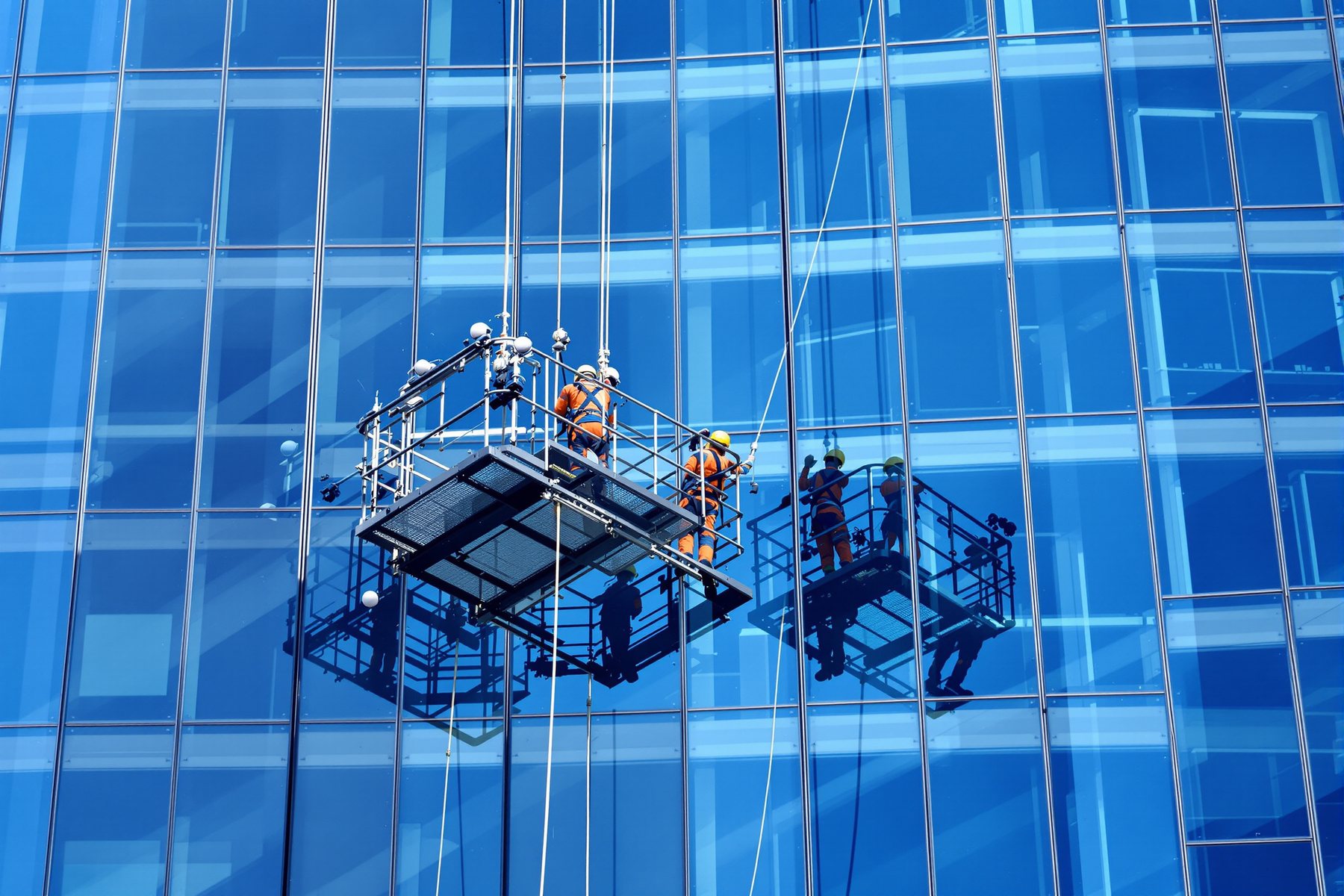
The most dangerous moment in a facade's life is not the fire or the storm - it is the worker hanging off it with a squeegee, twenty years after everyone who designed it has moved on.
Every facade has to be cleaned, inspected, resealed and eventually re-glazed - for its entire service life. Someone has to reach every square metre of it, safely, again and again. If that access is not designed in from the start, it gets improvised later: a worker leaning out of a window, a ladder against a tower, an unanchored rope. Facade access is a life-safety system as serious as fire, and in India - where labour at height is often informal and under-protected - designing safe, permanent access is not a luxury, it is a duty. This lesson is about the equipment that reaches the skin, the anchors that hold the worker, and the discipline of designing maintenance in.
Reaching the skin, safely, for forty years
BMU, mast climber, MEWP and rope access - matching method to building
There is a family of ways to reach a facade, and each suits a different height and geometry.
A Building Maintenance Unit (BMU) is the permanent, building-mounted machine: a roof-mounted crane or davit arm that lowers a cradle (a suspended platform) down the face on wire ropes - the standard solution for tall towers, designed and installed with the building. A mast climber is a powered platform that climbs fixed masts bolted to the facade - good for large, regular faces during construction and major recladding. A MEWP (Mobile Elevating Work Platform) - a cherry-picker or scissor lift - reaches lower facades from the ground, limited by its working height (typically up to ~40-50 m for the biggest booms). And rope access (industrial abseiling) uses workers on twin ropes anchored at the top - flexible, low-capital, ideal for complex geometry and spot repairs, but demanding rigorous anchor provision and trained technicians.
The choice is driven by height, geometry, frequency and load: a 200 m tower needs a BMU; a 12 m podium can use a MEWP; an intricate atrium may only be reachable by rope. The facade engineer's job is to ensure whatever method the building will need is actually possible - and that means designing it in early.
Eyebolts, anchor systems and the parapet that must take a falling worker's load
Every method except a fully self-contained BMU cradle relies on anchors built into the structure: eyebolts and anchor points for rope access and fall-arrest, davit sockets for cradles, mast fixings for climbers. These are not afterthoughts bolted to whatever is handy - each anchor must be structurally designed and load-tested to arrest a falling worker (fall-arrest anchors carry very high dynamic loads, far above static weight) and certified and re-tested periodically over the building's life.
The discipline is to design access at concept, exactly like fire and water. Where will the BMU park and travel on the roof? Can its cradle reach every re-entrant corner and soffit, or are there 'no-go' zones that will never be cleaned? Are anchor points provided at the right spacing for rope access? Can a glass unit be re-glazed - lifted out and a new one brought in - without dismantling half the facade? A facade you cannot safely reach is a facade you cannot maintain - and an unmaintained facade leaks, stains and, eventually, fails. The cost of designing access in is trivial; the cost of leaving it out is a lifetime of dangerous improvisation.
Maintenance is a 40-year programme the facade must be built to allow
Designing access is really designing for the whole maintenance programme. Glass and panels need regular cleaning (in dusty, polluted Indian cities, frequently). Sealant joints have a finite life - often 10-20 years - and must be re-sealed, which means a worker must be able to reach every joint. Gaskets perish; the occasional pane breaks and must be re-glazed; over decades, components are replaced.
So the facade engineer asks, for every part of the skin: how will this be reached, cleaned, resealed and replaced - and is the access for that designed and anchored? A unitized panel that can only be replaced from inside, or a deep recess the cradle cannot reach, or a balustrade with no anchor above it, all become maintenance traps. The best facades are designed backwards from their maintenance: every surface reachable, every replaceable part replaceable, every anchor provided and certified. This closes the loop the whole course has drawn - a facade is a system, engineered long before it is installed and for long after, because the forty years after handover are where it earns or loses its reputation.
Maintenance access shapes the building, so engage it at concept, not handover. The roof you want clear for a sky garden may be exactly where the BMU must park and travel; the dramatic re-entrant corner may be a place no cradle can reach. Design the BMU garage, the davit zones and the anchor points into the architecture from the start - a hidden, well-integrated BMU is far better than a brilliant building that cannot be cleaned. Ask of every move: how does someone safely reach this in year twenty?
You own the access strategy and the anchors as a designed system. Match method to the building (BMU for tall, MEWP for low, rope for complex), map the cradle's reach to confirm there are no un-reachable zones, and structurally design and schedule the proof-loading of every eyebolt, davit socket and mast fixing for fall-arrest dynamic loads - not static weight. Coordinate the access loads back into the structure early (a davit imposes real moments on the roof slab). And specify re-glazing access so a broken unit can be replaced without a demolition.
Access and anchors are life-safety kit: never use an anchor that is not certified, tested and in date, and never improvise access the facade was not designed for. Learn to spot the provisions - the davit sockets on the roof, the eyebolts at the parapet, the mast-fixing points - and confirm they are installed where the drawings say, because a missing or untested anchor is discovered the worst possible way. The worker on the cradle or the rope is trusting a bolt someone designed years ago; make sure it is the right bolt, properly fixed.
EN 1808 (BMU / suspended access)
Suspended access equipment
The European standard for the design and safety of suspended access equipment (BMUs and cradles) - widely referenced on Indian premium towers; sets stability, load and safety-factor rules for the cradle and its support.
EN 795 / IS 3521 (anchors & fall arrest)
Anchor devices & lifelines
EN 795 governs fall-arrest anchor devices; IS 3521 covers fall-arrest in India. Define the load and testing for eyebolts and anchor points - but they specify the anchor, not where you must provide them; that is the engineer's design call.
NBC 2016 Part 4 / BIS occupational rules
Maintenance & life safety
NBC life-safety provisions and BIS work-at-height rules frame safe maintenance in India, but prescriptive permanent-access (BMU) requirements are less developed than EN 1808 practice - so good projects adopt the international standard voluntarily.
“Maintenance and cleaning access can be sorted out after the building is finished - it is an operations problem, not a design one.”
Access is one of the most expensive things to retrofit and one of the cheapest to design in. A BMU needs roof space, structural support and travel paths reserved from the start; anchor points must be cast or fixed into the structure and load-tested; re-glazing needs to be possible without dismantling the facade. Leave it to operations and you get un-reachable zones, improvised and dangerous access, and panels that cannot be replaced. Like fire and water, maintenance access is a design-stage decision with a forty-year tail.
Worked example - sizing access & a fall-arrest anchor load
Two decisions the facade engineer must defend: which access method a building needs, and the load an anchor must be designed for. We will pick the method for a tower and size a rope-access anchor.
The building height and geometry, the access-equipment reach data, and the anchor design load and testing interval from EN 795 / IS 3521 and EN 1808.
GIVEN a maintenance-access study for a residential tower:

  HEIGHT           : 120 m (40 storeys)
  GEOMETRY         : mostly flat faces + 2 re-entrant corners
  MEWP MAX REACH   : ~45 m (biggest available boom)
  CLEANING FREQ    : quarterly (dusty city)
  ANCHOR (rope)    : single-person fall arrest
  DESIGN ANCHOR LOAD (per EN/IS) : 12 kN minimum per anchor point

  CHOOSE the access method; SIZE the anchor; CHECK the re-entrant zones.
- 1Eliminate the MEWP: max reach ~45 m against a 120 m tower - a MEWP covers barely the lowest third. For full-height quarterly cleaning you need a permanent, building-mounted solution. Rule it out above ~45 m.
- 2Select the primary method - a BMU: at 120 m and quarterly cleaning, a roof-mounted BMU with a cradle is the right primary system: permanent, fast, covers the flat faces. Reserve the roof space and structural support for it now.
- 3Cover the gaps with rope access: map the cradle's reach and find the 2 re-entrant corners the cradle cannot enter - provide rope-access anchor points above them so abseil technicians can reach the zones the BMU misses. No un-reachable square metre is allowed.
- 4Size the fall-arrest anchor: each rope-access/fall-arrest anchor must be designed for the code minimum - here 12 kN per point (dynamic fall-arrest load, vastly above a worker's ~1 kN static weight). Design the parapet/structure fixing for 12 kN AND schedule periodic proof-testing - an anchor is only safe while certified.
- 5Confirm re-glazing access: check that a broken unit on any face can be removed and replaced using the BMU cradle or a mast climber without dismantling adjacent panels - if a zone fails this, redesign the panel fixing or the access before handover.
You’ll walk away with
A facade access strategy: BMU as primary (roof space and support reserved), rope-access anchors at the 2 re-entrant corners the cradle misses, each fall-arrest anchor designed for 12 kN and scheduled for proof-testing, and confirmed re-glazing access on every face. The plan that keeps the skin maintainable - and the maintainers alive - for forty years.
Two closing reflections for the module.
- 01Look up at any tall tower and find how it is cleaned: a cradle on the face, a parked BMU arm on the roof, or no visible provision at all. The buildings with no obvious access are the ones improvising - and the most dangerous to maintain.
- 02Pick one facade detail (a recessed window, a deep fin, a re-entrant corner) and ask the maintenance question: how would a worker safely reach this to clean, reseal or re-glaze it? If you cannot answer, neither could whoever built it.
A facade must be reached - cleaned, resealed, re-glazed - safely for forty years, so access is a design-stage life-safety system, not an operations afterthought. Match the method to the building (BMU for tall, MEWP for low, rope for complex), provide and load-test certified anchors for fall-arrest loads, and design every surface to be reachable and every part replaceable. The best facades are designed backwards from their maintenance.
Access methods: BMU/cradle (permanent, building-mounted, for tall towers), mast climber (large regular faces), MEWP (low facades, ~45 m reach limit), rope access (complex geometry, spot repairs). All non-self-contained methods need structurally-designed, load-tested, certified anchors - eyebolts, davit sockets, mast fixings - sized for fall-arrest dynamic loads (e.g. ~12 kN), not static weight. Design access at concept; confirm no un-reachable zones and that units can be re-glazed.
What is a building maintenance unit (BMU)?
A BMU is the permanent, building-mounted machine that gives access to a tall facade for cleaning, inspection, resealing and re-glazing. It is typically a roof-mounted crane or davit arm that lowers a suspended cradle (a working platform) down the face on wire ropes, travelling around the roof to reach every elevation. A BMU is designed and installed with the building - it needs reserved roof space, structural support and a travel path - and is the standard access solution for high-rise towers that are too tall for ground-based equipment.
What facade access methods are there besides a BMU?
Mast climbers - powered platforms that climb masts bolted to the facade, good for large regular faces and recladding; MEWPs (mobile elevating work platforms, cherry-pickers and scissor lifts) that reach lower facades from the ground up to about 45-50 m; and rope access (industrial abseiling) where trained technicians work on twin anchored ropes, ideal for complex geometry and spot repairs. The method is chosen by the building's height, geometry, cleaning frequency and load - and whichever is needed must be designed in, with certified anchors, from the start.
Why must facade anchors be designed and tested, not just bolted on?
Because they carry a falling worker. A fall-arrest anchor experiences a large dynamic load when it arrests a fall - far higher than a person's static weight, commonly a 12 kN or greater design load - so each eyebolt, davit socket and mast fixing must be structurally designed into the building, installed correctly, and proof-tested and re-certified at intervals over the building's life. An untested or out-of-date anchor is discovered the worst possible way; designing and testing anchors is non-negotiable life safety, governed by standards such as EN 795 and IS 3521.
Peer-reviewed journals & authoritative standards
- 01Yuen, A.C.Y. et al. Evaluating the fire risk associated with cladding panels: an overview of fire incidents, policies, and future perspective in fire standards. Fire and Materials, 45(5). — Fire and Materials (Wiley), 2021.
- 02Preliminary Study on Measures to Improve Fire Safety in Existing High-Rise Residential Buildings with Combustible Facades. Buildings, 16(6):1196. — Buildings (MDPI), 2026.
- 03Ventilated facade system: A review (maintenance, durability and the service life of ventilated facades). — ScienceDirect (Elsevier), 2025.
The author
Amogh N P
Architect, interior designer, and creative polymath. Studio Matrx began in his notebooks — his vision of design made honest, useful, and open to everyone. Its Academy is written and taught in his memory, and free, forever.
More about Amogh →_That completes Module 8 - the facade as a life-safety system: fire contained, glass made safe, falls prevented, and the skin kept reachable for life. Next, Module 9 turns design into a built facade - fabrication, procurement and installation._