
Performance testing & the monsoon
A facade is only as good as its proof. The lab and the field test it for pass marks; the Indian monsoon tests it for real — and only one of them issues a certificate.
Lesson byAmogh N P· Architect & interior designer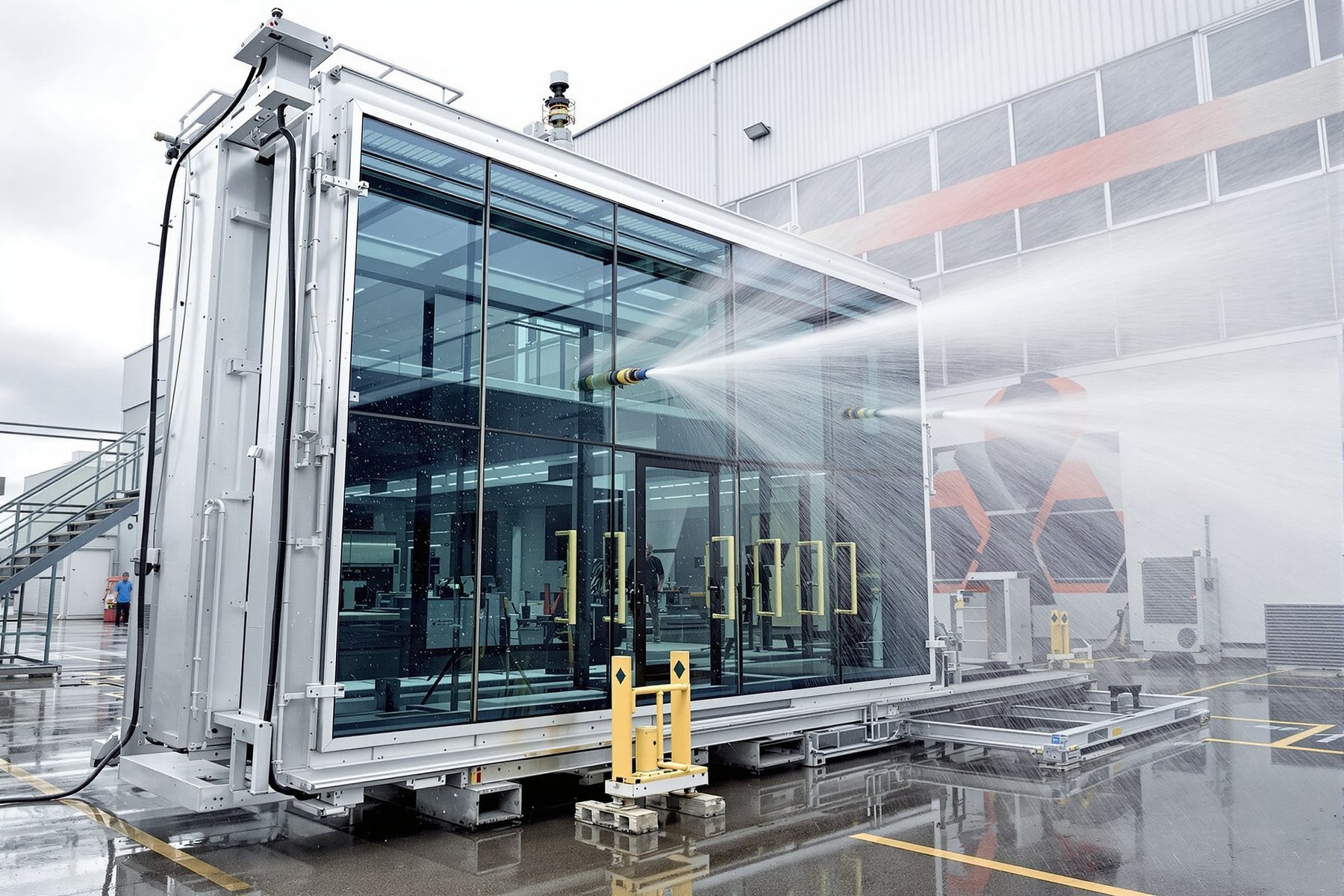
Mumbai gets three months of free, brutal facade testing every year — and it never signs the certificate. So we build a rig.
The Indian monsoon is the most demanding facade test on earth, and it runs for free for three months a year on every building. A coastal tower can take **2,000-3,000 mm of rain** in a single season, much of it driven horizontally at 20-30 m/s, with the wind building and collapsing the pressure across the skin every few seconds. The problem is that the monsoon issues no certificate and offers no controlled, repeatable proof — by the time it tells you the facade leaks, the building is full of tenants. So the industry recreates the monsoon **on a test rig**: a full-size mock-up of the real facade, hit with calibrated wind, spray and pressure, static and then dynamic, before a single production panel is made. This lesson is how that proof is built — and why a facade that passes the rig still has to survive Chennai.
Build the monsoon in a lab, then go to site and check
The lab proves the design; the field proves the installation — and they use different tools
Facade testing splits into two arenas. Laboratory testing is done on a performance mock-up (PMU) — a full-size section of the real facade built on a test chamber — and it proves the design and system before mass fabrication. Field testing is done on the installed facade and proves the workmanship — that the building was built like the mock-up that passed.
The classic lab suite is a sequence: air leakage (ASTM E283 / CWCT), then static water penetration (ASTM E331), then structural load under design wind (ASTM E330), often a dynamic water test (AAMA 501.1), and movement/seismic and impact as required — typically run in a defined order so each test does not mask the next. AAMA 501 is the umbrella for curtain-wall test methods; AAMA 501.1 is specifically the dynamic water test (it uses an aircraft-engine-style prop to generate real gusting wind). For the field, AAMA 502 (windows/doors) and AAMA 501.2 (field water-spray for fixed, non-operable curtain wall) and the CWCT field-test sequences let you spray a built facade and find the leaks the lab could not. The PMU is the script; the field test is the audit.
The lab tests the DESIGN; the field tests the INSTALLATION. A facade can pass on the rig and still leak on the building if the crew did not build the tested detail.
Static water under-tests a monsoon; dynamic water mimics the gust that actually drives the leak
The single most important distinction in water testing is static versus dynamic. A static water test (ASTM E331) sprays a calibrated water volume across the facade while a fan holds a constant pressure difference, and checks for penetration. It is repeatable and cheap — but it is honest only up to a point, because a real monsoon pressure is never constant. It gusts, and it is the fluctuation that pumps water through a pressure-equalised joint faster than the cavity can equalise.
A dynamic water test (AAMA 501.1) fixes this by generating real, fluctuating wind with a propeller in front of the spray, so the facade sees the gusting pressure it will actually meet. A pressure-equalised rainscreen that sails through a static test can leak under dynamic conditions, because the gust outruns the equalisation — which is exactly why, in a monsoon climate, specifying dynamic water testing is not optional on a serious facade. The test pressure itself (in pascals) is derived from the design wind for the site (Lesson's worked example below), usually taken as a fraction of the peak design wind pressure — high enough to be a real test, not so high it tests a storm the building will never see. Set the pressure too low and you certify a leak; too high and you reject a sound facade for failing a hurricane it was never designed for.
India's driving rain is the real exam — and it punishes exactly what the lab can miss
The Indian monsoon is a facade stress test the standards were not originally written around, and it punishes the weak points the lab is most likely to miss. The load is not just volume (2,000-3,000 mm in a season on the west coast) but direction and energy: rain driven horizontally onto vertical glass, combined with high humidity that keeps everything wet for weeks so nothing dries between storms, and a wind that builds and drops the pressure relentlessly. This is the dynamic, sustained, saturating condition that static lab tests under-represent — which is the whole argument for dynamic testing and for designing pressure-equalised, drained, generously-weeped facades in the first place.
The practical consequences are concrete. Test pressures for Indian coastal projects should be set from local IS 875-3 wind data, not borrowed from a European spec — Mumbai's monsoon driving-rain pressure is in a different league from London's. Dynamic water testing should be specified wherever wind-driven rain is severe. And the field water test on the installed facade matters more in India than almost anywhere, because the gap between a mock-up built by the best fabricator and a wall installed forty floors up in pre-monsoon haste is real — and the monsoon will find every weep that got blocked and every lap that got skipped. The lab gives you a certificate; the monsoon gives you the truth, and the field test is how you reconcile the two before the rain does.
Set the test pressure from LOCAL IS 875-3 wind, not a borrowed European spec. Mumbai's monsoon is not London's drizzle, and a facade tested for the wrong storm passes the wrong exam.
Use the mock-up as your last and best preview, and protect the testing budget — it is the cheapest insurance on the whole building. Standing in front of a full-size PMU as it is sprayed and pressurised is the truest test of your facade you will ever get before it exists, and it is the last cheap moment to fix appearance and performance together. Resist value-engineering the dynamic water test or the field test out of the programme: in a monsoon climate they are the difference between a facade that performs and a leak dispute that drags on for years.
Own the test regime end to end. Derive the water-tightness test pressure from the site's IS 875-3 design wind (not a borrowed number), specify the lab sequence (E283 air, E331 static water, E330 structural, AAMA 501.1 dynamic water, plus movement and impact as needed) and witness it personally. For monsoon-exposed projects, make dynamic water testing and field water-spray testing (AAMA 501.2 / 502, CWCT field sequences) mandatory, not optional. Then close the loop on site: the installed facade must match the mock-up that passed, and the field test is how you prove it did.
The mock-up is the 'right answer' your installed wall is measured against — learn the tested detail and reproduce it exactly. When the field water-spray test happens, treat a found leak as a cheap, controlled gift: it is far better to find it with a hose on a scaffold than with a tenant's ceiling in the first monsoon. The usual culprits are the ones you can check before testing: blocked or missing weep holes, skipped barrier laps, and seals not continuous around junctions. A facade that matches its mock-up and passes a field spray is a facade that will meet the monsoon.
ASTM E283 / E331 / E330
Air, static water, structural (lab)
The classic lab trio — air leakage (E283), static water penetration (E331), structural under design wind (E330). Honest limit: E331 is static and so under-represents the gusting monsoon; pair it with dynamic testing.
AAMA 501 / 501.1 / 501.2 / 502
Curtain-wall lab & field testing
AAMA 501 is the umbrella; 501.1 is the dynamic water test (gusting wind via a prop); 501.2 is field water-spray for fixed curtain wall; 502 is field testing of windows/doors. Voluntary methods, so the project sets its own pass pressures.
CWCT Standard & Test Methods (UK)
Sequenced facade performance testing
Defines the order and pass criteria for air, static and dynamic water, wind and impact — the script most premium Indian PMUs are tested to. The benchmark, but the test pressure must still be set from the local IS 875-3 wind.
“If a facade passes the standard static water test in the lab, it is proven watertight and will not leak in the monsoon.”
A static test holds a constant pressure, but a monsoon gusts — and it is the fluctuation that pumps water through a pressure-equalised joint faster than it can equalise. A facade can pass a static test and still leak under dynamic, gusting conditions. That is why dynamic water testing (AAMA 501.1) exists and why it should be specified in monsoon climates, and why a field water test on the installed wall is needed too: passing the lab proves the design, not the built building.
Worked example — derive the water-tightness test pressure
The water test pressure is not a guess — it is derived from the site's design wind. Let's take a coastal Indian tower through IS 875-3 to a peak pressure, then set the test pressure as a fraction of it.
A calculator and the IS 875 (Part 3) wind-pressure relation.
GIVEN a coastal Indian site (IS 875 Part 3 method, simplified):

  basic wind speed   Vb  = 44 m/s   (e.g. Mumbai zone)
  probability factor  k1 = 1.0
  terrain/height fac. k2 = 0.90
  topography factor   k3 = 1.0
  importance factor   k4 = 1.0
  design wind speed  Vz  = Vb * k1*k2*k3*k4
  design wind pressure pz = 0.6 * Vz^2   (N/m2, IS 875-3)
  test pressure       = a fraction (~15-25%) of peak pz

  Question: peak design pressure, then a water-test pressure.
- 1Compute the design wind speed: Vz = Vb * k1 * k2 * k3 * k4 = 44 * 1.0 * 0.90 * 1.0 * 1.0 = 39.6 m/s. This is the site-and-height-adjusted wind the facade must resist.
- 2Compute the design wind pressure: pz = 0.6 * Vz^2 = 0.6 * (39.6)^2 = 0.6 * 1568.16 = 940.9 N/m2 ~ 0.94 kPa. This is the peak positive design pressure on the facade from IS 875-3.
- 3Account for local pressure concentration: near corners and edges the external pressure coefficient amplifies this; with a local factor of, say, 1.4 the peak local pressure approaches 1.4 * 0.94 = ~1.32 kPa. The test should reflect the worst zone the panel may sit in.
- 4Set the water-test pressure as a fraction of design pressure: taking a common ~20% of the peak design wind pressure, test pressure ~ 0.20 * 940.9 = ~188 Pa. (Many specs instead anchor to a fixed value such as 300-600 Pa for severe exposure — pick the higher of the code fraction and the spec floor.)
- 5Choose the controlling value: for a monsoon-exposed coastal tower, take the more demanding of the two — here a ~300 Pa static water-test pressure is defensible, and then specify the SAME pressure under DYNAMIC (gusting) conditions per AAMA 501.1, because the monsoon is dynamic, not static.
- 6State the rule and sanity-check: test pressure is a defined fraction of the local design wind pressure, never a borrowed number — high enough to be a real monsoon test, not so high it tests a storm the building never sees. Units check: 0.6 (kg/m3 lumped) * (m/s)^2 = kg/(m.s2) = N/m2 = Pa. Good.
You’ll walk away with
A defensible test pressure: from Vb = 44 m/s the IS 875-3 peak design pressure is ~0.94 kPa, giving a water-tightness test pressure of order ~300 Pa applied both static (E331) and dynamic (AAMA 501.1) — derived from local wind, not borrowed. The skill of setting a test from first principles.
Two reflections to close the module.
- 01After the next monsoon, walk past a few towers and look for water stains below windows, at parapets and at corners. Each stain is a facade that failed a test the lab missed — try to name which mechanism (Lesson 5.1) and which missing defence (Lesson 5.2 or 5.3) caused it.
- 02Find the basic wind speed for your city's IS 875-3 zone and rough out the design wind pressure with pz = 0.6 * Vz^2. Notice how different a coastal monsoon pressure is from an inland one — and why a borrowed European test pressure would be the wrong exam.
A facade is only as good as its proof. The lab tests the design on a full-size mock-up (air, static and dynamic water, structural), the field tests the installation, and the monsoon tests the truth. Static water under-represents the gusting monsoon, so dynamic testing is mandatory where wind-driven rain is severe — and every test pressure must be derived from the local IS 875-3 wind, not borrowed. Pass the rig, then go to site and prove the built wall matches it.
Lab testing on a PMU proves the design (E283 air, E331 static water, E330 structural, AAMA 501.1 dynamic water); field testing (AAMA 501.2/502, CWCT) proves the installation. Static water under-tests a gusting monsoon, so dynamic testing is essential in India. Set the water-test pressure as a fraction (~15-25%) of the local IS 875-3 design wind pressure, applied static AND dynamic. The monsoon punishes blocked weeps and skipped laps the lab can miss.
What is the difference between static and dynamic water testing of a facade?
A static water test (ASTM E331) sprays water while a fan holds a constant pressure difference across the facade and checks for penetration — repeatable and cheap, but a real monsoon pressure is never constant. A dynamic water test (AAMA 501.1) uses a propeller to generate real, fluctuating wind in front of the spray, so the facade sees the gusting pressure it will actually meet. A pressure-equalised facade can pass a static test and leak under dynamic conditions, because the gust outruns the cavity's equalisation — which is why dynamic testing is essential in monsoon climates.
How is a facade water-tightness test pressure determined?
It is derived from the site's design wind, not borrowed. Using IS 875 (Part 3) you compute the design wind speed Vz from the basic wind speed and the k-factors, then the design wind pressure pz = 0.6 * Vz^2, then take the test pressure as a defined fraction (commonly around 15-25%) of the peak design pressure — or a fixed spec floor (e.g. 300-600 Pa for severe exposure), whichever is more demanding. The same pressure is applied static and, in monsoon climates, dynamic. Borrowing a European number tests the wrong storm.
What standards are used to test facade performance?
The classic lab trio is ASTM E283 (air leakage), E331 (static water penetration) and E330 (structural under design wind), often with AAMA 501.1 for dynamic water; AAMA 501 is the umbrella curtain-wall test umbrella. Field testing of the installed facade uses AAMA 501.2 (water-spray for fixed curtain wall) and AAMA 502 (windows/doors), plus CWCT field sequences. CWCT also defines a sequenced lab regime widely written into Indian premium-project specs. The test pressures are set from local IS 875-3 wind data.
Peer-reviewed journals & authoritative standards
- 01Ventilated facade system: A review (water control, drainage and the rainscreen principle). — ScienceDirect (Elsevier), 2025.
- 02Squadroni, F., De Michele, G., Mazzucchelli, E.S. et al. Analysis of condensation and ventilation phenomena for double skin façade units. — Journal of Building Physics (SAGE), 2022.
- 03IEA EBC Annex 43/44. Double Skin Facades: A Literature Review. — International Energy Agency (IEA-EBC), 2008.
The author
Amogh N P
Architect, interior designer, and creative polymath. Studio Matrx began in his notebooks — his vision of design made honest, useful, and open to everyone. Its Academy is written and taught in his memory, and free, forever.
More about Amogh →That closes the weatherproofing module: how facades leak, how pressure equalisation and drainage stop them, how air and water tightness are specified, and how it is all proven against the monsoon. Next, Module 6 turns to the material that carries most of the modern facade's load and lets in its light — glass — as an engineered structural element.