
Air & water tightness
Two invisible lines decide whether a facade performs: a continuous air barrier and a watertight one. Break either at a single junction and the whole wall fails there.
Lesson byAmogh N P· Architect & interior designer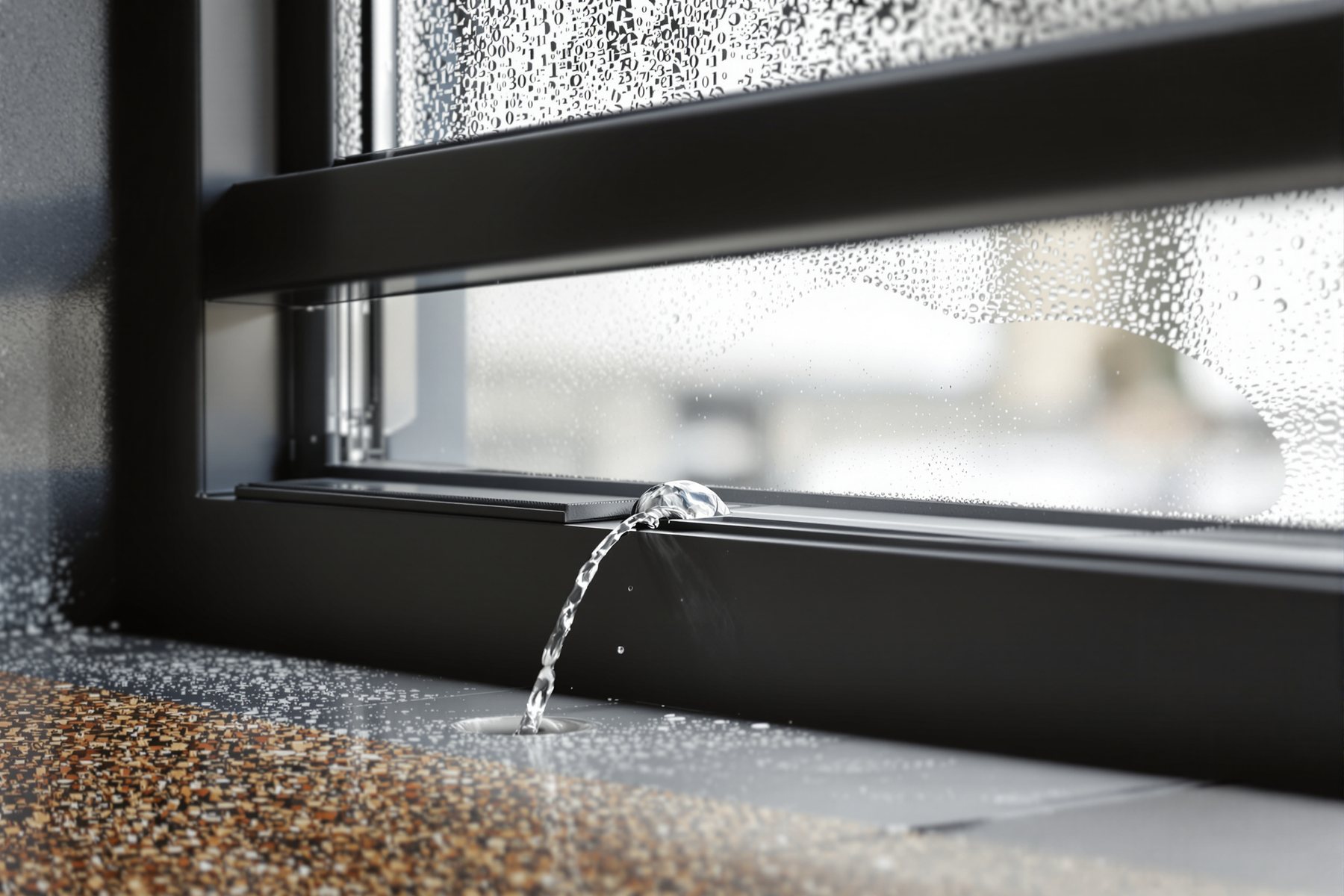
A facade can pass its test in the middle of the wall and fail at every window. Tightness is decided at the junctions.
Air tightness and water tightness are the two performance lines that quietly decide whether a facade works — and both are won or lost at the junctions, not the panels. An air barrier with one unsealed lap leaks _there_; a water barrier with one missed drainage path floods _there_. In an Indian commercial tower, uncontrolled air leakage can carry 20-30% of the cooling load straight through the gaps in the skin, invisibly, every hour for forty years — heat and humidity hitching a ride on air you never meant to let in. Meanwhile a single back-pitched sill or a blocked weep hole turns the first monsoon into a leak claim. **The middle of the wall almost never fails. The junctions almost always do.** This lesson is about making the two lines continuous, and proving they are.
Two continuous lines: air-tight, and water-tight
The air barrier must be one unbroken line around the whole building — and it usually is not
The air control layer stops uncontrolled air leakage, and air leakage is the biggest, most invisible energy loss in a facade because the moving air carries both heat and moisture with it. Two facades can have identical U-values and glass, and the leaky one costs dramatically more to cool — because air infiltration is a load the U-value never sees.
The golden rule is continuity. An air barrier is only as good as its weakest gap; one unsealed junction leaks there regardless of how perfect the rest is. So the test of a design is the 'pen test': can you trace the air barrier as a single unbroken line around the entire building — over every window head, around every corner, across every slab edge, behind every bracket — without lifting your pen? On a curtain wall the air barrier is typically the line of gaskets and the inner seals of the system, which must be continuously connected unit-to-unit and sealed back to the slab-edge and the inner finish. Most real air-leakage failures are a barrier that was perfect across the panel and forgotten at the transition — which is exactly where you must concentrate detailing and inspection.
The pen test: trace the air barrier around the whole building without lifting your pen. Wherever you HAVE to lift it is a leak — and it is always a junction.
Seal in two stages, then give the water that gets through a designed way out
Water-tightness is not 'seal the outside perfectly' — that is the face-sealing trap from Lesson 5.1. The robust approach is a two-stage seal: an outer weather seal (gasket or bead) that breaks most of the rain, an internal air seal that is the real air-and-water line, and a drained, pressure-equalised cavity between them that catches and removes whatever passes the outer seal. The outer seal is allowed to leak; the cavity drains it; the inner seal stays dry.
This only works if every cavity has a drainage path that actually reaches the outside. That means weep holes — deliberate openings at the bottom of each drained chamber and at every transom and sill, sized and positioned so collected water exits by gravity, with the cavity stepped or sloped toward them. Weeps are the most-skipped, most-blocked detail on site: buttered shut with sealant, clogged with offcuts, or simply omitted. A facade with a perfect outer seal and a blocked weep is worse than one with neither, because the water that gets in cannot get out — it pools, finds the inner seal, and leaks inboard. Designed drainage, not just sealing, is what makes a facade watertight.
Put a number on tightness, and test it — air leakage you can specify, water you can witness
Tightness is only real if it is a number you can verify. Air-tightness is specified as a maximum air-leakage rate at a reference pressure — for example, a curtain wall might be held to no more than 1.5 m3/hr per m2 at 75 Pa (a common premium-project target; many specs sit in the 0.3-2.0 m3/hr.m2 band). Lower is tighter. This is tested in the lab to ASTM E283 (or the equivalent in CWCT and EN regimes), and on a whole building by fan-pressurisation. Water-tightness is specified as 'no water penetration' up to a test pressure in pascals (Lesson 5.4 derives that pressure), tested static (ASTM E331) and, on serious projects, dynamic (AAMA 501.1, with a wind-generating prop to mimic gusting).
The India layer matters: ECBC and the Eco-Niwas Samhita set envelope performance targets but historically have leaned on U-value, SHGC and RETV rather than a hard air-leakage limit, so on most Indian projects the air-leakage number is inherited from the facade spec (CWCT/ASTM), not the energy code. The honest engineer writes the limit into the performance specification, designs the gaskets and seals to beat it with margin, and then proves it on the mock-up — because air and water tightness are the two performance lines clients dispute most, and a number tested on a rig is the only defence that holds.
Specify the leakage limit, design to beat it with margin, then PROVE it on the mock-up. An untested tightness claim is a hope, not a specification.
Air and water tightness need room and continuity, and your elegant junctions are where they get squeezed out. A flush, razor-thin transition that looks beautiful on the elevation may leave nowhere for the air seal to lap to the slab, or no depth for a drained, weeped cavity. When you draw a window-to-wall junction, a parapet or a base, leave room for the two seals and the drainage path behind them. The cleanest detail in the world fails if the air barrier has to stop dead at it — protect the continuity, and the appearance survives the first monsoon.
Own the leakage limit and the drainage. Write a testable air-leakage figure (e.g. <= 1.5 m3/hr.m2 at 75 Pa) into the spec, then design the gasket and inner-seal line to be genuinely continuous unit-to-unit and back to the structure. Detail a two-stage seal with a drained, pressure-equalised cavity and weep holes at every chamber base, transom and sill, sloped so they actually drain. Then prove it: ASTM E283 for air, E331 static and AAMA 501.1 dynamic for water on the PMU. The junctions — slab edge, window perimeter, parapet — are where you concentrate both the detail and the inspection.
Your job is continuity and clear drainage. The air seal and barrier membrane must be lapped and sealed at every junction — the laps people skip because 'it's hidden anyway' are exactly the ones that leak. Keep weep holes open: never butter them shut with sealant, never let mortar or offcuts block them, and check the cavity actually falls toward them. After cladding goes on, a missed lap or a blocked weep is a demolition to fix, so these are the things worth confirming before anything gets covered. The mock-up is the benchmark — the installed wall must match the one that passed the test.
ASTM E283 / E331 / E330
Air leakage, water penetration, structural
The classic lab trio: air leakage at a set pressure (E283), static water penetration (E331), structural under wind (E330). Honest limit: E331 is static, so it does not capture gusting — pair it with a dynamic test for monsoon realism.
CWCT Standard (UK)
Facade air & water performance
The de-facto international benchmark setting air-leakage limits and water-tightness test pressures; widely written into Indian premium-project specs. It sets the bar; the engineer still picks the pressure for the local wind.
ECBC 2017 / Eco-Niwas Samhita 2018 (India)
Envelope performance (U-value, SHGC, RETV)
India's commercial and residential envelope codes set thermal/solar targets but historically lean less on a hard air-leakage limit — so on most projects the air-tightness number is inherited from the facade spec, not the energy code.
“If the outer joints are fully sealed with good silicone, the facade is watertight — weep holes just let water in, so seal them too.”
Weep holes let water OUT, not in. A drained facade deliberately collects the small amount of water that passes the outer seal in a cavity and sheds it through weeps; sealing the weeps traps that water against the inner seal and makes leaks worse. And a fully sealed outer joint is a face-seal that fails when it cracks. Watertightness comes from a two-stage seal with a drained cavity and open weeps, not from one perfect outer bead.
Worked example — air leakage through a curtain wall
Air leakage sounds abstract until you turn the spec limit into actual cubic metres per hour for a real wall. Let's size the allowable leak for a tower facade and see why the limit matters.
A calculator and the spec leakage rate.
GIVEN a curtain-wall elevation and an air-leakage spec:

  facade width        W  = 30 m
  facade height       H  = 40 m  (about 12 storeys)
  spec air leakage    q  = 1.5 m3/hr per m2 at 75 Pa
  (an alternative tighter target q2 = 0.3 m3/hr.m2 for comparison)

  Question: total allowable air leakage through this
  facade at 75 Pa, and what a 5x leakier wall implies.
- 1Compute the facade area: A = W * H = 30 * 40 = 1200 m2. This is the gross wall area the leakage rate applies to.
- 2Apply the spec limit: total allowable leakage Q = q * A = 1.5 * 1200 = 1800 m3/hr at 75 Pa. That is the most air the whole facade is permitted to leak at the reference pressure — already a substantial volume, and this is the pass condition.
- 3Put it in human terms: 1800 m3/hr is 0.5 m3/s of air. Each cubic metre of hot, humid Mumbai outdoor air that leaks in must be cooled and dehumidified — so this leakage is a continuous, invisible cooling load that no U-value calculation captures.
- 4Compare a tighter target: at q2 = 0.3 m3/hr.m2, Q2 = 0.3 * 1200 = 360 m3/hr — five times less leakage for the same wall. The difference between a 1.5 and a 0.3 spec is a 5x swing in infiltration load, which is why premium projects in hot-humid climates push the air-leakage limit down.
- 5Now imagine a site failure: if junction defects make the built wall leak at, say, 5x the spec (7.5 m3/hr.m2), Q = 9000 m3/hr = 2.5 m3/s — the facade is haemorrhaging conditioned-space load through unsealed laps you cannot see. This is why the limit is tested (ASTM E283), not assumed.
- 6State the design takeaway: specify the air-leakage limit explicitly, design the gasket/inner-seal line continuous to beat it with margin, and verify by test — because the gap between a 0.3 and a 7.5 m3/hr.m2 wall is the whole difference between an efficient building and an energy sieve.
You’ll walk away with
A number you can defend: a 1200 m2 facade at a 1.5 m3/hr.m2 limit may leak up to 1800 m3/hr (0.5 m3/s) at 75 Pa — and a 5x-leakier built wall is 2.5 m3/s of uncontrolled infiltration. The quantitative case for specifying and testing an air-leakage limit.
Two quick checks of the two lines.
- 01Stand at a window or a curtain-wall junction in a building you know. On a hot day, feel for a draught or warmth at the perimeter joint — that is air leakage you can detect with your hand, and it is always at a junction.
- 02Look at the bottom of a window or a transom for weep holes (small slots or holes in the outer frame). Are they present and open? A missing or blocked weep is a leak waiting for the monsoon.
Air tightness and water tightness are two continuous lines, both decided at the junctions, not the panels. Make the air barrier one unbroken line around the whole building; seal water in two stages with a drained cavity and open weeps so water that gets in can get out. Then put a number on each — an air-leakage limit and a water test pressure — and prove it on the mock-up, because the middle of the wall rarely fails and the junctions almost always do.
Air leakage carries heat and moisture and is the biggest invisible energy loss; the air barrier must be one continuous line, and failures are at junctions. Water-tightness uses a two-stage seal with a drained, pressure-equalised cavity and OPEN weep holes — weeps let water out, blocking them makes leaks worse. Specify an air-leakage limit (e.g. <=1.5 m3/hr.m2 at 75 Pa), test to ASTM E283/E331, and prove it on the mock-up.
What is the difference between air tightness and water tightness in a facade?
Air tightness is the resistance to uncontrolled air leakage through the skin, specified as a maximum leakage rate at a reference pressure (e.g. 1.5 m3/hr per m2 at 75 Pa) and tested to ASTM E283; leaking air carries heat and moisture and is a major invisible energy loss. Water tightness is the resistance to liquid rain penetration, specified as 'no penetration' up to a test pressure and tested static (E331) and dynamic (AAMA 501.1). Both depend on continuity at junctions, and the two seals are usually combined in a drained, two-stage joint.
What are weep holes and why must they stay open?
Weep holes are deliberate openings at the bottom of a drained facade cavity, at transoms and sills, that let water which has passed the outer seal drain back to the outside by gravity. They let water OUT, not in. If they are blocked — buttered with sealant, clogged with debris, or omitted — the collected water has no escape, pools in the cavity, reaches the inner seal and leaks inboard. A facade with a perfect outer seal and a blocked weep can be worse than one with neither, because the trapped water cannot get out.
What is a typical air-leakage limit for a curtain wall?
A common premium-project target is no more than about 1.5 m3/hr per m2 of facade at a reference pressure of 75 Pa, with tighter specs reaching 0.3 m3/hr.m2 in hot-humid climates where infiltration load matters. Lower numbers mean a tighter wall. The limit is verified in the lab to ASTM E283 (or CWCT/EN equivalents) and on the building by fan-pressurisation. In India this number is usually inherited from the facade performance spec rather than the energy code, so the engineer must write it in explicitly.
Peer-reviewed journals & authoritative standards
- 01Ventilated facade system: A review (water control, drainage and the rainscreen principle). — ScienceDirect (Elsevier), 2025.
- 02Squadroni, F., De Michele, G., Mazzucchelli, E.S. et al. Analysis of condensation and ventilation phenomena for double skin façade units. — Journal of Building Physics (SAGE), 2022.
- 03Eco-Niwas Samhita 2018 (ECBC for Residential Buildings), Part I: Building Envelope. — Bureau of Energy Efficiency, Govt. of India, 2018.
The author
Amogh N P
Architect, interior designer, and creative polymath. Studio Matrx began in his notebooks — his vision of design made honest, useful, and open to everyone. Its Academy is written and taught in his memory, and free, forever.
More about Amogh →We have specified air and water tightness as numbers and designed to beat them. The last step is proof: how facades are tested in the lab and the field, static versus dynamic, the test pressures used — and the brutal reality check of the Indian monsoon, which tests every facade for free.