
Site installation, tolerances & QA/QC
The concrete frame is built to plus-or-minus 25 mm and the aluminium skin to plus-or-minus 2 mm - and the entire art of facade installation is reconciling that ten-to-one gap with a bracket that can move.
Lesson byAmogh N P· Architect & interior designer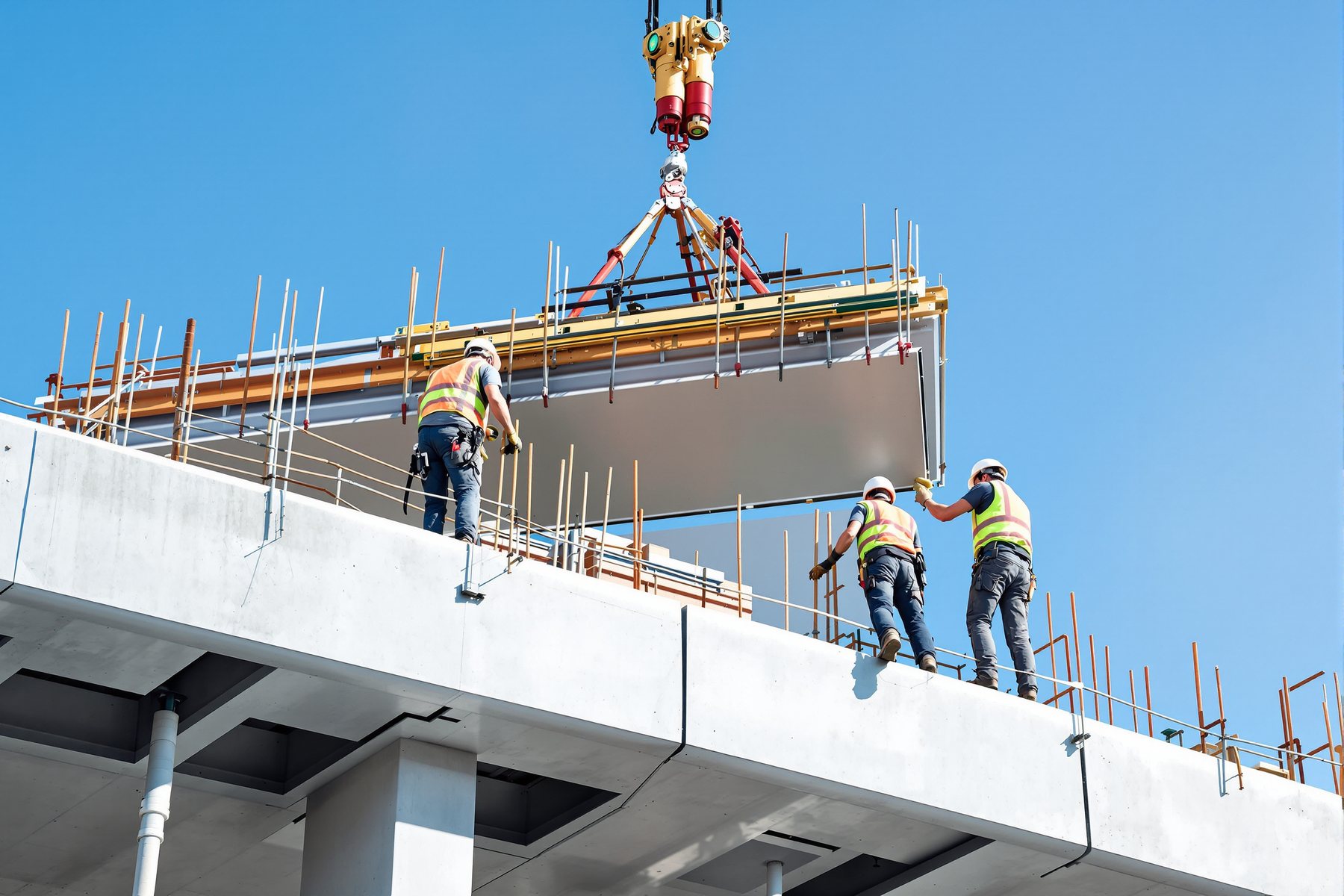
Two trades meet at the bracket: one built a concrete frame you could lose a thumb in the gaps of, the other made an aluminium skin true to the thickness of a credit card. The bracket is where they shake hands.
Walk onto any tall building under construction and you will see the great tolerance collision in the flesh. The reinforced-concrete frame, poured floor by floor in the heat and the rush, is accurate to maybe **+/-25 mm** at the slab edge - sometimes worse. The unitized facade panels, fabricated and sealed in a clean factory, are accurate to **+/-2 mm**. These two worlds have to meet, sealed and plumb, for forty years - and they meet at a small, three-way **adjustable bracket** that absorbs the difference. Every facade installation is, underneath the cranes and the harnesses, a careful exercise in reconciling a rough frame to a precise skin. Get the survey, the setting-out and the bracket adjustment right and the skin goes up plumb and watertight; get them wrong and you are shimming and packing your way into a leak.
Survey, set out, adjust - reconciling a rough frame to a precise skin
Measure the frame as built, then strike the true facade line that the panels will follow
Installation begins not with a panel but with a survey. The as-designed frame is a fiction - the real one has drifted within (and sometimes beyond) its tolerance. A surveyor records the as-built slab-edge positions, levels and plumb up the building, comparing them to the design grid. From that survey the team strikes the setting-out lines: the true vertical and horizontal datum the facade will actually be installed to, chosen to sit cleanly outside the worst frame deviation so every panel can reach its fixing.
This is the moment the rough frame is reconciled on paper before any steel is lifted. If the survey reveals a slab edge that has crept 30 mm proud - beyond the 25 mm the brackets were designed to absorb - it is found here, cheaply, by a surveyor, not later by an installer holding a panel that won't reach. The setting-out establishes the control lines every bracket and panel is then positioned from. Skip or rush it and every downstream tolerance problem compounds.
The frame as-built is never the frame as-drawn. Survey it, then strike a true facade line outside the worst deviation - that line, not the design grid, is what you install to.
A three-way adjustable bracket reconciles +/-25 mm of frame to +/-2 mm of facade
The hero of facade installation is the humble adjustable bracket - the connection between the slab (or embed/anchor channel) and the facade panel. A good bracket adjusts in three axes: in/out (to set the facade plane plumb over a frame that leans), up/down (to set level over a slab that sags), and side-to-side (to set the joint widths even over a frame that wandered). Slotted holes, serrated washers and shims provide the range and then lock it.
The reason this matters is the tolerance gap. The frame is a coarse-tolerance trade (+/-25 mm typical, per the structural concrete standard); the facade is a fine-tolerance trade (+/-2 mm panel-to-panel, because a 2 mm error shows as a kinked sightline and a strained gasket). The bracket's adjustment range must exceed the frame's tolerance, or panels at the worst-built bays simply cannot be set true. If the design wind and dead loads are the bracket's strength job, the tolerance reconciliation is its geometry job - and a bracket with too little adjustment range is a design error that surfaces as a site crisis. This is also why a bracket is a thermal bridge to manage (Module 7): it is the one place the skin is bolted hard to the structure.
Unitized panels hang fast; stick is built up in place - and both are checked against the tested benchmark
There are two install methods. Unitized facades arrive as complete factory-made-and-sealed panels that are craned and hooked onto pre-set brackets floor by floor - fast, weather-tight early, and high quality because the sealing happened in the factory; this dominates tall and premium work. Stick facades are built up in place from individual mullions, transoms and infills assembled and sealed on the scaffold - more flexible and lower tooling cost, but slower, weather-exposed during build, and quality depends on site sealing in the wind and rain. The trend, as in Lesson 0.4, is relentlessly toward off-site unitized work.
Whichever method, the discipline is QA/QC against the mock-up. The passed PMU is the benchmark: the installed facade must be built the same way the tested mock-up was, or it does not inherit the mock-up's proven performance. Site checks include bracket torque and adjustment lock-off, panel plumb and joint widths against the setting-out, gasket and seal continuity, and - critically - field water-spray testing (AAMA 501.2) on the installed facade to re-prove on the real building what the PMU proved on the rig. A QA/QC regime that records every check against the tested benchmark is what turns a proven design into a proven building.
Your crisp sightlines and even joints live or die at the bracket. The reason a real facade has a joint width - 15 or 20 mm, not a hairline - is that the joint is the tolerance buffer that lets a precise skin sit on a rough frame and still look straight; a flush, jointless elevation has nowhere to hide the inevitable frame deviation. Trust the setting-out survey when it says a panel line must shift a few millimetres to clear a crept slab edge: the alternative is a strained, leak-prone forced fit. And remember the installed facade only looks like your VMU if it is built the way the mock-up was built - so value the QA/QC that enforces that.
Size the bracket adjustment range against the real frame tolerance, not the design grid - and add margin, because concrete drifts. Run the tolerance stack-up (frame tolerance + fabrication tolerance + installation tolerance) and confirm the bracket and joint can absorb the worst credible case; a stack-up that exceeds the bracket range is a redesign, not a site fix. Own the QA/QC regime: define the hold points (survey sign-off, first-panel inspection, bracket lock-off, field water test) and insist the installed detail matches the tested mock-up exactly. Field water-test early and often - finding a leak on floor 3 is a detail fix; finding the same systemic leak on floor 30 is a recladding.
Two numbers run your job: the frame is +/-25 mm and the facade is +/-2 mm, and the bracket is how you get from one to the other. Always install to the **setting-out lines** from the survey, never to the design grid or the slab edge you can see - the visible edge is the one that drifted. Use the bracket's full three-way adjustment (in/out, up/down, side/side) before you reach for a shim stack; a panel forced into place with packers is a leak waiting for the monsoon. And check your work against the mock-up: same gaskets, same sealant, same sequence. The installed facade only performs like the tested one if you build it the same way.
AAMA 501.2 (field) + AAMA 501.4/501.7
Installed-facade testing & movement
AAMA 501.2 is the field water-spray test that re-proves the installed facade; 501.4/501.7 cover inter-storey/seismic movement acceptance. Field tests check a sample of the real building - they reduce risk but cannot prove every joint, so they pair with continuous QA/QC.
IS 456 / concrete construction tolerances
Structural frame tolerance (the coarse side)
Indian concrete practice (IS 456 and construction-tolerance guidance) governs the +/-25 mm-class accuracy of the slab edges the facade must reconcile to - the coarse half of the tolerance gap. The standards permit deviation the facade bracket must then absorb.
CWCT Standard + IS 875 (Part 3): 2015
Performance acceptance + design movement
CWCT frames the installed-performance acceptance criteria and the movement the facade must accommodate; IS 875 (Part 3) sets the design wind that fixed the bracket's strength. The tested mock-up - not the standard alone - is the day-to-day acceptance benchmark on site.
“Concrete is built precisely enough that the facade can just be bolted straight to the slab edge where it lands.”
A reinforced-concrete frame is a coarse-tolerance trade - typically +/-25 mm at the slab edge, sometimes more - while a unitized facade is a fine-tolerance trade at about +/-2 mm panel-to-panel. Bolting a precise skin straight to a rough frame produces kinked sightlines, uneven joints and gaskets strained out of their working range, which leak. The whole point of the adjustable bracket and the setting-out survey is to reconcile that ten-to-one tolerance gap: the facade is installed to a surveyed true line, and the bracket's three-way adjustment absorbs wherever the frame deviated. The reconciliation is the job, not an afterthought.
Worked example - a tolerance stack-up to size the bracket adjustment
The decisive facade-installation calculation is the tolerance stack-up: adding the worst-case deviations to confirm the bracket's adjustment range can absorb them. Let's run one for a unitized panel fixing in the in/out (plane) direction.
The frame, fabrication and installation tolerances, a calculator, and the bracket's stated adjustment range.
GIVEN - in/out (facade-plane) direction, one bracket:

  Frame tolerance (slab edge, as-built)   = +/- 25 mm
  Setting-out / survey tolerance            = +/-  3 mm
  Panel fabrication tolerance               = +/-  2 mm
  Installation/positioning tolerance        = +/-  3 mm
  Bracket stated adjustment range (in/out)  =  +/- 30 mm (60 mm total slot travel)
  QUESTION: does the bracket absorb the worst-case stack-up, and with what margin?
- 1List the contributors. In the in/out direction the deviations that the bracket must absorb are: frame +/-25, survey/setting-out +/-3, fabrication +/-2, installation +/-3 mm. (Some of these the setting-out partly removes, but for a conservative worst case we stack them.)
- 2Worst-case (arithmetic) stack. Add the magnitudes directly - the most conservative method, assuming every tolerance maxes out the same way: 25 + 3 + 2 + 3 = +/- 33 mm, i.e. a total possible spread of 66 mm.
- 3Compare to the bracket range. The bracket adjusts +/-30 mm (66 mm... actually 60 mm total travel). Worst-case demand is +/-33 mm > +/-30 mm available. The bracket FAILS the arithmetic worst case by 3 mm - at the very worst-built bay, the panel cannot be set true. This is exactly the kind of finding the survey exists to catch before panels arrive.
- 4Apply the statistical (RSS) method. Tolerances rarely all max out together, so the root-sum-square method is often used for the independent contributors: sqrt(25^2 + 3^2 + 2^2 + 3^2) = sqrt(625 + 9 + 4 + 9) = sqrt(647) = +/- 25.4 mm. By RSS the demand (25.4) is within the bracket's +/-30 mm, with ~4.6 mm margin.
- 5Decide and document. The honest engineer reports BOTH: by RSS the bracket works with modest margin; by arithmetic worst case it is 3 mm short at the very worst bay. The recommendation: either specify a bracket with +/-35 mm range (cheap insurance), or tighten the frame tolerance at the slab edge to +/-22 mm by surveying and grinding/packing proud edges before install. Never rely on RSS alone where a single bad bay would be unworkable.
- 6Tie it to the site control. Whichever route, the survey must flag any slab edge beyond +/-22 mm so it is corrected before that panel is lifted - turning the calculation into a hold point in the QA/QC plan.
You’ll walk away with
A two-method tolerance stack-up - arithmetic worst case +/-33 mm (bracket 3 mm short) and RSS +/-25.4 mm (bracket OK with margin) - and a defensible recommendation to upsize the bracket or tighten and survey the frame. The exact calculation that sizes the bracket adjustment and turns a tolerance gap into a controlled site hold point.
Two ways to feel the tolerance gap.
- 01On any concrete frame you can see under construction, eyeball the slab edges floor to floor - notice they are not a dead-straight plumb line. That visible drift is the +/-25 mm the facade brackets have to swallow.
- 02Re-run the stack-up with a tighter frame tolerance of +/-15 mm: what is the arithmetic worst case now, and does the +/-30 mm bracket pass comfortably? This shows why investing in a more accurate frame can save on facade brackets and rework.
Facade installation is the reconciliation of a coarse frame (+/-25 mm) with a precise skin (+/-2 mm) through a surveyed setting-out and a three-way adjustable bracket whose range must exceed the frame's tolerance. Panels - unitized and fast, or stick and built-up - go up to the surveyed true line, not the design grid, and are held to the tested mock-up by a QA/QC regime that includes field water testing. A facade inherits the mock-up's proven performance only if it is built the way the mock-up was.
Survey the as-built frame, strike setting-out lines outside the worst deviation, install to those lines. The bracket reconciles +/-25 mm frame to +/-2 mm facade via three-way adjustment - its range must exceed the frame tolerance (run the stack-up, arithmetic and RSS). Unitized = fast, factory-sealed, high quality; stick = flexible, site-sealed, slower. QA/QC holds the installed skin to the tested mock-up - same gaskets, sealant and sequence - with field water-spray testing (AAMA 501.2) re-proving the real building. Build it the way the mock-up was built.
Why is there a tolerance gap between the structure and the facade?
Because they are built by different trades to very different accuracies. A reinforced-concrete frame is a coarse-tolerance trade, poured on site and accurate to about +/-25 mm at the slab edge, while a unitized facade is a fine-tolerance trade, fabricated in a factory to about +/-2 mm panel-to-panel. The two must meet sealed and plumb, so the gap is reconciled by a three-way adjustable bracket and by installing the facade to a surveyed true line rather than to the as-built slab edge - the bracket's adjustment range must exceed the frame's tolerance, or the worst-built bays cannot be set true.
What is the difference between unitized and stick facade installation?
Unitized facades arrive as complete, factory-made and factory-sealed panels that are craned and hooked onto pre-set brackets floor by floor - fast, weather-tight early and high quality because the critical sealing happened in controlled factory conditions; this dominates tall and premium work. Stick facades are built up in place on the scaffold from individual mullions, transoms and infill panels, sealed on site - more flexible and lower in tooling cost, but slower, exposed to weather during build, and dependent on the quality of site sealing. The industry trend is strongly toward off-site unitized construction.
How is facade installation quality controlled (QA/QC)?
Against the tested mock-up. The passed performance mock-up is the benchmark, and the installed facade must be built the same way - same gaskets, sealant and sequence - to inherit its proven performance. Site QA/QC includes survey sign-off and setting-out checks, bracket torque and adjustment lock-off, panel plumb and joint widths against the setting-out lines, gasket and seal continuity, and field water-spray testing (AAMA 501.2) on the installed facade to re-prove on the real building what the mock-up proved on the rig. Recording every check against the tested benchmark at defined hold points is what turns a proven design into a proven building.
Peer-reviewed journals & authoritative standards
- 01Material Selection and Characterization for a Novel Frame-Integrated Curtain Wall. (PMC8069006). — Materials / NCBI-PMC, 2021.
- 02Bedon, C. et al. Performance of structural glass facades under extreme loads - design methods, existing research, current issues and trends. Construction and Building Materials, 163. — Construction and Building Materials (Elsevier), 2018.
- 03Su, Z. et al. Multi-Disciplinary Characteristics of Double-Skin Facades for Computational Modeling Perspective and Practical Design Considerations. Buildings, 12(10):1576. — Buildings (MDPI), 2022.
The author
Amogh N P
Architect, interior designer, and creative polymath. Studio Matrx began in his notebooks — his vision of design made honest, useful, and open to everyone. Its Academy is written and taught in his memory, and free, forever.
More about Amogh →That completes the facade's journey from design to site - drawn, proven, procured and installed to its tested benchmark. With the skin engineered, fabricated and hung, the course turns to the digital tools that increasingly drive all of it: facade BIM, computation and simulation.