
Facade BIM & the digital workflow
The facade arrives on site as data long before it arrives as aluminium. BIM is how that data is structured, coordinated and trusted — or how it quietly becomes a thousand clashing drawings.
Lesson byAmogh N P· Architect & interior designer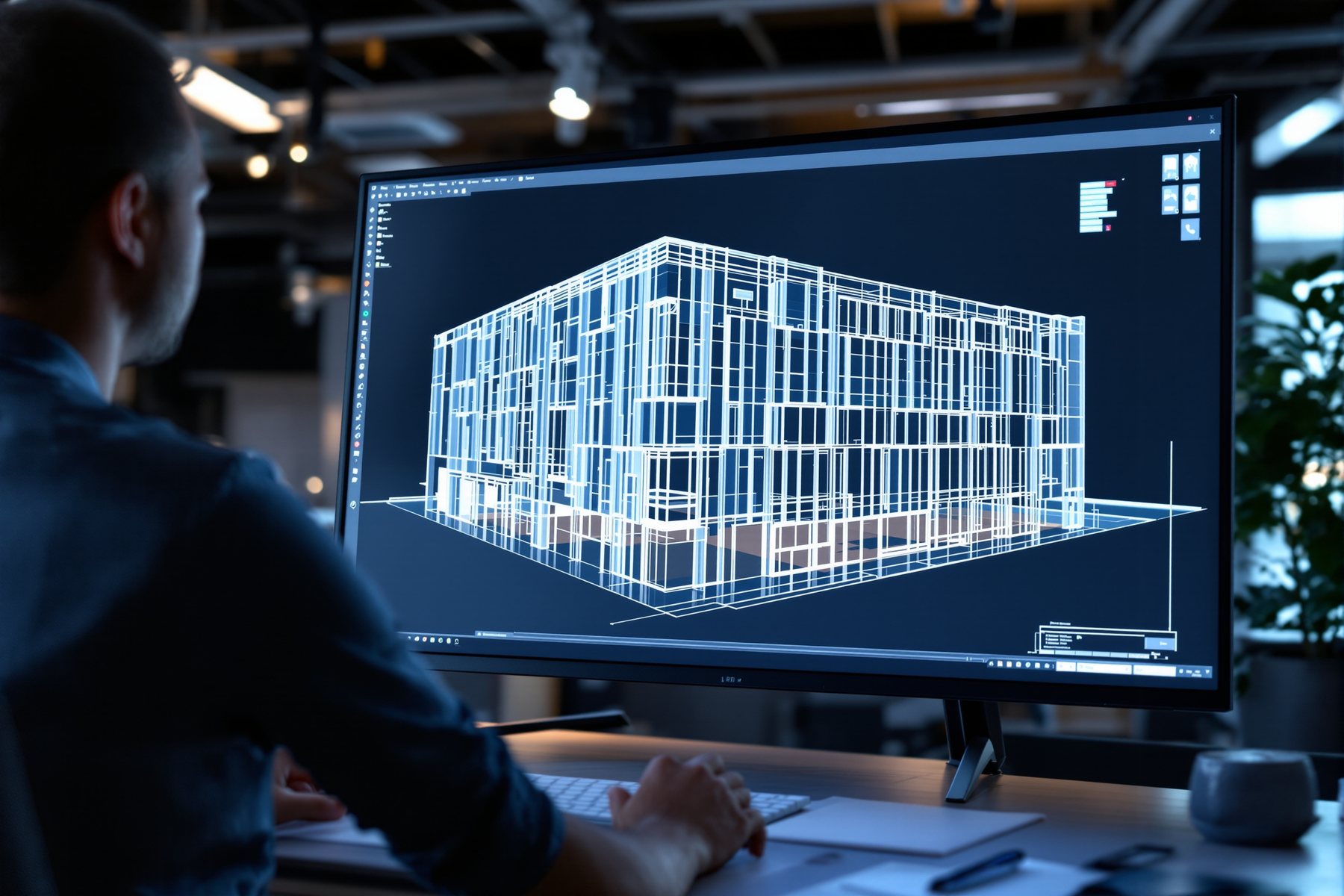
The facade is one elegant line on the architect's elevation and forty thousand objects in the model — and somebody has to make those two agree.
A facade is the most data-dense part of a building. A single unitised tower can carry tens of thousands of panels, each with a glass make-up, a frame profile, a bracket, a gasket run and a position fixed to a few millimetres. Drawn the old way, that is hundreds of paper sheets that drift out of sync the moment one mullion moves. BIM is the discipline of holding all of it as one coordinated model — geometry plus information — so the slab edge the structural engineer modelled and the bracket the facade contractor modelled actually meet. On Indian premium and tall projects this is now routine; the question is no longer whether to use BIM but at what level of development, and who owns which object.
BIM is a model plus information, coordinated in a federated whole
BIM is not 3D modelling; it is structured information attached to geometry
The first thing to unlearn is that BIM means 'a 3D model'. A pretty 3D model with no data behind it is a render. BIM (Building Information Modelling) is geometry plus structured information — every facade object carries data: which glass IGU, which frame system, U-value, fire rating, the supplier, the install zone, the warranty.
For the facade this matters more than for almost any other trade, because the envelope is where the most interfaces live. The facade model is not authored in isolation: it is one discipline model that is combined with the architectural, structural and services models into a single federated model — a coordinated whole where each team owns its part but everyone sees the collisions.
The spine of this whole course applies here too: a facade is a system, not a surface. In BIM that means the model must carry not just the cladding you see but the frame, the bracket, the barrier line and the slab interface behind it — the same five-jobs, four-layers assembly, now as queryable data.
If an object in the model has no data behind it, it is a picture of a facade, not a BIM facade. Geometry without information is just a 3D drawing.
LOD tells you how much to trust an object — and over-modelling early is as wasteful as under-modelling late
Level of Development (LOD) answers a deceptively simple question: how reliable is this object, right now? It runs from LOD 100 (a conceptual placeholder — a mass, a generic glass plane) through LOD 200 (approximate size and shape), LOD 300 (precise geometry, the design-intent facade you can document), LOD 350 (300 plus the interfaces and connections to other elements — critical for facades), to LOD 400 (fabrication-level: the contractor's real profile, gasket and bracket, ready to make) and LOD 500 (as-built, verified on site).
The craft is matching LOD to stage. At concept you want LOD 100-200 — a fast, loose mass to test glazing ratios, not a fully detailed mullion you will throw away. By tender you want LOD 300/350 — the geometry and interfaces frozen enough to price. The fabrication model is LOD 400 and it is usually the specialist facade contractor's, not the consultant's. Modelling a bracket to LOD 400 at concept is wasted work; carrying LOD 100 placeholders to tender is a clash waiting to happen.
The federated model exists to find clashes on a screen, not on a scaffold
The single most valuable thing BIM does for a facade is clash detection. When the facade model is federated with structure and services, software runs the geometry against itself and flags every collision — the bracket that lands on a beam, the embed that fights a rebar cage, the spandrel that crashes into a duct at the perimeter.
This is governed, not freelance. ISO 19650 is the international standard for managing information across a project: it defines the Common Data Environment (CDE) where models are exchanged, the information requirements, and the BIM Execution Plan (BEP) that says who models what, to what LOD, by when. IFC (Industry Foundation Classes) is the open, vendor-neutral file format that lets a facade contractor on one software hand a model to a consultant on another without losing the data.
The payoff is brutal and simple: a clash found in the federated model costs an email and a model edit. The same clash found on the scaffold, with panels already fabricated, costs a re-detail, a re-fabrication and weeks of programme. Every clash you resolve on screen is a dispute you never have.
Set the information requirements at the brief, not the end. Decide early what you need the facade model _for_ — coordination, energy analysis, area schedules, visualisation — because that drives the LOD you ask for. Resist the urge to demand LOD 400 everywhere; it slows the model and you will not use most of it at design stage. Your highest-value habit is insisting the facade model is federated with structure and services from developed design, so the slab-edge and perimeter clashes surface while they are still cheap to move on a screen.
You own the facade discipline model and its place in the federation. Write the facade section of the BIM Execution Plan: which objects you author, to what LOD at each stage, the naming and classification, and the handover to the contractor's LOD 400 fabrication model. Run clash detection ruthlessly against structure (slab edges, columns, beams) and services at the perimeter — that is where facade BIM earns its fee. Track the model's level of _development_ separately from its level of _detail_: a beautifully detailed object you cannot yet trust is a trap.
On site the model is your single source of truth, if it has been kept current. Learn to read the federated model on a tablet: where your panel sits, its mark number, the bracket it lands on, the clash that was resolved before you arrived. The as-built model (LOD 500) is what you help create — recording where the skin actually went, against tolerances. Understand that the rough concrete frame (built to plus or minus 25 mm) and the precise modelled facade (to a few mm) still meet at the bracket; BIM coordinates the intent, but the survey on site verifies the reality.
ISO 19650-1 & -2
Information management with BIM
The international standard for organising and producing information across a project's lifecycle — defines the CDE, information requirements and delivery process. It governs the WORKFLOW, not the facade content: it tells you how to manage the model, not how to detail a mullion.
IFC (ISO 16739)
Open BIM data exchange
The vendor-neutral file format for exchanging models between different software. Essential when a facade contractor and consultant use different tools — but IFC round-trips can lose or mangle data, so always verify a received IFC, never assume it is lossless.
BIM LOD specification (AIA / BIMForum)
Level of development
Defines LOD 100-500 so 'detailed model' means the same to everyone. Not an Indian code; teams adopt it by reference in the BEP. The common error is conflating level of detail (how it looks) with level of development (how much you can trust it).
NBC 2016 + CPWD/state BIM mandates (India)
Indian adoption context
India has no single national BIM code; NBC 2016 governs design, while BIM adoption is driven project-by-project (premium developers, CPWD pilots, large infra). As of 2026 facade BIM is common on tall and premium Indian projects but far from universal on mid-market work.
“We have a 3D model of the facade, so we are doing BIM.”
A 3D model is geometry; BIM is geometry plus structured information, coordinated in a federated whole under an agreed process (CDE, BEP, LOD, ISO 19650). A facade 'model' with no data, no defined LOD, not federated with structure and services, and not clash-checked is just a 3D drawing that happens to be three-dimensional. The value of BIM is in the information and the coordination, not the third dimension.
Worked example — choose the LOD for each facade decision gate
The most useful facade-BIM skill is not modelling; it is deciding how much model is enough at each stage. Over-model and you waste fees; under-model and you clash on site. Let's map LOD to the gates for a unitised curtain-wall tower.
The design gates from Module 0 (concept to install) and the LOD scale 100-500. No software needed.
For a 20-storey office, decide the facade model LOD at each gate, and what it must be good enough to do:

  GATE              LOD?   MUST SUPPORT
  -------------------------------------------------
  Concept           ___    glazing-ratio + massing study
  Developed design  ___    documentation + early clash
  Tender            ___    pricing a frozen design
  Contractor design ___    fabrication of real profiles
  As-built          ___    O&M + verified record

  Rule of thumb: LOD should be just high enough for the
  DECISION at that gate, and no higher.
- 1Concept: set LOD 100-200. You are testing glazing ratio and massing — a generic glass plane and approximate panel size is enough. Modelling a real mullion here is wasted; the geometry will change.
- 2Developed design: set LOD 300. Precise design-intent geometry — the grid, panel sizes, glass make-up and overall profiles — good enough to document and to start coordinating with structure.
- 3Tender: push the interface-critical parts to LOD 350 (300 plus connections to slab edge and adjacent trades) so contractors price a genuinely frozen, coordinated design and bid like-for-like.
- 4Contractor design: LOD 400 — the specialist contractor's fabrication model with the real extrusion, gasket, bracket and tolerances. This is THEIR model; you review it against the spec, you do not author it.
- 5As-built: LOD 500 — the verified, surveyed record of what was actually installed, handed over with the O&M data. Read the column back: each gate's LOD is set by the decision it must support, not by how impressive the model looks.
You’ll walk away with
An LOD map for a facade project — the right level of development at every gate — so you commission and produce exactly enough model to make each decision, and never pay to over-model geometry you will throw away.
Two quick ways to make BIM concrete.
- 01Take any facade drawing and ask: if this were a BIM object, what five pieces of DATA would it carry beyond its shape? (glass make-up, U-value, fire rating, supplier, install zone — that data is the 'I' in BIM.)
- 02Find a published clash-detection image of a perimeter (bracket vs beam, embed vs rebar). Notice the clash was caught on a screen — and imagine the cost of finding the same collision once the panel was fabricated and craned up.
Facade BIM is geometry plus information, authored as one discipline model and federated with structure and services so clashes surface on a screen, not on a scaffold. Level of development tells you how far to trust each object, and the craft is matching LOD to the decision gate — never over-modelling early or carrying placeholders late. ISO 19650 governs the process; IFC moves the data; clash detection is where it pays.
BIM = geometry + structured information, coordinated in a federated model. LOD 100 (concept) -> 200 -> 300 (design intent) -> 350 (interfaces) -> 400 (fabrication, contractor's) -> 500 (as-built). ISO 19650 governs the workflow (CDE, BEP); IFC is the open exchange format; clash detection finds collisions before they reach site. India: common on premium/tall projects, not yet universal.
What is the difference between BIM and a 3D model of a facade?
A 3D model is geometry only — a shape you can view and render. BIM is geometry plus structured information: every facade object carries data (glass make-up, U-value, fire rating, supplier, install zone) and the model is coordinated in a federated whole with structure and services, under an agreed process. The value of BIM lies in the information and the coordination, not in being three-dimensional.
What does LOD (Level of Development) mean for a facade?
LOD describes how much you can trust a facade object. LOD 100 is a conceptual placeholder, 200 approximate, 300 precise design-intent geometry, 350 adds interfaces and connections, 400 is fabrication-level (the contractor's real profile and bracket), and 500 is the verified as-built record. The skill is matching LOD to the project stage — loose at concept, fabrication-ready only when the contractor models it.
Is facade BIM used in India?
Yes, but unevenly. As of 2026 facade BIM is common on tall, premium and complex Indian projects, where international-standard coordination, clash detection and ISO 19650 workflows are routine. India has no single national BIM mandate; adoption is driven project-by-project by developers, large infrastructure programmes and government pilots (such as CPWD), and mid-market work still often relies on conventional 2D documentation.
Peer-reviewed journals & authoritative standards
- 01Su, Z. et al. Multi-Disciplinary Characteristics of Double-Skin Facades for Computational Modeling Perspective and Practical Design Considerations. Buildings, 12(10):1576. — Buildings (MDPI), 2022.
- 02Review on Glass Curtain Walls under Different Dynamic Mechanical Loads: Regulations, Experimental Methods and Numerical Tools. IntechOpen. — IntechOpen, 2023.
- 03National Building Code of India (NBC) 2016, Bureau of Indian Standards. — Bureau of Indian Standards, 2016.
The author
Amogh N P
Architect, interior designer, and creative polymath. Studio Matrx began in his notebooks — his vision of design made honest, useful, and open to everyone. Its Academy is written and taught in his memory, and free, forever.
More about Amogh →If BIM is how the facade model is coordinated, the next question is how it is generated — because on complex geometry, modelling tens of thousands of unique panels by hand is impossible. That is where parametric and computational design takes over.