
Aluminium & steel: extrusions & finishes
The frame is the facade's skeleton - extruded aluminium for almost everything, steel where loads or fire demand it, and a finish that has to survive forty monsoons.
Lesson byAmogh N P· Architect & interior designer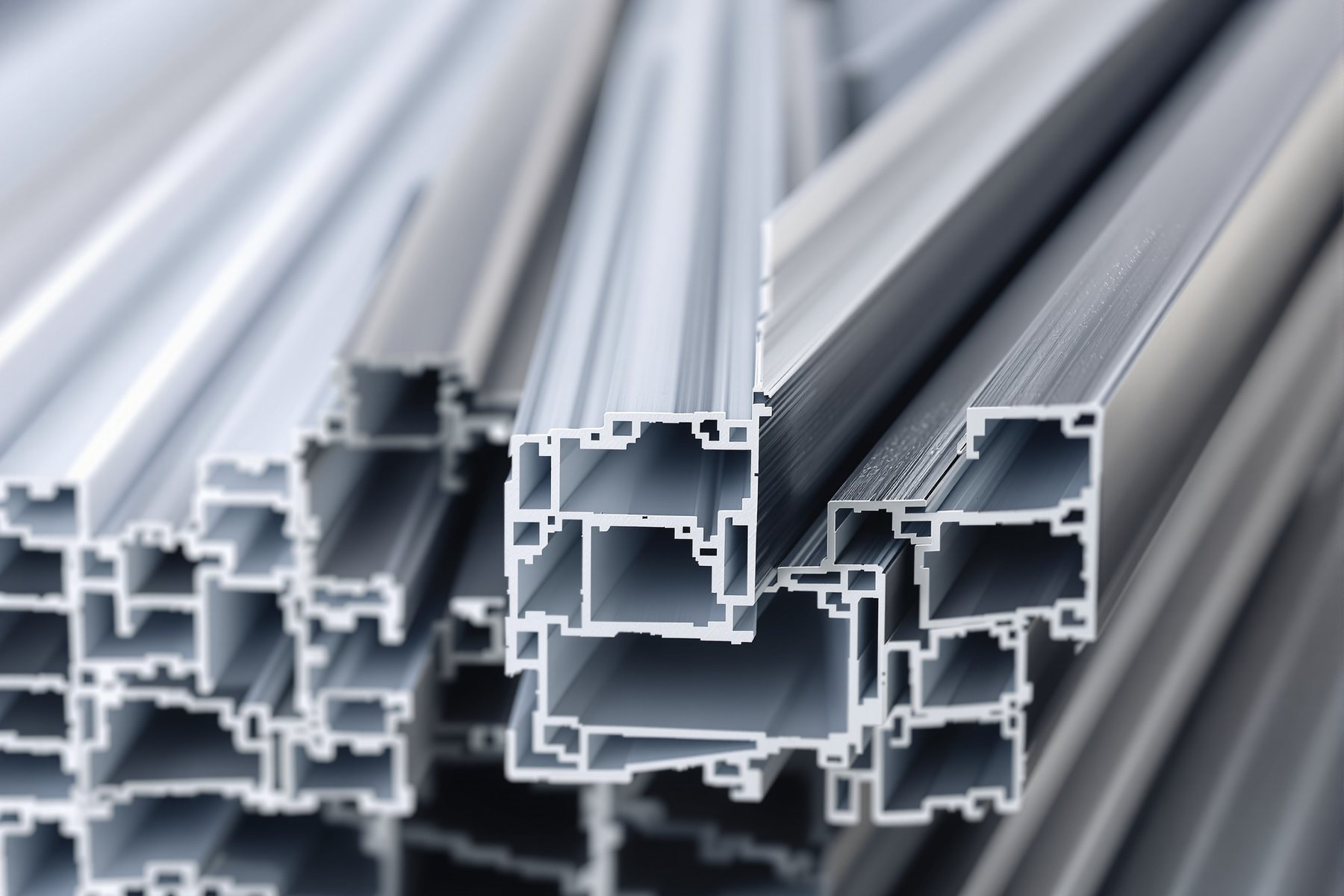
The glass gets the glory; the aluminium behind it does the work - and the wrong finish on it is a corrosion claim waiting to happen.
Behind almost every glass facade is a hidden skeleton of **extruded aluminium** - mullions, transoms, pressure plates, gaskets carriers - shaped into profiles so intricate they could only be squeezed from a die like toothpaste. Aluminium wins because it is light, it does not rust, it takes complex shapes cheaply, and it can be finished in any colour. But aluminium also conducts heat alarmingly well, softens in a fire, and corrodes violently when it touches the wrong metal. So the facade engineer's job is twofold: choose the right **alloy and profile** to carry the wind, and choose the right **finish and thermal break** so the frame survives the climate and does not bleed heat. On a coastal Indian project, the difference between PVDF and a cheap powder coat is the difference between a facade that looks new at twenty years and one that chalks and fades by five.
The skeleton, the break and the skin of the frame
6063 for shape, 6061 for strength - and the die makes the profile
Facade frames are almost always aluminium alloys of the 6000 series (aluminium-magnesium-silicon), because they extrude beautifully and resist corrosion well. 6063 is the workhorse: excellent extrudability, fine surface for anodising, and enough strength for most mullions - it makes the slim, complex profiles a curtain wall needs. 6061 is stronger but harder to extrude into fine detail, used where a profile carries heavy load or spans far.
Extrusion is the magic: a billet of hot aluminium (around 450-500 C) is pushed through a hardened steel die, emerging as a continuous profile of the die's cross-section - hollow chambers, screw ports, gasket races, all in one shape. This is why aluminium dominates: a steel section of equal complexity would have to be welded up from plates. The profile is then aged to its full temper (the T6 condition is typical), cut to length and finished.
The limit to remember: aluminium has roughly one-third the stiffness of steel (Young's modulus ~69 GPa versus ~200 GPa). For the same load it deflects three times as much, so facade mullions are sized by deflection, not strength - the span/175 limit you met in Module 0 governs the section, which is why mullions look deeper than their stress alone would need.
Aluminium deflects 3x more than steel for the same load - so facade mullions are sized by stiffness, not strength.
A polyamide strip splits the profile so heat cannot conduct straight through
Aluminium is a superb conductor of heat - which is a disaster in a facade frame, because an unbroken aluminium mullion is a continuous thermal bridge straight from the hot outside to the cool inside. In an Indian summer that bridge pours heat in; in an air-conditioned interior it can sweat with condensation.
The fix is the thermal break: the profile is made in two halves - an outer and an inner aluminium section - mechanically locked together by polyamide (nylon, usually glass-fibre-reinforced) strips that have low thermal conductivity. The polyamide carries the structural connection between the halves but blocks the heat path, dropping the frame's effective conductivity dramatically and lifting the whole window's U-value into code-compliant territory. A thermally broken frame can roughly halve the frame U-value versus a solid aluminium one.
The trade-off is honest: thermal-break profiles are more complex, slightly weaker across the break, and must be detailed so the polyamide is not bypassed by a metal screw or bracket short-circuiting the two halves. A thermal break with a steel screw bridging it is no thermal break at all.
Anodise or coat the aluminium - and never let it touch steel unprotected
Bare (mill-finish) aluminium oxidises to a dull grey, so facade aluminium is finished three main ways. Anodising grows a hard, integral aluminium-oxide layer electrochemically - extremely durable, abrasion-resistant, in metallic and bronze tones, graded by thickness (architectural anodising is typically Class AA25, a 25-micron film; IS 1868 sets the grades). PVDF (polyvinylidene fluoride, e.g. Kynar/Hylar) powder or liquid coating is the premium organic finish: outstanding colour retention and chalk resistance, the default for serious coastal and high-rise work, warranted 15-20 years. PPC (polyester powder coating) is cheaper and comes in any colour but chalks and fades faster, especially in UV-heavy coastal India - fine indoors or on budget low-rise, risky on a prestige west-facing skin.
The trap that catches careless detailing is galvanic (bimetallic) corrosion. When two dissimilar metals - say aluminium and carbon steel, or aluminium and copper - touch in the presence of moisture, the more anodic metal (aluminium) corrodes sacrificially and fast. The rule: isolate dissimilar metals with nylon washers, neoprene gaskets, or zinc/stainless intermediaries, and use stainless-steel fixings (austenitic A2/A4) into aluminium. A carbon-steel bracket bolted straight to an aluminium mullion on a humid coast is a corrosion claim with a date on it.
The finish is your facade's colour _and_ its lifespan, and the two trade off. **Anodising** gives the honest, metallic, slightly varied look of real aluminium and ages gracefully; **PVDF** gives any colour with the best long-term retention; **PPC** gives any colour cheaply but fades, so reserve it for sheltered or budget work. On a coastal or high-UV Indian site, do not let a contractor value-engineer PVDF down to PPC to save a few rupees per square metre - you will see the chalking from the street in five years. Steel only appears where you want it seen (feature fins) or where loads force it.
Size the mullion by **deflection** (aluminium's low modulus governs), specify the alloy and temper (6063-T6 for most, 6061 where loads demand), and own the **thermal break**: detail it so no fastener or bracket short-circuits the polyamide, and confirm the frame U-value in the system's certified thermal model. For finishes, set anodising to a class (AA25 / IS 1868) or PVDF to a coating-thickness and warranty spec, and write the **galvanic isolation** detail explicitly - dissimilar-metal contact is a specification failure, not a site mistake.
Two site disciplines protect the frame. First, **never let aluminium touch carbon steel** (rebar, structural steel, fixings) without the isolating washer or gasket the detail calls for - bare contact plus moisture eats the aluminium. Use the stainless fixings specified, not the carbon-steel ones in the van. Second, **protect the finish**: keep the peel-coat film on until the last moment, never drag profiles, and keep wet concrete, mortar splash and alkaline runoff off anodised and coated aluminium - alkali burns both finishes permanently. The frame arrives perfect; site is where it gets ruined.
IS 1868 / EN 12373 (ISO 7599)
Anodising of aluminium
Specify and grade anodic oxide coatings (architectural Class AA25 = 25-micron film). They set the coating quality; they say nothing about the alloy's structural capacity.
AAMA 2604 / 2605
Organic coatings (PPC vs PVDF)
American performance classes for powder/liquid coatings - 2604 ~ standard polyester, 2605 ~ PVDF-grade (best fade and chalk resistance). The benchmark to write into a finish warranty.
IS 733 / IS 63601:2024 (Al alloys)
Aluminium alloy and temper
Indian specs for wrought aluminium alloys (e.g. 6063, 6061) and tempers for structural use. They give the material properties you size profiles from, not the profile geometry.
IS 800 / IS 2062 (steel)
Structural steel framing
General steel construction (IS 800) and structural steel grades (IS 2062) where steel carries facade loads. Steel needs its own corrosion protection - galvanising or coating - on a facade.
“Aluminium does not rust, so a facade frame needs no special finish or protection.”
Aluminium does not rust like steel, but it is far from inert. Bare aluminium dulls and pits, it suffers **galvanic corrosion** fast when it touches carbon steel or copper in moisture, and it is **attacked by alkalis** - wet concrete, mortar and cement runoff will permanently stain or etch it. That is why facade aluminium is anodised or coated, why dissimilar metals are isolated, and why profiles are protected from concrete splash on site. 'It will not rust' is true and dangerously incomplete.
Worked example - choose the anodising grade and check galvanic risk
Two everyday frame decisions, made with numbers: what thickness of anodising a coastal facade needs, and whether a proposed fixing is a galvanic time-bomb.
The IS 1868 anodising-grade table and the galvanic series of metals.
GIVEN a seafront residential tower in Chennai, anodised aluminium frames:

  ENVIRONMENT : coastal, high chloride, high UV
  FINISH      : architectural anodising, choose a grade
  Grades (anodic film thickness):
     AA10 = 10 micron  (interior / mild)
     AA15 = 15 micron  (exterior, sheltered)
     AA20 = 20 micron  (exterior, normal)
     AA25 = 25 micron  (exterior, severe / coastal)
PROPOSED FIXING: carbon-steel bracket bolted to the aluminium mullion- 1Match the anodising grade to the exposure: a high-chloride seafront is a severe exterior environment, so the right architectural class is AA25 (25-micron) - the thicker oxide film resists chloride pitting far better than AA15. Specify AA25 minimum, and check the system warranty assumes it.
- 2Confirm the alloy suits anodising: 6063 anodises to a clean, even finish; 6061 can streak. For a uniform anodised look, specify the visible profiles in 6063-T6 and keep 6061 for hidden structural members.
- 3Now test the galvanic risk: in the galvanic series aluminium is anodic to carbon steel, so a bare carbon-steel bracket touching aluminium in salt-laden moisture makes the aluminium corrode sacrificially and fast - exactly where it is structurally connected. This fixing fails.
- 4Fix the detail: switch to an austenitic stainless-steel (A4/316) bracket and fixings, and add a nylon/neoprene isolating washer and sleeve so even the small potential difference to stainless is broken. A4 (not A2) because A2 stainless can pit in chloride coastal air.
- 5Write it up: AA25 anodising on 6063-T6 visible profiles, A4 stainless fixings, isolated from the aluminium with nylon washers - a frame specification that will survive a Chennai seafront where the cheaper version would not last a decade.
You’ll walk away with
A coastal frame spec - AA25 anodising on 6063-T6, A4 stainless fixings isolated by nylon washers - and the reasoning that turns 'anodised aluminium frame' into a durable, galvanically safe assembly.
Two quick reflections to anchor the frame.
- 01Find an aluminium facade and look at the mullion depth versus the glass it holds - then remember it is that deep because aluminium deflects three times more than steel and is sized by stiffness, not strength.
- 02Look at an older powder-coated facade in a sunny Indian city and check for **chalking** (a dull, powdery surface) or fading - that is a polyester (PPC) coat showing its age, and the reason PVDF is specified where appearance must last.
Extruded aluminium is the facade's skeleton - light, shapeable, corrosion-resistant, but a thermal conductor that deflects three times more than steel, so mullions are sized by stiffness and split by a polyamide thermal break. The finish (anodising, PVDF or PPC) sets both colour and lifespan, and the cardinal rule is to isolate dissimilar metals and use stainless fixings, or galvanic corrosion will eat the frame from the connection out.
Facade frames are 6000-series aluminium (6063 for shape, 6061 for strength), extruded through a die and aged to T6. Aluminium's low modulus means deflection governs mullion size. A polyamide thermal break splits the profile to halve frame U-value - never short-circuit it with a fastener. Finish by anodising (AA25/IS 1868), PVDF (best, coastal), or PPC (cheap, chalks). Isolate dissimilar metals and use stainless fixings or galvanic corrosion follows.
Why is aluminium used for facade frames instead of steel?
Aluminium is light (about a third the density of steel), it does not rust, and above all it can be **extruded** - pushed through a die into intricate, hollow profiles with gasket races and screw ports in a single shape, which steel cannot match without welding up plates. It also takes durable finishes (anodising, PVDF) in any colour. Its weaknesses - lower stiffness, high thermal conductivity, softening in fire - are managed by sizing mullions for deflection, adding polyamide thermal breaks, and using steel where loads or fire performance demand it.
What is a thermal break in an aluminium facade frame?
A thermal break is a strip of low-conductivity polyamide (glass-fibre-reinforced nylon) that splits an aluminium profile into an outer and an inner half, mechanically locked but thermally separated. Because aluminium conducts heat extremely well, an unbroken profile is a thermal bridge that pours heat through the frame and can cause condensation. The polyamide carries the structural connection while blocking the heat path, roughly halving the frame's U-value. It must be detailed so no screw or bracket bridges the two halves and short-circuits it.
Anodising versus powder coating - which is better for a facade?
Neither is universally better; they suit different jobs. Anodising grows a hard, integral oxide film that is extremely abrasion-resistant and ages gracefully in metallic and bronze tones - specify a thicker class (AA25/IS 1868) for coastal exposure. Powder coating is an organic finish: PVDF-grade (AAMA 2605) gives any colour with excellent fade and chalk resistance and is the premium choice for high-rise and coastal work, while standard polyester (PPC, AAMA 2604) is cheaper but chalks and fades faster in UV-heavy India. Choose by colour need, exposure and required lifespan.
Peer-reviewed journals & authoritative standards
- 01Material Selection and Characterization for a Novel Frame-Integrated Curtain Wall. (PMC8069006). — Materials / NCBI-PMC, 2021.
- 02Li, X. & Wu, Y. A review of complex window-glazing systems for building energy saving and daylight comfort. Journal of Building Physics. — Journal of Building Physics (SAGE), 2025.
- 03Ventilated facade system: A review (cladding-support framing, fixings and durability). — ScienceDirect (Elsevier), 2025.
The author
Amogh N P
Architect, interior designer, and creative polymath. Studio Matrx began in his notebooks — his vision of design made honest, useful, and open to everyone. Its Academy is written and taught in his memory, and free, forever.
More about Amogh →_Glass and metal are the lightweight skin. When the architecture calls for mass and texture - stone, terracotta, a composite panel - the rules of weight, fixing and durability change again, which is Lesson 2.3._