
Pressure equalisation & drained design
The most elegant idea in weatherproofing does not fight water harder — it removes the force that pushes it in. Equalise the pressure, and the leak has no engine.
Lesson byAmogh N P· Architect & interior designer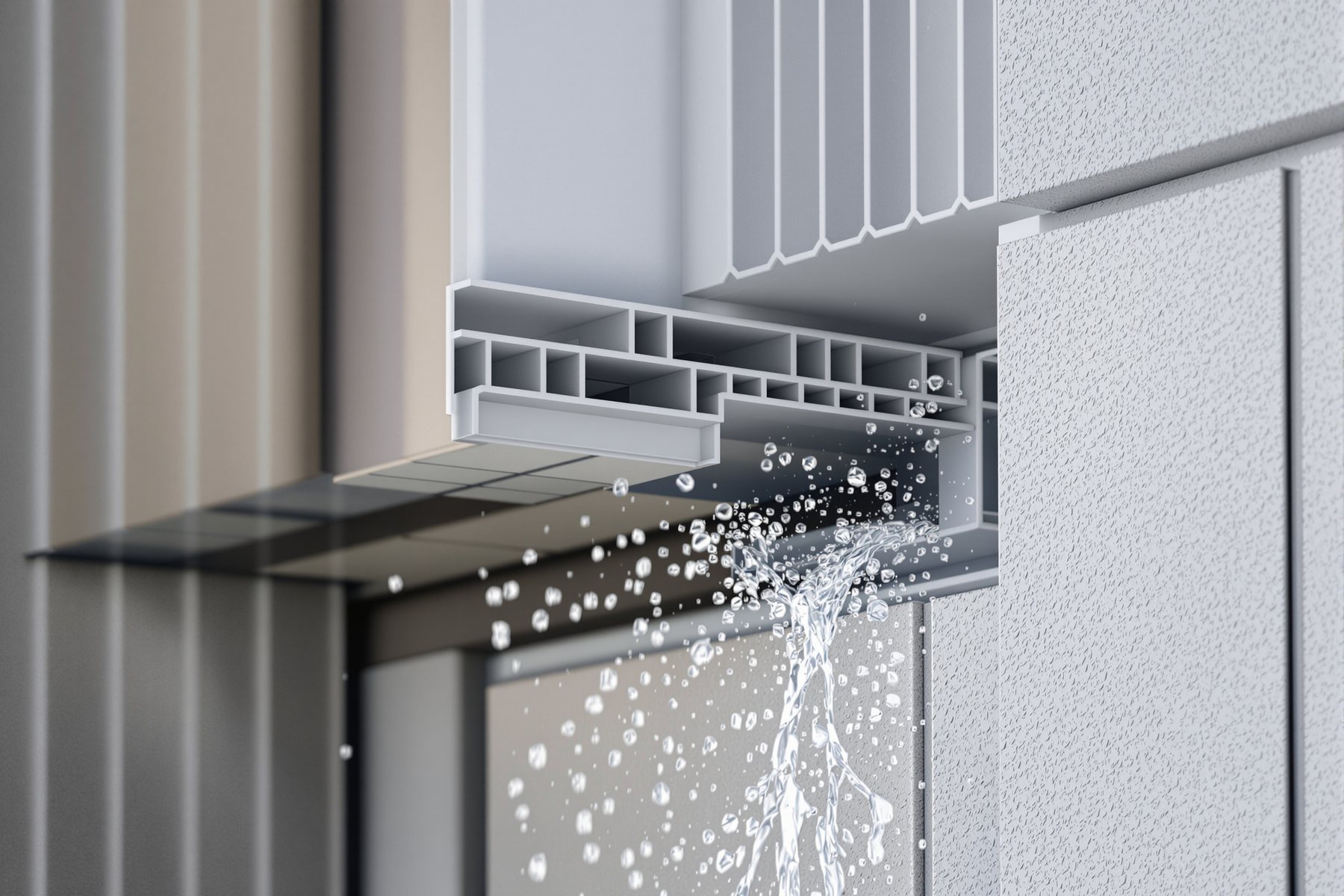
Stop trying to out-seal the wind. Let the wind into the cavity, and it stops pushing water through your wall.
Here is the counter-intuitive move that defines modern facade weatherproofing: instead of sealing the outer face perfectly to keep the wind out, you _let air into a cavity behind the screen_ on purpose. Why? Because the force that pumps water through a tall facade is the **pressure difference** across the outer skin. If the cavity behind the screen is at the same pressure as the outside, there is no pressure difference across the outer joints — and with no pressure difference, the air-pressure mechanism has nothing to pump with. Water that does sneak past the screen simply falls into a drained cavity and runs back out. **You did not defeat the wind; you removed its leverage.** This is the pressure-equalised rainscreen, and once it clicks, every leak you ever diagnosed reorganises itself in your head.
Equalise the pressure, drain the rest — the two-stage skin
Split the one job into two lines: a screen that breaks the rain, a barrier that stops the water
A face-sealed wall asks one line — the outer bead — to do two contradictory things: break the wind-driven rain AND be the final waterproof barrier. A rainscreen splits that into two stages. The outer screen (the visible cladding, with open or baffled joints) breaks the kinetic energy of the rain and sheds most of it — but it is deliberately not watertight. Behind it sits a drained, ventilated cavity, and behind that the real air and water barrier on the backing wall, which never sees driving rain, only the small amount that gets through.
This is two-stage weatherproofing, sometimes called the 'screen and drain' principle. The screen takes the punishment and is allowed to leak a little; the cavity catches and drains what passes; the concealed barrier stays pristine because it is sheltered. The genius is the division of labour: no single element has to be perfect. The screen can have open joints (which is why rainscreens can look so crisp), the cavity quietly does the draining, and the barrier — protected from UV and impact — lasts far longer than any exposed sealant ever could.
A rainscreen is allowed to leak. That is not a defect — it is the design. The leak falls into a cavity and drains back out before it ever reaches the real barrier.
Open the cavity to the outside so there is no pressure to push water through the screen
A plain drained-and-back-ventilated rainscreen already works by gravity. The pressure-equalised rainscreen (PER) adds the master refinement: the cavity is vented to the outside so its pressure rises and falls with the external wind pressure. When the wind gusts and pressurises the outer face, air rushes through the vents into the cavity until the cavity pressure equals the outside pressure. At that instant the pressure differential across the outer joints is zero — and the air-pressure mechanism, the dominant leak driver on tall buildings, is switched off. No pressure difference, no air flowing inward through the joints, no water carried with it.
For PE to work, three conditions matter. The vent area must be large enough relative to the cavity volume that pressure equalises faster than the gust changes (PE is never perfect under fluctuating wind, which is why we say pressure-moderated). The cavity must be compartmented — divided by baffles into bays — so wind cannot drive a high-pressure-to-low-pressure flow sideways along the cavity (around a windward corner the pressure can swing from strong positive to strong suction over a few metres). And every bay must still drain to the outside at its base. Get those three right and the facade defends itself with air, not sealant.
Baffles stop kinetic splash; compartments stop the cavity becoming a horizontal pressure highway
Two details make PE real on a building rather than a diagram. Baffles are upstands or labyrinth profiles set in the open joints: they let air pass (so the cavity can equalise) but block the straight-line path of a wind-driven droplet, defeating the kinetic-energy mechanism without sealing the joint. A good baffle is a chicane for water and an open door for air.
Compartmentation is the non-negotiable that designers most often forget. On a tall facade the external wind pressure is not uniform — it is strongly positive on the windward face, strongly negative (suction) near corners and edges, and varies floor to floor. If the cavity is one continuous void, the wind simply uses it as a horizontal pressure highway: high-pressure air enters at the windward middle and blasts along the cavity to low-pressure corners, dragging water across the whole wall and ruining equalisation. So the cavity is divided into bays — vertically at corners and floor lines, horizontally at slab edges — each small enough that the pressure within it is roughly uniform and equalises quickly. Compartmentation also doubles as the line where cavity fire barriers sit (Module 8), so the same divisions earn their keep twice. A PER without compartmentation is a drained wall pretending to be a pressure-equalised one.
Compartment the cavity. An un-compartmented cavity is a wind tunnel that drags water from the windward face to the suction corners — exactly where you least want it.
The rainscreen principle is why the crispest modern facades have _open_ joints and shadow-gaps — those are not a style, they are the screen of a two-stage wall. Embrace them: a drained, expressed joint is both more honest and more durable than a face-sealed flush one. But know the trade you are making: a rainscreen needs cavity depth, vents and compartment lines, so protect that depth in your section and accept the corner and floor-line divisions that compartmentation demands. A clean open-jointed elevation with a properly compartmented cavity behind it is one of the safest facades you can specify in a monsoon climate.
Own three numbers: cavity depth, vent (equalisation) area, and compartment size. Size the vents so the equalisation time is short relative to gust duration (the bigger the cavity volume, the more vent area it needs). Compartment the cavity at every corner, parapet and slab edge so each bay sees roughly uniform pressure — corners are where un-compartmented PE collapses. Keep a continuous, sheltered air-and-water barrier as the true line of defence, and drain every compartment at its base with weeps that cannot be blocked. Then prove it: dynamic water testing (Lesson 5.4) is what actually demonstrates the pressure-moderation works.
On a rainscreen, the things you cannot see are the things that matter. Check that cavity baffles and compartment barriers are actually installed at corners and floor lines (they are the first thing a rushed crew skips because 'the cavity is hidden anyway') — without them the wall is not pressure-equalised. Check that weep holes and cavity drainage at each compartment base are open and not buttered shut with sealant or clogged with offcuts. And keep the concealed barrier membrane continuous and well-lapped: it is the real waterproofing, and once the cladding screen goes on, a missed lap is a demolition to fix.
CWCT Standard & Test Methods (UK)
Rainscreen & PE performance
Sets the water-penetration test pressures and pass criteria a pressure-equalised rainscreen is verified against. The benchmark, but it specifies performance, not how to size your vents or compartments — that is engineering judgement.
AAMA 508 / 509
Pressure-equalised rainscreen (US)
The American voluntary specifications for pressure-equalised (508) and drained-and-back-ventilated (509) rainscreen wall systems. Useful definitions and test regimes; voluntary, so a project still writes its own pass criteria.
NBC 2016 (India) / IS 875 (Part 3): 2015
Wind pressure that PE must equalise
IS 875-3 gives the external wind pressures (positive and suction, including high local edge/corner coefficients) that drive the cavity pressure and dictate where compartmentation is essential. It sets the load, not the rainscreen method.
“A pressure-equalised rainscreen keeps the cavity completely dry by sealing the outside — the open joints are just for looks.”
A rainscreen deliberately lets some water past the open joints; that is the design, not a defect. The cavity is drained precisely because water gets in. And the open joints are not decorative — they are the vents that let the cavity pressure equalise with the outside, switching off the air-pressure mechanism that drives leaks. The cavity is not kept dry; it is kept _draining_, and the real barrier behind it stays dry because it never meets driving rain.
Worked example — will this cavity pressure-equalise fast enough?
Pressure equalisation is a race: the cavity must fill (or empty) to match the outside faster than the gust changes. Let's check a compartmented cavity bay against a realistic gust, conceptually, with numbers.
A calculator and the proportional relations above.
GIVEN one compartmented rainscreen bay:

  bay area          A    = 3.0 m wide x 3.5 m high = 10.5 m2
  cavity depth      t    = 0.05 m  (50 mm)
  cavity volume     V    = A * t   = 0.525 m3
  vent (open-joint) area Av (to size)
  rule of thumb     Av  >= ~0.5% of bay area for good PE
  design gust       changes meaningfully over ~ 1 s

  Question: target vent area, and is equalisation plausible in << 1 s?
- 1Set the target vent area from the rule of thumb: Av >= 0.5% of bay area = 0.005 * 10.5 = 0.0525 m2 = 525 cm2 of open joint per bay. Spread over open joints ~10 mm wide, that is about 5.25 m of open-joint length per bay — easily achieved on a 3 m x 3.5 m bay with vertical and horizontal open joints.
- 2Note why a SMALL cavity helps. Equalisation time scales with cavity volume divided by vent area (more air to move, or a smaller hole, both slow it down). Our volume is just 0.525 m3 because the cavity is shallow (50 mm) and the bay is compartmented small. A continuous un-compartmented cavity might be tens of m3 — orders of magnitude slower, which is why compartmentation is what makes PE physically possible.
- 3Reason about the timescale. With ~525 cm2 of vent feeding only 0.525 m3, the air needed to equalise even a large pressure swing is a fraction of the cavity volume, and at typical gust-driven flow velocities it moves through 525 cm2 in well under a second — faster than the ~1 s gust change. So this bay can plausibly pressure-moderate (never perfectly equalise, but track the gust closely).
- 4Now break compartmentation and watch it fail. Remove the corner and floor barriers so the cavity becomes one 30 m-tall void of, say, 30 m3. The same 525 cm2 of vent now feeds ~57x more volume, equalisation time stretches well beyond the gust, and worse, wind drives a horizontal flow from the windward face to the suction corners — the cavity becomes a pressure highway and PE collapses.
- 5Confirm drainage. Each bay must drain at its base: provide weeps at the compartment sill so the small amount of water that passes the screen leaves the cavity. A bay that equalises but cannot drain just relocates the leak.
- 6State the design rule. Keep the cavity shallow and compartmented (small V), give each bay >= ~0.5% open vent area (adequate Av), and drain every bay — then the cavity tracks the gust and the air-pressure leak mechanism stays disarmed.
You’ll walk away with
A defensible feasibility check: a 3 x 3.5 m compartmented bay with a 50 mm cavity needs ~525 cm2 of vent to pressure-moderate within a ~1 s gust — and the same cavity un-compartmented (tens of m3) cannot. The quantitative reason compartmentation is mandatory, not optional.
One quick test of the principle.
- 01Find an open-jointed metal or stone rainscreen building near you. Look for the cavity behind an open joint and try to spot a compartment line or a baffle at a corner or floor — then judge whether what you see is a true pressure-equalised rainscreen or just a drained one.
A rainscreen splits weatherproofing into two stages: a screen that breaks the rain and is allowed to leak, and a sheltered barrier that does the real waterproofing. Pressure equalisation adds the master move — vent the compartmented cavity so its pressure tracks the wind, and the air-pressure differential that pumps water through tall facades simply vanishes. You stop water not by sealing harder but by removing its force, then draining the rest.
Two-stage weatherproofing: outer screen breaks the rain (open joints, allowed to leak), drained cavity catches what passes, sheltered barrier does the real waterproofing. The pressure-equalised rainscreen vents the cavity so its pressure tracks the outside — zeroing the pressure differential and the leak mechanism. PE needs adequate vent area, small compartmented bays (so corners don't become pressure highways) and drainage at every bay base.
What is a pressure-equalised rainscreen (PER)?
A two-stage facade where an outer screen with open or baffled joints breaks the wind-driven rain, a drained and ventilated cavity catches and sheds whatever gets through, and a sheltered air-and-water barrier behind the cavity does the real waterproofing. The defining feature is that the cavity is vented to the outside and compartmented, so its pressure tracks the external wind pressure — zeroing the pressure differential across the outer joints and switching off the air-pressure mechanism that drives most leaks on tall buildings.
Why does pressure equalisation beat face-sealing?
Face-sealing relies on one continuous outer bead being perfect for forty years across kilometres of joint — physically impossible, and when it cracks water gets behind it with nowhere to drain. Pressure equalisation instead removes the force that drives the leak (the pressure differential) and provides a drained cavity for any water that passes, while keeping the true barrier sheltered from UV, impact and driving rain. It is defence-in-depth that no single element has to be perfect for, rather than a single fragile line.
Why must a rainscreen cavity be compartmented?
Because external wind pressure varies sharply across a tall facade — strongly positive on the windward face, strongly negative (suction) at corners and edges. If the cavity is one continuous void, wind drives a horizontal flow from high-pressure to low-pressure zones, dragging water across the wall and destroying pressure equalisation. Dividing the cavity into small bays at corners, parapets and slab edges keeps the pressure within each bay roughly uniform so it equalises quickly, and those same divisions usually carry the cavity fire barriers too.
Peer-reviewed journals & authoritative standards
- 01Ventilated facade system: A review (water control, drainage and the rainscreen principle). — ScienceDirect (Elsevier), 2025.
- 02Squadroni, F., De Michele, G., Mazzucchelli, E.S. et al. Analysis of condensation and ventilation phenomena for double skin façade units. — Journal of Building Physics (SAGE), 2022.
- 03IEA EBC Annex 43/44. Double Skin Facades: A Literature Review. — International Energy Agency (IEA-EBC), 2008.
The author
Amogh N P
Architect, interior designer, and creative polymath. Studio Matrx began in his notebooks — his vision of design made honest, useful, and open to everyone. Its Academy is written and taught in his memory, and free, forever.
More about Amogh →A pressure-equalised, drained skin handles the water that gets past the screen. But the true line of defence behind it — the air and water barrier — only works if it is genuinely continuous and tight. How we make and verify that continuity, and the leakage limits we hold it to, is next.