
Curtain wall: stick vs unitized
The same curtain wall can be built two completely different ways — one piece at a time in the wind, or as finished panels off a factory line — and that single choice reshapes your programme, your quality and your price.
Lesson byAmogh N P· Architect & interior designer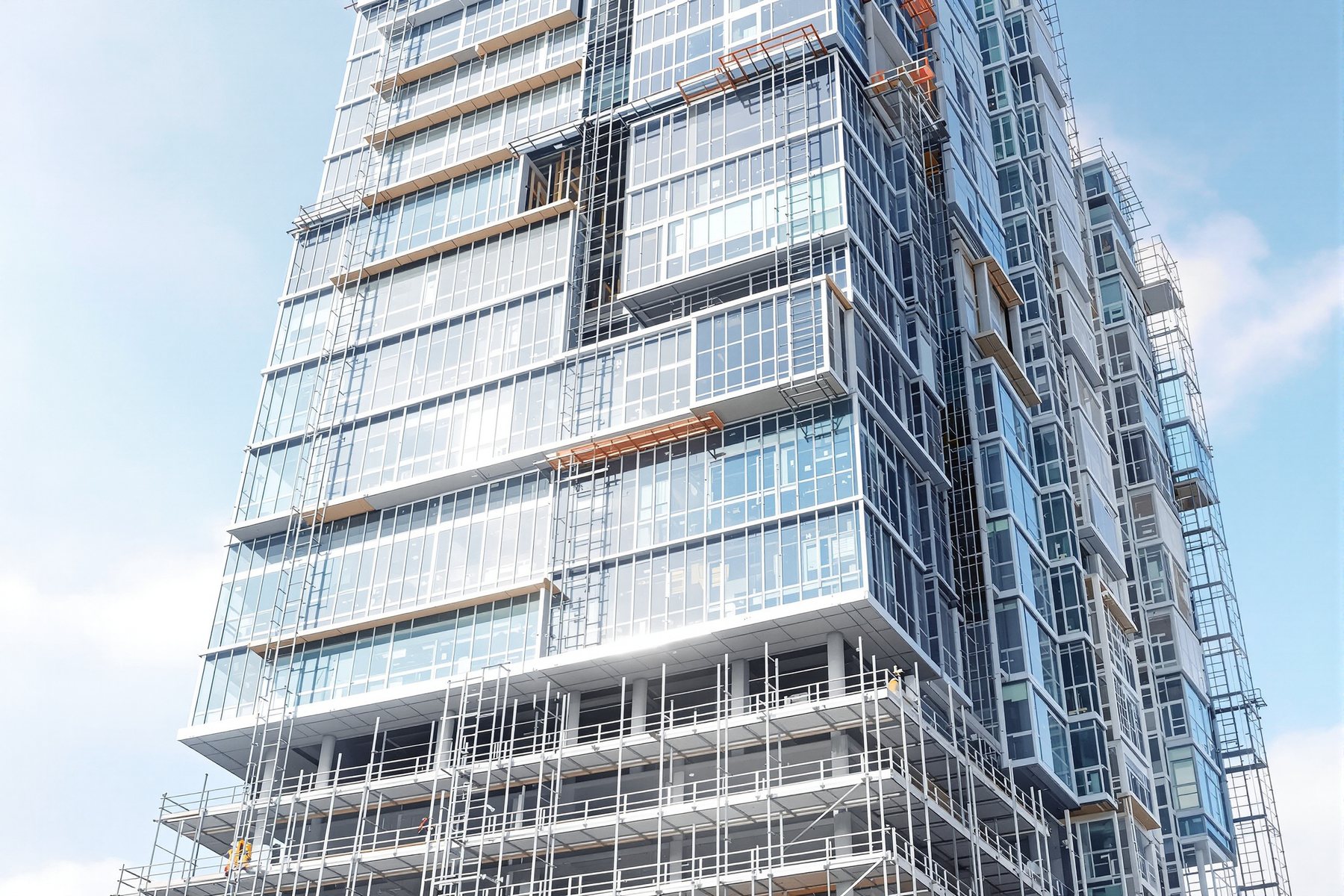
Two towers, same drawing, same glass — one took eighteen months to clad and leaked, the other six months and passed first time. The difference was how the curtain wall was assembled.
A curtain wall is a non-load-bearing aluminium-and-glass skin hung off the floor slabs. That is the textbook definition, and it hides the most consequential decision in the whole system: _how_ it gets assembled. Build it **stick** by stick on site — mullions up, transoms across, glass glazed in place, forty floors up in the monsoon wind — or build it as finished **unitized** panels in a clean factory and just hang them. The drawings can look identical. The programme, the quality, the weathertightness and the price are not. In a Mumbai or Gurugram tower, getting this choice wrong is months of slip and a wall that leaks.
Two ways to build the same wall
Stick is site-built piece by piece; unitized is factory-built as storey-high panels
A stick curtain wall arrives on site as a kit of parts: long aluminium mullion lengths, shorter transoms, glass units, gaskets, brackets and pressure plates. The crew bolts the mullions to the slab edges, fits transoms between them to make a grid, then glazes the glass and infill panels into that grid - all in place, on the building, exposed to weather and access constraints. It is flexible and cheap to tool, but slow, and the critical weather seals are made by hand at height.
A unitized curtain wall flips this. The facade is divided into factory-made panels - typically one storey tall and one structural bay wide - each a complete, glazed, sealed, finished unit. The clever part is the split mullion: each panel carries one half of a vertical mullion, so when two panels are hung side by side the halves interlock to form the joint, and a stack-joint does the same horizontally at each floor. Panels arrive finished, get lifted, and clip onto pre-set brackets. Almost no fabrication happens on site - the building is just assembled from tested pieces.
That is the whole difference, and everything downstream - speed, quality, cost, water performance, the size of building each suits - follows from it.
Stick = a kit you build into a wall on site. Unitized = a wall built in a factory and hung. Same glass, opposite risk profile.
The factory buys you speed, repeatable quality and weathertightness - at a tooling cost
Programme. Stick is slow: every joint is a separate site operation, and the work competes with everyone else on the scaffold. Unitized installs fast - a trained crew can hang a panel in minutes and clad whole floors per week, often 2-4x the rate of stick, and it can chase the structure up the building without waiting for full enclosure.
Quality and weather. This is the real argument. A unitized panel is glazed and sealed in a controlled factory - clean, dry, lit, with jigs and trained operators - then often pressure-tested as a sample before it ships. A stick wall's seals are made by a worker on a swing stage, in heat, dust and wind, where one missed bead becomes a leak you find in the monsoon. The factory environment is the single biggest reason unitized facades are more reliably weathertight - the rainscreen and pressure-equalisation detailing of a unitized split mullion is hard to reproduce by hand on site.
Cost. Unitized carries higher up-front tooling and engineering - dies, jigs, panel design - so on a small or low building it can lose on price. But on a tall, repetitive tower its factory productivity, faster programme (and the financing saved by it) and lower rework usually win. The crossover is roughly the point where there is enough repetition to amortise the tooling - often cited around mid-rise and up, but it is a project-by-project sum, not a rule.
Match the method to the building: stick for small and bespoke, unitized for tall and repetitive
Stick wins on low-rise and mid-rise work, on small areas, on highly bespoke or irregular geometry where every panel differs (so there is no repetition to amortise tooling), on tight or awkward sites where craning storey-high panels is impractical, and where the local contractor base is set up for stick and budgets are tight. Much of India's smaller commercial and institutional curtain walling is still stick for exactly these reasons.
Unitized wins on tall buildings, on large repetitive facades, where programme is king (a faster skin closes the building and starts the fit-out and the revenue sooner), where weathertightness is critical, and where site access or congestion makes piece-by-piece glazing at height slow and dangerous. India's premium towers in Mumbai, Gurugram, Bengaluru and Hyderabad have moved decisively to unitized for these reasons.
There are hybrids - semi-unitized (or unit-and-mullion) systems split the difference, with mullions set on site and pre-glazed cassettes clipped in. The honest answer to 'which is better?' is always: it depends on the building - and being able to run the trade-off is the skill.
Your choice of method quietly constrains the elevation. Unitized loves repetition and a regular grid - a tartan of identical storey-high bays is what makes it cheap, so a wildly varying facade fights the system. Unitized also shows a visible **stack joint** at every floor and a split-mullion line at every bay; those joint lines are part of the design language, not a defect, so compose with them. If you want a frameless, jointless look or highly irregular panels, you are pushing toward stick or a special system - and toward higher cost and risk. Decide the method early, at concept, because it shapes the grid you are allowed to draw.
Own the **split mullion and stack joint** - they are where unitized lives or dies. The interlocking male/female mullion and the stack joint must form a **drained, pressure-equalised** path with continuous gaskets, accommodate inter-storey drift and thermal movement, and stay watertight while moving. Specify the **anchor/bracket** system that lets a 25 mm-tolerance concrete frame receive a 2 mm-tolerance panel: three-way-adjustable brackets are standard. For stick, your discipline is the opposite - relentless inspection of hand-made site seals and a realistic view of what can be sealed well at height. Either way, fix the movement and tolerance strategy before geometry freezes.
Stick and unitized are different trades. Stick is detailed bench-and-scaffold work: set mullions plumb to the survey, glaze and seal each joint by hand, and the wall's watertightness is literally in your gasket and silicone work. Unitized is a logistics-and-rigging operation: panels are big, heavy and fragile, so craning, sequencing, just-in-time delivery and protecting the finished units matter more than sealing. On unitized, the panel was already proven on a mock-up - your job is to hang it true to the benchmark and not damage it. The brackets reconcile the rough concrete and the precise panel; learn to set and adjust them.
AAMA / FGIA curtain-wall standards
Stick & unitized definitions and testing
US Architectural Manufacturers (now FGIA) define curtain-wall types and the air (E283), water (E331) and structural (E330) test methods - the common North-American performance language, but they are voluntary unless a spec calls them up.
CWCT Standard (UK)
Facade performance specification & test
The Centre for Window & Cladding Technology standard sets the air/water/wind/movement performance and mock-up regime widely used on Indian premium curtain-wall projects - a benchmark, not a legal code in India.
NBC 2016, Part 6 (India)
Structural framing of the wall
Frames how the non-load-bearing skin and its anchorage are designed in India and references IS 875-3 for the wind the curtain wall must resist; it does not itself give curtain-wall test pass criteria, which come from the spec.
IS 875 (Part 3): 2015
Design wind loads
The Indian wind-load code that fixes the design pressure each curtain-wall panel and its anchors must carry - the load case behind the mullion size and bracket choice, but cladding pressures need the local factors applied carefully.
“Unitized is just a more expensive, premium version of stick - same wall, you pay more for the brand.”
They are different construction methods, not grades of the same thing. Unitized moves the fabrication and the critical weather seals off the building and into a controlled factory, which is why it is faster and more reliably watertight - the higher up-front cost buys tooling and engineering, not prestige. On a tall, repetitive tower that productivity and reliability usually make unitized cheaper overall; on a small bespoke wall, stick's low tooling cost wins. The right method depends on the building, not on the budget alone.
Worked example - stick vs unitized for a 20-storey tower
The choice between stick and unitized usually comes down to a programme-and-cost sum. Let's run it for a real-feeling Indian office tower and see where unitized's faster install beats its higher tooling cost.
The facade area and install rates below, a calculator, and the stick-vs-unitized comparison from this lesson.
GIVEN - a 20-storey office tower, regular grid:

  Facade area        A   = 12,000 m2
  Floor height       h   = 3.5 m
  Structural bay     w   = 1.5 m   (panel = 1.5 x 3.5 = 5.25 m2)
  STICK install rate     = 40 m2 / day  (whole crew)
  UNITIZED install rate  = 140 m2 / day (whole crew)
  STICK supply+install   = 18,000 INR / m2
  UNITIZED supply+install= 21,000 INR / m2  (incl. tooling)
  Crane + financing cost = 60,000 INR / day saved on programme

  FIND: install duration each, and which is cheaper all-in.
- 1Panel count (unitized): A / panel = 12,000 / 5.25 = ~2,286 panels - a lot of repetition, which is exactly the condition unitized is built for.
- 2Install duration: stick = 12,000 / 40 = 300 crew-days; unitized = 12,000 / 140 = ~86 crew-days. Unitized saves about 214 days of facade programme - call it ~7 months on a single-crew basis.
- 3Direct facade cost: stick = 12,000 x 18,000 = INR 21.6 crore; unitized = 12,000 x 21,000 = INR 25.2 crore. On the sticker price stick looks INR 3.6 crore cheaper.
- 4Programme value of the time saved: 214 days x 60,000 = INR 1.28 crore in crane, preliminaries and financing - and that ignores the revenue from finishing ~7 months sooner, which on a let tower can dwarf it.
- 5Add the rework risk: stick's hand-made site seals carry a higher leak-and-snag rate; budget even a conservative 2% of stick area for remediation = 240 m2 x ~5,000 = ~INR 12 lakh, plus dispute risk the factory-tested unitized panel largely avoids.
- 6Net: unitized's INR 3.6 cr premium is offset by ~INR 1.4 cr of measured programme and rework value, narrowing the real gap to ~INR 2.2 cr - and once the revenue-acceleration and lower-risk weathertightness of the tall tower are weighed, unitized is the rational choice here. Flip the area to 1,500 m2 on a 4-storey block and the tooling no longer amortises - stick wins.
You’ll walk away with
A defensible stick-vs-unitized comparison: install durations (300 vs ~86 crew-days), all-in cost with the programme and rework value folded in, and the size-of-building logic for which method wins - the exact trade-off a facade engineer runs at concept.
Two quick reads to make the method visible.
- 01Find a tall glass tower near you and look for the horizontal **stack joint** at each floor and the vertical split-mullion line at each bay. A clean repeating grid of those joints means unitized; a denser, hand-glazed look often means stick.
- 02Imagine the same facade on a 3-storey building versus a 30-storey one. Write one line on why unitized's tooling cost is fatal on the first and trivial on the second - that is the amortisation idea in a sentence.
A curtain wall can be stick-built piece by piece on site or unitized as factory-finished, storey-high panels that interlock on a split mullion. Unitized buys speed, repeatable factory quality and weathertightness for a higher tooling cost; stick is cheap to tool and flexible but slow and hand-sealed at height. Match the method to the building - stick for small and bespoke, unitized for tall and repetitive.
Stick = site-assembled kit of mullions, transoms and glass, hand-sealed at height: flexible, low tooling, slow, leak-prone. Unitized = factory-glazed storey-high panels that interlock via split mullion and stack joint: fast (2-4x), factory-quality, reliably watertight, higher up-front cost. Unitized wins on tall, repetitive towers; stick on small, bespoke, awkward jobs; hybrids split the difference.
What is the difference between a stick and a unitized curtain wall?
A stick curtain wall is assembled piece by piece on site - mullions, transoms and glass installed and sealed in place on the building. A unitized curtain wall is built as complete, factory-glazed storey-high panels that are delivered finished and hung on the structure, interlocking via a split mullion and stack joint. Stick has lower tooling cost but is slow and hand-sealed at height; unitized is faster, factory-quality and more reliably watertight but costs more up front.
Is unitized always better than stick?
No. Unitized wins on tall, large, repetitive facades where speed and weathertightness matter and the tooling cost amortises over many identical panels. Stick wins on small areas, low-rise buildings, highly bespoke or irregular geometry, tight sites where craning panels is impractical, and tight budgets - because its low tooling cost beats unitized when there is little repetition. The right method depends on the building, not on price alone.
Why is unitized curtain wall considered more weathertight?
Because its critical weather seals are made in a controlled factory - clean, dry, lit, with jigs and trained operators - and panels are often pressure-tested before they ship, rather than hand-sealed by a worker on a swing stage in heat, dust and wind. The drained, pressure-equalised split-mullion and stack joints are also engineered as a system. Moving the sealing off the building is the main reason unitized facades leak less than site-glazed stick walls.
Peer-reviewed journals & authoritative standards
- 01Material Selection and Characterization for a Novel Frame-Integrated Curtain Wall. (PMC8069006). — Materials / NCBI-PMC, 2021.
- 02Review on Glass Curtain Walls under Different Dynamic Mechanical Loads: Regulations, Experimental Methods and Numerical Tools. IntechOpen. — IntechOpen (peer-reviewed chapter), 2023.
- 03Ventilated facade system: A review (review of ventilated/double-skin/rainscreen families). — ScienceDirect (Elsevier), 2025.
- 04IS 875 (Part 3): 2015, Design Loads (Other than Earthquake) - Wind Loads. — Bureau of Indian Standards, 2015.
The author
Amogh N P
Architect, interior designer, and creative polymath. Studio Matrx began in his notebooks — his vision of design made honest, useful, and open to everyone. Its Academy is written and taught in his memory, and free, forever.
More about Amogh →_Stick and unitized are both framed, glazed grids - but glass can also hang off a building with almost no visible frame at all. Next: window wall, structural silicone glazing and point-fixed glass._