
How a facade gets built
A facade travels a long road from a concept sketch to a tested, installed skin — and knowing the stages tells you when every decision must be locked.
Lesson byAmogh N P· Architect & interior designer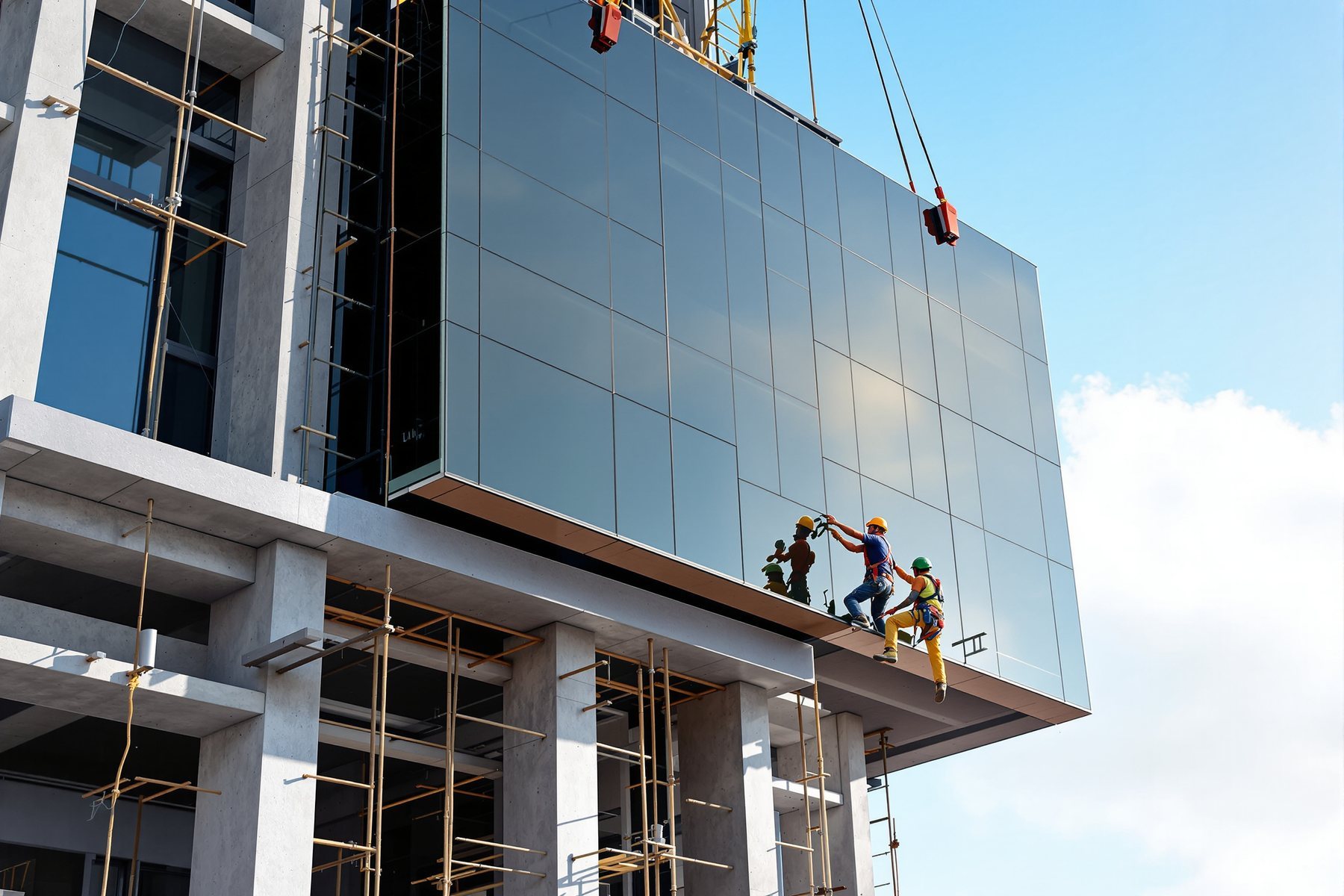
By the time the first panel is craned into place, the most important facade decisions are months — and millions — behind you.
Watching a facade go up looks like the moment it's 'built'. It isn't. By the time a unitized panel swings off the crane, its system was chosen at concept, its performance was specified at developed design, its geometry was frozen at tender, its details were fabricated from shop drawings, and its real-world performance was already proven on a test rig months earlier. The visible installation is the _last_ ten percent. Understanding the whole journey — and which decisions lock at which gate — is what lets an architect or engineer act at the right moment, instead of trying to change a skin that's already in production.
Concept to installation — the facade's journey
Concept → developed design → performance spec → tender
The facade matures through gates. At concept (RIBA Stage 2 / schematic), the system family and the big moves are chosen — glazing ratios, the look, the broad performance ambition. At developed/detailed design (Stage 3–4), the facade engineer writes the performance specification and the typical details, and the geometry, grid and key interfaces are resolved. At tender, the package goes out to specialist facade contractors, who price a defined, frozen design.
The critical idea is that the cost of change rises at every gate. Moving a mullion at concept costs an eraser. Moving it after tender costs a variation. Moving it after the contractor has tooled up for fabrication costs real money and weeks of programme. Each stage trades flexibility for certainty — and a facade decision made at the right gate is cheap, while the same decision one gate too late is expensive.
Every stage is a one-way door. You can always add detail going forward; going back to change a frozen decision is what blows budgets.
The specialist contractor designs for fabrication — and the mock-up proves it before mass production
After award, the specialist facade contractor produces the contractor's design and shop drawings — the fabrication-level detailing of every profile, gasket, bracket and panel — which the facade engineer reviews against the performance spec. Then comes the step that makes facades trustworthy: the mock-up.
A visual mock-up (VMU) confirms appearance — colour, finish, sightlines — on site. A performance mock-up (PMU) is a full section of the real facade built on a test rig and subjected to simulated wind, wind-driven rain, air-pressure and movement, to prove it actually meets the spec before thousands of square metres are fabricated. Finding a water path on a PMU is a cheap, controlled lesson; finding it on the installed building is a leak dispute. The mock-up is the facade industry's single most valuable risk-reduction ritual.
Factory to site to sign-off — and why off-site quality wins
With the design proven, the facade is fabricated — increasingly as unitized panels assembled in a controlled factory, where quality and weather are managed, rather than stick-built piece by piece in the wind and rain on site. Panels are delivered just-in-time (facade logistics — crane access, sequencing, storage — is a real constraint), then installed floor by floor, with site quality checks against the tested benchmark. Finally the facade is handed over with its warranties, and a maintenance and cleaning regime begins that lasts its whole life.
The modern trend is clear: move as much work as possible off-site, into the factory, because a panel built and sealed in controlled conditions and tested before it arrives is dramatically more reliable than one assembled forty floors up. The facade journey is, increasingly, a manufacturing process with a short installation at the end.
Map your facade intentions onto these gates and front-load the decisions that are expensive to change — system, grid, glazing ratio, the look of the joint. Use the mock-up as a design tool, not just a contractual hurdle: standing in front of a full-size PMU is the truest preview of your building you will ever get before it exists, and it's the last cheap moment to adjust appearance. Resist 'we'll sort the facade later' — later is where intent gets value-engineered away.
You drive the spec at developed design, review the contractor's design against it, and own the testing regime. Be ruthless about what the PMU must demonstrate (static and dynamic water, air, structural, movement) and witness it personally. Track every decision to its gate and flag late changes for what they cost. Your reputation is built at the mock-up rig and on the scaffold, confirming the installed skin matches the proven one.
Follow one panel from drawing to wall: the shop drawing defines it, the factory fabricates and seals it, logistics deliver it, the crew installs it to a survey, and QC checks it against the mock-up benchmark. Two ideas to carry: the mock-up is the 'right answer' everything is measured against, and tolerances are reconciled by the brackets — the rough concrete frame and the precise aluminium skin meet at an adjustable connection. That's where the journey becomes physical.
CWCT Standard & Test Methods
Performance mock-up testing
Defines the sequence and pass criteria for facade performance testing (air, water static & dynamic, wind, impact) — the script a PMU is tested to on most premium projects.
ASTM E283 / E331 / E330
Air, water & structural tests
The classic North-American lab test trio — air leakage (E283), water penetration (E331), structural under wind (E330) — often specified alongside or instead of CWCT.
AAMA 501 / 503
Curtain-wall field & lab testing
American Architectural Manufacturers Association methods for testing storefronts and curtain walls, including field water-spray testing of installed facades.
“The facade is sorted out during construction — it's a build problem, not a design-stage problem.”
By the time construction starts, the facade's fate is largely sealed: its system, performance and geometry were decided in design, and the mock-up was tested before mass fabrication. Treating the facade as a construction-stage afterthought is exactly how buildings end up with skins that leak, overheat or blow the budget. The facade is overwhelmingly a design-and-procurement problem with a construction tail — which is why it's engineered long before anyone reaches for a crane.
Worked example — place the decisions on the timeline
The single most useful facade-process skill is knowing which gate locks which decision. Let's build that map for a real-feeling project.
Pen and paper; the five gates from this lesson.
Draw the gates as a line, then drop each decision onto the gate where it MUST be locked:

  CONCEPT -> DEVELOPED DESIGN -> TENDER -> CONTRACTOR DESIGN -> MOCK-UP -> FABRICATION -> INSTALL

  Decisions to place:
   a) curtain wall vs rainscreen system
   b) exact gasket profile & bracket design
   c) glazing ratio & overall grid
   d) glass make-up (IGU spec, coating)
   e) proof that it doesn't leak under wind-driven rain
   f) panel delivery sequence & crane plan
- 1Place (a) system at concept — it shapes everything downstream and is the most expensive thing to change late.
- 2Place (c) glazing ratio & grid at developed design, and (d) glass make-up by tender — these set performance and price and must be frozen for contractors to bid like-for-like.
- 3Place (b) gasket & bracket detail at contractor design / shop drawings — this is fabrication-level detail the specialist contractor owns.
- 4Place (e) the no-leak proof at the mock-up gate — this is exactly what the performance mock-up exists to demonstrate, before fabrication scales up.
- 5Place (f) the crane & delivery plan at fabrication/installation, and then read the line back: notice how the irreversible decisions (system, grid, glass) all sit early, and the executional ones sit late. Acting at the wrong gate is the root of most facade cost overruns.
You’ll walk away with
A facade decision timeline — every key choice mapped to the gate that locks it — so you always know whether a given facade decision is still cheap to change or already frozen.
A closing reflection for the module.
- 01Think of a building you've watched go up. At what point did the facade 'appear'? Now you know that the visible installation was the last act of a year-long engineering process — and you can name the stages that came before it.
A facade is engineered long before it's installed: system at concept, performance at developed design, geometry frozen at tender, fabrication detail in the contractor's shop drawings, and real performance proven on a mock-up before mass production. The cost of change rises at every gate, so the skill is acting on each decision at the right moment — and trusting the mock-up as the benchmark the built facade must match.
Facade gates: concept (system) → developed design (performance spec, grid) → tender (frozen geometry, priced) → contractor design (shop drawings) → mock-up (VMU appearance, PMU performance proof) → fabrication (off-site, unitized) → installation → handover + maintenance. Change gets costlier at every gate; the PMU is the benchmark; off-site factory quality beats site assembly.
What are the stages of facade design and delivery?
Concept (choose the system and big moves), developed/detailed design (write the performance specification and typical details, freeze geometry), tender (specialist facade contractors price a defined design), contractor's design and shop drawings (fabrication-level detailing), mock-up and testing (visual and performance mock-ups prove appearance and performance), fabrication (often off-site unitized panels), installation, and handover with maintenance. Decisions lock progressively at each gate.
What is a facade performance mock-up (PMU)?
A full-size section of the real facade, built on a test rig and subjected to simulated wind, wind-driven rain, air-pressure differences and structural movement, to prove the facade meets its performance specification before mass fabrication begins. It's the facade industry's key risk-reduction step: finding a leak or a weak joint on the mock-up is cheap and controlled, while finding it on the installed building is a costly dispute.
Why are modern facades built off-site as unitized panels?
Because factory conditions produce far more reliable facades than assembling pieces forty floors up in wind and rain. Unitized panels are fabricated, glazed and sealed in a controlled factory, quality-checked, then delivered just-in-time and quickly hung on site. This improves quality and weather-tightness, speeds installation, and reduces site labour and risk — which is why off-site unitized construction dominates tall and premium facades, despite a higher up-front tooling cost.
Peer-reviewed journals & authoritative standards
- 01Su, Z. et al. Multi-Disciplinary Characteristics of Double-Skin Facades ... and Practical Design Considerations. Buildings, 12(10):1576. — Buildings (MDPI), 2022.
- 02Material Selection and Characterization for a Novel Frame-Integrated Curtain Wall. — Materials / NCBI-PMC, 2021.
- 03Ventilated facade system: A review (fabrication, installation and performance of ventilated/unitized systems). — ScienceDirect (Elsevier), 2025.
The author
Amogh N P
Architect, interior designer, and creative polymath. Studio Matrx began in his notebooks — his vision of design made honest, useful, and open to everyone. Its Academy is written and taught in his memory, and free, forever.
More about Amogh →That's the groundwork complete — what a facade is, how it works, who engineers it, and how it's delivered. From here we go deep: Module 1 opens up the facade systems themselves, starting with the curtain wall and the stick-versus-unitized decision at the heart of modern facades.