
B.Arch CurriculumFree, forever
A tribute to Amogh N P
Design Technology & Innovation
The emerging-technology course — digital fabrication, artificial intelligence, virtual and augmented reality, smart homes, 3D printing and technology for sustainability — taught as a designer's critical, working understanding of what these tools really can and cannot do. Its spirit is that technology is a tool that serves design and people, never the master, and its honesty matters most here because technology is sold with hype. It begins with digital fabrication, the file-to-factory workflow that makes physical objects straight from a digital model through additive 3D printing and subtractive CNC and laser cutting and robotic fabrication, and it is clear that this is powerful and precise but bounded by cost, material, scale and skill, and that it complements the craftsman rather than replacing him. It teaches artificial intelligence honestly, that generative AI produces images and options quickly but does not understand space, structure, code or context, that an AI image is not measured, not buildable and not code-compliant as it stands, that AI can hallucinate and carries real questions of bias and of the copyright of its training data, and that AI is therefore an assistant that augments the designer, so the claim that AI will replace the interior designer is a myth, because judgement, taste, coordination, ethics and responsibility remain human, while generative design, in which the computer offers many options and the designer selects, is a genuinely useful method. It presents virtual and augmented reality as real aids to visualising and communicating a design without being a substitute for measured design or real space, and the brain-computer interface as real research that is still early and speculative for design. It looks to the near future through smart homes and automation, real and useful yet overstated when smart is assumed to mean better, since privacy, security, interoperability, complexity and e-waste are real costs and automation should serve the user, and through the 3D printing of buildings, real and promising, as India's own first 3D-printed house and post office show, yet limited today mostly to walls and to immature codes. It treats innovation for sustainability as smart lighting, HVAC controls, sensors and building management that cut energy and operating cost, while insisting that high technology is not automatically green because electronics carry embodied cost and become e-waste and passive, low-tech and vernacular strategies often beat it, so that the most sustainable answer is frequently the simplest. And it ends in the critical evaluation of trends, using the idea of a hype cycle and the discipline of case study and seminar to separate what a technology truly delivers from what it is promised to do. Throughout, technology is treated as a servant of good design and of the people who live with it, adopted for real value rather than novelty.
Course byAmogh N P· Architect & interior designer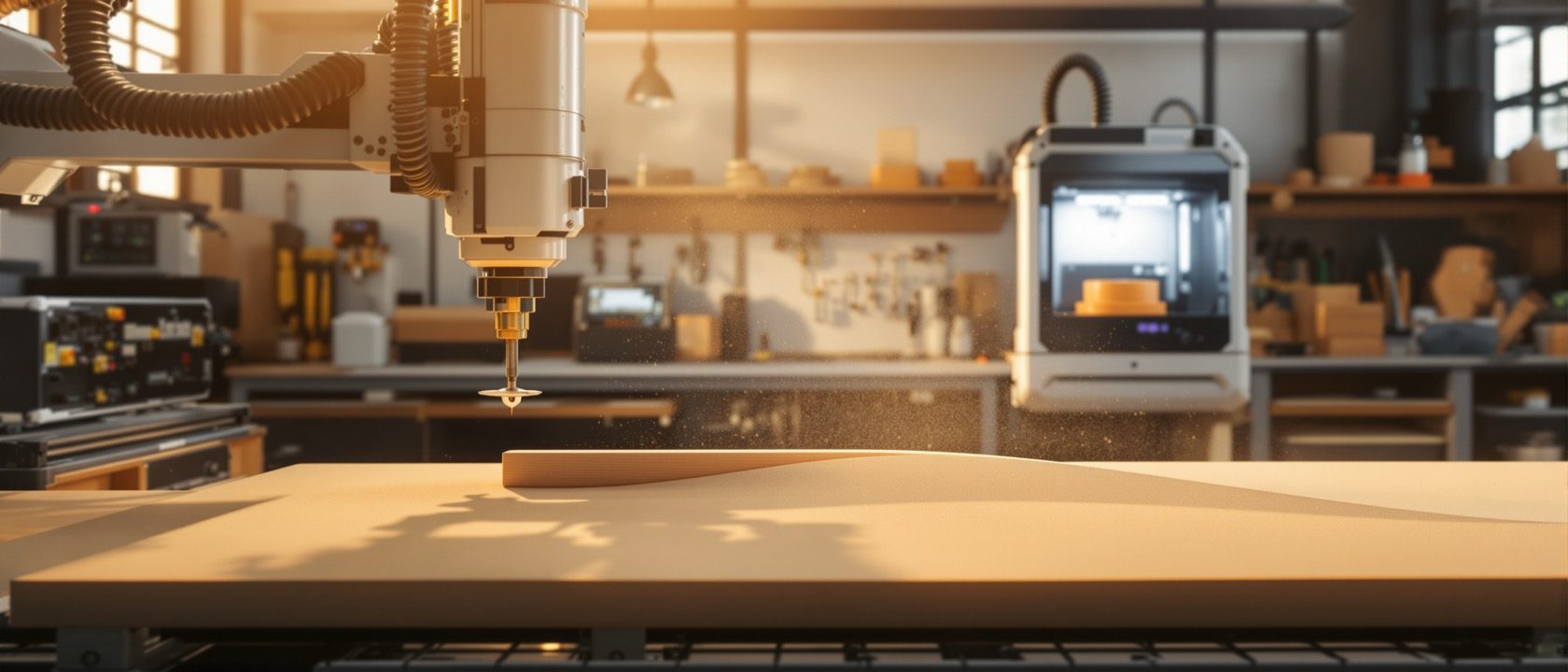
The syllabus
5 units · 5 liveThe emerging-technology course — digital fabrication, artificial intelligence, virtual and augmented reality, smart homes, 3D printing and technology for sustainability. All 5 units are live as full interactive lessons, each with original zoomable diagrams, a self-assessment quiz and a study task — and each honest, past the hype, about what these technologies really can and cannot do: that digital fabrication is powerful but doesn't replace the craftsman; that AI generates images and options but doesn't understand your room, and assists rather than replaces the designer; that VR, smart homes and 3D printing are real and useful yet over-sold; that high-tech is not automatically green, and the simplest answer often wins; and that a designer adopts technology for real value, not novelty. Technology is a tool that serves design and people — never the master.
Unit 1 — Digital Fabrication
LiveIntroduction to digital fabrication — the file-to-factory workflow; additive (3D printing) and subtractive (CNC, laser cutting) methods; robotic fabrication and parametric design; its evolution in interior design; and its honest merits and demerits.
Unit 2 — Artificial Intelligence & Virtual Reality
LiveArtificial intelligence and virtual reality in interior design — AI design tools and what they can and cannot do (hallucination, bias, not buildable as-is); AI as assistant not replacement; generative design; VR and AR; the brain-computer interface; AI for marketing.
Unit 3 — The Future of Interior Design
LiveThe future of interior design — virtual and augmented reality in practice; smart homes and automation (the Matter standard) and their real costs; and 3D printing at building scale, including India's first 3D-printed house and post office, read past the hype.
Unit 4 — Innovation Technology for Sustainable Design
LiveInnovation technology for sustainable design — smart lighting, HVAC controls, sensors and building-management systems that cut energy and cost; sustainable materials and strategies; and the honest nuance that high-tech is not automatically green (embodied cost, e-waste, passive design).
Unit 5 — Case Study & Seminar
LiveCase study and seminar — the hype cycle for reading a trend; analysing a real project's use of technology as a case study; and sharpening critical judgement in seminar, so a designer adopts technology for real value rather than novelty.
Course outcomes
What you will be able to doUnderstand digital fabrication and work on smart digital platforms for interior design.
Explain how digital fabrication can enhance the interior design process, with its merits and limits.
Understand the basics and honest limits of artificial intelligence and virtual reality.
Apply immersive tools, 3D printing and smart-home technology critically in interior design.
Evaluate trending technology and its role in sustainable design through case study.
The author
Amogh N P
Architect, interior designer, and creative polymath. Studio Matrx began in his notebooks — his vision of design made honest, useful, and open to everyone. Its Academy is written and taught in his memory, and free, forever.
More about Amogh →Will AI replace the interior designer?
No — and understanding exactly why is the point of this course. AI generates plausible images and options fast, but it does not understand space, structure, building code, a budget, or a real client and site; an AI render is not measured, not buildable and not code-compliant as it stands; it hallucinates, and it carries real questions of bias and of the copyright of its training data. So AI is an assistant that augments the designer — while judgement, taste, coordination, ethics and responsibility stay human. That honesty runs through the whole course, past the hype: digital fabrication is powerful and precise but has real limits and works with the craftsman, not instead of him; virtual reality, smart homes and 3D printing are real and useful yet over-sold, and India's own first 3D-printed house and post office show both the promise and the limits; high technology is not automatically green, because electronics carry embodied cost and e-waste and passive, low-tech and vernacular strategies often win, so the most sustainable answer is frequently the simplest; and every trend rides a hype cycle a designer must read critically. Read the five units, try the design-tech decoder and the fabrication explorer, and learn to command technology with judgement — because it is a powerful servant and a poor master.
The curriculum is free, forever