
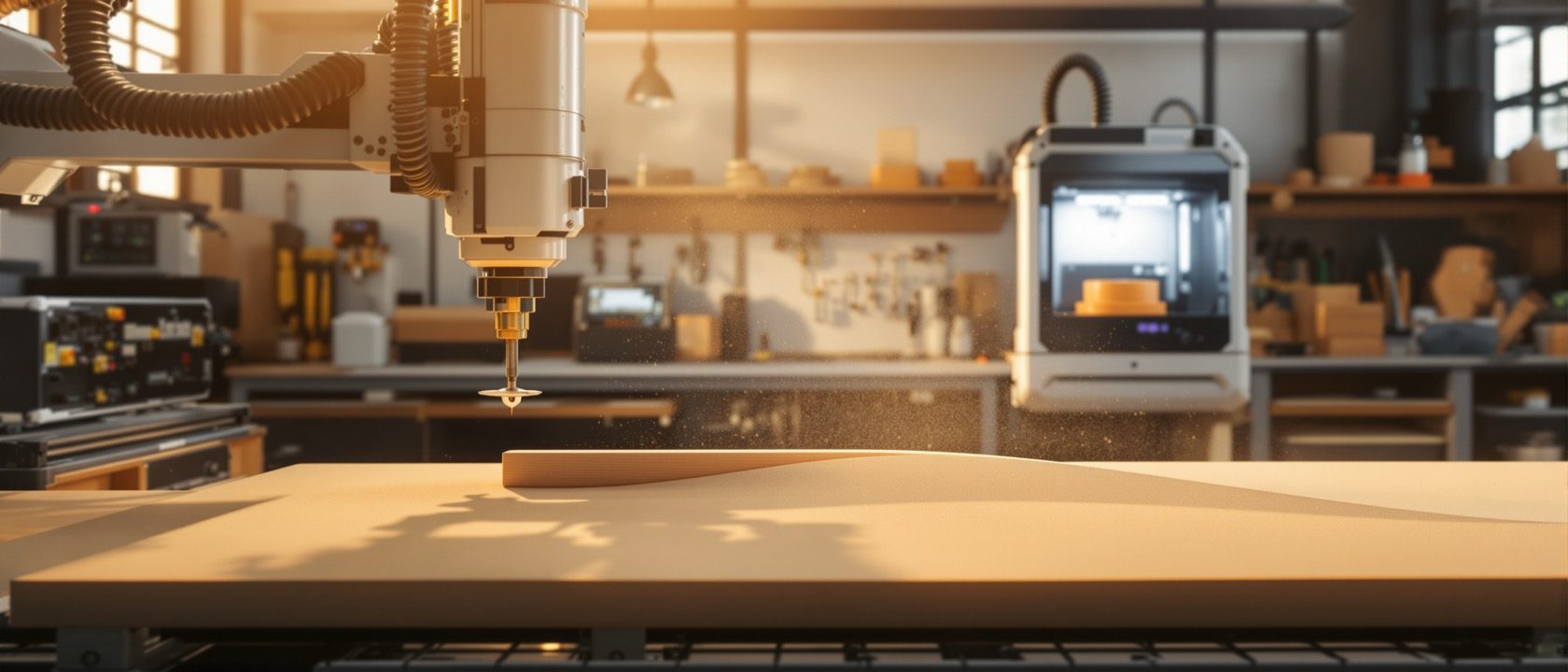
Digital Fabrication
File to factory — powerful, precise, and not magic
Digital fabrication makes a physical object directly from a digital design file — the ‘file-to-factory’ workflow — opening complex, custom forms. It splits into additive (3D printing, building up) and subtractive (CNC and laser, cutting away), and pairs with parametric design. But it is a tool, not magic: its real merits come with real demerits of cost, material, scale and skill, and it does not replace the craftsman — the best work is machine with maker.
Learning objectives
By the end of this lesson, you will be able to — mapped to the course outcomes for Design Technology & Innovation:
Explain digital fabrication and the file-to-factory workflow.
Distinguish additive and subtractive methods — 3D printing, CNC, laser.
Weigh the merits and demerits of digital fabrication, and its relation to craft.
File to factory
Digital fabrication makes an object straight from a digital file with computer-controlled machines. It splits into additive (3D printing) and subtractive (CNC, laser) — and ‘digital fab means 3D printing’ is a myth: most interior fabrication is subtractive. Choosing the right process is the real skill.[1]
From the model to the made thing
DIGITAL FABRICATION makes a physical object directly from a digital design FILE, using computer-controlled machines — the 'file-to-factory' workflow. You model a form, and a machine cuts, carves or builds it, precisely and repeatably. It has grown from industry into interior design and making, opening a NEW REALM of design expression: complex, curved, patterned and customised forms that would be impractical to draw and build by hand. But it is a TOOL, not magic — its power comes with real constraints, and understanding both the possibility and the limit is the mark of a designer who can actually use it.[1, 2]
Fabrication explorer · each method suits different work
CNC router / mill
Subtractive — cuts material away
- Materials:
- Wood, MDF, plywood, acrylic, foam, soft metals, stone
- Strengths:
- Precise, repeatable cutting, carving and shaping of sheet and block material
- Real limits ·
- Wastes the cut-away material; limited by tool reach and axes; needs fixturing and skill
None is magic — choosing the right process for the material, form and purpose is the real skill.
Design-tech decoder · the vocabulary of design technology
Digital fabrication, AI, immersive & smart, and sustainable tech — graded VERIFIED, NUANCED or MYTH.
Digital fabrication
File to factory
Means: Making physical objects directly from a digital design file with computer-controlled machines — CNC routing, laser cutting, 3D printing and robotic fabrication ('file-to-factory').
Honestly · It lets a designer build complex, precise and customised forms straight from the model. But it is a tool with real limits — cost, material, scale, skill — not magic, and it complements craft rather than erasing it.
Additive vs subtractive
Build up, or cut away
Means: ADDITIVE fabrication builds an object up layer by layer (3D printing); SUBTRACTIVE fabrication cuts material away from a block or sheet (CNC routing, laser cutting).
Honestly · Each suits different work: additive makes complex hollow geometry with little waste; subtractive is fast and strong in sheet material. Choosing the right process for the job is the real skill.
CNC machining
Precise computer cutting
Means: Computer Numerical Control — a machine (router, mill) cuts, carves or drills a material along a precise digital path, repeatably.
Honestly · Excellent for precise, repeatable cutting and carving of wood, MDF, acrylic and metal. Limited by tool access, axes and the subtractive waste it produces — powerful, not limitless.
3D printing
Additive, layer by layer
Means: Building an object up in thin layers from a digital model — in plastic and resin at small scale, and in concrete for building-scale construction.
Honestly · NUANCED: superb for complex one-off geometry and prototypes, and real at building scale (India's own first 3D-printed house and post office). But it is slow, size- and material-limited, and 'it can print anything, and will replace construction' is overstated hype.
Parametric design
Design by rules
Means: Designing with parameters and rules (in tools like Rhino/Grasshopper) so a form can be generated and varied by changing values, and fed straight to fabrication.
Honestly · It enables complex, adaptable and mass-customised forms that would be impractical to draw by hand. But a parametric model is only as good as its logic and its designer's judgement — cleverness is not the same as good design.
Generative AI
Generates images & options
Means: AI tools that generate design images, renders and layout options from a prompt or brief — text-to-image models and interior-render tools.
Honestly · NUANCED and useful for fast ideas, moods and options. But AI generates IMAGES, not designs: its output is not measured, not buildable and not code-compliant as it stands, and it must be judged, corrected and made real by the designer.
'AI will replace designers'
It assists, it doesn't replace
Means: The claim that AI will make the interior designer obsolete.
Honestly · A MYTH. AI augments the designer — speeding ideas, renders and routine work — but judgement, taste, context, coordination, ethics and responsibility stay human. AI does not understand space, a client, a budget or a building code; a person must.
AI hallucination & bias
Plausible is not true
Means: AI models can produce confident output that is wrong, impossible or biased — a beautiful render of a room that cannot be built, or that repeats the biases of its training data.
Honestly · AI output is plausible, not verified. Every AI result must be checked against reality — measurement, structure, code, cost and sense — and its bias and the copyright of its training data are real, unresolved concerns.
Generative design
Many options, human selects
Means: A method where the computer generates MANY design options against goals and constraints, and the designer explores and SELECTS from them.
Honestly · A genuinely useful method: the machine explores a huge option space fast; the human sets the goals and picks and refines with judgement. The designer stays the author; the tool widens the search.
Brain-computer interface
Real research, early days
Means: Technology that reads brain signals to control a computer — from non-invasive EEG headsets to implanted devices in human trials.
Honestly · NUANCED: real, fast-moving research, but early and speculative for interior design. Treat it as a horizon to watch, not a present-day design tool — and separate the genuine science from the hype around it.
VR & AR
Immersive design
Means: Virtual Reality immerses a viewer inside a designed space (a headset walkthrough); Augmented Reality overlays design on the real world (placing furniture in a room through a phone).
Honestly · Genuinely valuable for visualising and communicating a design, and for client buy-in. But VR is not the real built space — it does not replace measured design, real materials or true spatial experience, and hardware cost limits its reach.
Smart home & IoT
Connected automation
Means: Connected devices — lighting, climate, security, sensors — controlled and automated through a hub, an app or voice, increasingly on a common standard (Matter).
Honestly · NUANCED: real convenience, comfort and efficiency, but 'smart means better' is overstated. Privacy and data security, devices that don't work together, complexity and e-waste are real costs — automation should serve the user, not be a gimmick.
3D-printed construction
Real, but limited today
Means: Building at scale by extruding concrete layer by layer from a large printer — used for walls and small structures (India built its first 3D-printed house and post office this way).
Honestly · NUANCED: a real, promising technology, fast for certain walls and forms. But today it mostly prints walls (roofs, services and finishes are conventional), codes and standards are immature, and 'it will replace all construction' is hype.
Smart efficiency
Cutting energy & cost
Means: Smart lighting, HVAC controls, occupancy sensors, energy monitoring and building-management systems that reduce a building's energy use and operating cost.
Honestly · A real, worthwhile use of technology: automatically dimming, switching off and tuning systems to actual use saves energy and money. Best when it makes a well-designed building run better — not a patch on a badly-designed one.
'High-tech = sustainable'
Often the simple wins
Means: The assumption that more technology automatically makes a building greener.
Honestly · NUANCED, and often false: electronics carry embodied energy and become e-waste, and PASSIVE, low-tech and vernacular strategies — orientation, shading, thermal mass, ventilation — frequently beat high-tech. The most sustainable answer is often the simplest.
The hype cycle
Read trends critically
Means: The pattern by which new technology is over-hyped (a peak of inflated expectations), then dismissed (a trough of disillusionment), before finding its real, useful place (a plateau of productivity).
Honestly · A tool for thinking clearly about any new technology: ask where on the curve it sits, and what it truly delivers versus what is promised. A designer adopts technology for real value, not for novelty.
Technology is a powerful servant and a poor master — adopt it for real value, not novelty.
Parametric, and the honest balance
Digital fabrication pairs with parametric design (rules and parameters) to enable mass customisation — but a model is only as good as its logic. Its real merits (precision, complex form, iteration) come with real demerits (cost, material, scale, skill); ‘cheap, fast and easy’ is a myth.[1, 2]
Design that feeds the machine
Digital fabrication pairs with PARAMETRIC design — designing with rules and parameters (in tools like Rhino and Grasshopper) so a form can be generated, varied and optimised by changing values, then sent straight to the machine. This lets a designer produce complex, adaptable and MASS-CUSTOMISED work — every piece different, yet all made from one logic. But a parametric model is only as good as its LOGIC and the designer's judgement: cleverness is not good design, and a fabrication workflow amplifies a bad idea as faithfully as a good one. The technology serves the design intent, not the reverse.[1]
It doesn't replace craft
‘Digital fabrication replaces the craftsman’ is a myth. The machine is precise but not wise — the best work pairs digital precision with human craft (in India, machine with karigar). The question is never ‘what can the machine do?’ but ‘what does the design need?’[1, 2]
Machine and maker together
'Digital fabrication replaces the craftsman' is a MYTH. The machine is precise but not wise: it needs a designer to model well, a maker to set up, finish and assemble, and craft judgement to turn a cut or printed part into a good object. The best work pairs digital precision with human CRAFT — a CNC-cut joint finished by hand, a printed form cast in a traditional material. In India especially, where craft skill is deep and alive, the future is not machine INSTEAD of karigar but machine WITH karigar, each doing what it does best. Technology extends the hand; it does not amputate it.[1, 2]
At a glance
| Aspect | The fact | The folklore |
|---|---|---|
| Digital fabrication is | Making objects from a digital file — file-to-factory | A magic box that makes anything free |
| The two families | ADDITIVE (3D print, build up) and SUBTRACTIVE (CNC, laser, cut away) | All the same thing |
| The skill is | Choosing the right process for the job | Using the newest machine |
| Its merits come with | Real demerits — cost, material, scale, skill | No downsides |
| It relates to craft by | Working WITH the craftsman — machine and maker | Replacing the craftsman |
| The question is | What does the design need? | What can the machine do? |
Key terms
Making physical objects directly from a digital file with computer-controlled machines — CNC, laser, 3D printing, robotic fabrication; the 'file-to-factory' workflow.
Additive builds an object up in layers (3D printing); subtractive cuts material away from a block or sheet (CNC routing, laser cutting) — each suited to different work.
Computer Numerical Control — a machine cuts, carves or drills along a precise digital path, repeatably, in wood, MDF, acrylic, metal and more.
Designing with rules and parameters so a form can be generated and varied by changing values, and fed straight to fabrication — only as good as its logic.
Making many pieces each different, yet all from one parametric logic and one fabrication process — a possibility digital fabrication opens.
The honest balance — precision, complex form and fast iteration against cost, material and scale limits and the skill required; a capable tool, not magic.
Study task
Take one interior element — a screen, a light, a piece of furniture, a wall feature — and plan how you would make it with digital fabrication. Decide which method fits (use the fabrication explorer): would you 3D-print it, CNC-route it, laser-cut it, or use a robotic process, and why? List its real merits for this job and its honest demerits (cost, material, scale, skill). Then say exactly where human craft would still be needed — finishing, assembly, judgement. Grade three claims you have heard about digital fabrication as VERIFIED, NUANCED or MYTH using the decoder. The goal is to use the technology for what the design genuinely needs, not for novelty.
Self-assessment
1. What is digital fabrication?
2. What is the difference between additive and subtractive fabrication?
3. Does digital fabrication replace the craftsman?
4. What is the honest question to ask before using digital fabrication?
Recap
References & further reading
- [1]Digital fabrication in interior design and architecture — CNC, 3D printing, laser cutting, robotic fabrication and parametric design (Jonathon Anderson & Lois Weinthal (eds.), Digital Fabrication in Interior Design: Body, Object, Enclosure, Routledge, 2022). https://www.routledge.com/
- [2]Digital design and making — the file-to-factory workflow and its merits and limits (digital-fabrication and design-technology references). https://www.routledge.com/
Further reading
- Jonathon Anderson & Lois Weinthal (eds.), Digital Fabrication in Interior Design: Body, Object, Enclosure.
- Lisa Iwamoto, Digital Fabrications: Architectural and Material Techniques.
- Fabricate (research series on digital fabrication).
Sources gathered and fact-checked June 2026. Published values vary by source, sample and method — treat as indicative and confirm against the cited standard before structural use.
The author
Amogh N P
Architect, interior designer, and creative polymath. Studio Matrx began in his notebooks — his vision of design made honest, useful, and open to everyone. Its Academy is written and taught in his memory, and free, forever.
More about Amogh →