
The Future of Interior Design
VR/AR, smart homes and 3D printing — real, and overhyped
The near-future technologies — VR/AR, smart homes and 3D printing — are real and useful, and over-sold. VR and AR let a client see a design before it’s built, but aren’t the real space. ‘Smart means better’ is a nuanced half-truth — privacy, security, complexity and e-waste are real costs. And 3D-printed construction is real (India’s own first 3D-printed house and post office) but limited today, mostly to walls. Every ‘future’ tech finds its true value once the hype settles.
Learning objectives
By the end of this lesson, you will be able to — mapped to the course outcomes for Design Technology & Innovation:
Describe VR and AR uses and the honest limits of immersive design.
Weigh smart-home automation against privacy, security, complexity and e-waste.
Explain the real, promising but limited state of 3D-printed construction.
VR and AR in practice
VR lets a client walk through a design at full scale before a wall is built; AR places design in the real room through a phone. Both are powerful for design review and client communication — but they show a design, they don’t test its reality; a window onto the design, not the design itself.[1]
Seeing before building
VIRTUAL and AUGMENTED REALITY are moving from novelty into everyday interior practice. VR lets a client WALK THROUGH a design at full scale before a wall is built, catching problems and building confidence that no drawing can. AR overlays design on the real world — seeing a chosen sofa, colour or layout in your ACTUAL room through a phone or tablet. Both are powerful for DESIGN REVIEW and client communication, and increasingly affordable. The honest caveat remains: they SHOW a design, they do not test its reality — measurement, materials, structure and code still have to be got right in the real world. A window onto the design, not the design itself.[1]
Smart homes, honestly
The smart home connects and automates lighting, climate, security and sensors (increasingly on the Matter standard). Real benefits — but ‘smart means better’ is a nuanced half-truth: privacy, security, interoperability, complexity and e-waste are real costs. Automation should serve the user, not be a gimmick.[2]
Connected, and convenient
The SMART HOME connects devices — lighting, climate, security, blinds, sensors — and controls and automates them through a hub, an app or voice, increasingly on a common standard (Matter) so devices from different makers can work together. Real benefits follow: convenience, comfort, security and energy saving, and support for the elderly and differently-abled. As a designer you increasingly PLAN for this — wiring, device locations, controls — as part of the interior. Done well, automation quietly serves the people who live there. The skill is to design it around real needs and habits, not to bolt on gadgets for their own sake.[2]
3D-printed construction
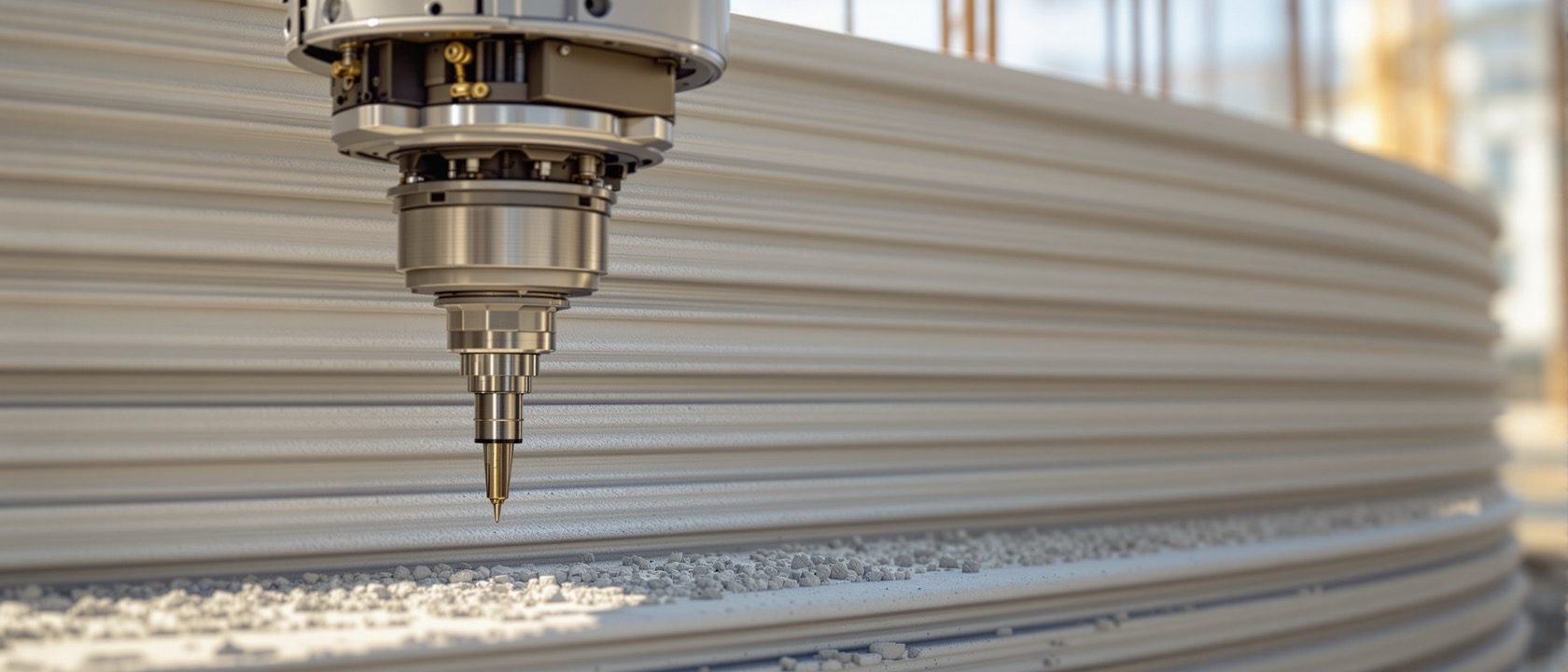
3D printing at building scale (extruding concrete) is real and advancing — India built its first 3D-printed house (2021) and post office (2023). But it’s limited today: mostly walls, with roofs, services and finishes conventional and codes immature. ‘It will replace all construction’ is hype.[3]
Real, promising, limited
3D PRINTING at BUILDING scale — extruding CONCRETE layer by layer from a large printer — is real and advancing. India has built its own firsts: the first 3D-printed HOUSE (IIT Madras with Tvasta, about 600 sq ft, 2021) and a 3D-printed POST OFFICE (Bengaluru, L&T, 2023, structurally validated by IIT Madras and approved by BMTPC), showing the technology works here. It is fast for certain curved or complex WALLS, and cuts formwork and some labour. But it is LIMITED today: it mostly prints walls, while roofs, services, doors, windows and finishes stay conventional; there is no settled Indian Standard code for it yet (projects are validated case by case); and it suits some jobs, not all.[3]
At a glance
| Aspect | The fact | The folklore |
|---|---|---|
| VR and AR | Show a design before it's built — a window onto it | Test or replace its reality |
| The smart home | Real convenience, comfort, security, energy saving | Always and simply 'better' |
| Smart's real costs | Privacy, security, interoperability, complexity, e-waste | None worth worrying about |
| Automation should | Serve the user simply and reliably | Impress with gadgetry |
| 3D-printed construction is | Real, promising, but mostly walls, codes immature | About to replace all building |
| Every 'future' tech is | Real, over-sold at first, then finds its true value | Exactly as hyped |
Key terms
Using virtual reality to walk through a design at scale, and augmented reality to overlay design on the real room — powerful for design review and client communication, not a test of reality.
Connected, automated devices (lighting, climate, security, sensors) controlled by hub, app or voice, increasingly on a common standard (Matter) so they interoperate.
An industry standard (from the Connectivity Standards Alliance) intended to let smart-home devices from different makers work together — addressing the interoperability problem.
The honest downsides of automation — privacy and data security, devices that don't interoperate, complexity, and the e-waste of short-lived electronics.
Building at scale by extruding concrete layer by layer — real and advancing (India's first 3D-printed house and post office), but today mostly walls, with immature codes.
Separating a technology's genuine promise from its over-sold claims — each 'future' tech is real, over-hyped at first, and finds its true value once the excitement settles.
Study task
Pick one of the three technologies — VR/AR, the smart home, or 3D-printed construction — and evaluate it honestly for a real interior project. Say what it would genuinely deliver (a client walkthrough, automated lighting, a fast curved wall), and then its real limits and costs (it’s not the real space; privacy and e-waste; only walls, immature codes). Find one real example (for 3D printing, India’s printed house or post office). Finally, decide: would you use it here, and why — separating the genuine promise from the hype. The goal is to adopt the reality, not the advertisement.
Self-assessment
1. What are VR and AR genuinely good for in interior design?
2. Is 'smart means better' true for the home?
3. What is the honest state of 3D-printed construction today?
4. What pattern do VR, smart homes and 3D printing share?
Recap
References & further reading
- [1]Virtual and augmented reality in interior design and design review (VR/AR in architecture and design references; furniture AR such as IKEA Place). https://www.oreilly.com/
- [2]Smart homes, IoT and home automation — the Matter standard (Connectivity Standards Alliance) and the honest costs of privacy, security, interoperability and e-waste. https://csa-iot.org/
- [3]3D printing in construction — concrete extrusion and India's first 3D-printed house (IIT Madras / Tvasta) and post office (Bengaluru); its real state and limits (confirm current specifics). https://www.iitm.ac.in/
Further reading
- Neil Leach, Architecture in the Age of Artificial Intelligence.
- Jenifer Tidwell et al., Designing Interfaces.
- Current sources on 3D-printed construction and the Matter smart-home standard.
Sources gathered and fact-checked June 2026. Published values vary by source, sample and method — treat as indicative and confirm against the cited standard before structural use.
The author
Amogh N P
Architect, interior designer, and creative polymath. Studio Matrx began in his notebooks — his vision of design made honest, useful, and open to everyone. Its Academy is written and taught in his memory, and free, forever.
More about Amogh →