
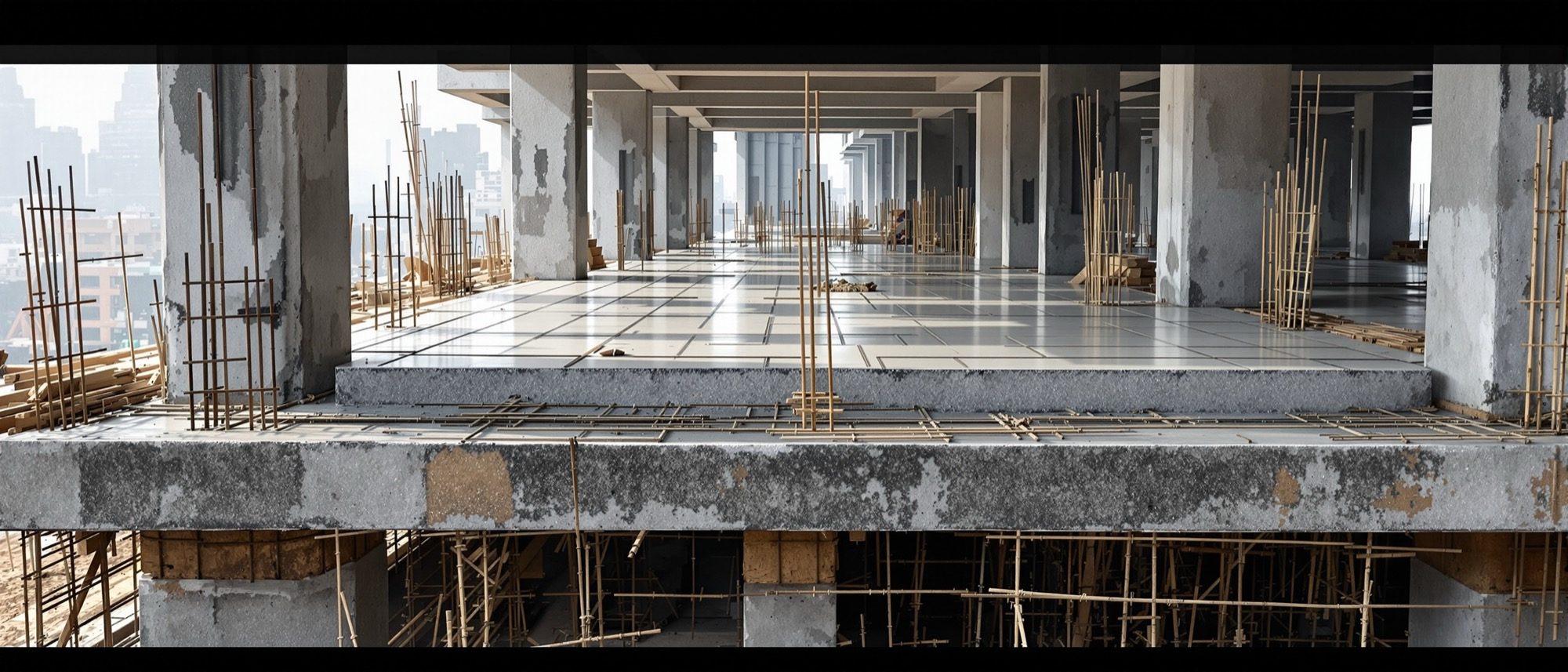
Special RCC Slabs & Footings
Beyond the ordinary slab — the circle, the beamless floor and the raft.
Beyond the ordinary beam-and-slab floor lie three special RCC elements an architect should recognise: the circular slab, the beamless flat slab, and the raftfoundation. This unit treats them at concept level — what they are, where they are used, and the main idea behind each. The detailed reinforced-concrete design lives in Design of Structures I.
Learning objectives
By the end of this lesson, you will be able to — mapped to the course outcomes for Design of Structures I:
Describe the circular slab and its radial and circumferential moments.
Explain the flat slab — beamless, on drops and column heads — and the IS 456 direct-design conditions.
Say when a raft foundation is used and name its types.
Choose the right special element for a situation and cross-link its detailed design.
Special slabs
A circular slab works in radial and circumferential moments (round tank covers, roofs); a flat slab is carried directly on columns with no beams, on drops and column heads, to give clear soffits and more headroom (IS 456 Clause 31).[1, 2]
Radial and ring moments
A slab spanning over a circular boundary develops two moments — radial (along the radii) and circumferential/tangential (along the rings). It is reinforced to suit both, with top steel near a fixed edge for the hogging radial moment. Used for circular tank covers and bottoms and round roofs.[1]
The raft foundation
A raft (mat) is one large slab under the whole building, used when the soil is weak, loads are heavy, or isolated footings would cover more than about half the plan — spreading the load and evening out settlement.[3]
Weak soil, heavy loads
A raft (mat) foundation is one large slab under the whole building. It is used when the safe bearing capacity is low, loads are heavy or columns closely spaced, or when isolated footings would cover more than about half the plan area — and to even out differential settlement.[3]
At a glance
| Aspect | One | The other |
|---|---|---|
| Slab support | Flat slab: directly on columns, no beams | Conventional: slab on beams on columns |
| Flat-slab variants | Flat slab: has drops/column heads | Flat plate: neither — relies on slab thickness |
| Foundation choice | Isolated footing: SBC adequate, footings < ~50% plan | Raft: low SBC / heavy loads / footings > ~50% plan |
| Circular slab moments | Radial — along the radii | Circumferential — along the rings |
| This course vs DoS-I | BMC-IV: concept and identification | Design of Structures I: detailed RCC design |
Key terms
A slab over a round boundary, analysed in radial and circumferential moments.
A beamless slab carried directly on columns (IS 456 cl. 31).
A flat slab with no drops or column heads.
A local thickening of a flat slab over a column to resist punching shear (≥ 1/3 panel each way).
A flared column top that enlarges the slab support and shear perimeter.
The two-way shear that tends to push a column through the slab, checked at d/2 from the column.
One slab under the whole building, spreading all loads onto the soil.
An IS 456 shortcut for regular flat-slab layouts meeting set span and load conditions.
Studio task
For a small office on weak soil, decide whether to use isolated footings or a raft, and justify it in two lines. Then sketch a flat-slab floor plate, marking the drops and column heads, and say what they are fighting.
Self-assessment
1. A flat slab is supported —
2. A drop in a flat slab must have a length each way of at least —
3. A raft foundation is most appropriate when —
Recap
References & further reading
- [1]Circular slabs — radial and circumferential (tangential) moments (RCC design references).
- [2]IS 456:2000 — Plain and Reinforced Concrete (Clause 31, flat slabs). Bureau of Indian Standards.
- [3]Raft (mat) foundations — use, types and design requirements (foundation engineering references).
- [4]Studio Matrx — Design of Structures I (detailed RCC member design). https://www.studiomatrx.org/students/design-of-structures-1
Further reading
- N. Krishna Raju, Advanced Reinforced Concrete Design — circular slabs and flat slabs.
- B.C. Punmia et al., R.C.C. Designs — flat slabs and raft foundations.
- S.U. Pillai & Devdas Menon, Reinforced Concrete Design.
Sources gathered and fact-checked June 2026. Published values vary by source, sample and method — treat as indicative and confirm against the cited standard before structural use.
The author
Amogh N P
Architect, interior designer, and creative polymath. Studio Matrx began in his notebooks — his vision of design made honest, useful, and open to everyone. Its Academy is written and taught in his memory, and free, forever.
More about Amogh →