
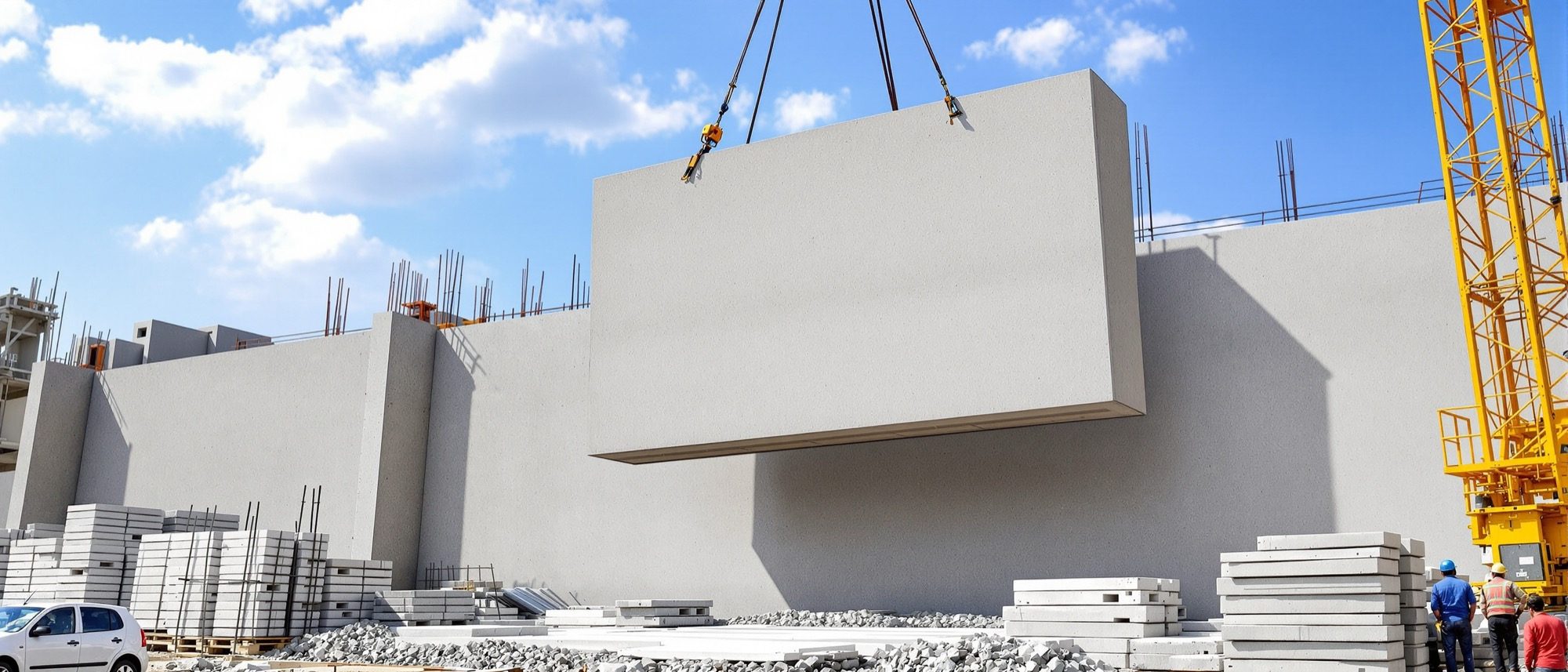
Pre-Fabrication Technology
Build it in a factory, assemble it on site — and design the joints.
Why build everything in place when you can build it in a factory? Pre-fabricationmanufactures components off-site under controlled conditions, then transports and assembles them — faster, cleaner and more consistent, but limited by transport and handling. Learn its types, from precast columns to 3D volumetric modules, and the make-or-break issue: the detailing of joints, where leakage and structural integrity are won or lost.
Learning objectives
By the end of this lesson, you will be able to — mapped to the course outcomes for Design of Structures I:
Explain what pre-fabrication is and its advantages and limitations.
Identify the types — precast components, panels, 3D volumetric/modular, tilt-up.
Compare wet and dry joints and why detailing is the critical issue.
Describe where pre-fabrication suits Indian construction.
What, why and the types
Pre-fabrication brings factory speed and quality to building, at the cost of transport limits and reduced flexibility. Its forms run from precast components and panels to 3D volumetric/modular units and on-site tilt-up.[1, 2]
The joint is the engineering
A wet joint (site-poured grout/concrete, e.g. a grout sleeve) is near-monolithic but needs curing; a dry joint (bolted/welded) is fast but generally weaker. Detailing — tolerances, sealing, sequence — is the real engineering of prefab.[3]
Cast-in-situ continuity
A wet joint is completed by site-poured concrete or high-grade grout — for example a grout-sleeve connection, where rebar projecting from one element seats into sleeves in the next and is grouted to imitate monolithic behaviour. Strong and continuous, but it needs curing time.[3]
At a glance
| Aspect | One | The other |
|---|---|---|
| Where made | Precast: factory-cast, quality-controlled, fast | Cast-in-situ: poured on site, monolithic, flexible but slower |
| Two joints | Wet: grout/concrete-filled, near-monolithic, needs curing | Dry: bolted/welded, fast follow-on, generally weaker |
| Two ways to precast | Off-site: in a remote factory | Tilt-up: cast flat on site, tilted upright |
| The trade | Speed + quality + less waste | Transport limits, handling, joint design, less flexibility |
| What is the real engineering | Not the panels — the joints | Integrity across connections governs |
Key terms
Manufacturing building components off-site in a factory, then assembling them on site.
Concrete elements cast and cured in moulds before placement (vs cast-in-situ).
Concrete pre-compressed by tensioned tendons, allowing longer, slimmer spans.
Fully three-dimensional factory-finished units — bathroom pods, room modules.
A precast connection completed by site-poured concrete or grout — near-monolithic.
A precast connection made by bolting or welding — fast but generally weaker.
Wall panels cast flat on site, then tilted upright by crane.
Projecting rebar seated into grout-filled sleeves to splice precast elements.
Studio task
For a row of identical low-cost houses, list three components you would prefabricate and say why. Then sketch one wet and one dry joint between two precast panels, and note which you would trust against water leakage.
Self-assessment
1. A wet joint between precast elements is completed by —
2. Tilt-up construction means panels are —
3. The most commonly reported weak point of prefabricated buildings is —
Recap
References & further reading
- [1]Prefabrication in building construction — an Indian perspective (NBM&CW; BMTPC literature).
- [2]Pre-fabrication — advantages and disadvantages (standard construction references).
- [3]Precast concrete joints and connections — wet and dry, detailing (industry references).
- [4]Roy Chudley & Roger Greeno, Building Construction Handbook. Routledge, 2010.
Further reading
- Roy Chudley & Roger Greeno, Building Construction Handbook.
- B.C. Punmia et al., Building Construction.
- BMTPC literature on emerging prefab technologies for mass housing (India).
Sources gathered and fact-checked June 2026. Published values vary by source, sample and method — treat as indicative and confirm against the cited standard before structural use.
The author
Amogh N P
Architect, interior designer, and creative polymath. Studio Matrx began in his notebooks — his vision of design made honest, useful, and open to everyone. Its Academy is written and taught in his memory, and free, forever.
More about Amogh →