
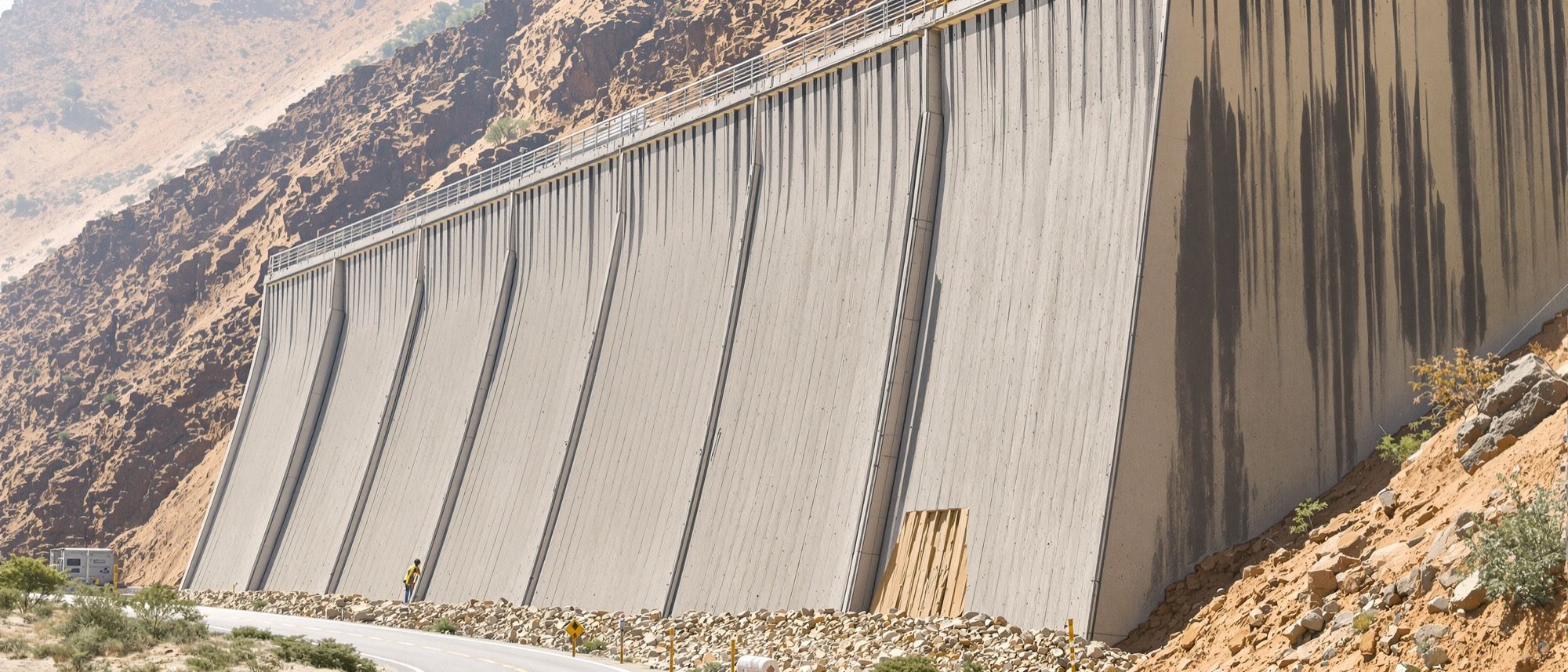
Retaining Walls
Holding back the earth — pressure, and the three ways a wall can fail.
A retaining wall holds back a difference in ground level against the relentless lateral push of the soil. Learn the types — gravity, cantilever and, for taller walls, counterfort — the earth pressurethat drives them (Rankine's Ka, a triangular pressure giving a thrust at one-third the height), and the heart of the design: the three stability checks against overturning, sliding and base bearing.
Learning objectives
By the end of this lesson, you will be able to — mapped to the course outcomes for Design of Structures I:
Distinguish gravity, cantilever and counterfort retaining walls and where each is used.
Compute the active earth pressure coefficient Ka and the total thrust Pa, and locate it at H/3.
Check a wall for overturning, sliding and base bearing against the standard factors of safety.
Identify the parts of a cantilever wall and how a counterfort wall differs.
Types, and the pressure
Gravity walls resist by mass; cantilever walls (stem + base) by flexure, up to ~6–7 m; counterfort walls add earth-side webs for taller heights. Soil pushes with active pressure (Ka) and resists with passive (Kp).[1, 3]
The three stability checks
The thrust Pa = ½·Ka·γ·H² acts at H/3. Check the wall against overturning (FoS ≥ 2.0), sliding (FoS ≥ 1.5) and base bearing (resultant in the middle third, toe pressure ≤ SBC).[3, 4]
Ka, and the thrust
Rankine's active coefficient for level backfill is Ka = (1 − sinφ)/(1 + sinφ). The pressure grows linearly with depth (p = Ka·γ·z), so the total active thrust per metre is Pa = ½·Ka·γ·H², acting at H/3 above the base — not mid-height.[3]
Retaining-wall calculator
Set the wall height, soil unit weight and friction angle to get Ka, the active thrust Pa and the overturning moment. A 5 m wall in soil of γ = 18 kN/m³ and φ = 30° gives Ka = 0.333 and Pa = 75 kN/m at 1.67 m.[3]
Retaining wall · earth pressure & overturning
Rankine Ka = (1−sinφ)/(1+sinφ); thrust Pa = ½·Ka·γ·H² acting at H/3; overturning moment Mo = Pa·H/3.
0.0 kN/m
Active thrust Pa (per m run)
0.000
Active coefficient Ka
0.00
Passive Kp = 1/Ka
0.0 kN/m²
Pressure at base
0.0 kNm/m
Overturning moment Mo
The wall is safe when resisting moment ≥ 2·Mo (overturning) and sliding FoS ≥ 1.5 (IS 14458).
At a glance
| Aspect | One | The other |
|---|---|---|
| Two types | Cantilever: stem bends vertically (≤ ~6–7 m) | Counterfort: stem spans horizontally between webs (taller) |
| Two pressures | Active (Ka < 1): the driving thrust | Passive (Kp > 1): the resisting pressure at the toe |
| Two failures | Overturning: rotation about the toe (FoS ≥ 2.0) | Sliding: horizontal translation (FoS ≥ 1.5) |
| Two base parts | Heel: rear, soil weight aids stability | Toe: front, high upward bearing pressure |
| Point of thrust | Pa acts at H/3 from the base | (Surcharge thrust acts at H/2) |
Key terms
A structure resisting the lateral pressure of soil where ground levels differ.
Pressure as the wall yields away from the soil — the driving thrust; Ka = (1−sinφ)/(1+sinφ).
Resistance as the wall pushes into the soil; Kp = 1/Ka.
The soil shear-strength parameter that sets Ka and Kp.
The vertical slab / rear base under backfill / front base projection of a cantilever wall.
A transverse web on the earth side tying stem to heel, acting as a tension T-beam.
A downward projection under the base that mobilises passive resistance against sliding.
The resultant must fall within the central third of the base (e ≤ b/6) so the heel has no tension.
Worked example
A 5 m cantilever wall, soil γ = 18 kN/m³, φ = 30°: Ka = (1−sin30)/(1+sin30) = 0.333; Pa = ½ × 0.333 × 18 × 5² = 75 kN/m, acting at H/3 = 1.67 m; overturning moment Mo = 75 × 1.67 = 125 kNm/m. The resisting moment from the wall and backfill must be at least 2 × 125 = 250 kNm/m for overturning safety.
Self-assessment
1. For level backfill with φ = 30°, the Rankine active coefficient Ka is —
2. The total active thrust on a retaining wall acts at what height above the base?
3. The minimum factors of safety against overturning and sliding (static) are —
Recap
References & further reading
- [1]Types of retaining walls — gravity, cantilever, counterfort, buttress (standard construction references).
- [2]B.C. Punmia, Ashok Kumar Jain & Arun Kumar Jain, R.C.C. Designs (retaining walls). Laxmi Publications.
- [3]Rankine's theory of active and passive earth pressure (soil mechanics).
- [4]IS 14458 (Part 2):1997 — Retaining wall for hill area, design (factors of safety 2.0 overturning, 1.5 sliding). Bureau of Indian Standards.
Further reading
- B.C. Punmia et al., R.C.C. Designs — the retaining-wall chapters.
- S. Ramamrutham, Design of Reinforced Concrete Structures.
- N. Krishna Raju, Reinforced Concrete Design (Limit State Method).
Sources gathered and fact-checked June 2026. Published values vary by source, sample and method — treat as indicative and confirm against the cited standard before structural use.
The author
Amogh N P
Architect, interior designer, and creative polymath. Studio Matrx began in his notebooks — his vision of design made honest, useful, and open to everyone. Its Academy is written and taught in his memory, and free, forever.
More about Amogh →