
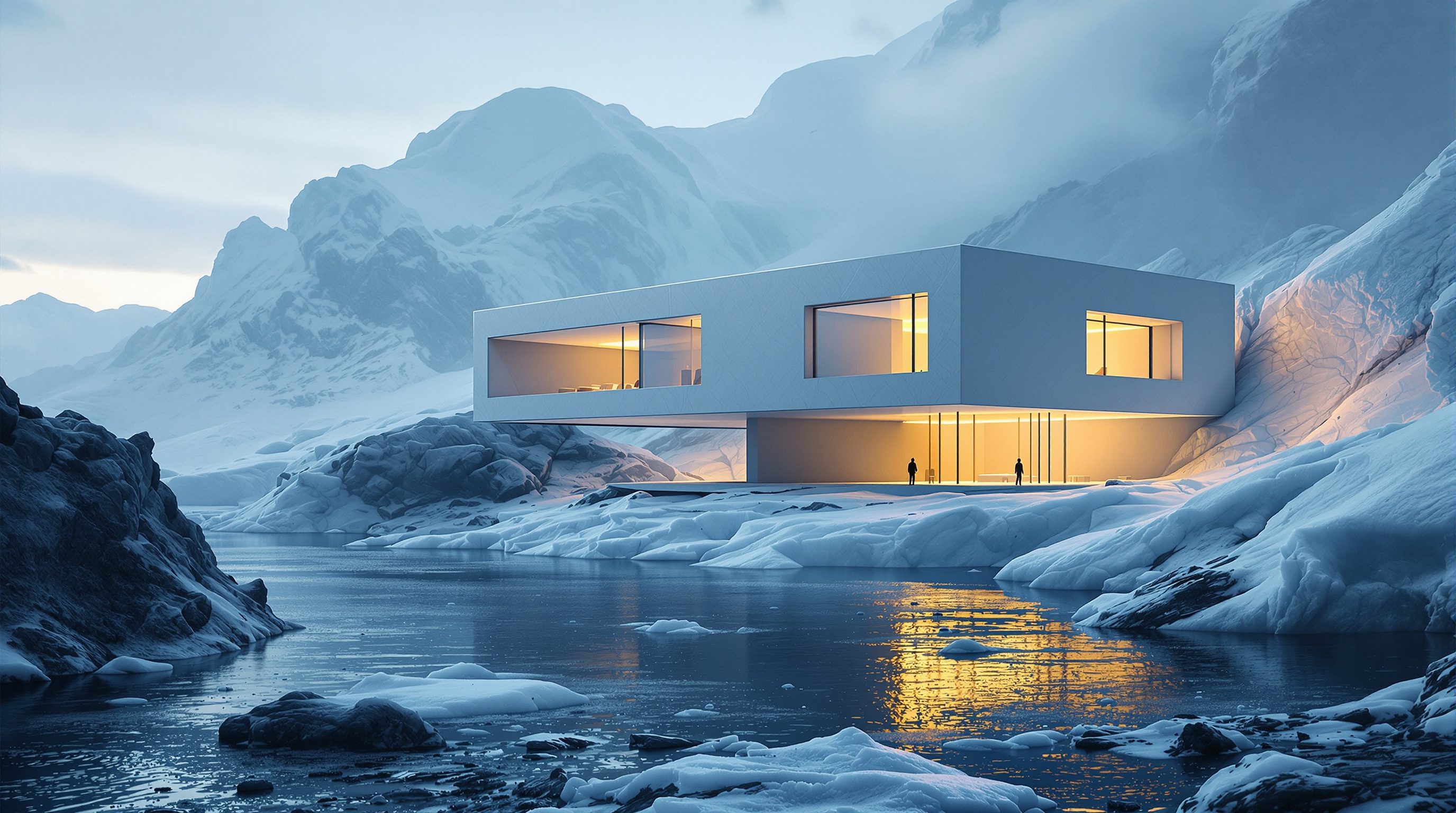
 Lesson 0.2
Lesson 0.2 · The Edge of the Possible
What Extreme-Environment Architecture Is
Ordinary building quietly lives off six gifts the environment hands over for free - breathable air, a survivable temperature, solid dry ground, ordinary gravity, water and materials to hand, and a safe outside; extreme-environment architecture is the discipline of building where one or more of those gifts is withdrawn, so the envelope must manufacture what the world no longer supplies, and as the world turns hostile that envelope stops being shelter and becomes life support - a serious, mostly near-term field, not a futurist spectacle
A building in an ordinary place is a guest the environment feeds for free; in an extreme place it must make its own air, warmth and water - and the envelope quietly turns into life support.
Stand in any ordinary room and it seems to ask nothing remarkable of its design. That ease is a loan. It rests on six conditions so dependable we never think to design for them: breathable air outside every wall, a temperature the body can survive, solid dry ground that stays put, ordinary gravity, water and materials delivered to the site, and an outside you can safely step into. Ordinary architecture is what you build when all six hold. It gets to spend its attention on beauty, function and cost precisely because survival is quietly guaranteed - off the books - by the place itself.
Extreme-environment architecture is what you do when one or more of those gifts is withdrawn. The moment a gift is gone, the building has to provide it deliberately, at real cost in structure, energy and discipline - and the more the environment withholds, the more the envelope stops being mere shelter and becomes life support, until at the far edge it is doing the entire work of keeping people alive. This lesson defines the field exactly, through that single idea, and is careful from the first line about what the field is and is not: it is mostly urgent, humane and buildable now, with a small and heavily-hyped speculative fringe - not the futurist spectacle the renders suggest.
Define by subtraction: ordinary place = 6 free gifts (air, temp, dry ground, gravity, water/materials, safe outside). Extreme = 1+ withdrawn -> building must PROVIDE it. Count the withdrawals -> position on the gradient: shelter -> enclosure -> LIFE SUPPORT. Not futurist spectacle; ordinary architecture with the subsidy removed. Survival engineering stays with the engineers + codes.
The six gifts you never designed for
Before you can design for an extreme, you have to notice what an ordinary place hands you for nothing. There are roughly six of these gifts, and they stay invisible precisely because ordinary architecture never has to pay for them. The first is breathable air: the atmosphere sits outside every wall at a survivable pressure, with enough oxygen, and it refreshes itself endlessly, so a normal building treats ventilation as a matter of comfort and freshness, never as the manufacture of a gas people need to stay alive. The second is a survivable temperature: the outdoor climate stays inside a band the body and ordinary materials can bear, so heating and cooling become questions of energy and comfort, not the few minutes between warmth and death. The third is solid, dry, stable ground - firm earth that holds still and stays dry - which turns a foundation into a routine problem with textbook answers.
The fourth gift is ordinary gravity: a steady one-g pull that makes water run downhill, keeps a floor underfoot and a roof overhead, and quietly underwrites the entire vocabulary of building. The fifth is materials and water to hand: concrete, steel, timber, glass, brick and clean water arrive by road from a supply chain so dependable that we design as if the site were plugged into everything. The sixth is a safe outside: if a system fails, or you simply want to step out for air, the world beyond the walls will not kill you. Every one of these is a standing subsidy from the environment, and ordinary architecture spends the subsidy without ever noticing - which is exactly why beauty, function and cost can absorb almost all of a designer's attention. Survival is handled quietly, off the books, by the place itself. Name the six and you gain a precise instrument: you can now say what an extreme environment actually is, rather than gesturing vaguely at 'harsh' or 'remote'. India's own vernacular already reads this ledger with great care - a Thar courtyard house budgets deliberately for the temperature and the water the desert refuses to give - which is the clue that this way of seeing is not a novelty at all, but old, practical wisdom rediscovered.
Ordinary place = 6 free gifts: air + survivable temp + dry ground + gravity + water/materials + safe outside. Free, so we never design for them. Name them and you can define 'extreme' exactly.
An extreme environment is where a gift is withdrawn
With the six gifts named, the definition of the field becomes exact and almost austere: an extreme environment is any place where one or more of those gifts is withdrawn, and extreme-environment architecture is what you do about it. The definition is deliberately narrow, and its narrowness is the whole point. It does not turn on distance, glamour or budget. A monsoon flood plain forty minutes from a state capital qualifies; a remote but temperate hill station does not. What qualifies a place is subtraction. Take away solid dry ground and you have the water and flood condition. Take away water and push temperature past what the body can bear and you have the desert. Take away the safe, lit, easily reached outside and you have the deep sea and the underground. Take away almost everything at once - air, temperature, gravity, materials, a survivable outside - and you have space.
The consequence of a withdrawn gift is always the same in shape: whatever the environment stops providing, the building must now provide deliberately, and pay for it in structure, energy, systems and discipline. A house on the delta can no longer assume dry ground, so it must actively supply the missing stability - by floating on the water, rising with it, or lifting clear of it on stilts. A desert dwelling can no longer assume water and coolness, so it must harvest, store, shade and move heat around in time and space. This is why the field has a single spine running through every case, from the humblest to the most exotic: the building can no longer assume its environment, so it must actively provide what the environment withholds. That one sentence is worth memorising, because it turns a bewildering catalogue of devices - stilts, pontoons, wind-catchers, airlocks, thermal mass, closed loops - into a single question asked at rising intensity. It also keeps a designer honest about scope. Providing the missing gift is often a matter of demanding engineering: buoyancy, pressure vessels, life support, radiation shielding. So the architect's real job is to name clearly what must be provided and to shape the human answer around it, while the binding calculations that guarantee people survive stay with qualified engineers, tested systems and the governing codes - in India the National Building Code and the IS codes, and, further out, the relevant marine, aviation and space-agency standards.
As hostility rises, the envelope becomes life support
The six-gift definition does more than sort places in or out; it measures how extreme a place is, by how many gifts fail and how completely they fail. A flood plain withdraws a single gift - dry ground - while leaving breathable air, a survivable temperature and a way out intact; water is dangerous, but you can still breathe and still, in the end, leave. Antarctica withdraws temperature almost absolutely and strains materials and access at the same time. The deep ocean and the deep underground withdraw the safe outside and much of the light and easy exit. Space withdraws nearly all six together. As the count and severity climb, something qualitative changes about the envelope itself. In an ordinary building the outer wall is shelter: it moderates a benign world you could survive without it, if uncomfortably. As gifts fall away, the same wall is asked to hold a survivable inside against a hostile outside - and at the far end it is doing the entire job of keeping people alive.
That is what people mean by the phrase the envelope becomes life support. At the hostile end it is not a metaphor; it is literal. On the polar ice, inside a submarine, aboard a space station, the boundary between inside and outside is the difference between life and death measured in minutes, and behind it sits the closed-loop machinery that recycles air, water, energy and waste because nothing outside can be assumed and little can be brought. This gradient - from shelter, through protective enclosure, to full life support - is the most useful single idea in the whole course, because it tells a designer in advance how much of their attention the pure survival problem will demand, and therefore how much of the work must be led by engineers and how little room is left for the ordinary freedoms of architecture. It carries a warning in the other direction too. The more the envelope becomes life support, the more brutal the human experience of confinement and isolation behind it, so the habitable interior stops being a finish applied at the end and becomes a survival requirement in its own right - the psychological life-support system that keeps people sane through a months-long polar night or a long-duration mission. That is a theme the interior-design tier of this course returns to again and again, and it is the reason the field is as humane as it is technical.
Count the gifts that fail. 0 = shelter. 1 (flood) = still breathable, can leave. 3-4 (deep/polar) = harsh. ~6 (space) = envelope is total life support, failure kills.
What it is - and what it is not
It is worth saying plainly what extreme-environment architecture is not, because the popular image gets it almost exactly backwards. It is not, first and foremost, a futurist spectacle - not chrome domes on Mars or spiralling ocean towers glowing at dusk. Those images belong to the field roughly the way concept cars belong to driving: real on a show stand, largely absent from the road. The centre of gravity of the discipline is unglamorous and urgent - an amphibious house that floats up its guides when the river rises and settles back onto its foundation when the water falls; a stilted bamboo home over an Assam flood plain; a shaded courtyard behind a thick wall in the Thar; a plain, undramatic, life-saving polar research station that has simply worked for decades. Defining the field by its renders is like defining medicine by miracle cures: it mistakes the marketing for the substance and quietly erases the work that actually keeps people alive.
Nor is it a separate, exotic branch of architecture with its own private rules. It is ordinary architecture with the hidden subsidy removed, which is precisely why it teaches the rest of the discipline so well. Every building everywhere leans on the six gifts; extreme cases simply make that dependence visible by taking the gifts away, and the habits they force - designing for the loss of a resource, closing loops, planning for failure, respecting an outside that will not forgive a mistake - are exactly the habits a warming, water-stressed, resource-constrained world increasingly needs even in temperate cities. So the honest description is this: extreme-environment architecture is the disciplined design of buildings for places that withhold one or more of the conditions ordinary building silently assumes, practised as a partnership in which the architect owns the spatial and human logic and qualified engineers own the survival guarantees. It is mostly near-term and humane, with a small, genuine, heavily-hyped speculative frontier at its far edge. Knowing which is which - rather than being dazzled by the pictures - is the first real skill of the field, and the next two lessons build it directly: first by laying the whole range out as a single spectrum, then by separating the honest promise from the hype.
The six gifts define what counts as extreme
A precise definition of the field
Ordinary building assumes breathable air, survivable temperature, solid dry ground, ordinary gravity, materials and water to hand, and a safe outside. An extreme environment is any place where one or more is withdrawn - regardless of distance, glamour or cost. Modules 0.1, 0.3.
Provide what the environment withholds
The defining logic
Whatever the environment stops giving, the building must actively provide, paying for it in structure, energy, systems and discipline. Naming the withdrawn gift is the first design move - float, rise, shade, harvest, seal, recycle. Modules 1, 3, 6.
The shelter-to-life-support gradient
Measuring how extreme a place is
The more gifts fail and the more completely, the more the envelope shifts from shelter to full life support, and the more the survival engineering leads. Use the gradient to scope how much freedom the design has. Modules 0.3, 7, 8.
Design, not survival engineering
The limit of a designer's claims
Where the envelope is life support a failure kills. Every binding structural, marine, aerospace, pressure, life-support, radiation, geotechnical, fire and safety determination stays with qualified engineers, tested systems and the codes (NBC India, IS, and marine/aviation/space standards) - never a designer's assertion. Modules 2.3, 8.2.
Workshop - audit a building's six gifts, then withdraw one
The whole field begins with seeing the subsidy an ordinary building spends without noticing, and then reasoning about what changes when one part of it is taken away. This workshop makes the six-gift ledger a working tool, honestly and without pretending to engineer anything.
Just one building you know, one gift to remove and a notebook. No engineering - this is about seeing the subsidy and reasoning in terms of what is withdrawn and what must be provided; every binding structural, life-support and safety matter stays with qualified engineers, tested systems and the codes.
Goal: turn the six-gift definition into a working design instrument
Inputs: one building you know well + one gift to withdraw (choose water, dry ground or survivable temperature) + a notebook
Time: ~45 minutes
- 1Take a building you know well and write down, for each of the six gifts - breathable air, survivable temperature, solid dry ground, ordinary gravity, materials and water to hand, a safe outside - exactly how the environment supplies it for free today.
- 2Choose ONE gift to withdraw (for instance, imagine the site now floods a metre deep each monsoon, so solid dry ground is gone) and describe precisely what the building can no longer assume.
- 3For that withdrawn gift, list what the building would now have to actively provide instead, and name two or three plausible design responses (for lost dry ground: float, rise with the water, or lift clear on stilts).
- 4Place the modified building on the shelter-to-life-support gradient: with one gift gone, is the envelope still mostly shelter, or edging toward life support? Justify where you put it.
- 5Write a short, honest note: which of your responses are near-term and buildable, which are speculative, and where the line falls between what you as a designer could shape and what would have to be handed to qualified engineers and checked against the codes.
You’ll walk away with
A one-page 'six-gift audit' of a familiar building, one gift withdrawn and worked through - what it can no longer assume, what it must now provide, plausible responses, its place on the gradient, and an honest near-term-versus-speculative note. Keep it; you will reuse the method across the course.
Three altitudes on the same idea
Read the band that fits you — or all three.
Your job in an extreme environment is the structure that survives and serves where the ordinary gifts fail - and the six-gift ledger is how you scope that job before you draw anything. Read the site as a set of withdrawals: which of breathable air, survivable temperature, solid dry ground, ordinary gravity, materials and water to hand, and a safe outside no longer holds, and how completely. Each withdrawal becomes a thing the building must actively provide, and the sum of those provisions tells you where you sit on the gradient from shelter to life support - and therefore how much of the project the survival engineering will lead. Keep your ambition proportionate to that reading: on a flood plain you can still shape a generous, daylit home; where the envelope is life support the freedoms narrow sharply. Own the spatial logic, the organisation of shelter and life, the sequence of spaces and exits, the human experience - and defer every binding structural, marine, aerospace, pressure, life-support, radiation, geotechnical, fire and safety determination to qualified engineers, tested systems and the codes (NBC India, IS, and the relevant marine, aviation and space standards). Design on evidence and precedent, not on confidence.
As the envelope turns from shelter into life support, the interior stops being a finish and becomes part of survival - because the same enclosure that keeps people alive also confines them, closest to the body and the senses. This is where the field needs everything the program has taught about designing for the human being. In a sealed, resource-constrained volume - a polar station through the long night, a submarine, a flood shelter, a capsule - the qualities that keep people well are not decoration but requirements: daylight or a careful substitute for it, variety and change against monotony, privacy alongside connection, a sense of nature and a view onto something, order, dignity and a room that reads as human rather than merely mechanical. Learn to make a small, hermetic, tightly-budgeted interior genuinely liveable over long, stressful stretches; that is the interior designer's real contribution at the edge. But hold the boundary firmly: the systems that actually keep the interior breathable, warm, dry and safe belong to the engineers, and every binding life-support, fire and safety matter is theirs and the codes'. Your domain is the human habitability inside the envelope they guarantee.
Extreme-environment architecture is the clearest possible way to understand what all architecture depends on: it defines the field by subtraction, showing you the six gifts ordinary buildings quietly assume by taking them away one at a time. Learn the core move first. Ordinary building silently relies on breathable air, a survivable temperature, solid dry ground, ordinary gravity, materials and water to hand, and a safe outside; an extreme environment is any place where one or more of those is withdrawn, and the building must then actively provide what the environment no longer gives for free. Watch the gradient that follows: the more gifts fail, the more the envelope becomes life support, until at the far end it is doing the whole job of keeping people alive. And carry the honest framing into every example - much of this field is near-term and humane, a small part of it is speculative and heavily hyped, and the skill is telling them apart while staying genuinely excited. It is a rigorous, thrilling, deeply human field, and understanding it will sharpen how you read even the most ordinary building.
“Extreme-environment architecture is a narrow, exotic specialism - something for polar scientists and astronauts. It has little to teach an ordinary architect designing homes and offices in an ordinary city.”
Do it yourself
No tools needed - reason it through.
- 1Name the six gifts an ordinary environment provides for free, and define an extreme environment in a single sentence using them.
- 2Explain why the field's definition turns on subtraction rather than on distance, cost or glamour.
- 3What does 'the building must provide what the environment withholds' mean in practice? Give one worked example.
- 4Describe the gradient from shelter to life support, and say what changes for the designer as you move along it.
- 5Give two reasons extreme-environment architecture is best understood as ordinary architecture with the subsidy removed, not as an exotic specialism.
The one line to carry out
Peer-reviewed journals & authoritative standards
- 01Autonomous building and self-sufficiency — Wikipedia - Autonomous building, 2026.
- 02Life support system — Wikipedia - Life support system, 2026.
- 03Vernacular architecture — Wikipedia - Vernacular architecture, 2026.
- 04Sustainable architecture — Wikipedia - Sustainable architecture, 2026.
- 05National Building Code of India — Wikipedia - National Building Code of India, 2026.
If the field is defined by how many gifts fail and how completely, then it must have a shape - a range from places that withdraw a single gift to places that withdraw them all. The next lesson lays that whole range out as one spectrum, from the flood plain at our feet to the surface of Mars.
The author
Amogh N P
Architect, interior designer, and creative polymath. Studio Matrx began in his notebooks — his vision of design made honest, useful, and open to everyone. Its Academy is written and taught in his memory, and free, forever.
More about Amogh →