
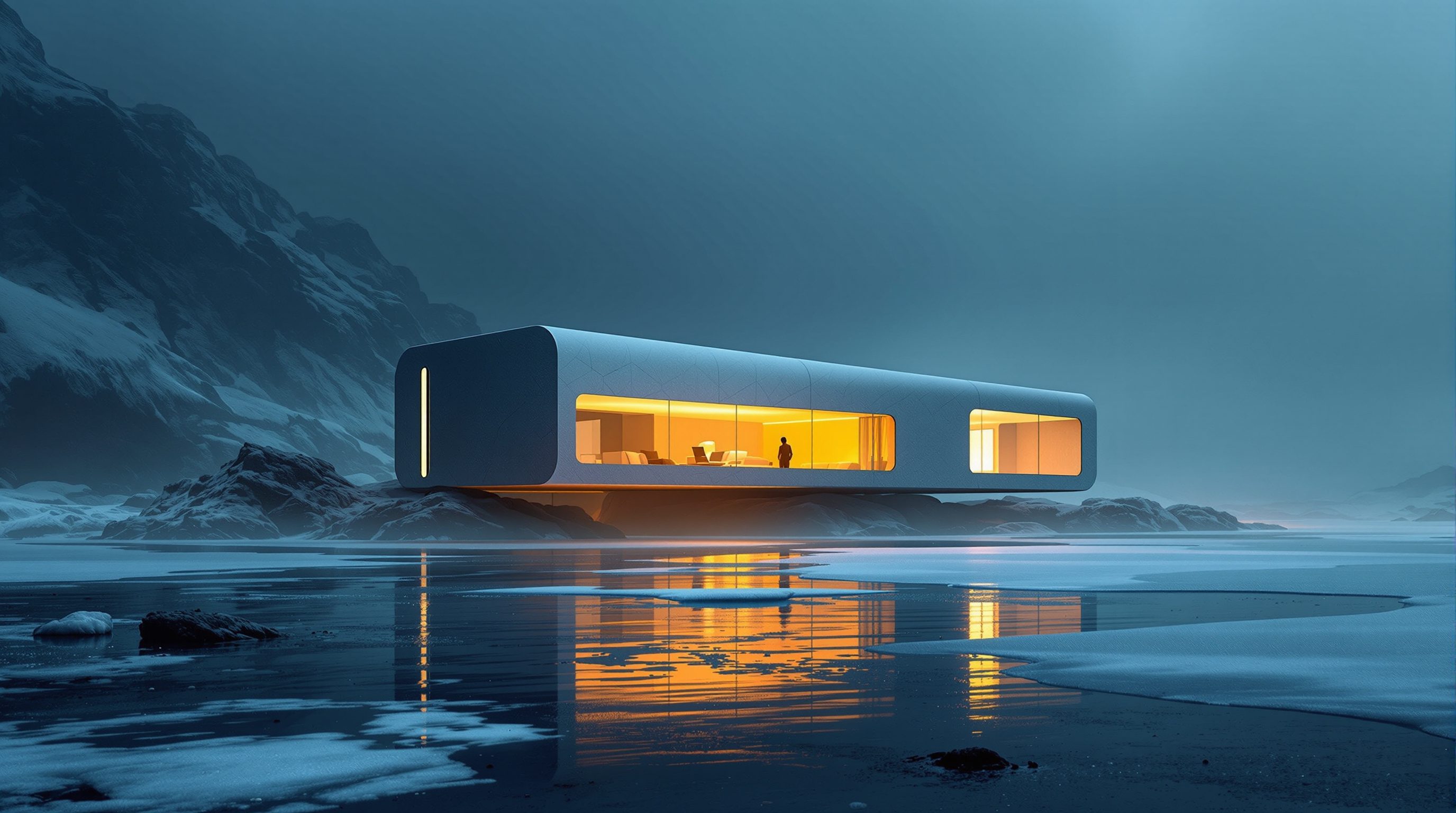
 Lesson 0.3
Lesson 0.3 · The Edge of the Possible
The Spectrum of Extremes
A field guide across the whole range - the water and flood family at the near end where a single gift fails and you can still leave, the hostile edges of polar cold, desert heat, underwater and underground in the middle where several gifts fail and the outside can kill, and space at the far end where nearly all six fail absolutely; organised by how many assumptions fail and how completely, it reveals that a flood house and a Mars base are the same lesson at different intensities
Lay every extreme on one scale - from the flood plain at our feet to the surface of Mars - and a bewildering catalogue becomes a single ordered spectrum of how many gifts fail and how completely.
The last lesson defined the field by subtraction: an extreme environment is any place where one or more of the six gifts ordinary building assumes is withdrawn. That definition immediately implies a shape. If some places withdraw a single gift and others withdraw them all, then the whole field must lay out along one continuous scale - from the gentlest extreme, where a single gift fails partially and you can still leave, to the harshest, where every gift fails absolutely and the envelope does the entire work of keeping people alive.
This lesson is that field guide. It walks the spectrum end to end: the water and flood family at the near end, urgent and buildable now; the hostile edges - polar cold, desert heat, underwater and underground - in the middle, proven but demanding; and space at the far end, the purest form of the problem and its best teacher, but for human settlement distant and heavily hyped. Organise the range by how many assumptions fail and how completely, and its deep unity appears: a flood house and a Mars base are not opposites but the same lesson at different intensities.
SPECTRUM: [water & flood: 1 gift, can leave, urgent NOW] -> [hostile edges: polar/desert/deep, several gifts, outside kills, envelope = life support] -> [space: ~6 gifts fail absolutely, purest problem, mostly future]. Same lesson at rising intensity. Urgency + reality drop as you move right. Flood house = Mars base, different dial setting.
The near end: the water and flood family
Because the field is defined by subtraction, it has a natural shape: a spectrum running from places that withdraw a single gift to places that withdraw them all. At the near end sits the family that matters most to people alive today - water and flood. It is the most pressing, humane and buildable part of the whole discipline, and it is where any honest field guide has to begin. The climate is warming, seas are rising, and rainfall and storms are intensifying, so water is being forced into places built on the assumption of dry ground: coastal cities, river deltas, flood plains and low islands. What unites this family is a single withdrawn gift. Solid dry ground is gone - seasonally, as a monsoon flood plain drowns each year and drains again; permanently, as a delta subsides or the sea creeps up a coast; or catastrophically, as a storm surge drives the ocean inland for a day.
Crucially, only that one gift fails. The air is still breathable, the temperature still survivable, and - the humane fact at the heart of this family - you can still, in the end, leave. Water is dangerous, but it does not kill in seconds the way vacuum or extreme cold does, and that changes everything about the design response. The building does not have to become sealed life support; it has to make peace with water. So the family's whole vocabulary is about the loss of dry ground and nothing else: building that floats on the water, building that rises with it (amphibious), building lifted clear on stilts, building that can safely get wet and dry out again, and communities that plan to live with water rather than only wall it out. For India this is not a future scenario but a present emergency, with a long densely-populated coastline, sinking coastal megacities and catastrophic monsoon and urban flooding - and, at the same time, a magnificent living tradition to learn from, from the stilted chang ghar of Assam to the houseboats of Kerala and Kashmir. This is the near, urgent, real end of the spectrum, and the course gives it the first and heaviest weight.
Near end = WATER & FLOOD. Only dry ground is withdrawn; air breathable, exit open. Float / rise / lift on stilts / wet-dry. Urgent, humane, buildable now - India front line.
The middle: the hostile edges
Move along the spectrum and you reach the hostile edges - environments that withdraw not one gift but several, and withdraw them far more completely. Here the character of the problem changes in kind. The polar and high-altitude cold withdraws the survivable-temperature gift almost absolutely, and strains materials, water and access at the same time; a failure of heat or shelter through a polar winter is measured in minutes, not seasons. The desert stretches temperature to the edge of survivability and withdraws water, so an arid settlement must harvest, store, shade and move heat through the day and night just to remain habitable. Underground and underwater architecture withdraws the safe, lit, easily reached outside, and underwater adds crushing pressure and the loss of breathable air, so the enclosure must supply light, air and a way back to the surface. Across all of them the shared fact is stark: the environment beyond the envelope can now kill you, by cold, heat, suffocation, pressure or simple entrapment.
That single fact separates this family from the water family in the most important way. In the water family water is dangerous but the air is breathable and you can leave; on the hostile edges the envelope itself becomes life support, a failure is death rather than discomfort, and the closed-loop logic of recycling air, water, energy and waste is forced toward its purest form because little can be assumed and little can be brought. Isolation and confinement stop being inconveniences and become survival problems in their own right, which is why the habitable interior is a requirement here, not a luxury. India sits on these edges too, and has answered them for centuries: the cold-desert architecture of Ladakh, superbly tuned to Himalayan altitude and cold, and the hot-arid vernacular of the Thar, with its courtyards, thick walls, wind-catching and water-harvesting, are world-class designs for withdrawn gifts. These edges are real and mostly proven - polar research stations have worked for decades - but they demand far more survival engineering than the water family, and the honest designer treats every binding structural, thermal, pressure and life-support matter as the domain of qualified engineers, tested systems and the codes.
The far end: space
At the far end of the spectrum sits space - orbit, the Moon and Mars - where the withdrawal is total. Nearly all six gifts fail at once and fail absolutely. There is no breathable air; the temperature swings hundreds of degrees between sun and shadow; there is no ordinary gravity, so the entire vocabulary of floors, drainage and structure has to be rethought; deadly radiation replaces the safe outside; nothing is to hand, so materials and water must either be carried at enormous cost or made from what is already there; and an outside that kills in seconds means every exit is an airlock and every wall is life support. This is the purest and most extreme form of the whole field's logic, and studying it teaches the underlying problem with unmatched clarity - the closed loop taken to its limit, the envelope as total life support, the human body and mind pushed to their edge by isolation, confinement and danger.
But clarity is not the same as nearness, and this is exactly where honesty matters most. The space end of the spectrum is real as engineering - the International Space Station is a genuine, continuously-inhabited building in orbit - and largely speculative as settlement. A permanent, self-sustaining human presence on the Moon or Mars faces enormous unsolved problems of radiation, life support, resources, biology, cost and time, and the confident renders of domed cities are overwhelmingly imagery, not plans. So the spectrum must be read with its urgency and its reality decreasing together as you move outward: the water family is urgent and buildable now; the hostile edges are proven but demanding; space is illuminating but, for settlement, distant. India belongs on this far end too, not as a spectator but through a respected space programme with lunar and Mars missions and human spaceflight in development - so even the frontier is part of the national story, to be treated with excited literacy rather than either credulity or dismissal. The far end teaches the near end; it does not replace it. That is the honest way to keep the frontier in view - as a demanding teacher of the field's logic, not as a promise about where people will soon live.
One scale: a flood house and a Mars base, the same lesson
The reason to lay the whole range out as one spectrum, rather than as a set of unrelated specialisms, is that it reveals the deep unity of the field: every point on it is the same lesson at a different intensity. A flood house and a Mars base are not opposites; they are the same problem - the building can no longer assume its environment, so it must actively provide what the environment withholds - solved for one withdrawn gift in the first case and for all six in the second. Organise the spectrum by how many assumptions fail and how completely, and a messy catalogue of exotic cases becomes a single ordered scale. At one end, one gift fails, partially and survivably, and you can still leave; at the other, all gifts fail, absolutely, and the envelope does the entire work of keeping people alive. Everything in between - polar, desert, underground, underwater - sits at an honest position defined by its own pattern of withdrawals.
This ordering is not just tidy; it is a working tool, and it does two jobs at once. First, it tells a designer how much of a project the survival engineering will lead, and therefore how much room is left for the ordinary freedoms of architecture - generous daylight and openness near the water end, a tightly-disciplined sealed volume near the space end. Second, and just as important, it maps neatly onto the field's other axis: urgency and reality. As you move outward along the spectrum, the work generally becomes less near-term and more speculative, and more prone to hype - which is why the very next lesson turns from the spectrum to the honest ledger of promise versus hype. Keep the spectrum in your head as the field's backbone: the near, urgent, buildable water family; the proven-but-demanding hostile edges; and the illuminating, largely future frontier of space - one continuous scale, read with excitement and with a clear eye, and with the binding survival engineering at every point left to qualified engineers, tested systems and the codes. Read this way, the spectrum is less a catalogue of exotic cases to memorise than a compass to reason with - and it points, at its near end, straight at the water already rising at our feet.
Order by how many gifts fail: flood plain (1) -> desert/polar (2-3) -> deep sea (3) -> space (6). Same problem, rising intensity. Urgency + reality fall as you move outward.
Order by how many gifts fail and how completely
Structuring the whole field
The spectrum runs from one gift withdrawn partially (water and flood) through several withdrawn more completely (polar, desert, underwater, underground) to nearly all withdrawn absolutely (space). Position sets how much the survival engineering leads. Modules 0.2, 8, 9.
The water family is one withdrawn gift - and you can leave
The near, urgent end
Only dry ground fails; air stays breathable and exit remains possible, so the response is to live with water (float, rise, lift, wet- and dry-proof), not to seal. Urgent, humane, buildable now; for India a present emergency. Modules 1 to 4.
The hostile edges kill; space withdraws almost everything
The middle and far ends
On the hostile edges several gifts fail and the outside can kill, so the envelope becomes life support; in space nearly all fail absolutely, the purest form of the problem. Real as engineering, largely speculative as settlement. Modules 5 to 9.
Same lesson, different intensity - and defer the engineering
The unity and the limit
A flood house and a Mars base solve one problem at different intensities. Urgency and reality generally fall as you move outward. Every binding structural, marine, thermal, pressure, life-support, radiation, fire and safety determination stays with qualified engineers, tested systems and the codes. Modules 0.4, 10.
Workshop - map the spectrum, and place three real projects on it
The spectrum is only useful once you can place a real project on it and defend the position. In this workshop you build the scale yourself and use it to compare three environments that look unrelated but sit on one line.
The six-gift list, three environments and a notebook - no engineering. The exercise is about ordering and comparison; every binding structural, thermal, pressure, life-support and safety matter stays with qualified engineers, tested systems and the codes.
Goal: turn the spectrum into a working comparison tool
Inputs: three environments (pick, for example, a Kerala backwater village, a Ladakh cold-desert settlement, and a Mars surface base) + the six-gift list + a notebook
Time: ~50 minutes
- 1Draw a horizontal line labelled 'shelter' at the left and 'life support' at the right, and mark three regions along it: water and flood, the hostile edges, and space.
- 2For each of your three chosen environments, list which of the six gifts is withdrawn and note beside each whether the loss is partial or near-total.
- 3Place each environment on your line according to how many gifts fail and how completely, and write one sentence justifying its position relative to the other two.
- 4For each, name the leading design response (for the water case: live with water by floating, rising or lifting; for the cold desert: conserve and gather heat; for Mars: seal, shield and close the loop) and say how much freedom the architect retains at that point.
- 5Write a short, honest note ranking your three by near-term reality: which is buildable now, which is proven but demanding, and which is largely speculative - and mark, for each, where the survival engineering would take over from design.
You’ll walk away with
A one-page spectrum diagram with three real environments placed and justified, each annotated with its withdrawn gifts, its leading design response, the designer's remaining freedom, and an honest near-term-versus-speculative ranking. Keep it as the map you carry through the rest of the course.
Three altitudes on the same idea
Read the band that fits you — or all three.
Use the spectrum as a scoping instrument: it tells you, before you design, how many gifts a site withdraws, how completely, and therefore how much of the project the survival engineering will lead. Near the water end - flood plain, delta, coast - a single gift fails and you retain real architectural freedom: generous daylight, openness, connection to the setting, because the problem is to live with water, not to seal against a lethal outside. As you move toward the hostile edges (polar, desert, underground, underwater), several gifts fail more completely, the envelope shifts toward life support, and the freedoms narrow; near the space end almost everything is dictated by survival. Place your project honestly on the scale and let that placement set your ambitions, your programme and, above all, the balance of authority between you and the engineers. Own the spatial logic and the human experience at every point, and defer every binding structural, marine, thermal, pressure, life-support, radiation, geotechnical, fire and safety determination to qualified engineers, tested systems and the codes (NBC India, IS, and marine/aviation/space standards). The spectrum also flags urgency: the near end is where you can help real communities now.
Read the spectrum as a scale of confinement: the further out a project sits, the more the interior is sealed, isolated and monotonous - and the more the habitable inside becomes a survival requirement rather than a finish. Near the water end the interior can still open to daylight, air and a view, and your work is closer to ordinary residential practice under a flood constraint. On the hostile edges - a polar station through the long night, an underground or underwater habitat, and at the far end a capsule - the volume is small, hermetic and resource-constrained, and the qualities that keep people well become non-negotiable: daylight or a careful substitute, variety against monotony, privacy alongside connection, a sense of nature, order and dignity. Your contribution rises in importance exactly as you move outward, because isolation and confinement do their psychological damage precisely where the envelope is doing the most physical work. Design the life-supporting interior of each point on the spectrum for its real level of enclosure - and hold the boundary: the systems that keep that interior breathable, warm, dry and safe are the engineers' and the codes', while the human habitability inside is yours.
The spectrum is the single most useful map of the field: organise every extreme by how many of the six gifts fail and how completely, and a confusing catalogue - flood plains, deserts, the deep sea, the Moon - becomes one ordered scale. Learn its three regions. The water and flood family, at the near end, withdraws only dry ground; the air is breathable and you can still leave, so it is urgent, humane and buildable now - and for India a present emergency. The hostile edges - polar cold, desert heat, underwater, underground - withdraw several gifts more completely, the outside can kill, and the envelope becomes life support. Space, at the far end, withdraws nearly all six absolutely, which makes it the purest form of the problem and the best teacher of its logic, but for settlement it is distant and heavily hyped. Notice the key insight: a flood house and a Mars base are the same lesson at different intensities. And notice that urgency and reality generally fall as you move outward - the near end is real now, the far end mostly future - which sets up the honest promise-versus-hype ledger of the next lesson.
“The really serious, advanced part of architecture for extreme environments is space - the Moon and Mars. Flood houses and desert vernacular are simpler, lower-tech problems, almost a warm-up before the real frontier.”
Do it yourself
No tools needed - reason it through.
- 1Describe the three regions of the spectrum and the single organising principle that orders them.
- 2Why does the water and flood family sit at the near end - which gift is withdrawn, and why does 'you can still leave' matter so much to the design response?
- 3What changes about the envelope as you move from the water family to the hostile edges to space?
- 4Explain the claim that 'a flood house and a Mars base are the same lesson at different intensities'.
- 5Why do urgency and reality generally fall as you move outward along the spectrum, and what does that imply about reading spectacular space renders?
The one line to carry out
Peer-reviewed journals & authoritative standards
- 01Floodplain — Wikipedia - Floodplain, 2026.
- 02Research stations in Antarctica — Wikipedia - Research stations in Antarctica, 2026.
- 03Desert climate — Wikipedia - Desert climate, 2026.
- 04Space architecture — Wikipedia - Space architecture, 2026.
- 05Colonization of Mars — Wikipedia - Colonization of Mars, 2026.
The spectrum quietly carries a second axis: as you move outward, projects grow less near-term, more speculative and more prone to hype. The next lesson meets that head on - the honest ledger of what this field can genuinely build now against the flood of beautiful renders that will never leave the screen.
The author
Amogh N P
Architect, interior designer, and creative polymath. Studio Matrx began in his notebooks — his vision of design made honest, useful, and open to everyone. Its Academy is written and taught in his memory, and free, forever.
More about Amogh →