
 Lesson 0.4
Lesson 0.4 · The Edge of the Possible
The Promise & the Hype
The honest ledger of the field - on one side the genuine, urgent, buildable-now promise of flood-resilient floating and amphibious housing, proven polar stations and world-class desert and delta vernacular; on the other the endless flood of speculative, never-built renders of floating cities, ocean towers and Mars colonies - held together by a single habit, excited literacy without credulity, and by the life-and-death seriousness the beautiful imagery works hard to hide
No field of architecture produces more spectacular renders that will never be built - and none carries higher stakes when the envelope is life support. The skill is holding both truths at once.
Search for architecture in extreme environments and you are flooded with beauty: floating eco-cities on calm blue water, spiralling ocean towers, underwater hotels, domed Martian settlements glowing at dusk. It is seductive, it goes viral, and it is overwhelmingly speculative - concepts and marketing, not buildings people live in. Beneath that imagery sits a quieter, larger and far more important reality: flood-resilient floating and amphibious housing keeping real families safe, proven polar stations that have worked for decades, and centuries-old desert and delta vernacular that solves withdrawn-gift problems with astonishing skill.
This lesson is the honest ledger that closes the first module. It sets the genuine, urgent, buildable-now promise squarely against the flood of never-built renders; it teaches how to interrogate a spectacular image and place it as real, prototype or fantasy; it names the habit that holds the two apart - excited literacy without credulity; and it keeps in view the life-and-death seriousness the beautiful imagery works hard to hide. Get this right and you can love the frontier without being fooled by it.
TWO COLUMNS. REAL & NOW: floating/amphibious/stilt housing, polar stations, desert+delta vernacular (India front line) - the field's true centre. RENDER & HYPE: floating cities, ocean towers, Mars domes - mostly never built. Interrogate: built? prototype? real substance? or just a picture? Excited literacy, not credulity - and not cynicism. Beneath it all: envelope = life support, failure kills; engineering stays with engineers + codes.
The promise: urgent, humane and buildable now
Begin with the side of the ledger that the renders never show, because it is the larger, more important and more honest half of the field: the genuine, urgent, buildable-now promise. This is not a promise about the future; it is work being done today for real communities. At its centre is the water and flood family. Flood-resilient housing that floats - a home built on a buoyant base that lifts on the water and settles again as it falls - is real, occupied and repeatable. Amphibious houses, which rest on their foundations in dry times and float up along guide posts only when a flood arrives, are a proven, elegant answer for places that flood sometimes but not always. Raised and stilted building, the oldest response of all, keeps living space clear of the water and is written into vernacular traditions across the world. Wet- and dry-proofing lets a building safely get wet and dry out, or keep water out up to a designed level, without pretending the flood will never come.
The promise reaches well beyond water. The polar research station is one of the field's quiet triumphs: proven, unglamorous buildings that have kept people alive and working through the harshest winters on Earth for decades, refined over many iterations into genuinely reliable architecture. The desert and delta vernaculars are another - centuries-old, superbly-tuned answers to withdrawn gifts, from the courtyards, thick walls, wind-catching and water-harvesting of hot-arid regions to the stilted, flood-adapted dwellings of great river deltas. India holds a magnificent share of this real promise: the chang ghar of Assam, the houseboats of Kerala and Kashmir, the cold-desert architecture of Ladakh, the hot-arid vernacular of the Thar - each a world-class design for an extreme, and each buildable, improvable and revivable now. This is the field's true centre of gravity: humane, near-term, life-saving work, most of it modest, much of it old, none of it dependent on a breakthrough that has not happened yet. An honest course leads with it, because it is where a designer can genuinely help - and because it is exactly what the spectacular imagery tends to erase.
REAL side: flood-resilient floating homes, amphibious houses, raised/stilt, proven polar stations, desert & delta vernacular (India: chang ghar, Kerala/Kashmir houseboats, Ladakh, Thar). Humane, near-term, life-saving. The field's true centre.
The hype: a field of never-built renders
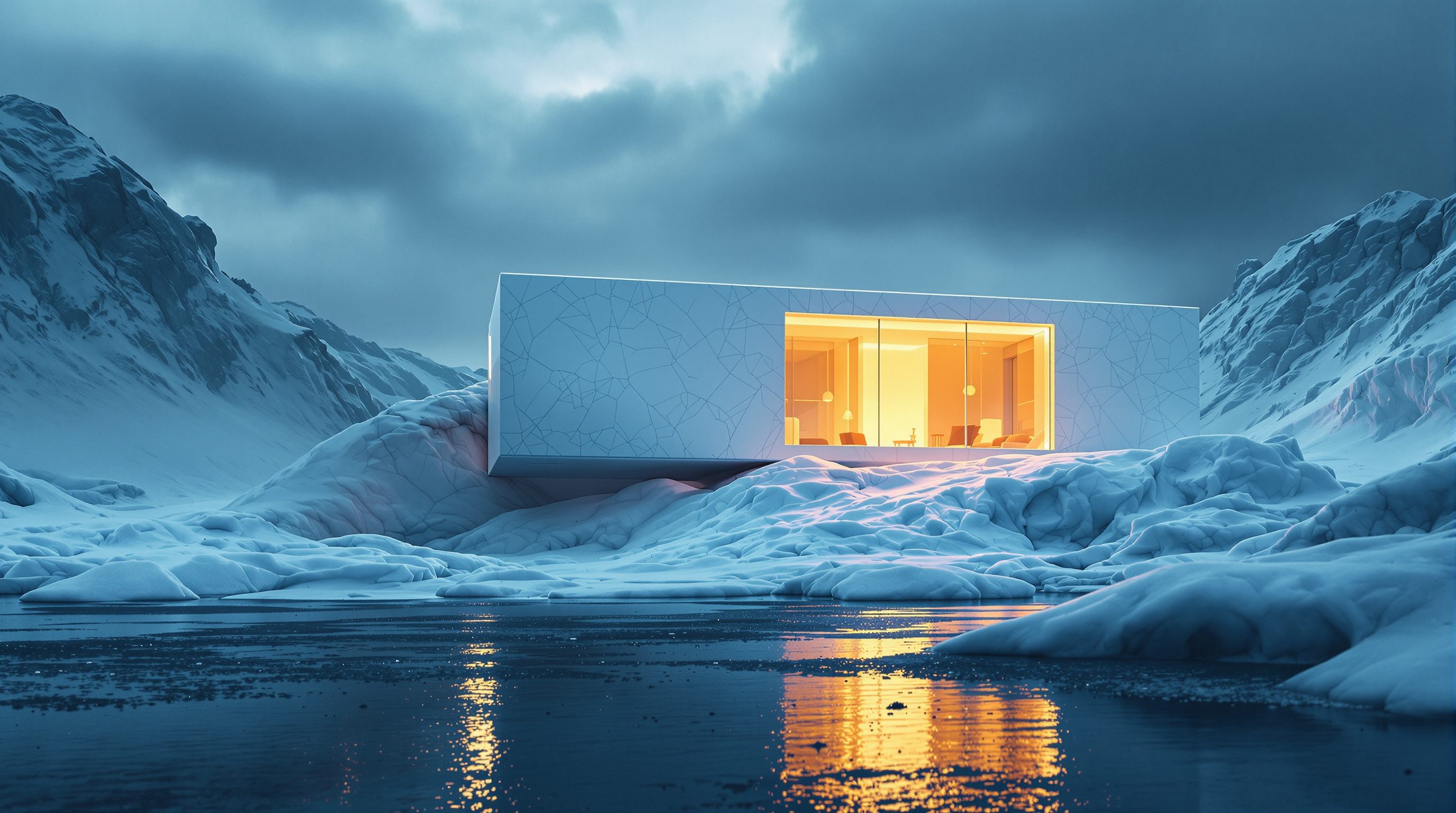
Set against that real promise is the other half of the ledger, and no field of architecture produces more of it: a flood of speculative, never-built renders. Floating eco-cities glittering on calm blue water; spiralling ocean towers; underwater hotels lit like aquariums; domed Martian settlements glowing in warm evening light - the imagery is gorgeous, viral and endlessly reproduced, and it is overwhelmingly concepts, competition entries and marketing rather than buildings anyone lives in. Some of it is honest speculation, clearly labelled as a vision; much of it is presented, deliberately or carelessly, as if it were imminent, and that is where the harm lies. Treated uncritically, the renders turn a serious, mostly urgent field into science fiction, and they crowd out the unglamorous work that actually matters - the modest amphibious house, the proven polar station, the centuries-old courtyard - by making it look dull beside the fantasy.
The renders share a family of tells, and learning to read them is a core skill. They are almost always exterior hero shots at a flattering time of day, with the hard parts left offscreen: no mooring in a storm, no sewage or fresh water, no evacuation route, no cost, no named engineers, no code compliance, no site, no client, no date. They answer the question 'how would it look?' and pointedly avoid 'how would it work, what would it cost, who would build it, and has anyone?'. The most seductive - permanent Mars colonies, self-governing ocean cities - are precisely the ones facing the deepest unsolved problems of engineering, biology, economics, law and time. None of this means the images are worthless; a good speculative render can genuinely expand a discipline's sense of the possible, and enthusiasm for the frontier is healthy and right. It means only that the image is a starting question, not an answer - and that a designer who cannot tell a plan from a picture will be led badly astray, both about what is coming and about where the real work lies. The habit to build, then, is not blanket suspicion of every image but a steady reflex to notice what a render is quietly leaving out - and to treat that absence as the real information.
Excited literacy without credulity
The discipline that holds these two halves together is a single habit of mind, and it is worth naming precisely: excited literacy without credulity. Excited, because this is a thrilling field and enthusiasm is the right response to the frontier - the field genuinely needs people who are drawn to it and want to push it forward. Literate, because enthusiasm alone, without the ability to read what you are looking at, curdles into credulity and does real harm. The two are not in tension; the goal is to hold both at once - to enjoy a spectacular render fully and then, without losing the enjoyment, ask the hard question of it. That question can be made into a simple, repeatable interrogation, and it is one of the most practical tools this whole course offers.
Confronted with any dazzling extreme-environment project, ask it in order. Is it built and occupied today? If so, it is real and near-term - study it as architecture. If not, is there a funded, tested prototype - a real structure, not just a model or a film? If so, it is a promising prototype - watch it, but do not treat it as settled. If not, does it at least come with the unglamorous substance that separates a plan from a picture: named engineers, a real site, a cost, a route to code compliance, a client and a date? If so, it is worth watching. And if it has none of these - if it is only a beautiful image with the hard parts left offscreen - then it is just a picture, to be enjoyed as a vision and filed as such, not cited as evidence of what is coming. Running this interrogation quickly becomes second nature, and it is the difference between a designer who is literate about the frontier and one who is merely dazzled by it. It also keeps enthusiasm honest, which is the only kind of enthusiasm this field can afford. Practise the interrogation on a dozen real projects and it stops feeling like a checklist and becomes simply how you see - the quiet mark of a designer who is literate about the frontier rather than merely dazzled by it.
Interrogate a render in order: built & occupied? -> REAL. tested prototype? -> PROMISING. named engineers/site/cost/code/date? -> worth watching. none? -> JUST A PICTURE. Enjoy the image, then ask the hard question.
The stakes: a matter of life and death
Beneath the whole ledger - the real promise and the seductive hype alike - runs a fact the imagery works hard to hide, and it is the most serious thing in the course: this is a matter of life and death. Where the environment is truly hostile, the envelope is life support, and a leak, a power loss, a structural failure or a life-support fault does not make people uncomfortable - it kills them. The warm evening render of a Mars dome shows none of the machinery on which every life inside would depend; the glossy image of an ocean city shows no storm, no failure, no funeral. That gap between the picture and the stakes is precisely why credulity in this field is not a harmless enthusiasm but a genuine danger, and why the seriousness beneath the imagery must be kept in view at every step.
This has one absolute consequence for how a designer works, and it is the boundary this course draws around all its excitement. Extreme-environment architecture sits on top of demanding, specialised survival engineering - structural, marine and naval, aerospace, pressure, life-support, radiation, geotechnical, fire and safety - and every binding decision in those domains belongs to the relevant qualified engineers and specialists, tested systems and the governing codes and standards: in India the National Building Code and the IS codes, and further out the relevant marine, aviation and space-agency standards. The architect's own domain is real and vital - the spatial logic, the human experience, the organisation of shelter and life, the choreography of a place people can actually endure and even flourish in - but it must be exercised in humble partnership with the engineering that keeps people alive, never in place of it. That is the honest posture with which to end this first module and begin the real work: genuinely excited by the frontier, clear-eyed about the renders, and permanently serious about the stakes - because in this field, unlike almost any other in architecture, getting it wrong is not a bad review but a death. Hold the promise and the hype in the same clear gaze, and you are ready for the water.
Lead with the genuine, buildable-now promise
The field's true centre of gravity
Flood-resilient floating and amphibious housing, raised and stilted building, proven polar stations, and desert and delta vernacular (in India the chang ghar, Kerala and Kashmir houseboats, Ladakh, the Thar) are humane, near-term and real. Most of the field is this, not spectacle. Modules 1 to 4, 10.3.
Read the tells of a speculative render
Separating a plan from a picture
Never-built renders are hero shots at flattering hours with the hard parts offscreen: no mooring in a storm, no water and waste, no evacuation, no cost, no named engineers, no code compliance, no site or date. The image answers 'how would it look?', not 'how would it work?'. Modules 4.2, 4.4, 9.4.
Excited literacy without credulity
The interrogation to run
Ask, in order: built and occupied (real); funded, tested prototype (promising); named engineers, site, cost, code route, client and date (worth watching); none of these (just a picture). Enthusiasm plus a hard question - never dismissal, never credulity. Modules 0.1, 4.4.
The stakes are life and death - defer the engineering
The seriousness beneath the imagery
Where the envelope is life support a failure kills. Every binding structural, marine, aerospace, pressure, life-support, radiation, fire and safety determination belongs to qualified engineers, tested systems and the codes (NBC India, IS, and marine/aviation/space standards) - never a designer's confidence or a render's promise. Modules 2.3, 8.2.
Workshop - build a promise-versus-hype ledger and interrogate a render
The habit of excited literacy without credulity only becomes real when you practise it on actual projects. In this workshop you assemble both sides of the ledger and run the interrogation on a real spectacular image, ending honestly.
A handful of real projects, one striking render and a notebook - no engineering. The exercise builds judgement about reality and hype; every binding structural, marine, life-support, fire and safety matter stays with qualified engineers, tested systems and the codes.
Goal: turn 'excited literacy without credulity' into a working routine
Inputs: several real extreme-environment projects (a mix of built and speculative) + one spectacular render you find striking + a notebook
Time: ~50 minutes
- 1Draw two columns - 'real and buildable now' and 'render and speculative' - and sort at least six extreme-environment projects into them, writing one line of evidence for each placement.
- 2Choose the single most spectacular, seductive render on your speculative side and describe honestly what it shows - and, just as important, what it leaves offscreen (mooring, water and waste, evacuation, cost, engineers, code route, site, date).
- 3Run the interrogation in order on that render: is it built and occupied? a funded, tested prototype? backed by named engineers, a real site, a cost and a date? or just a picture? Record your verdict and your reasoning.
- 4Now argue the other side honestly: what, if anything, of genuine value does this speculative image still offer - a real idea, a question, a direction worth pursuing - even though it will not be built as shown?
- 5Write a closing paragraph on the stakes: for one hostile-environment project in your ledger, name what would kill the occupants if the envelope failed, and state clearly which parts of keeping them alive belong to qualified engineers and the codes rather than to the designer.
You’ll walk away with
A one-page promise-versus-hype ledger with at least six projects sorted and justified, one render fully interrogated and honestly credited, and a closing note on the life-and-death stakes and where the survival engineering takes over. Keep it as your discipline against hype for the rest of the course.
Three altitudes on the same idea
Read the band that fits you — or all three.
Your defence against the field's hype is a professional habit: interrogate every spectacular render before you let it shape a brief, a client's expectations or your own sense of the possible. Run the question in order - built and occupied today (real); funded, tested prototype (promising); named engineers, site, cost, code route, client and date (worth watching); none of these (just a picture). The tells are reliable: hero shots at flattering hours with the hard parts offscreen - no mooring in a storm, no water and waste, no evacuation, no cost, no engineers, no date. Bring that same discipline to your own presentations: when you show a visionary image, label it honestly as a vision, and never let a render stand in for the unglamorous substance a real project needs. And keep the deeper seriousness in front of you - where the envelope is life support a failure kills, so anchor your work in evidence, precedent and proven systems, own the spatial and human logic, and defer every binding structural, marine, pressure, life-support, radiation, fire and safety determination to qualified engineers, tested systems and the codes (NBC India, IS, and marine/aviation/space standards). Excited literacy is a professional obligation, not a mood.
The renders hide exactly what the interior designer is responsible for: the lived, human reality of surviving inside a hostile envelope over long, stressful stretches - which is why credulity about the imagery is also a failure of your discipline. A glowing Mars-dome interior in a marketing image shows an airy lounge with a view; it does not show the small, sealed, resource-constrained volume, the monotony, the confinement, the isolation, the noise of the machinery keeping everyone alive. Your job is precisely that hidden reality: making a hermetic, tightly-budgeted interior genuinely liveable through a polar night, a long mission or a flood emergency, with daylight or its careful substitute, variety, privacy alongside connection, a sense of nature, order and dignity. So read the promise-versus-hype ledger with an interior eye: the real promise (proven stations, flood shelters, occupied floating homes) has interiors you can study and improve now, while the hype offers only flattering pictures of spaces no one has yet had to live in. And hold the boundary that keeps everyone safe - the systems that keep the interior breathable, warm, dry and safe belong to the engineers and the codes; your domain is the human habitability inside the envelope they guarantee.
The honest ledger is the skill that defines a literate beginner in this field: hold the genuine, urgent, buildable-now promise in one hand and the flood of never-built renders in the other, and learn to tell them apart without losing your enthusiasm. The promise is the field's true centre - flood-resilient floating and amphibious housing, raised and stilted building, proven polar stations, and the world-class desert and delta vernacular India holds in abundance - humane, near-term work being done for real communities now. The hype is the beautiful, viral imagery of floating cities, ocean towers and Mars colonies, overwhelmingly concepts rather than buildings. Learn the tells (hero shots with the hard parts offscreen) and the interrogation: built and occupied, tested prototype, real substance behind it, or just a picture? Practise 'excited literacy without credulity' - real enthusiasm plus a hard question of every project. And never lose sight of the seriousness beneath the imagery: where the environment is hostile the envelope is life support and a failure kills, so the survival engineering belongs to qualified engineers and the codes. Master this, and you will read the whole field - and your own portfolio - honestly.
“Being sceptical about the hype means dismissing the exciting stuff. The mature, serious view of extreme-environment architecture is that floating cities, ocean towers and Mars colonies are basically fantasy, and a professional should ignore them and stick to practical flood work.”
Do it yourself
No tools needed - reason it through.
- 1Give three examples of the field's genuine, buildable-now promise, and explain why they, not the renders, are its true centre of gravity.
- 2List the tells that mark a speculative, never-built render, and say what question such an image answers and what question it avoids.
- 3State the interrogation for a spectacular render as an ordered set of questions, and name the four verdicts it can produce.
- 4Explain 'excited literacy without credulity', and why dismissing the whole speculative frontier is just as mistaken as believing all of it.
- 5Why is credulity in this field a genuine danger rather than a harmless enthusiasm, and what boundary does that place around a designer's role?
The one line to carry out
Peer-reviewed journals & authoritative standards
- 01Floating architecture — Wikipedia - Floating architecture, 2026.
- 02Seasteading — Wikipedia - Seasteading, 2026.
- 03Climate change adaptation — Wikipedia - Climate change adaptation, 2026.
- 04Very large floating structure — Wikipedia - Very large floating structure, 2026.
- 05Mars habitat — Wikipedia - Mars habitat, 2026.
The ledger points straight to where the genuine promise is largest and most urgent - the water at our feet. The next module opens the first family in earnest: why rising seas and worsening floods have made water the defining frontier of architecture in our time.
The author
Amogh N P
Architect, interior designer, and creative polymath. Studio Matrx began in his notebooks — his vision of design made honest, useful, and open to everyone. Its Academy is written and taught in his memory, and free, forever.
More about Amogh →