
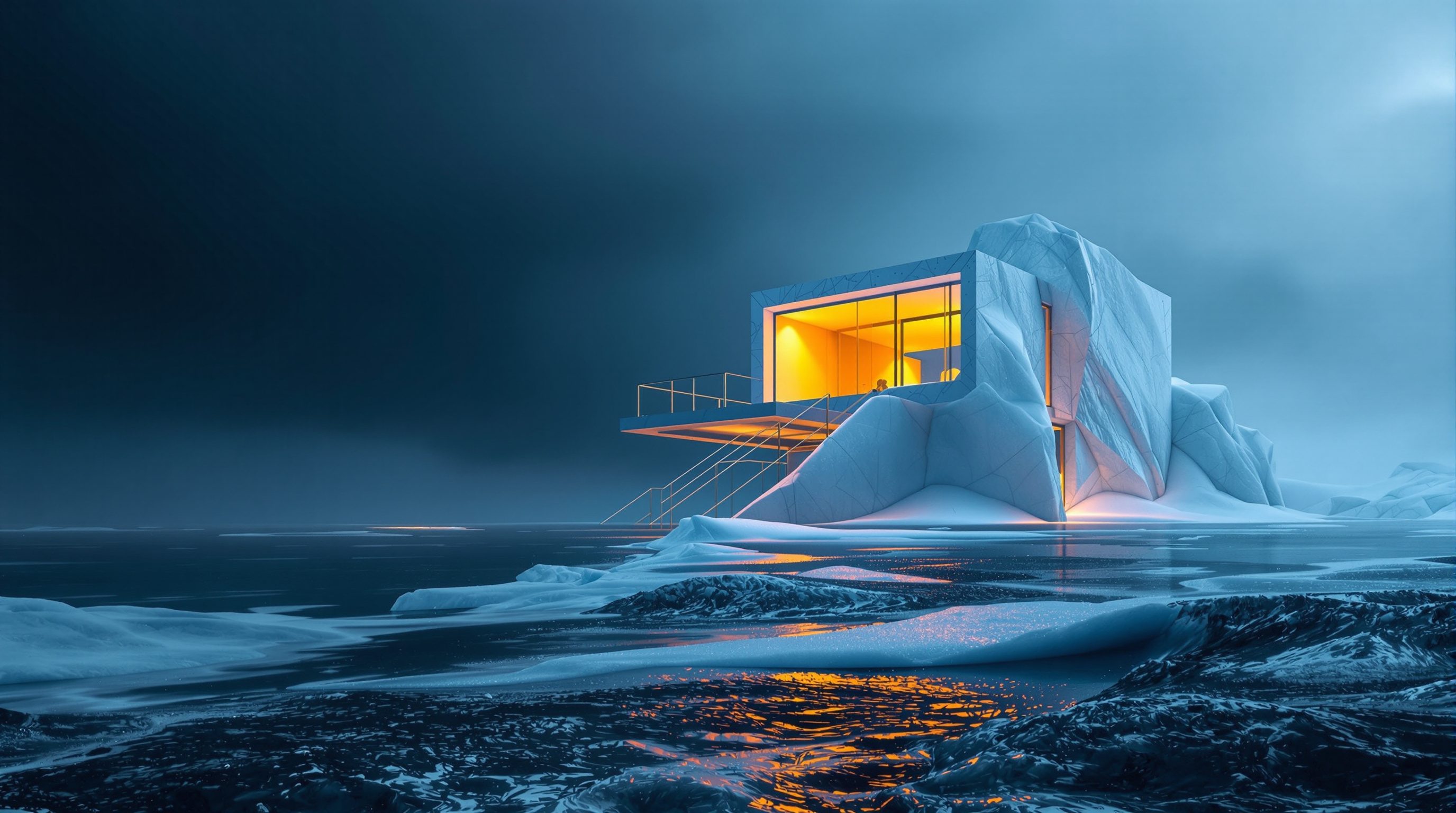
 Lesson 4.2
Lesson 4.2 · Floating Cities & the Ocean
Seasteading & Its Problems
The reality check - seasteading is the purest form of the dream, a permanent, autonomous, self-governing settlement on the open sea, and it keeps not happening for reasons that are structural, not incidental: brutal ocean engineering, staggering cost, fragile life-support and resupply, and a legal and governance limbo the beautiful renders never show
Seasteading is the floating-city dream in its purest form - a permanent, autonomous, self-governing city on the open sea - and the striking fact is that, decade after decade, it keeps not happening.
A seastead is not a houseboat, and not a floating home moored off a jetty. It is the boldest version of the whole dream: a permanent, autonomous, self-governing settlement on the open sea, deliberately beyond the territory and laws of any nation - homesteading the ocean the way pioneers once homesteaded land, under rules chosen from scratch. It has a real intellectual history, a devoted following, serious money and serious people behind it.
And yet there is no thriving autonomous city on the open ocean, and there never has been. The interesting question is not whether the dream is appealing - it plainly is - but why it stalls, every time, at the render and the pilot. This lesson is the reality check, held fairly and without gloating: the open sea, the budget and the law each, independently, say no. Brutal ocean engineering, staggering cost, fragile life-support and resupply, and a legal and governance limbo the renders never show - together they explain why the purest form of the dream keeps not happening, and what quietly survives when it meets reality.
Seastead = permanent + autonomous + self-governing city on the OPEN sea. Keeps NOT happening - four structural walls: (1) brutal ocean engineering, (2) staggering cost, (3) fragile life-support + resupply (storm cuts the lifeline), (4) legal limbo (no state = no courts/rescue/recourse). When it gets real it SHRINKS toward shore, smaller, under a state. Engineering + law = the experts'.
What seasteading actually is
The purest, most ambitious version of the floating-city dream has a name: seasteading. A seastead is not a houseboat, and not a floating home moored off a jetty; it is a permanent, autonomous, self-governing settlement on the open sea, deliberately beyond the territory and the laws of any existing nation. The word fuses "sea" with "homesteading," and that is exactly the ambition - to stake out a new home on the ocean the way pioneers once staked out land, and to govern it by rules chosen from scratch. Where the floating home asks only to live safely on sheltered water under an ordinary government, the seastead asks for something far larger: to live on the open ocean, self-sufficient, and free of any state.
It is important to define it precisely, because the precision is where the difficulty lives. Three claims stack on top of one another, and each one makes everything harder. Permanent means this is not a voyage or a visit but a place people live indefinitely, so every system must last for decades in the most punishing environment on the planet's surface. Autonomous means it must, to a serious degree, supply its own power, water, food and services, because it is far from shore and cannot simply be plumbed into a city; the more autonomous, the more the settlement must become a closed system. And self-governing means it sits outside the legal order of any nation - which sounds like freedom but turns out to be a profound practical problem, because law is not only a constraint but also the thing that provides safety, rescue, courts, contracts and recourse.
Seasteading has a real intellectual history and a genuine following - it has been promoted for decades as a way to try out new forms of society, to relieve crowded and expensive cities, and, for its most committed advocates, to escape what they see as sclerotic and coercive governments. The motive of autonomy is old and human, and the vision has attracted serious money and serious people. And yet, despite all of that, seasteading keeps not happening. There is no permanent, autonomous, self-governing settlement thriving on the open ocean. The interesting question - the one this lesson pursues, fairly and without gloating - is not whether the dream is appealing, because it plainly is, but why, decade after decade, it stalls at the render and the pilot and never becomes the city. The answer is not a failure of imagination. It is that the open sea, the budget and the law each, independently, say no.
Seastead = PERMANENT + AUTONOMOUS + SELF-GOVERNING settlement on the OPEN sea, beyond any state. Three claims stacked; each makes everything harder. Not a houseboat, not a moored home. It keeps NOT happening - the question is why.
Brutal ocean engineering and staggering cost
The first reason seasteading keeps not happening is the most physical: the open ocean is a brutal place to put a permanent structure, and building there is staggeringly expensive. The next lesson takes the engineering in detail; here it is enough to feel the shape of it. The open sea is not a calm pond scaled up. It delivers large storm waves that impose enormous, repeated loads on any structure and whatever holds it in place; it corrodes metal relentlessly with salt; it fouls every submerged surface with marine growth; and it moves, constantly, so that a permanent home on it must either ride that motion or fight it, and both are hard. Humanity does build on the open sea - offshore oil and gas platforms, and a handful of very large floating structures - but it does so at colossal cost, for high-value industrial reasons, with specialist marine engineering, constant maintenance and crews who are paid to endure it. That is a very different proposition from a settlement where ordinary people are meant to live good, affordable lives.
Cost is not a detail that clever design can wave away; it is close to the heart of the matter. Everything at sea is more expensive than its equivalent on land: the structure, the mooring or station-keeping, the delivery of every material by ship, the power, the maintenance of parts permanently half-submerged, the insurance against a hostile environment. The offshore industry's numbers are measured in the hundreds of millions and billions, and it accepts them only because oil, gas or defence justify them. A seastead has no comparably valuable product to pay for its extraordinary costs - it is, in the end, just somewhere to live, and somewhere to live has to compete with the enormous, cheap supply of dry land, however crowded that land may feel.
This is why the honest version of the physical objection is not "it is impossible" but "it is possible only at a cost, and in a manner, that defeats the purpose." You can, in principle, engineer a structure to survive the open ocean - the oil industry proves it - but the result is an industrial installation costing a fortune, not an affordable new city for ordinary people. The dream needs the open sea to be roughly as forgiving and cheap to build on as sheltered water near shore, and it simply is not. And every binding number here - what loads a structure would face, what it would cost to survive them, whether any given design is safe - belongs not to a designer's optimism but to qualified marine and structural engineers, tested systems and the governing standards.
Life-support, resupply and the governance limbo
The second cluster of reasons is about keeping people alive and supplied, and about who governs them - and these are the problems the beautiful renders most completely ignore. Start with life-support and resupply. A settlement far from shore cannot lean on the city behind it for the endless flow an ordinary community takes for granted: fresh water, food, fuel, medicine, spare parts, and the removal of waste and sewage. It must either produce these itself - which is extraordinarily hard to do reliably at sea, and pushes the seastead toward the same closed-loop life-support logic as a space station - or have them shipped in and out constantly, which is expensive, fragile, and vulnerable to the very storms that make the open ocean dangerous. A lifeline that a bad week of weather can cut is not a foundation for a permanent home. The renders show gardens and solar panels; they do not show what happens when the desalination fails, the resupply boat cannot sail for ten days, or someone needs a hospital.
Then there is the problem that sounds like freedom and behaves like limbo: governance and law. The seasteading dream prizes being outside any state, but law is not only a set of rules to escape; it is also what provides courts, contracts, policing, safety regulation, rescue and recourse when things go wrong. On the high seas, whose law applies? A vessel normally carries the law of the country whose flag it flies, but a permanent settlement claiming autonomy fits awkwardly into that system, and the moment a real dispute, a crime, an injury or a rescue arises, the absence of a clear governing authority becomes not liberating but dangerous. Nations, understandably, are wary of permanent autonomous settlements off their coasts, and international law of the sea does not obligingly make room for a new sovereign city. Every attempt to actually plant a seastead has run hard into this: the water that is genuinely beyond all states is also genuinely beyond all protection.
Put the clusters together and the pattern is clear. The libertarian dream imagines the open ocean as an empty frontier where a free society can simply begin. The buildable reality is that the same openness that promises freedom also removes the shore's supply chain and the state's protection at once - so a real seastead must either retreat toward the shore and a state's waters (and stop being a seastead) or accept the crushing costs and risks of true isolation. That is the gap the dream cannot close, and every binding safety and legal determination within it belongs to qualified specialists and the governing law, never to a designer's confidence.
The dream renegotiated back toward the shore
What survives, then, when the dream meets the sea, the budget and the law? Not nothing - but something much smaller and closer to shore than the render promised, and understanding that shrinkage is the real lesson of seasteading. The honest pattern of the field is that the permanent, autonomous, open-ocean city recedes, and what actually gets attempted is a small pilot, near shore, inside some nation's waters, plugged into that nation's supply and protection - which is to say, almost the opposite of a seastead on every axis that defined it. The moment a project becomes real enough to build, the physics pushes it toward calmer water, the budget pushes it toward smaller scale, and the law pushes it back under a state. The dream does not so much fail as get quietly renegotiated into something buildable - a floating development, not an autonomous ocean city.
This is not a tragedy, and a designer should not treat it as one. It is the field being honest about itself. The genuinely valuable, humane, near-term floating architecture - the floating homes and neighbourhoods of the previous module, on sheltered water, under ordinary law, connected to shore - is exactly what you get when you let go of the three impossible claims (permanent open-ocean isolation, full autonomy, statelessness) and keep the good, buildable core (living well on water). Seasteading, read fairly, is a useful thought experiment that clarifies by exaggeration where the real limits lie: it shows that the hard constraints on floating settlement are not mainly architectural imagination but ocean engineering, cost, resupply and law, and that relaxing the most extreme demands is what turns a render into a home.
So hold seasteading the way this course holds the whole frontier: with genuine interest and without credulity. Respect the motives - autonomy, experiment, a fresh start - and the seriousness of the people who have pursued it; admire the imagination; and then be clear-eyed that the open-ocean, autonomous, self-governing city keeps not happening for reasons that are structural, not incidental, and unlikely to yield soon. Back the buildable near-term - floating homes and neighbourhoods on sheltered water, which are real and kind - and read the seastead render for what it is. And keep the boundary absolute: everything that would decide whether any real settlement on the sea is safe or lawful - the marine and structural engineering, the life-support, the safety certification, the governing law - belongs to qualified engineers, specialists, tested systems and the law, never to a designer moved by the dream of a free city on the waves.
Three stacked claims
What a seastead demands
Permanent (decades in the harshest environment), autonomous (supplies its own power, water, food, services), and self-governing (outside any state). Each claim compounds the difficulty. Relaxing them is what turns a render into a buildable floating development. Module 4.2.
Four structural obstacles
Why seasteading keeps not happening
Brutal open-ocean engineering, staggering cost, fragile life-support and resupply, and legal and governance limbo. Any one can stop a seastead; the open ocean presents all four at once. These are structural, not incidental. Modules 4.2, 4.3.
Statelessness is limbo, not freedom
The governance problem
Law provides not only constraint but courts, contracts, policing, safety, rescue and recourse. On the high seas, whose law applies is genuinely unresolved for a permanent settlement - a danger, not a liberation. Whose law governs is a legal determination, not a designer's. Module 4.2.
Design, not marine, life-support or legal engineering
The limit of a designer's claims
Every binding marine and structural, life-support, safety and legal determination belongs to qualified engineers, specialists, tested systems and the governing law and standards - never to a designer moved by the dream. Modules 4.2, 4.3.
Workshop - stress-test a seasteading proposal against the four obstacles
You will take one seasteading or open-ocean settlement proposal (real or from a render) and reason it honestly against the four structural obstacles, watching where each one forces the dream to shrink - and marking clearly where the binding questions leave the designer.
Just one proposal and a notebook. No engineering - this workshop is about reasoning honestly about why the open-ocean city stalls, and about locating where every binding marine, structural, life-support, safety and legal question passes to qualified specialists, tested systems and the governing law.
Goal: to see why the open-ocean autonomous city keeps not happening, by testing one proposal against the four obstacles
Inputs: one seasteading/ocean-settlement proposal (image and any description) + a notebook
Time: ~45 minutes
- 1State the proposal's three claims honestly: how permanent, how autonomous, and how self-governing does it claim to be? The stronger each claim, the harder the test.
- 2Test it against ocean engineering and cost: what open-sea forces would it face, and what does the offshore-industry comparison suggest about the order of cost? (Reason about scale, not numbers - the numbers are the engineers'.)
- 3Test it against life-support and resupply: list what must come in and go out continuously, and note what happens to the settlement if a storm cuts the lifeline for ten days.
- 4Test it against law and governance: whose law would apply, who provides rescue, safety and recourse, and how the proposal handles a serious crime, injury or dispute.
- 5Write a one-paragraph honest verdict: which obstacle bites hardest, how far the proposal must shrink toward calmer water, smaller scale and a state's waters to become buildable, and which questions must go to qualified marine, structural, life-support and legal specialists and the governing law.
You’ll walk away with
A one-page stress-test of one seasteading proposal against the four structural obstacles, showing where each one forces the dream to shrink toward the shore, and marking explicitly where the binding engineering, safety and legal questions begin.
Three altitudes on the same idea
Read the band that fits you — or all three.
Seasteading is the floating-city dream in its purest form - permanent, autonomous, self-governing settlement on the open sea - and it keeps not happening for reasons that are structural, not incidental, which is exactly why it is worth studying. Learn the three stacked claims, because each compounds the difficulty: permanent (every system must last decades in the harshest environment on the surface), autonomous (it must supply its own power, water, food and services, pushing it toward closed-loop life support), and self-governing (it sits outside any state's law, which removes not just constraint but courts, safety, rescue and recourse). Learn the four obstacles - brutal open-ocean engineering, staggering cost, fragile life-support and resupply, and legal and governance limbo - and note that any one can stop a seastead while the open ocean presents all four at once. Above all, learn the pattern of what survives: the moment a project becomes buildable, physics pushes it to calmer water, budget to smaller scale, and law back under a state, so it becomes a floating development near shore, not an autonomous ocean city. Design accordingly, and defer every binding marine, structural, life-support, safety and legal determination to qualified engineers, specialists, tested systems and the governing law.
The seasteading render sells an interior of serene self-sufficiency - gardens, light, a free community at ease on the ocean - and the honest, humane thing a designer can do is notice everything that render leaves out of daily life, because those omissions are where real habitability lives. A permanent settlement far from shore has to solve, unglamorously and continuously, the things an ordinary home never thinks about: reliable fresh water and food, the removal of waste and sewage without fouling the sea, medicine and care when someone falls ill, and the psychological strain of isolation and confinement when the resupply boat cannot sail for ten days. The renders show the pleasures and hide the plumbing and the loneliness. Take from this the discipline that in any settlement on water the interior's real quality depends on the mundane systems being genuinely solved, not rendered away - and attach your care for light, space and human comfort to the buildable near-term (floating homes and neighbourhoods on sheltered water, under ordinary law and services) rather than the open-ocean fantasy. And keep the boundary firm: every binding life-support, safety and structural system belongs to qualified engineers and the codes; your domain is the human interior inside what they can actually guarantee.
Seasteading is the perfect case study in why a beautiful idea can be genuinely serious and still keep not happening - and learning to explain that, fairly and precisely, is a mark of real design literacy. Start with the definition and feel how three claims stack: permanent, autonomous and self-governing settlement on the open sea. Then learn the four reasons it stalls, and notice that they are structural, not incidental: the open ocean is brutal and building on it is staggeringly expensive (the offshore oil industry proves it can be done, but only at colossal cost for high-value reasons); life-support and resupply are fragile far from shore, so a storm can cut the lifeline; and being outside any state means being outside its courts, safety, rescue and recourse, which is limbo, not freedom. Then learn the most useful part - what survives: the moment a project gets real, it shrinks toward the shore, smaller, and back under a state, becoming a floating development rather than an ocean city. That is not the dream failing so much as the field being honest about where its real limits lie: not in architectural imagination, but in engineering, cost, resupply and law. Excited literacy without credulity, on its hardest case.
“Seasteading has not happened yet only because it needs more funding and bolder builders - the engineering is basically solved, and once a serious backer commits, permanent autonomous cities on the open ocean will follow quickly.”
Do it yourself
No tools needed - reason it through.
- 1Define a seastead precisely, and explain how it differs from a floating home moored near shore.
- 2Name the three stacked claims (permanent, autonomous, self-governing) and say how each one compounds the difficulty.
- 3List the four structural obstacles that keep seasteading from happening, and explain why cost is close to the heart of the matter.
- 4Why is being outside any state's law a form of limbo rather than freedom for a permanent settlement?
- 5Describe the pattern of 'what survives' when a seasteading project becomes real enough to build - and say why that is honesty, not failure.
The one line to carry out
Peer-reviewed journals & authoritative standards
- 01Seasteading — Wikipedia - Seasteading, 2026.
- 02Offshore construction — Wikipedia - Offshore construction, 2026.
- 03Ocean engineering — Wikipedia - Ocean engineering, 2026.
- 04Very large floating structure — Wikipedia - Very large floating structure, 2026.
Two of the four obstacles - cost aside - come down to the physical reality of the open ocean itself. The next lesson takes that reality head on: why the open sea is so much harder than sheltered water, and how offshore engineering really does the little it does.
The author
Amogh N P
Architect, interior designer, and creative polymath. Studio Matrx began in his notebooks — his vision of design made honest, useful, and open to everyone. Its Academy is written and taught in his memory, and free, forever.
More about Amogh →