
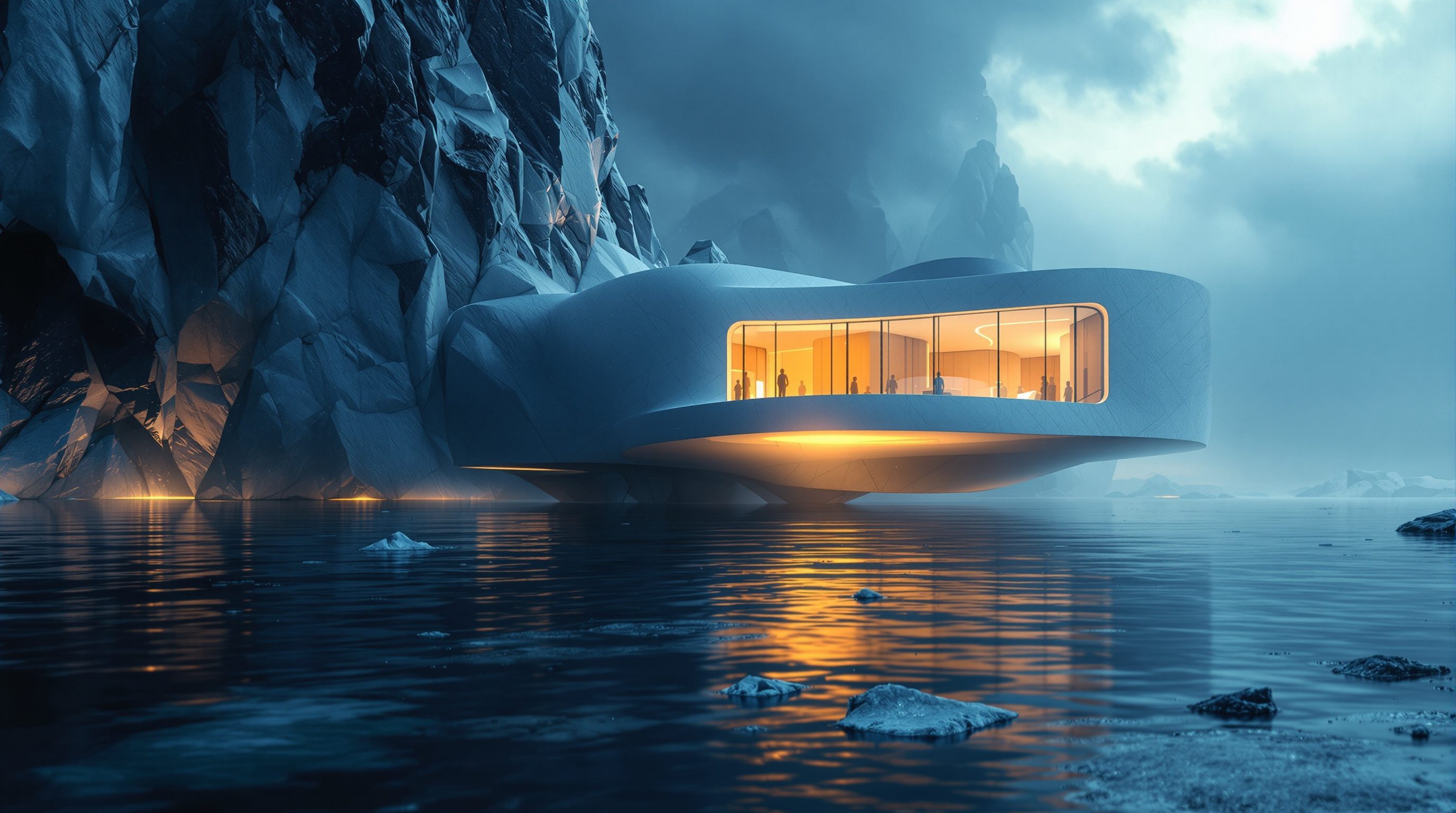
 Lesson 4.1
Lesson 4.1 · Floating Cities & the Ocean
The Floating-City Dream
The most seductive image in all of extreme-environment architecture - a whole city floating free on the ocean, answering sea-level rise, land shortage and the wish for a fresh start in a single dazzling render - presented fairly, as the dream to be tested rather than the fantasy to be mocked
A whole city, floating free on the ocean, is one of the most seductive images architecture has ever produced - and one of the least built.
You have seen the render, even if you have never named it: low buildings and slender towers on hexagonal platforms lashed into a settlement, canals and walkways between them, gardens spilling over the edges, solar panels glinting, small boats in the channels, and beyond the last platform only sea and sky - all bathed in warm evening light and an air of serene, self-sufficient calm. This is the floating-city dream, and it is one of architecture's most powerful and recurring images.
Its power is no accident. In a single picture it promises to answer three real anxieties at once: rising seas, so build up off the water; cities out of room, so expand onto the vast empty ocean; societies that feel stuck, so start fresh on a clean slate at sea. That is a great deal of hope loaded onto one image, and it is exactly why the image travels so far. This lesson does something the internet rarely does with that render: it takes the dream seriously and fairly - feeling the genuine force of its appeal - and sets it up honestly as the thing to be tested over the rest of the module, neither swallowed whole nor sneered away.
Floating-city dream = ONE render promising to fix rising seas + land shortage + a fresh start. Four motives: refuge / eco-city / libertarian escape / luxury spectacle. Fame runs OPPOSITE reality - iconic ocean cities = least built; real floating homes = quiet + unglamorous. Be fair to the dream, hard on the evidence. Every binding question -> engineers + the law.
A whole city, floating free
Picture it, because the picture is the point: a whole city, floating free on the open water. Ribbons of low buildings and slender towers rest on hexagonal platforms lashed together into a settlement; walkways and canals thread between them; gardens spill green over the edges; solar panels glint and small boats move in the channels; and beyond the last platform there is only sea and sky. It is rendered, almost always, in warm evening light, calm water, and a mood of serene, self-sufficient optimism. This is the floating-city dream - the idea that we could lift a city clear of the land altogether and set it down on the ocean - and it is one of the most powerful and recurring images in all of architecture.
It is worth taking the dream seriously and fairly before testing it, because its appeal is genuine and it answers to real anxieties. If the seas are rising and coasts are going under, why not simply build up off the water instead of fighting it? If the great cities are running out of land and choking on their own density, why not expand onto the vast, empty surface of the ocean, which covers most of the planet? And if our societies feel stuck - politically, economically, environmentally - why not start again on a clean slate, a new kind of settlement unencumbered by the mistakes baked into the old ones? The floating city promises, in a single image, to answer sea-level rise, land shortage and the wish for a fresh start all at once. That is a lot of hope to load onto one render, and it is exactly why the image travels so far.
This lesson presents the dream honestly, as the thing to be tested rather than the thing to be mocked. The cynic's reflex - to dismiss the whole idea as science-fiction nonsense - is as lazy as the futurist's reflex to believe the render shows what is coming. The disciplined position, the one this course teaches, sits between them: take the vision seriously enough to understand its real pull, then ask of it the hard questions the rest of this module asks - is this genuinely near-term, a promising prototype, or a beautiful picture that will never be built? Before we can sort the floating city honestly, we have to feel, fairly, why so many intelligent people have wanted it to be true.
The render: platforms + towers + canals + gardens + boats, sea to the horizon, warm light. Promises to answer THREE anxieties in one image - rising seas, land shortage, a fresh start. Take it seriously and fairly, then TEST it.
The genuine appeal: four serious motives
Why does this particular dream keep coming back, generation after generation, when so many other architectural fantasies fade? Because underneath the render sit several genuinely serious motives, and it helps a designer to name them, because each one leads to a different kind of floating-city proposal with a very different chance of being real.
The first and most sympathetic is climate refuge. For low-lying island nations and sinking coastal cities, rising seas are not a distant worry but an existential one, and a floating settlement that rises with the water rather than drowning under it is a rational thing to wish for. When a country literally faces losing its land, floating up off it is not a whim; it is a search for survival, and it deserves respect even where it proves impractical. The second is the eco-city or blue-economy vision: a self-sufficient, green settlement at sea, generating its own power, growing its own food, drawing on ocean resources, treading lightly. It appeals to a real and admirable desire for a way of living that does less harm. The third is the libertarian escape - the wish to build a community beyond the reach of any existing government, with new rules chosen from scratch, on water that belongs to no state. Whatever one thinks of the politics, the motive of autonomy is a real and old human impulse. And the fourth, less idealistic but very influential, is luxury spectacle: ocean resorts, floating towers and marine developments rendered in gold light to attract investment, tourism and prestige.
Naming the four flavours is useful precisely because it breaks the single seductive image back into its motives - and motives, unlike renders, can be examined. A climate-refuge proposal for a sheltered lagoon is a very different animal from a libertarian city on the open Pacific or a developer's luxury render, even when all three arrive wrapped in the same glossy picture. Some of these motives point toward things that are genuinely buildable and humane at the scale of a home or a neighbourhood, on protected water, now. Others point toward the open ocean and the far edge of what engineering, economics and law can currently deliver. Keeping the appeal honest - feeling the genuine force of each motive - is what lets you then judge each proposal on its own terms rather than being swept along, or shutting down, at the sight of the render.
The renders that made it famous
The floating-city dream is carried, above all, by images - a small number of spectacular concepts that have circulated so widely they have come to stand for the whole idea. Over the decades there have been floating arcologies and pyramid-cities; spiralling ocean towers shaped like lily pads or shells; modular hexagonal settlements presented at international forums as answers to sea-level rise; and a steady stream of developer visions for marine resorts and floating districts. They are, as a body of work, genuinely beautiful and genuinely inventive - some of the most imaginative architecture of the last half-century lives in these unbuilt concepts, and it would be philistine to pretend otherwise.
But here is the pattern a literate designer learns to see, and it is the crux of this lesson: fame in this field runs almost exactly opposite to reality. The concepts that are most photographed, most shared and most iconic - the full ocean cities, the floating utopias on the open sea - are precisely the ones that have never been built and, on present evidence, are furthest from being buildable. Meanwhile the genuinely real floating architecture, the part that people actually live in, is comparatively invisible: modest floating homes on canals and lakes, the Dutch floating neighbourhoods on sheltered water, the pilot platforms and prototypes that test one honest piece of the idea at a time. The render ladder runs from render, to prototype, to built-and-lived-in - and the famous names cluster almost entirely at the render end, while the quiet, real work clusters at the far, unglamorous end.
This is not an argument that the concepts are worthless. Visionary renders have a real job: they enlarge the imagination, attract attention and funding to the problem of living with water, and occasionally seed a prototype that teaches something true. The danger is only in mistaking the image for the achievement - in letting the sheer beauty and confidence of a render stand in for the engineering, economics, law and human reality that would have to be solved before anyone could live there. A designer's task, faced with one of these famous pictures, is the double one this course keeps insisting on: to admire the imagination fully and honestly, and, at the very same moment, to ask where on the ladder this actually sits. Almost always, the most dazzling ones sit at the bottom rung - and saying so plainly is not cynicism but literacy.
The dream to be tested, not mocked
So how should a designer hold the floating-city dream? Not with the futurist's credulity, which takes the render as a preview of the inevitable; and not with the cynic's contempt, which dismisses the whole thing as a fantasy unworthy of thought. Both are ways of not looking. The disciplined stance - the one this module builds toward - is to hold the dream fairly and critically at the same time: to grant it the full force of its appeal and imagination, and then to subject it, without flinching, to the hard questions of engineering, cost, law and human life that the next three lessons take up in turn.
Being fair to the dream means several concrete things. It means acknowledging that the motives behind it are largely serious and often humane - survival for sinking nations, a lighter way of living, autonomy, even prestige that funds real work. It means recognising that the renders are frequently brilliant pieces of imagination that have done genuine good in dramatising the problem of rising water. And it means conceding that some fraction of the dream is already real, just not at the scale or in the place the famous images promise: people do live on water, happily and safely, in floating homes and neighbourhoods on sheltered water, and that is the dream cashed out honestly. Being fair does not require pretending the ocean city is imminent; it requires refusing to sneer.
Being critical, in turn, means insisting that a beautiful picture is not evidence, that motive is not method, and that the questions the render leaves out - can it be engineered on the open sea, can it be afforded, whose law governs it, can people actually live good lives on it - are the ones that decide everything. This is the through-line of the whole course applied to its most tempting case: excited literacy without credulity. And it carries a firm boundary, repeated because it is a matter of life and death: none of the binding questions a floating city raises - structural, marine, ocean, life-support, safety, legal - are a designer's to settle. They belong to qualified engineers and specialists, tested systems, and the governing law and standards. The designer's job here is not to certify the dream but to read it honestly - and, over the next three lessons, to learn exactly why the ocean keeps turning these particular renders back into renders.
Be fair before you are critical
How to meet a spectacular render
The floating-city dream has genuine appeal and largely serious motives (climate refuge, eco-city, autonomy, prestige). Grant that fully before testing it. Neither swallow the render nor sneer at it. Modules 4.1, 0.3.
Break the image into its motives
Judging a floating-city proposal
One render can hide four very different projects - a sinking-community refuge, an eco-settlement, a libertarian escape, a luxury spectacle - each with a different chance of being real. Examine the motive, not just the picture. Module 4.1.
Fame runs opposite to reality
Reading the famous concepts
The most iconic ocean-city concepts are the least built; the real floating architecture (homes and neighbourhoods on sheltered water) is comparatively invisible. Ask where on the render-to-built ladder a project sits. Modules 4.1, 4.4, 2.4.
Design, not ocean or legal engineering
The limit of a designer's claims
Every binding structural, marine, ocean, life-support, safety and legal question a floating city raises belongs to qualified engineers, specialists, tested systems and the governing law and standards - never a designer moved by a render. Modules 4.2, 4.3.
Workshop - take a famous floating-city render and read it fairly, then critically
You will choose one well-known floating-city concept and practise the module's central habit on it: first do it justice - feel and name its appeal and its motive - and only then interrogate it, honestly and without sneering, marking clearly where your competence ends and the engineers' begins.
Just one floating-city image with any description, and a notebook. No engineering - this workshop is about the judgement of reading a render honestly, doing the dream justice and then testing it, and locating where every binding structural, marine, safety and legal question passes to qualified specialists and the governing law.
Goal: to practise holding a spectacular render fairly and critically at once
Inputs: one famous floating-city concept (an image and any description you can find) + a notebook
Time: ~45 minutes
- 1Describe the render generously and in detail, as if you loved it: what does it show, what feeling does it sell, and what genuine anxiety or hope is it answering? Do the dream justice before you test it.
- 2Identify which of the four motives it primarily serves - climate refuge, eco-city or blue economy, libertarian escape, or luxury spectacle - and note how that motive shapes what is being promised.
- 3Place it on the render-to-built ladder: is it a pure render, a tested prototype, or something built and lived in? Note what evidence (beyond the image) would move it up a rung.
- 4List the hard questions the render leaves out - can it be engineered on this water, can it be afforded, whose law governs it, can people live good lives on it - without trying to answer them.
- 5Write a one-paragraph honest verdict that is fair and critical at once: what the concept gets genuinely right about the human wish behind it, where it sits on the ladder, and which questions must go to qualified engineers, specialists and the governing law.
You’ll walk away with
A one-page reading of one floating-city concept: a generous description and its motive, its place on the render-to-built ladder, the questions it leaves out, and an honest fair-and-critical verdict that marks clearly where the binding engineering and legal questions begin.
Three altitudes on the same idea
Read the band that fits you — or all three.
The floating-city dream is the most seductive render in the field, and your first professional duty toward it is to be fair before you are critical - to grant the real force of its appeal and the seriousness of its motives, then test it honestly rather than being swept along or shutting it down. Learn to break the single image back into its motives - climate refuge, eco-city, libertarian escape, luxury spectacle - because each leads to a different proposal with a different chance of being real, and a developer's gold-lit ocean tower is not the same animal as a sheltered-lagoon refuge for a sinking community. Learn the pattern that fame runs opposite to reality: the most iconic ocean-city concepts are the least built, while the genuinely real floating architecture (homes and neighbourhoods on sheltered water) is comparatively invisible. Admire the imagination fully; then ask where on the render-to-built ladder any given project actually sits. And hold the boundary without exception - every binding structural, marine, ocean, life-support, safety and legal question a floating city raises belongs to qualified engineers, specialists, tested systems and the governing law, never to a designer moved by a beautiful picture.
The floating-city render sells a feeling as much as a place - serene, light-filled, self-sufficient, at ease on the water - and it is worth understanding that feeling, because it is the humane core the dream gets right even where the engineering does not. The images promise interiors open to water and light, a life lived close to the sea, gardens and green woven through, a calm and generous domesticity. That longing is real and answerable - but, honestly, it is answerable now at the scale of the floating home and neighbourhood on sheltered water, not the ocean city on the open sea. So take from the dream what is true about the human experience of living well on water - the light, the closeness to the surface, the sense of a settlement rather than a machine - and attach it to the buildable near-term rather than the render. And keep the boundary clear: the systems that would make any real floating interior safe, breathable, dry and serviced belong to qualified engineers and the codes; your domain is the liveable, human quality of the space inside the envelope they guarantee.
This lesson trains one of the most important skills the whole course teaches, on its most tempting case: how to look at a spectacular architectural render without either believing it uncritically or dismissing it as nonsense. Start by feeling, honestly, why the floating-city dream is so seductive - it promises to answer sea-level rise, land shortage and the wish for a fresh start in a single beautiful image. Then learn to break that image into its four serious motives (climate refuge, eco-city, libertarian escape, luxury spectacle), because motives can be examined where renders cannot. Then learn the pattern that will serve you across the whole field: fame runs opposite to reality - the most famous floating-city concepts are the least built, while the real floating architecture people actually live in is quiet and unglamorous. The disciplined stance is to be fair to the dream and hard on the evidence at once: excited literacy without credulity. It is a thrilling image and a genuine imaginative achievement - and learning to test it, rather than swallow or sneer at it, is exactly the judgement that marks a serious designer.
“Floating cities are basically here - the renders you see from design forums and developers show real projects that are being built now, and within a decade or two whole cities will be floating on the ocean as the answer to rising seas.”
Do it yourself
No tools needed - reason it through.
- 1In one sentence, explain why the floating-city dream is so seductive - what three anxieties does a single render promise to answer?
- 2Name the four serious motives behind the dream, and say why breaking the image into motives is more useful than judging the image whole.
- 3Explain the pattern that 'fame runs opposite to reality' in floating architecture, with an example of the famous versus the real.
- 4What does it mean to be 'fair to the dream' without being credulous about it?
- 5List three hard questions a floating-city render leaves out that must be answered before anyone could live there - and say who owns each.
The one line to carry out
Peer-reviewed journals & authoritative standards
- 01Floating architecture — Wikipedia - Floating architecture, 2026.
- 02Seasteading — Wikipedia - Seasteading, 2026.
- 03Arcology — Wikipedia - Arcology, 2026.
- 04Sea level rise — Wikipedia - Sea level rise, 2026.
Having felt the dream fairly, we now begin to test it in earnest - starting with the purest and most ambitious version of it: seasteading, the idea of a permanent, autonomous settlement on the open sea, and the brutal reasons it keeps not happening.
The author
Amogh N P
Architect, interior designer, and creative polymath. Studio Matrx began in his notebooks — his vision of design made honest, useful, and open to everyone. Its Academy is written and taught in his memory, and free, forever.
More about Amogh →