
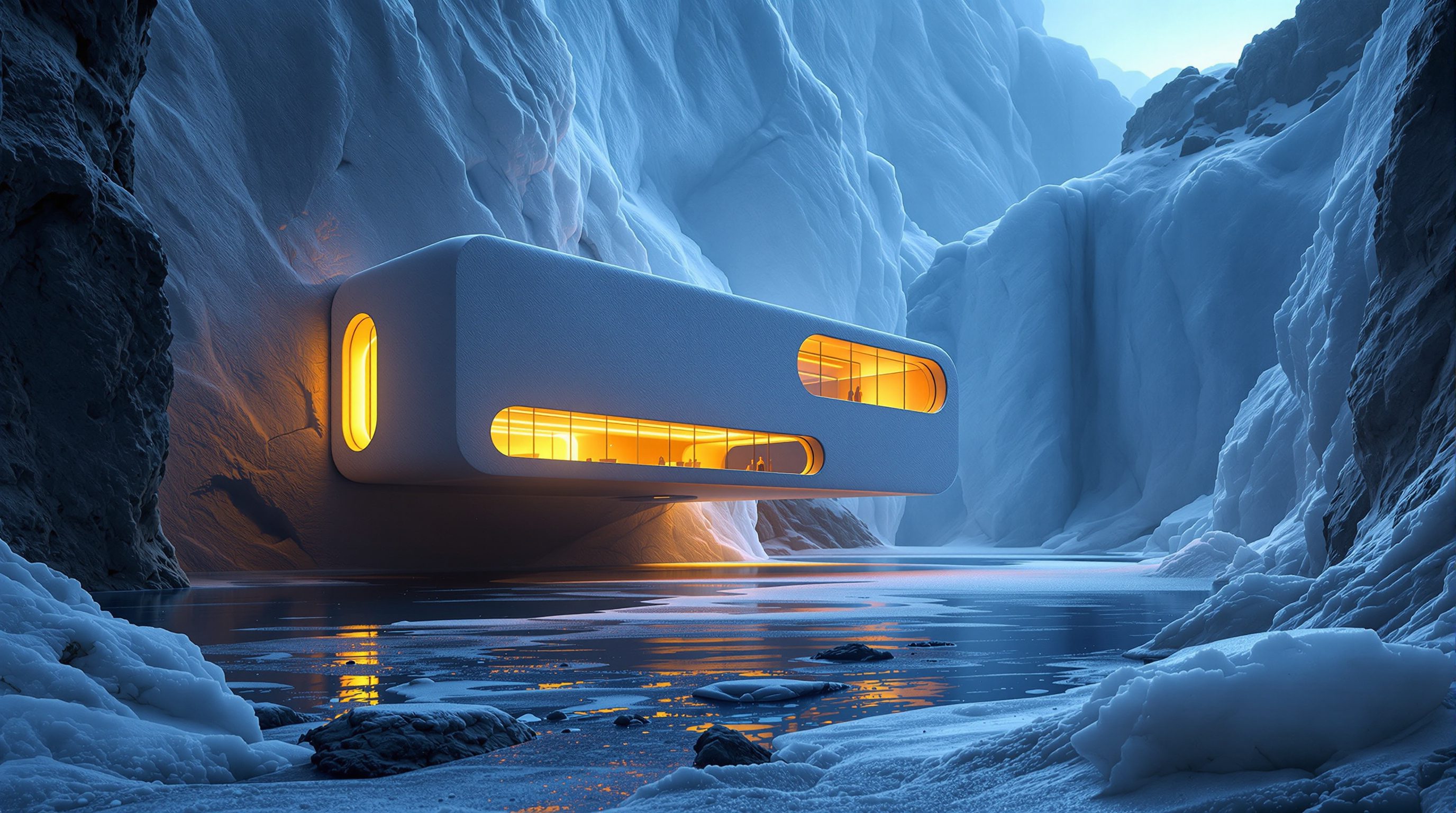
 Lesson 4.3
Lesson 4.3 · Floating Cities & the Ocean
Ocean-Engineering Realities
Why the open ocean is so hard - waves and storms, relentless corrosion, biofouling and fatigue, the categorical gap between sheltered water and the open sea, and what offshore engineering (oil platforms, very large floating structures) actually costs and how it is really done: the concrete, physical reasons the ocean-city renders stay renders
The reason floating cities stay renders is not a lack of imagination - it is that the open ocean is a categorically harder place to build than the sheltered water where floating homes actually work.
A floating home sits calmly on a lake because a lake is protected: something limits how big its waves can grow and how hard its weather can hit, so a broad, low platform barely moves and feels utterly steady. That is the whole world of real, built floating architecture - and it is a good world. But the ocean-city render is set somewhere else entirely: the open sea, where the protection is gone.
The step from sheltered water to the open ocean is not a matter of degree; it is a change of kind. Out there, wind builds storm waves that pound a structure with enormous, repeated loads; salt eats metal relentlessly; marine growth colonises every surface; and constant motion fatigues every joint - all at once, all the time, on parts that are hard to reach. Humanity does build on the open sea, in oil platforms and very large floating structures, but only as heavy, hugely expensive, specialist infrastructure justified by high-value industry. This lesson gives the concrete, physical reasons the ocean keeps turning the renders back into pictures - and draws, firmly, the line where a designer's literacy ends and the marine engineers' work begins.
Sheltered water =/= open ocean (kind, not degree). Open sea attacks a structure 4 ways at ONCE + forever: storm waves (huge repeated loads) + salt corrosion + biofouling + motion fatigue. Oil platforms + VLFS prove it's possible - but only as billion-dollar crewed industrial infrastructure. Cost ladder: cheap sheltered home -> platform -> VLFS -> ocean city sits OFF THE TOP. That contradiction = why renders stay renders. Numbers = marine engineers'.
Sheltered water is not the open sea
The single most useful thing a designer can understand about floating cities is not a number but a distinction: sheltered water and the open ocean are not the same problem, and the gap between them is not a matter of degree but of kind. On sheltered water - a lake, a reservoir, a harbour, a canal, a calm flood-prone waterfront - the waves are small and gentle, the loads on a mooring are modest, and a broad, low platform can sit almost still, so a home built on it feels steady and permanent. That is why the real floating architecture of the previous module lives on sheltered water, and why it works. The moment you move out onto the open sea, every one of those comforts is removed at once, and the problem becomes something offshore engineers, not architects, are equipped to face.
Why is the step so sharp? Because the open ocean has fetch - the vast uninterrupted distance over which wind can build waves - and it has weather no breakwater tames. Sheltered water is protected precisely because something (land, a harbour wall, a narrow entrance) limits how big the waves can grow and how hard the weather can hit. Take that protection away and waves grow from ripples that a floating home shrugs off into storm waves that can impose enormous, repeated, punishing loads on a structure and on whatever holds it in place. The gentle bobbing of a harbour becomes violent, ceaseless motion. And the calm that let a building sit level and still simply does not exist for long.
This is exactly why the field's most seductive renders - floating cities and ocean towers on the open sea - stay renders, while floating homes on lakes get built. It is not that architects lack imagination or that money is short; it is that the open ocean is categorically harsher, and building a permanent, liveable, affordable settlement there runs into problems sheltered-water floating architecture never has to solve. The rule of thumb from Module 2 returns here with a physical explanation behind it: the calmer and more sheltered the water, the more real the project; the more open and stormy, the more likely a render. This lesson gives the physical reasons behind that rule - the forces, the corrosion, the fouling, and the real cost of doing anything on the open sea - so that when you meet an ocean-city render you understand, concretely, why the ocean keeps turning it back into a picture. And, as always, the binding truth of any real structure - what it must withstand, and whether it can - belongs to qualified marine and structural engineers, not to a designer's eye.
Sheltered water (lake, harbour): small waves, low loads, sits still - REAL. Open ocean: storm waves, huge loads, violent motion - a different KIND of problem. The step is not degree, it is kind. Calmer water -> more real; open, stormy water -> more likely a render.
Waves, corrosion, biofouling, fatigue - all at once
The open ocean attacks a permanent structure in several distinct ways at once, without pause, and it helps to name them, because together they explain why offshore work is so hard and so expensive. The first and most dramatic is waves and storms. Storm waves carry immense energy, and they deliver it as huge, repeated impact loads on any structure and its mooring or foundation - not a steady push a designer can simply add up, but a violent, cyclic pounding that the structure must survive tens of millions of times over its life. Designing for the worst storm in decades, while also surviving the ordinary daily wave loading, is a specialist discipline of its own. The second attack is corrosion. Salt water and salt air eat metal relentlessly; steel that would last a century inland can be seriously degraded in years at sea without constant, expensive protection and maintenance. The third is biofouling - the ceaseless colonisation of every submerged surface by marine growth, from slime to barnacles to weed - which adds weight, increases drag, accelerates corrosion and decay, and must be cleaned off again and again. The fourth, quieter but decisive, is fatigue: the endless flexing and cycling from constant motion gradually weakens joints and materials, so that a structure can fail not from one great blow but from the accumulated wear of never being still.
What makes these so punishing is that they operate simultaneously and permanently. A building on land faces weather, but it faces it intermittently, on a solid dry base, in air, with easy access for repair. An open-ocean structure faces storm loading, salt corrosion, biofouling and motion fatigue all at once, all the time, on parts that are hard and dangerous to reach, in an environment that punishes any lapse in maintenance. This is why the offshore world is a world of heavy engineering, redundancy, inspection regimes and specialist crews - not because engineers are timid, but because the sea is genuinely relentless.
Crucially, none of this is a designer's to judge or specify. The magnitude of the wave loads, the corrosion allowances, the fatigue life, the fouling regime and the maintenance strategy for any real structure are determined by qualified marine, structural and ocean engineers, tested against real conditions and the governing standards. The designer's job is to understand that these forces exist and why they are so severe - enough to know that the open sea is not a decorative backdrop but an active adversary, and enough to read an ocean render for the physical problems it is quietly ignoring. Understanding the forces is literacy; quantifying them is engineering, and the two must never be confused.
Oil platforms and very large floating structures - and their cost
It helps enormously to look at how humanity actually does build on the open ocean, because we do - just not in the way the renders imagine. The clearest example is the offshore oil and gas platform: a genuine permanent structure standing or floating in the open sea, sometimes in very deep water, surviving decades of storms. Its very existence proves the engineering is possible. But look at what it costs and how it is really done, and the lesson for floating cities is sobering. An offshore platform is an industrial installation costing hundreds of millions to billions; it is built and maintained by a large specialist industry; it is crewed by people who are paid well to work there in shifts and go home; it carries heavy redundancy and constant inspection; and it exists only because the oil or gas beneath it is worth that staggering expenditure. It is not a place ordinary families live affordable, ordinary lives - and it never tries to be.
The other honest reference point is the very large floating structure - the family of huge engineered pontoons and floating platforms explored and occasionally built for things like floating bridges, offshore runways, industrial platforms and port facilities. These, too, prove that large things can float on real water, and they are a serious field of ocean engineering. But again the reality is instructive: they are enormously expensive, they are engineered and maintained as major infrastructure, and the biggest and most ambitious remain rare, experimental, or confined to relatively sheltered locations. They are not, on inspection, floating cities in waiting; they are specialist infrastructure that shows both what is possible and what it truly costs.
Set these real examples beside the ocean-city render and the gap becomes concrete. The render shows a settlement the size of a town, on the open sea, where ordinary people live pleasant, affordable lives - and it shows it without the price, the crews, the redundancy, the maintenance regime or the industrial reason that every real open-ocean structure requires. Offshore engineering does not disprove floating cities; it prices them, and the price is the problem. It shows that the open sea can be built on, but only as heavy, hugely expensive, specialist infrastructure justified by high-value industry - which is exactly what a place for people to live cannot be. This is why the physical reasons and the economic reasons are really one reason: the open ocean can be conquered, at a cost that defeats the purpose. And what that cost is, for any real structure, is a determination for qualified engineers and the governing standards, never for a designer moved by a picture.
The cost-and-difficulty ladder - and where the render sits
Pull the physical realities together and you have a clear, honest map of why the renders stay renders - and, just as importantly, of where floating architecture genuinely belongs. The whole difficulty scales with exposure to the open sea, and it is useful to picture it as a ladder of cost and difficulty. At the bottom, cheap and common, sits the houseboat and the sheltered-water floating home: gentle waves, low loads, ordinary maintenance, a home that sits nearly still. A rung up is the larger floating development on protected water - more engineering, but still buildable and real. Far above that, at vastly greater cost, sits the offshore oil platform: proven, but an industrial installation justified only by oil. Higher still is the very large floating structure: major infrastructure, rare and hugely expensive. And the ocean-city render sits off the top of the ladder entirely, promising the scale and cost of the highest rungs with the affordability and ease of the lowest - which is precisely the contradiction that keeps it unbuilt.
This ladder is the practical payoff of the lesson. It tells a designer, immediately and physically, why a floating home on a lake is buildable now, why a floating district in a sheltered harbour is plausible, why an offshore platform is possible but industrial, and why a floating city on the open sea is, for the foreseeable future, a beautiful picture. It converts the vague sense that ocean cities are unrealistic into a concrete understanding of the forces, the corrosion, the fouling, the fatigue and the cost that each rung up the ladder adds. That is exactly the excited literacy this course teaches: not a blanket cynicism about floating architecture, but a precise map of where it is real and where it is not, so you can back the buildable near-term with genuine enthusiasm and read the ocean render with a clear eye.
And it carries, one more time, the boundary that defines the field. Everything in this lesson is the designer's literacy - enough to understand why the open sea is so hard, to place a project on the ladder, and to read a render honestly. None of it is the designer's to quantify or certify. What loads a real structure would face, what it would take to survive them, how long it would last, what it would cost and whether it is safe are binding determinations for qualified marine, structural and ocean engineers, tested systems and the governing standards. The physical reasons the renders stay renders are, in the end, the reasons this is engineering - and the honest designer understands them well enough to know exactly where their own competence ends.
Sheltered vs open is kind, not degree
The great divide
Protection limits wave growth and weather; sheltered water lets a home sit nearly still, the open ocean does not. Real floating architecture lives on sheltered water; the ocean-city render lives on the open sea. Calmer water means more real. Modules 4.3, 2.4.
Four attacks at once
What the open ocean does to a structure
Storm-wave impact loads, salt corrosion, biofouling and motion fatigue operate simultaneously and permanently, on parts hard to reach. Their magnitude, allowances and maintenance regimes are marine and structural engineering, not a designer's judgement. Module 4.3.
Offshore proves cost, not cities
How the open sea is really built on
Oil platforms and very large floating structures show the open sea can be built on - but only as heavy, hugely expensive, crewed, redundant, maintained infrastructure justified by high-value output, never as affordable homes. The physical and economic limits are one. Module 4.3.
Design, not marine or ocean engineering
The limit of a designer's claims
Understand the forces and place a project on the cost-and-difficulty ladder; but every binding wave load, corrosion allowance, fatigue life, maintenance strategy, durability and cost belongs to qualified marine, structural and ocean engineers, tested systems and the governing standards. Modules 4.3, 2.1.
Workshop - place a floating proposal on the cost-and-difficulty ladder
You will take a range of floating proposals (from a lake houseboat to an open-ocean city render) and reason them onto the cost-and-difficulty ladder using the physical realities of this lesson - to make concrete why exposure to the open sea changes everything, and where a designer's competence stops.
Just a few floating proposals across the spectrum and a notebook. No engineering - this workshop is about reasoning qualitatively about the forces and the cost, placing projects honestly on the ladder, and locating where every binding wave, corrosion, fatigue, durability and cost question passes to qualified marine, structural and ocean engineers and the governing standards.
Goal: to turn the vague sense that ocean cities are unrealistic into a concrete physical map
Inputs: three or four floating proposals across the spectrum (houseboat, sheltered floating home, offshore platform photo, ocean-city render) + a notebook
Time: ~45 minutes
- 1For each proposal, judge the water: is it sheltered (protected, small waves) or open (exposed, storm waves)? Note that this single judgement drives everything else.
- 2For each, mark which of the four attacks - storm waves, corrosion, biofouling, fatigue - it must face, and how severely, given its water. Reason qualitatively; the magnitudes are the engineers'.
- 3Place each proposal on the cost-and-difficulty ladder, from the cheap sheltered home at the bottom to the industrial platform and very large floating structure far above.
- 4Locate the ocean-city render: show why it sits off the top of the ladder, promising the scale and exposure of the highest rungs at the affordability and ease of the lowest.
- 5Write a one-paragraph honest conclusion: what makes the buildable proposals buildable, why the render is not, and which questions (loads, corrosion, fatigue, durability, cost, safety) must go to qualified marine, structural and ocean engineers and the governing standards.
You’ll walk away with
A one-page cost-and-difficulty ladder with several floating proposals placed on it, notes on which forces each faces and why, and an explicit statement of why the ocean-city render sits off the top - marking clearly where the binding marine engineering begins.
Three altitudes on the same idea
Read the band that fits you — or all three.
The most useful thing this lesson gives a practising designer is a physical map of why floating architecture is real on sheltered water and a render on the open ocean - and the discipline to place any project on it. Understand first that sheltered water and the open sea differ in kind, not degree: protection limits wave growth and weather, so a sheltered home sits nearly still, while the open ocean removes that protection and delivers storm-wave loads, relentless salt corrosion, ceaseless biofouling and motion fatigue all at once, permanently, on parts that are hard to reach. Understand next how humanity really builds on the open sea - offshore oil platforms and very large floating structures - and what it teaches: the engineering is possible, but only as heavy, hugely expensive, crewed, redundant, constantly maintained industrial infrastructure justified by high-value output. That is exactly what a place for ordinary people to live affordably cannot be, which is why the physical and the economic reasons are really one. Carry the cost-and-difficulty ladder in your head, from cheap sheltered home to industrial platform to off-the-chart ocean city, and use it to read renders honestly. And defer, without exception, every binding wave load, corrosion allowance, fatigue life, maintenance regime and cost to qualified marine, structural and ocean engineers, tested systems and the governing standards.
This lesson is mostly about forces and structure, but it carries a real lesson for the interior too: on the open sea, the environment never lets the building be still, and stillness is a precondition of ordinary domestic life. A home on sheltered water can be so steady that residents forget they are on water at all - which is exactly what makes it liveable. On the open ocean, constant, sometimes violent motion is not a background detail but a daily fact that would shape sleep, cooking, movement, safety and wellbeing, in the way that living on a ship at sea does - a demanding thing few people would choose for a permanent home. Salt, damp and relentless maintenance would pervade the interior as well as the structure. So the honest interior-design reading is that the humane, liveable floating interior belongs on sheltered water, where the platform sits calm; the open-ocean version trades away the very stillness and ease that make living on water pleasant. Attach your craft to the buildable, calm-water near-term - and leave every binding question of loads, motion, corrosion and safety to qualified marine and structural engineers and the governing standards, whose work defines what interior is even possible.
This lesson converts a vague feeling - that floating cities seem unrealistic - into concrete physical understanding, which is exactly what turns an opinion into literacy. Learn the central distinction first: sheltered water and the open ocean are different in kind, not degree, because protection is what limits waves and weather, and the open sea has none. Then learn the four attacks that operate at once and forever on an open-sea structure - storm waves and their huge repeated impact loads, salt corrosion that eats metal, biofouling that colonises every surface, and fatigue from constant motion that weakens joints over time. Then look at how humanity really does build on the open ocean: offshore oil platforms and very large floating structures prove it is possible, but only as heavy, hugely expensive, specialist, crewed, constantly maintained industrial infrastructure justified by high-value output - never as affordable homes. Finally, carry the cost-and-difficulty ladder, with the cheap sheltered home at the bottom and the ocean-city render sitting off the top, promising the scale of the highest rungs at the affordability of the lowest. That contradiction is why the renders stay renders - and every binding number behind it belongs to qualified marine and structural engineers, not to a designer's eye.
“Building a floating city on the open ocean is just floating architecture at a bigger scale - if we can build floating homes on a lake and oil platforms in the sea, joining the two ideas into an ocean city is mainly an engineering-scale-up and a funding problem.”
Do it yourself
No tools needed - reason it through.
- 1Explain why sheltered water and the open ocean are different in kind, not degree - what does protection actually do?
- 2Name the four ways the open ocean attacks a permanent structure, and say why operating all at once and permanently is what makes them so punishing.
- 3What does the offshore oil platform prove about building on the open sea - and what does its cost and manner of construction warn about floating cities?
- 4Describe the cost-and-difficulty ladder and explain where the ocean-city render sits on it and why.
- 5List three binding questions about any real open-ocean structure that must go to qualified marine and structural engineers rather than a designer.
The one line to carry out
Peer-reviewed journals & authoritative standards
- 01Ocean engineering — Wikipedia - Ocean engineering, 2026.
- 02Offshore construction — Wikipedia - Offshore construction, 2026.
- 03Oil platform — Wikipedia - Oil platform, 2026.
- 04Very large floating structure — Wikipedia - Very large floating structure, 2026.
- 05Breakwater (structure) — Wikipedia - Breakwater (structure), 2026.
Now we have the whole picture: the dream, its purest form and its problems, and the physical reasons the open ocean turns renders back into pictures. The final lesson turns all of it into a practical, course-wide skill - sorting the genuinely near-term from the speculative, and interrogating any dazzling render.
The author
Amogh N P
Architect, interior designer, and creative polymath. Studio Matrx began in his notebooks — his vision of design made honest, useful, and open to everyone. Its Academy is written and taught in his memory, and free, forever.
More about Amogh →