
What a Modular Kitchen Actually Costs in 2026
Why two identical kitchens can differ by lakhs — and how to read a quotation past the total.
A modular kitchen is not priced by size alone. Two kitchens with identical layouts can differ by several lakhs — because of the materials, the hardware, the countertop, the shutter finish, the appliances, and what a quotation quietly includes or leaves out. Learning to read those differences is the first step to a smarter investment.
Walk into three kitchen studios with the same floor plan and you will likely leave with three very different quotations — ₹2.8 lakh from one, ₹4.6 lakh from another, ₹9 lakh or more from a premium brand. At first glance it is baffling: the kitchen is the same size, the same shape, and seems to include the same cabinets.
The reality is that a modular kitchen is not a single product. It is a collection of systems working together, and behind every quotation are dozens of decisions. The cabinet carcass may be particle board, HDHMR, commercial plywood or marine plywood. The shutters may be laminate, acrylic, PU paint, veneer or glass. Drawers may run on standard soft-close runners or premium tandem systems with organisers. Countertops may be natural granite, engineered quartz or sintered stone — each carrying a different price and a different life.
Quotations vary for a second reason: companies package services differently. Some include transport, installation, site measurement and after-sales support; others charge for each separately, and a quotation that looks cheaper may not stay that way once those are added. This is why comparing only the final figure misleads. A lower quote is not always better, nor a higher one always justified — the value lies in understanding what you are paying for, and whether those specifications match your needs. The rest of this piece reads a quotation the way an architect or interior designer would: breaking it into its components, and following where the money actually goes.
Never compare on price alone
Our first recommendation is simple: never compare two kitchen quotations by price alone — compare them line by line. The most expensive kitchen may include features you will never use; the cheapest may exclude essentials you will end up paying for separately. The common mistake is to spend weeks negotiating the total while never asking about the carcass material, the hardware, the warranty or the installation scope — the hidden details that decide whether a kitchen performs well for five years or twenty. As you read on, keep one question in mind: if two kitchens look similar, what exactly am I paying extra for?
The carcass — the part you never see
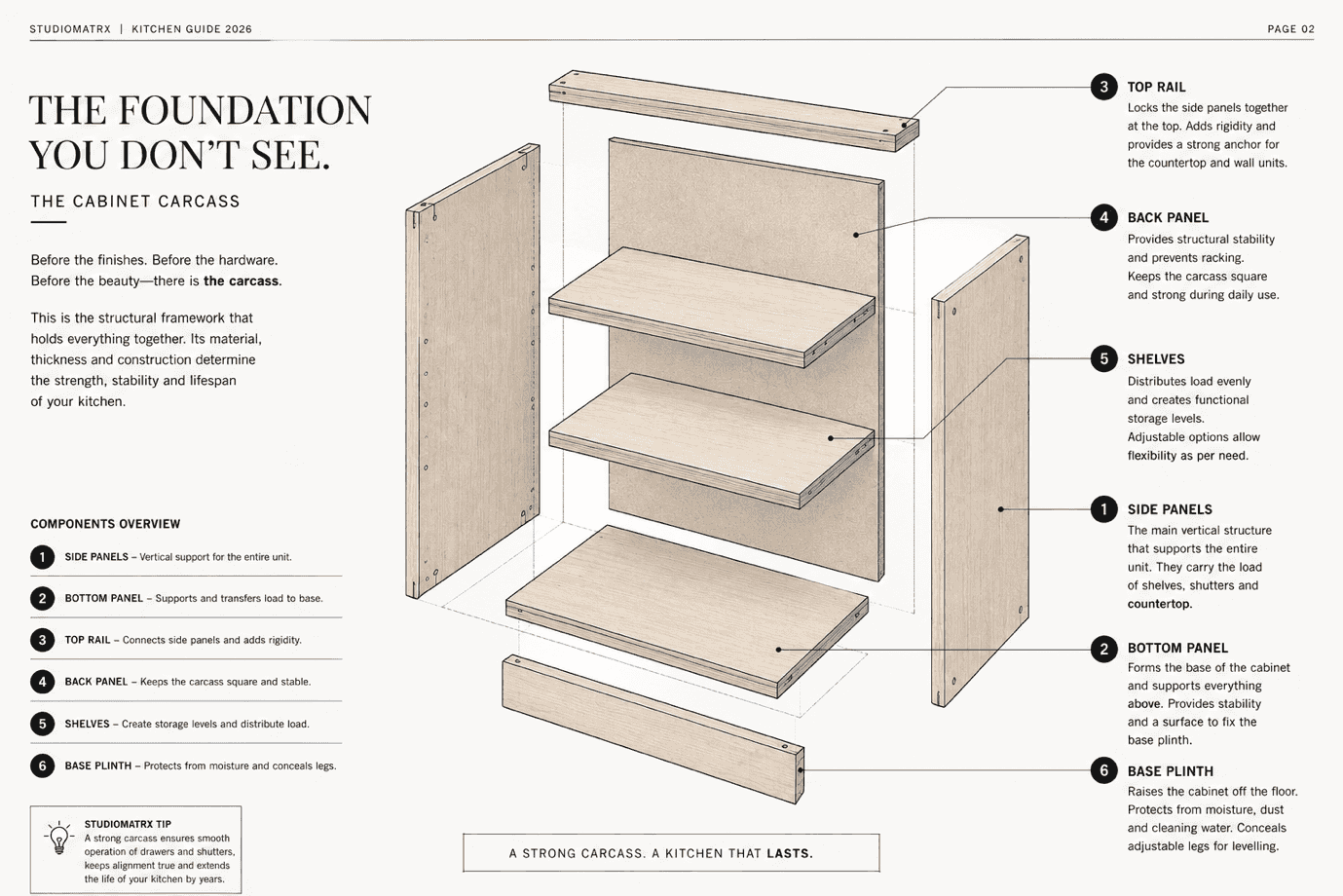
Ask a homeowner what makes a kitchen expensive and most point to glossy shutters, quartz countertops or premium appliances. Ask an architect or a manufacturer and the answer is usually different: the cabinet carcass. The carcass is the internal box structure — the foundation of every cabinet. It carries the weight of the countertop, supports the drawer systems, holds cookware and groceries, and withstands years of opening, closing, moisture and daily use. It is rarely visible after installation, but it is the backbone of the whole kitchen, and no premium shutter can compensate for a poor one.
Where your money actually goes
The cost of a carcass depends mainly on the board. Entry-level kitchens often use particle board — economical, but with limited moisture resistance. Mid-range kitchens usually specify HDHMR (high-density high-moisture-resistant board) for its balance of durability and price. Premium kitchens generally use BWP (boiling-waterproof) marine plywood, valued for its strength and long life in humid conditions. Material is only part of it: board thickness, edge-banding quality, manufacturing precision and installation standards all affect durability and price. A poorly sealed edge lets moisture into the board, swelling it and shortening the cabinet's life whatever the material. A carcass quotation rises with higher-grade board, thicker panels, better edge banding, factory-finished precision panels, moisture-resistant construction and longer warranty periods.
If your budget is limited, invest in a better carcass before upgrading decorative finishes: shutters can be swapped later, but replacing the cabinet structure usually means rebuilding the kitchen. The common mistake is the opposite — spending on glossy shutters while accepting a lower-grade carcass. A beautiful exterior cannot make up for a weak structural foundation. Before you decide, ask the company four things: what material the carcass is, whether it is BWP marine plywood, HDHMR or particle board, what the board thickness is, and what warranty covers the cabinet structure.
A beautiful exterior cannot make up for a weak structural foundation.
The shutters — what you actually see
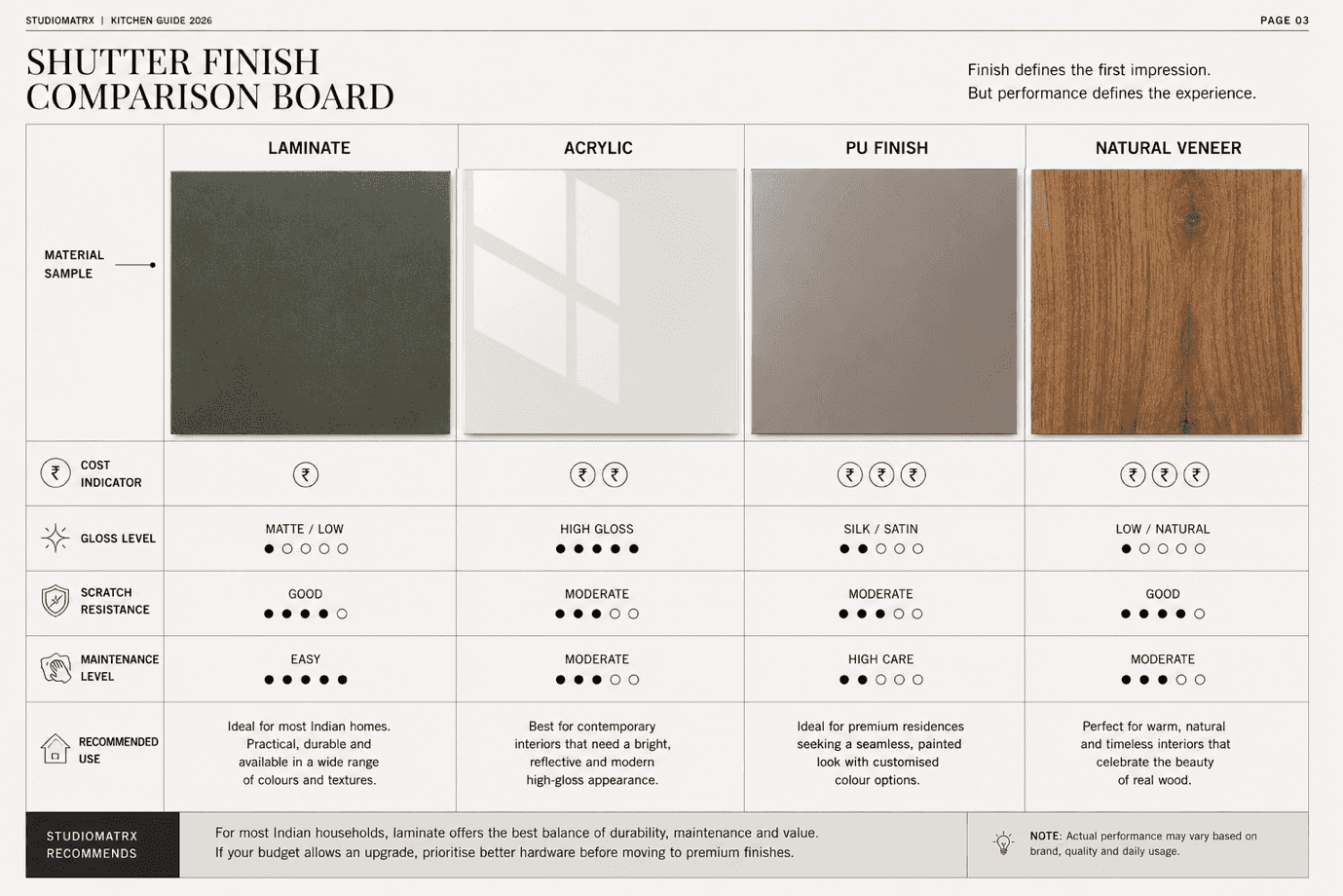
The shutter is the most visible part of a kitchen, but not the most important. High-gloss acrylic reflects light beautifully, PU paint gives a seamless premium look, and laminates offer hundreds of colours and textures at an affordable price. Because shutters dominate what you see, many homeowners give them the largest share of the budget — and end up with a kitchen that looks impressive at first but performs poorly, because the structure or the hardware was compromised to pay for the finish.
Matching the finish to your life
Each finish has its place. Laminates are the most practical choice for Indian homes: durable, varied and easy to maintain. Acrylic gives a modern, mirror-like finish that brightens a small kitchen but shows scratches and fingerprints and needs more care. PU (polyurethane) paint offers a premium, seamless surface and full colour customisation, but it is the most expensive and the most demanding to keep looking new. Veneer brings natural-wood warmth at a moderate maintenance level. There is no universally best finish — the right one depends on how the kitchen is used, the look you want, and how much upkeep you will accept. A shutter quote rises with imported finish materials, high-gloss acrylic panels, PU spray-painted finishes, coated veneer, glass or aluminium-framed shutters, and custom colour matching.
For most Indian households, laminate offers the best balance of durability, maintenance and value; if the budget allows, put the money into better hardware before moving up from laminate to a premium finish. The common mistake is choosing a glossy finish because it looks beautiful in the showroom, only to find that fingerprints, scratches and constant cleaning become part of daily life. Before you decide, ask yourself whether you want a low-maintenance kitchen, whether the finish suits your daily cooking habits, and whether you are paying for better performance or simply a different appearance.
The hardware — the moving machinery
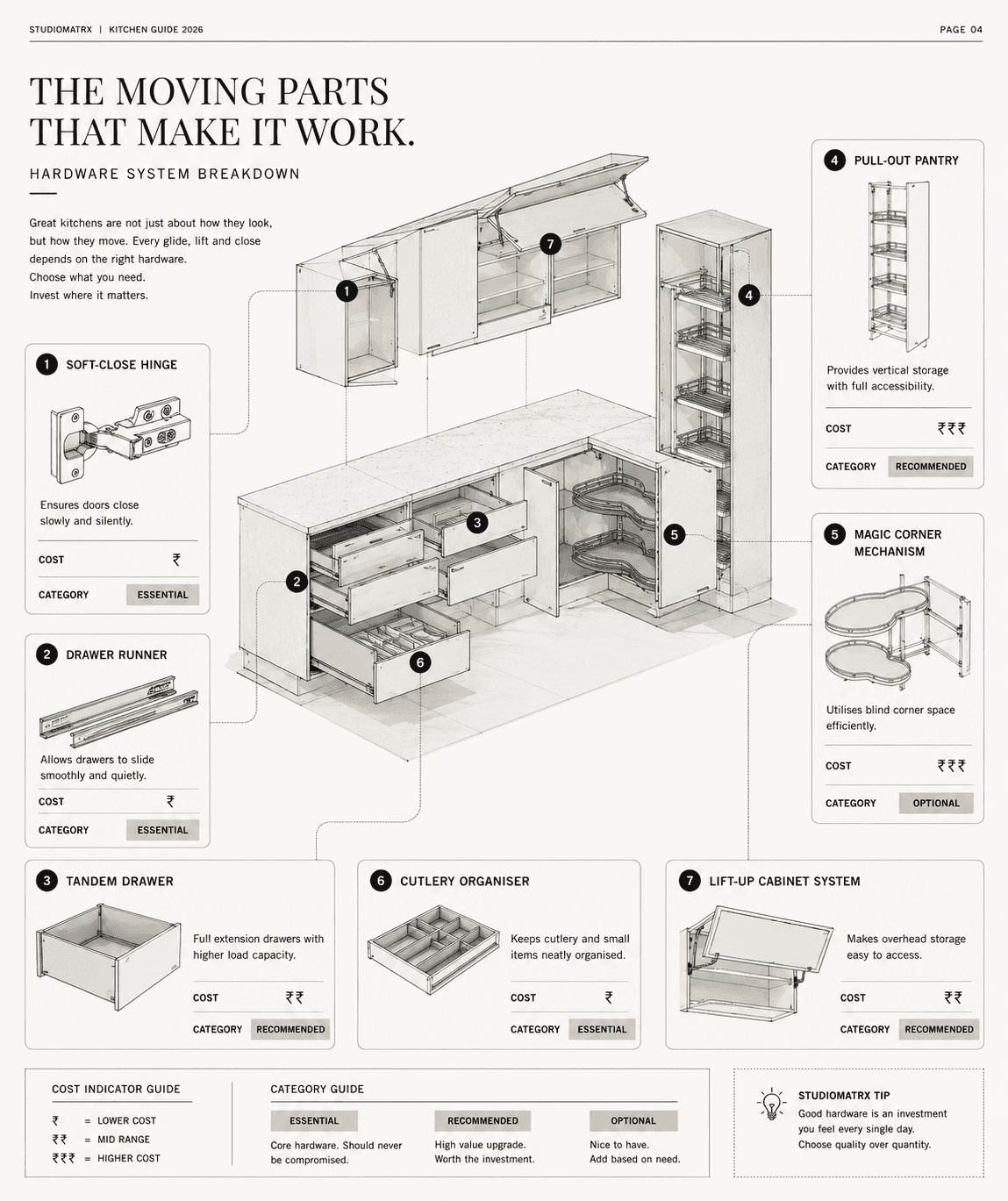
A kitchen can look identical from the outside, and the difference only shows when you open a drawer or lift an overhead cabinet. Hardware is the moving machinery of a modular kitchen — every drawer that glides smoothly, every door that closes silently, every basket that slides out effortlessly depends on it. This is where quotations diverge sharply. One company specifies standard soft-close hinges and basic runners; another includes premium tandem drawers, lift-up mechanisms, corner units and pull-out organisers — upgrades that add tens of thousands of rupees while the kitchen looks almost unchanged from the outside.
Not every upgrade is essential. A family that cooks a great deal benefits from premium drawers and organised storage; decorative accessories and specialised organisers add little if they are rarely used. Rather than buying the most expensive package, focus on the components you touch every day — a smooth-running drawer or a durable hinge gives more lasting satisfaction than most cosmetic upgrades. A hardware quote rises with premium international brands, heavy-duty drawer systems, tall pantry pull-outs, magic-corner units, lift-up cabinet mechanisms, built-in organisers, and designer or handleless handle profiles.
Spend here before you spend on looks
If your budget allows, spend on hardware before decorative upgrades: good hardware improves the kitchen every single day, while a premium finish mainly improves how it looks. The common mistake is to buy expensive shutters and then fit entry-level hinges and runners — within a few years the doors sag, the drawers turn noisy, and the kitchen loses the smooth operation a modular system is supposed to give. Before you decide, ask which hardware brand is being quoted, whether the hinges and drawers are soft-close, what warranty the hardware carries, and whether individual components can be replaced in future.
The countertop — the hardest-working surface
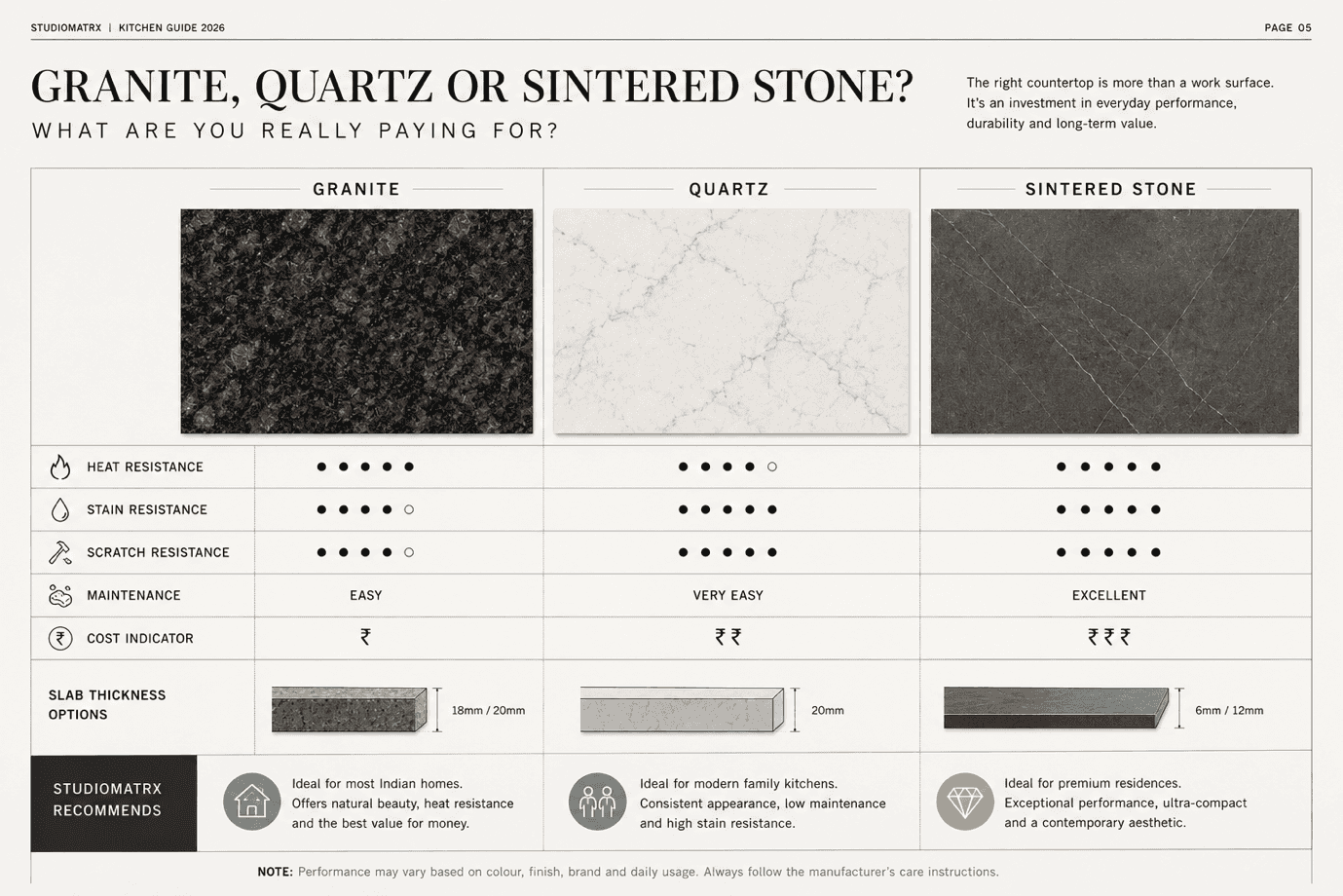
The countertop is one of the few surfaces in constant use — exposed to hot cookware, water, oil, food stains, sharp utensils and frequent cleaning. Choosing one is not only an aesthetic decision; it is an investment in durability. Granite remains the most popular choice in Indian kitchens: a natural stone, each slab unique, with excellent heat resistance, good durability and a relatively low cost. Quartz, an engineered material, has grown popular for its uniform appearance and low maintenance — non-porous, stain-resistant and easy to keep, though generally dearer than granite. Sintered stone sits at the premium end: made under extreme heat and pressure, highly resistant to heat, scratches, stains and UV, and available in thinner profiles and larger seamless surfaces favoured in luxury projects.
All three perform well; the best choice depends on your priorities. A family that cooks heavily may value durability and easy maintenance, while a homeowner after a minimalist, contemporary look may prefer the seamless surface of quartz or sintered stone. A countertop quote rises with imported slabs, premium colours and finishes, greater slab thickness, waterfall edges, seamless island installations, integrated sinks and special edge profiles.
For most homeowners, granite offers the best value for money; if the budget allows and you prefer a cleaner, low-maintenance surface, quartz is an excellent upgrade, and sintered stone earns its cost only where its performance advantages genuinely justify it. The common mistake is to choose a countertop purely on colour or showroom appearance, without asking how it will behave under daily cooking — a surface that stains easily or needs constant care becomes a long-term frustration. Before you decide, ask whether the price includes fabrication and installation, what thickness is provided, whether the sink and hob cut-outs are included, whether the material carries a warranty, and how it should be maintained.
The hob & chimney — sized to how you cook
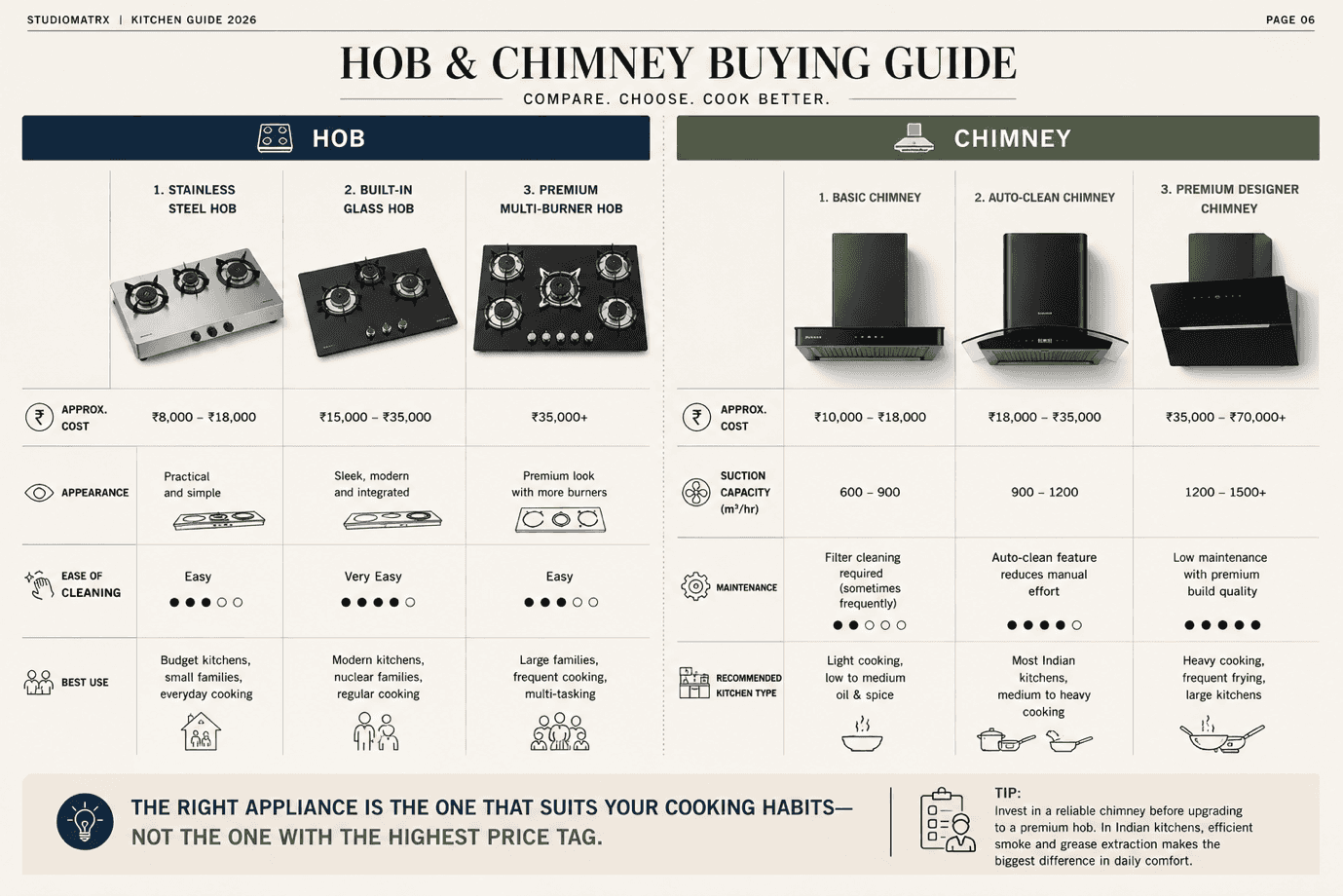
Once the cabinetry is planned, attention turns to appliances, and the hob and chimney are usually chosen first. One company may quote ₹25,000 for both; another may include appliances worth ₹1.2 lakh. The gap is rarely about better cooking — it is brand positioning, extra features, design integration and technology you may not need. The hob is the centre of the cooking zone: a stainless-steel hob is economical, durable and easy to replace, while a built-in glass hob gives a cleaner, integrated look common in modern kitchens. The chimney should be sized by how much you cook, not by the size of the kitchen — homes that regularly fry, make curries or cook heavily spiced food need more suction than homes where cooking is light.
Premium chimneys now add auto-clean systems, filterless technology, motion sensors, touch controls and low-noise operation. These improve convenience, but not necessarily cooking performance; understanding which features are genuinely useful prevents unnecessary spend. The best appliance is the one that matches how your household cooks — not the one with the longest feature list. An appliance quote rises with imported brands, built-in appliances, larger four- or five-burner hobs, premium chimney designs, auto-clean technology, motion-sensor controls, smart connectivity, and integrated oven-and-microwave combinations.
The best appliance is the one that matches how your household cooks — not the one with the longest feature list.
Invest in a reliable chimney before a premium hob: in Indian kitchens, efficient smoke and grease extraction affects long-term comfort more than premium cooking features. The common mistake is buying on showroom demonstrations rather than actual cooking habits — expensive smart features go unused while inadequate suction causes daily inconvenience. Before you buy, ask what suction capacity (in m³/hr) suits your cooking style, whether installation is included, whether the gas pipe and electrical connections are covered, what warranty applies to the motor and glass, and whether spares and servicing are easily available in your city.
Storage & accessories — worth it, or just extra?
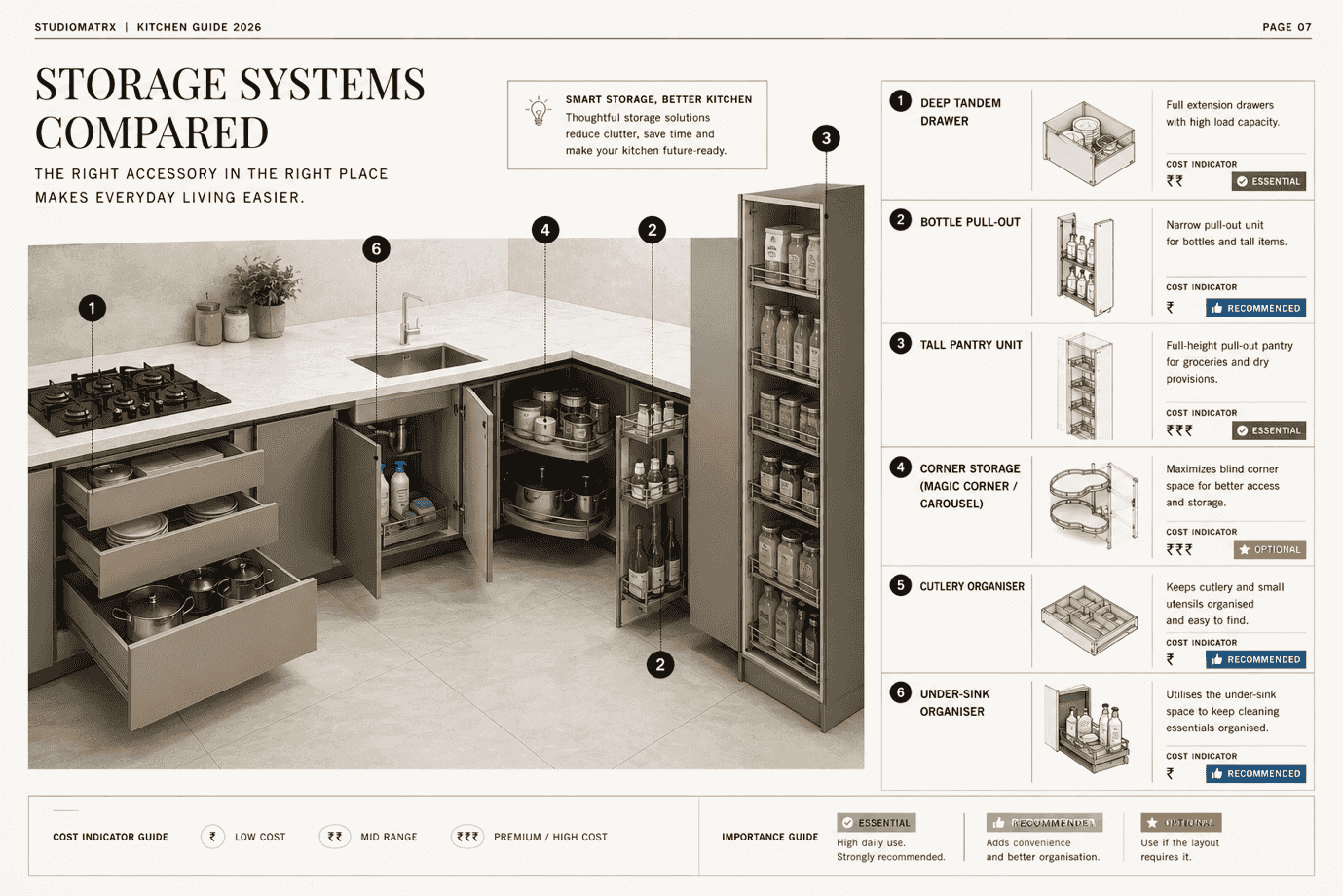
A showroom is full of pull-out baskets, tandem drawers, corner organisers, bottle pull-outs, pantry units, cutlery trays, spice racks, magic corners and lift-up systems. They make excellent demonstrations, but not every accessory adds equal value. The answer depends on how the kitchen is used: a family cooking several meals a day benefits from deep drawers, organised pantry storage and accessible corner solutions, while specialised organisers look impressive and then sit empty. Storage planning should begin with what actually has to be stored — heavy cookware, groceries, small appliances, crockery and cleaning supplies each need a different solution. Adding accessories without that thinking simply adds cost. Storage costs rise with multiple internal organisers, imported pantry systems, premium corner mechanisms, motorised lift-up storage, custom drawer inserts and full-height pull-out units.
If your budget allows only a few upgrades, prioritise tandem drawers and a well-designed pantry before expensive corner accessories — those are the storage systems you will use every day. The common mistake is to install impressive-looking accessories that, months later, remain underused because they were never planned around the family's real storage needs. Before you decide, ask what you will actually store there, whether you will use the accessory every day, whether it solves a storage problem or simply adds cost, and whether it can be added later if needed.
What the quotation leaves out
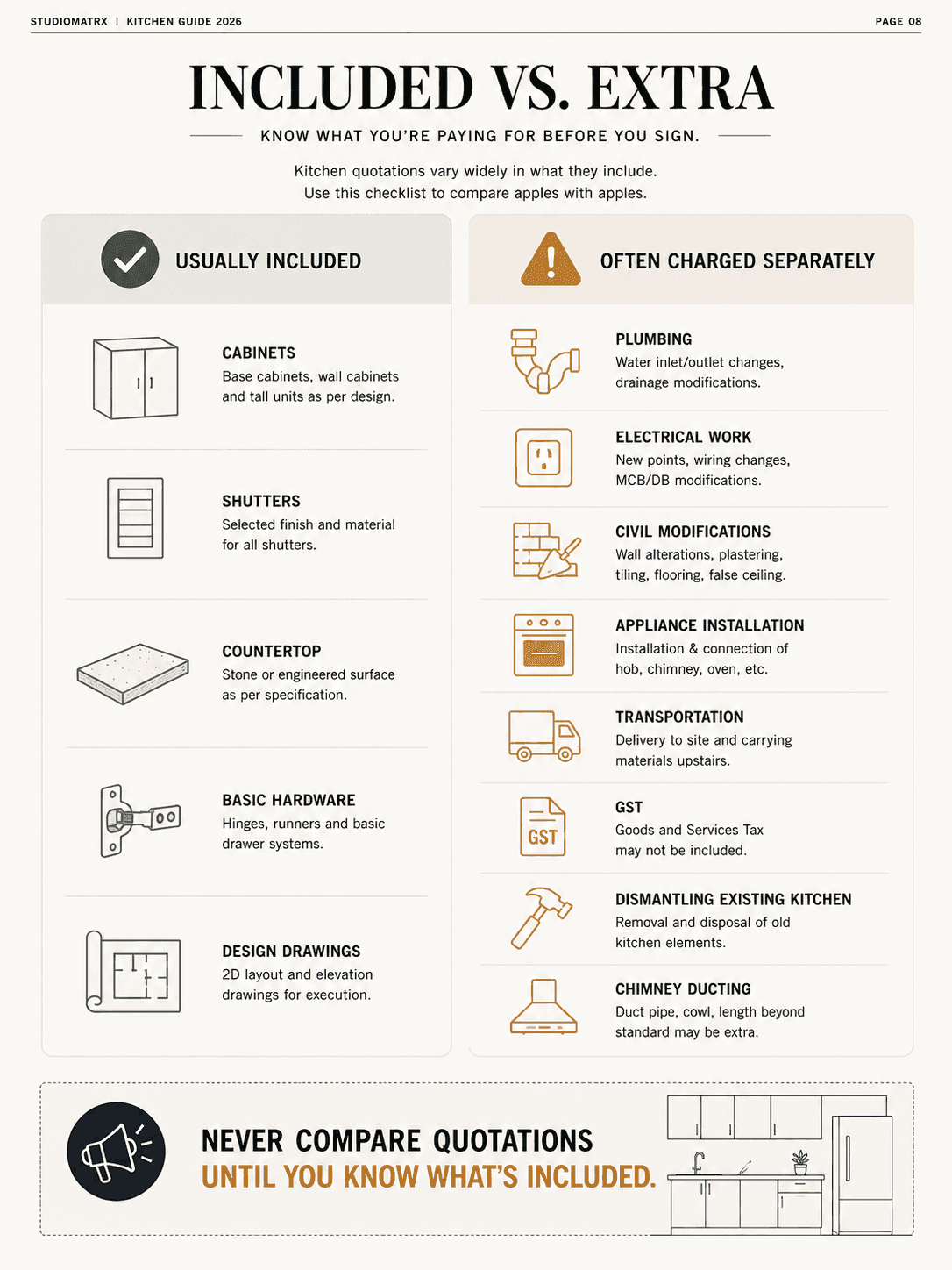
One of the commonest reasons homeowners overrun a renovation budget is not design changes but misreading what a quotation includes. Some companies give a comprehensive turnkey proposal — design, manufacturing, transport, installation, plumbing coordination and electrical adjustments. Others quote only the modular cabinetry and leave the rest to on-site contractors. Relocating a water inlet or drain is usually plumbing work and may not be in the package; shifting sockets, adding power points, civil modifications, wall tiling, false ceilings, painting and dismantling the old kitchen are often excluded unless specifically named. Appliances are another grey area — sometimes only the cabinetry is included, with hob, chimney, oven, dishwasher and refrigerator quoted separately, and even then installation, flexible gas pipes or ducting kits may be billed on their own.
The safest approach is simple: never assume something is included because it appears in the drawing — if it is not written in the quotation, ask before you sign. Request an itemised quotation with clear inclusions and exclusions; transparency protects both the homeowner and the contractor from misunderstandings later in the project. The common mistake is to compare only the total value: a ₹4 lakh quotation that excludes installation, plumbing and GST can end up costing more than a ₹4.6 lakh quotation that includes everything. Final bills commonly creep up through additional electrical points, plumbing relocation, countertop cut-outs, appliance installation, extra site visits, delivery beyond city limits, GST left out of the original figure, and design changes made after manufacturing has begun.
Reading the quote
A modular kitchen is a long-term investment, expected to perform reliably for fifteen to twenty years. The lowest quotation may not be the most economical, and the highest does not guarantee the best quality. Compare specifications before prices, ask questions before signing, and remember that the unseen quality — the carcass, the edge banding, the hardware — is usually what endures the longest. The tables below show where the money goes, material by material; the checklist that follows is the one to run through before you approve any quotation.
The lowest quotation may not be the most economical, and the highest does not guarantee the best quality.
Where the money goes — and the checklist to run before you sign
- BE, Civil Engineering
- ME, Structural Engineering