
The Nine-Lakh Question
A kitchen number means nothing without a scope.
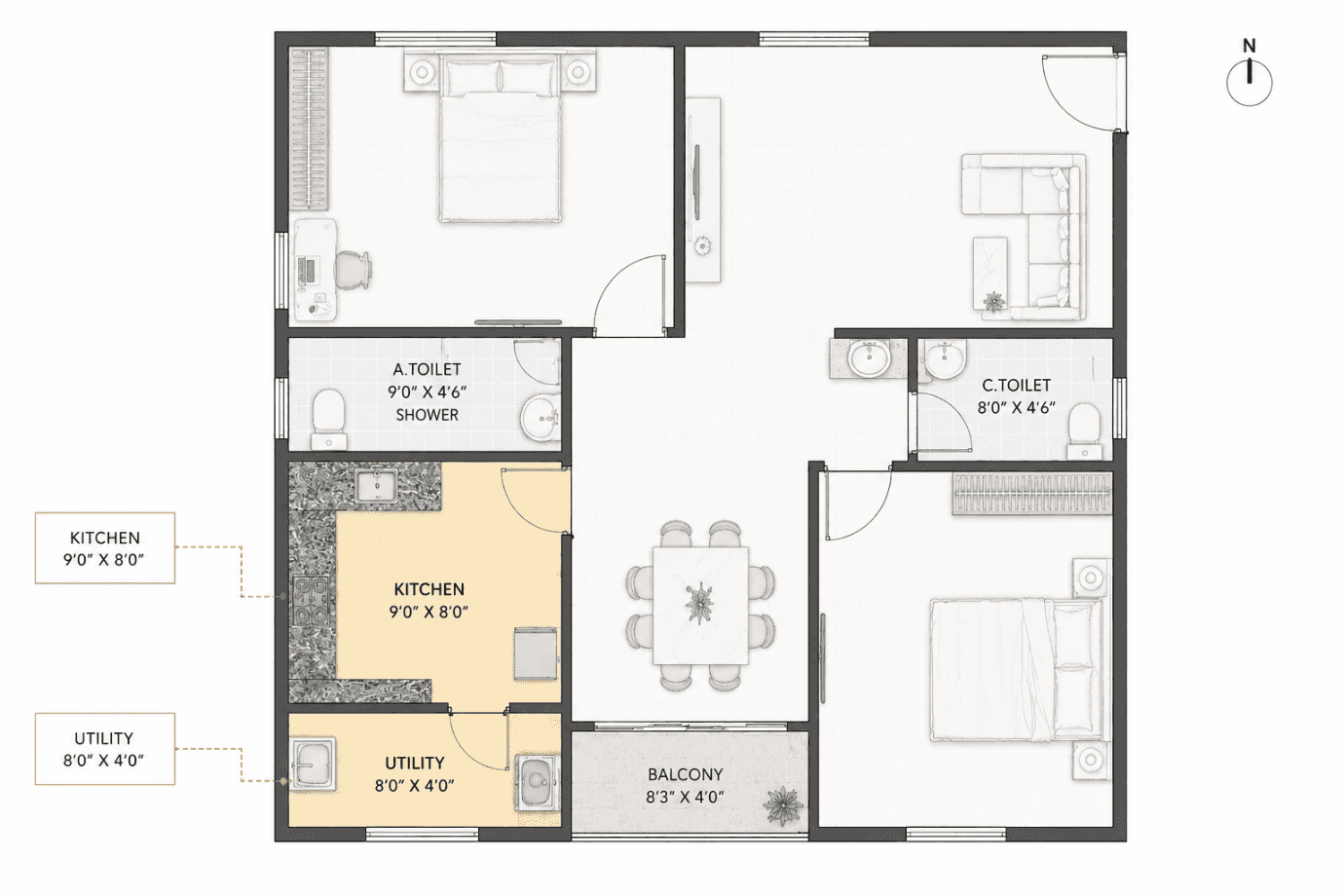
₹9 lakh sounds like a useful number. It is specific enough to become a reference point for someone planning the interiors of a new apartment. But without knowing what was included, the number tells you surprisingly little. At Karthik AB Heights in Bengaluru, ₹9 lakh was spent on the interiors of a newly constructed 2BHK apartment — and that was not the cost of the kitchen. The budget covered the complete kitchen interior, a master-bedroom wardrobe and loft, a guest-room wardrobe and loft, a TV unit with rafters, and a pooja unit. That distinction is where this budget story begins, because when homeowners compare interior costs, the headline number often travels much faster than the scope behind it.
72 sq ft kitchen + 32 sq ft utility
The kitchen itself measures approximately 9' × 8', or about 72 sq ft, within the 1,110 sq ft apartment. An adjoining 8' × 4' utility — roughly another 32 sq ft — extends the service area beyond the main kitchen. It is a compact, defined room, worked by a single regular cook, in which cooking, washing, storage, appliances and movement all have to be resolved within a limited footprint.
The finished cabinetry is only one layer of what went into creating it. The project involved demolition of previous granite and wall work, relocation of plumbing and electrical points, new kitchen interiors, hardware and accessories, sink and plumbing work, electrical work, appliances, civil work, and labour and installation. The kitchen uses an acrylic finish and includes a 90 cm covered Faber chimney. Much of that expenditure disappears once the kitchen is complete. You see shutters, counters, storage and appliances; you do not see the electrical changes behind the wall, the plumbing beneath the sink, the demolition that preceded installation or the labour that assembled the finished interior. A completed kitchen hides much of what it cost to create.
There is another reason the ₹9 lakh figure needs context: it combines spaces with very different requirements. A wardrobe does not carry the plumbing of a kitchen. A TV unit does not require a chimney. A pooja unit has different material and hardware requirements than kitchen cabinetry. Compressing all of them into one number makes comparison with somebody else's kitchen-only quotation misleading. Throughout this case study, therefore, the two numbers stay separate: ₹9 lakh is the reported whole-home interior budget, and kitchen expenditure is identified only where the project information allows it.
A budget number becomes useful only when you know what the number bought.
Before the finish
When you look at a completed kitchen, most of what catches the eye is visible — cabinetry, shutters, countertop, appliances and finishes. But some of the money went into work that almost disappears once the interior is complete. At Karthik AB Heights, the project costs list ₹45,000 for electrical work, ₹20,000 for sink and plumbing, and ₹7,000 for civil work. Together, these total ₹72,000. The project also notes that plumbing and electrical points were moved, and that previous granite and wall work were demolished to prepare the kitchen for its new interior. None of these three categories is the cabinetry itself.
That distinction matters because a kitchen does not begin with shutters. Electrical points must match how appliances and lighting will be used. Water supply and drainage must fit the sink position. Existing surfaces may need removal or alteration before new work can be installed. By the time the kitchen is photographed, much of this expenditure has disappeared behind, beneath or around the finished interior. The same principle extends beyond the ₹72,000: the project records another ₹80,000 for labour and installation. Again, this is not represented by a single object you can point to in the finished kitchen — it is part of the process that turns individual materials, components and services into an installed interior.
This is where comparing kitchen quotations only by cabinetry price becomes misleading. One quotation may include electrical alterations, plumbing and civil preparation. Another may exclude them from the quoted kitchen price. A third may include installation but exclude appliances. The final kitchens may look comparable while the numbers represent completely different scopes. For a homeowner, the useful question is therefore not simply 'How much are the cabinets?' It is 'What has to happen to this room before, around and after the cabinets — and which of those costs are included in my quote?' Some of the money that makes a kitchen work is spent on things you will never see once it is finished.
The cost beyond the cabinets
Kitchen budgets are often discussed through the price of cabinetry: how much per square foot, what the shutters cost, whether the finish is laminate or acrylic. The figures for this project show how quickly expenditure accumulates outside the carcass and shutters. Six reported categories account for ₹2,64,000: ₹80,000 for labour and installation, ₹71,000 for hardware and accessories, ₹45,000 for electrical work, ₹41,000 for the hob, chimney and appliances, ₹20,000 for sink and plumbing, and ₹7,000 for civil work.
What makes this number useful is what it does not tell you. The breakdown does not separately state the cost of the carcass and cabinetry, the acrylic shutters and finishes, the countertop, or other unlisted components. Nor should ₹2.64 lakh be presented as the total kitchen cost. It is simply the portion of expenditure for which individual figures were supplied.
The ₹71,000 hardware and accessories figure is particularly revealing. Hardware is easy to underestimate because much of it disappears once a shutter or drawer closes. Yet hinges, channels, drawer systems and accessories determine how storage opens, carries weight and is accessed every day. In this project, that category alone is larger than the reported electrical, appliance, plumbing or civil-work figures individually. Labour and installation form the largest identified category at ₹80,000 — and again, no single ₹80,000 object sits in the room; the value is in putting the interior together. The ₹41,000 allocated to the hob, chimney and appliances covers the equipment that supports cooking, while the electrical and plumbing expenditure represents the services needed around the interior.
This is why the most useful way to read a kitchen budget is not as one large number but as layers of expenditure. There is what you see: the acrylic finish, cabinetry, hardware, hob and chimney, sink and countertop. There is what the finished photograph hides: electrical work, plumbing work, civil preparation, labour and installation. And there is a third layer — what this breakdown does not yet separate: the carcass and cabinetry, the acrylic shutters and finish, the countertop, and other unlisted components.
Being explicit about missing information is more useful than creating an artificial kitchen total. A real budget does not lose value because every rupee cannot be separated; it becomes misleading only when partial figures are presented as if they represent the whole. ₹2.64 lakh is not the price of this kitchen. It is the part of the kitchen expenditure this breakdown allows us to identify.
The ₹9 lakh question
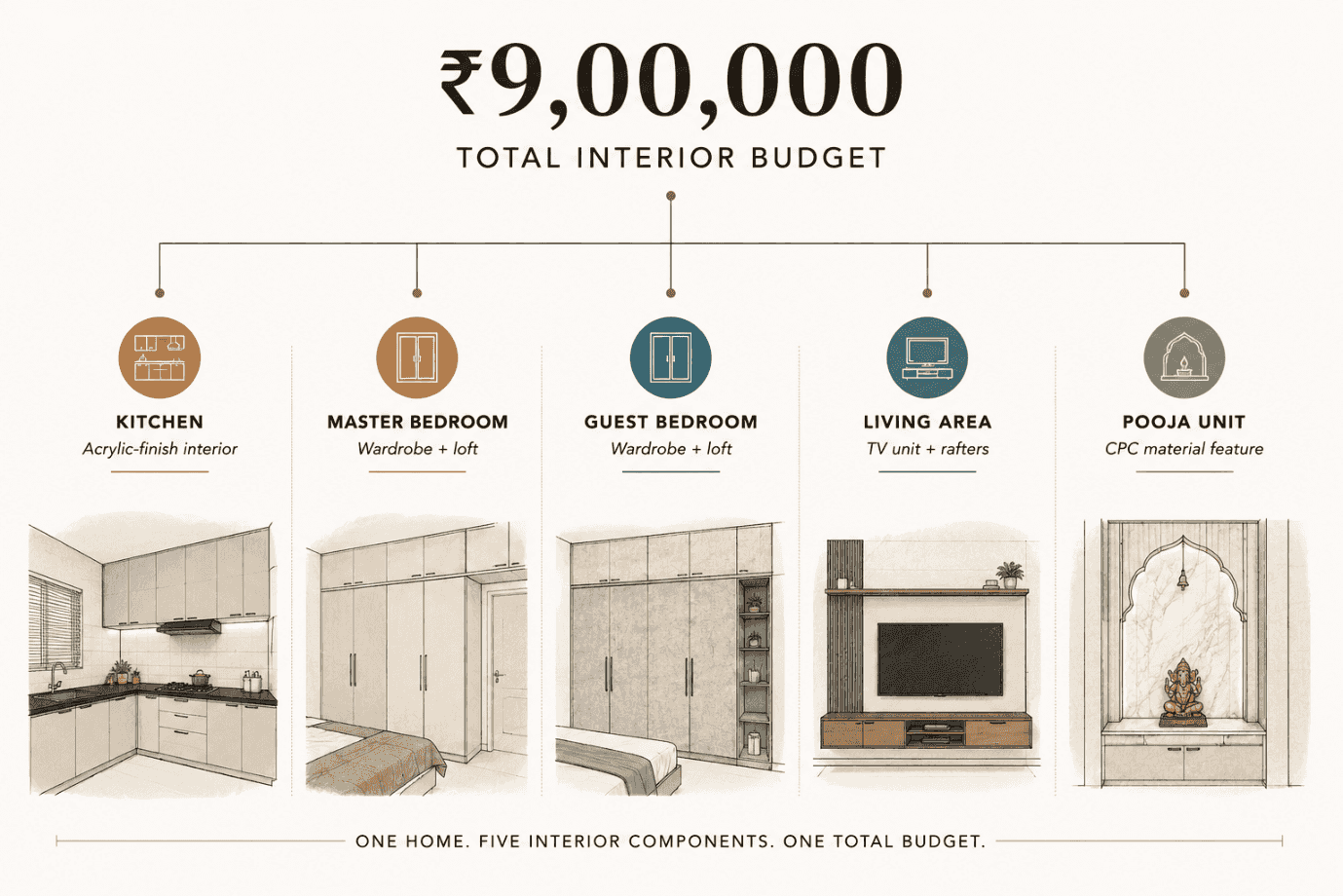
The largest number attached to this project is ₹9,00,000, and it is also the easiest to misunderstand. This was the reported budget for the apartment's complete interior package, not just the kitchen. That ₹9 lakh covered the kitchen interior plus a master-bedroom wardrobe and loft in a laminate finish, a guest-room wardrobe and loft in a granite-look laminate finish, a TV unit with rafters, and a pooja unit carrying a Ganesha image in CPC material. Each required different materials, quantities, hardware and labour. The kitchen is one part of a much larger interior scope.
This distinction sounds obvious once everything is listed. Yet interior costs are often communicated without that list. Someone says, 'We did our interiors for ₹9 lakh,' and the number becomes a benchmark. Another homeowner compares it with a ₹7 lakh or ₹12 lakh quotation without knowing whether either includes the same rooms, materials, services or appliances.
The problem becomes clearer when you return to the kitchen figures. We know that ₹2.64 lakh is represented by six supplied cost categories, but significant kitchen components have not been separately priced in the information available. You therefore cannot responsibly subtract ₹2.64 lakh from ₹9 lakh, assign the remainder to cabinetry, or estimate the kitchen's total from the overall interior budget — the remaining money also funded interiors elsewhere in the apartment. This is the difference between a budget and a benchmark. The ₹9 lakh figure is useful for understanding this particular home's overall interior spend; it becomes a poor benchmark for somebody else's kitchen unless you first separate the scope. A meaningful comparison begins only when both quotations answer the same question: what exactly does this number include?
Never compare two interior totals until you have compared the scope behind them.
Read the quote, not just the total
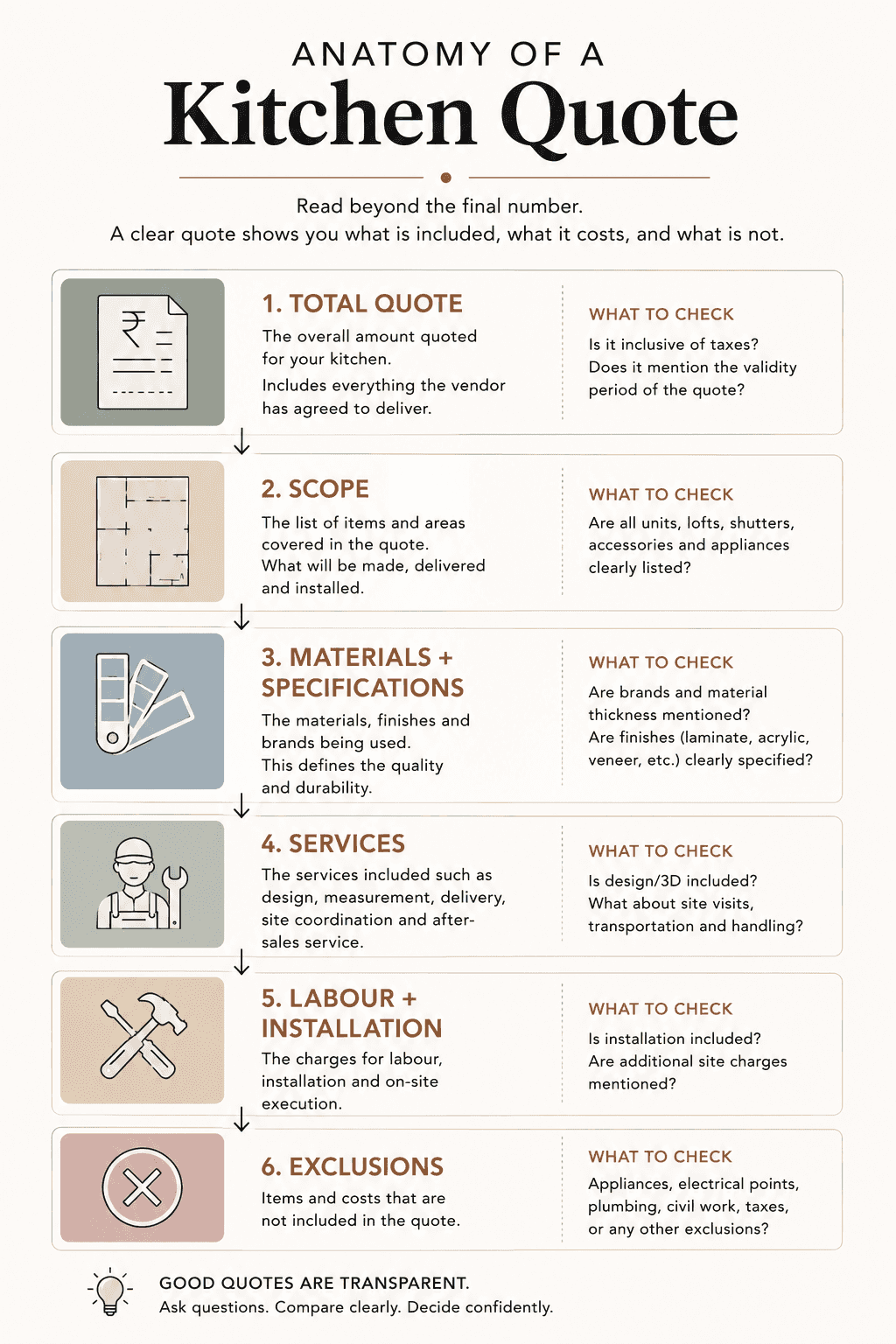
The Karthik AB Heights kitchen offers something more useful than a finished photograph or a headline budget. It shows why the first question about an interior quotation should be 'What am I actually paying for?' rather than 'Is this expensive?' In this project, ₹9 lakh covered interiors across several parts of the home. Within the kitchen details available, ₹2.64 lakh is identified for hardware and accessories, electrical work, the hob, chimney and appliances, sink and plumbing, civil work, and labour and installation. Other major components — including the cabinetry, the acrylic shutters and the countertop — are not separately priced in the breakdown. That makes it an unusually useful example of how a real quotation should be read: the total alone cannot show whether one kitchen offers better value than another. Scope, specification and exclusions must accompany the number.
A lower quotation is not better if essential work has been moved outside it. Equally, a higher quotation does not mean better quality if the extra cost is not explained by scope or specification. The useful comparison is not between totals, but between what those totals actually include. The lesson from this 2BHK goes beyond its 9' × 8' kitchen: real budgets become useful when opened rather than reduced to a single number. Ask what was built, specified, included and excluded — and what still had to be paid for elsewhere.
The useful budget isn't the lowest number. It's the number whose scope you can understand.