
The Kitchen News Desk
The hob that stopped shouting for attention, the chimney that finally has a real job to do, and why the showroom is becoming somewhere you go to touch things — four ways the Indian kitchen quietly moved this year.
Nobody reinvented the Indian kitchen this year. It just got tuned. Appliances stopped sitting apart from the cabinetry and started belonging to it. Manufacturers stopped selling boxes and started thinking about the whole wall. And finishes are being judged the way a cook judges a pan — not by how it shines in the showroom, but by how it behaves after a year of frying. Four things crossed the desk this season, and each one changes how a kitchen gets drawn before a single cabinet is ordered.
01 — The hob stops shouting for attention
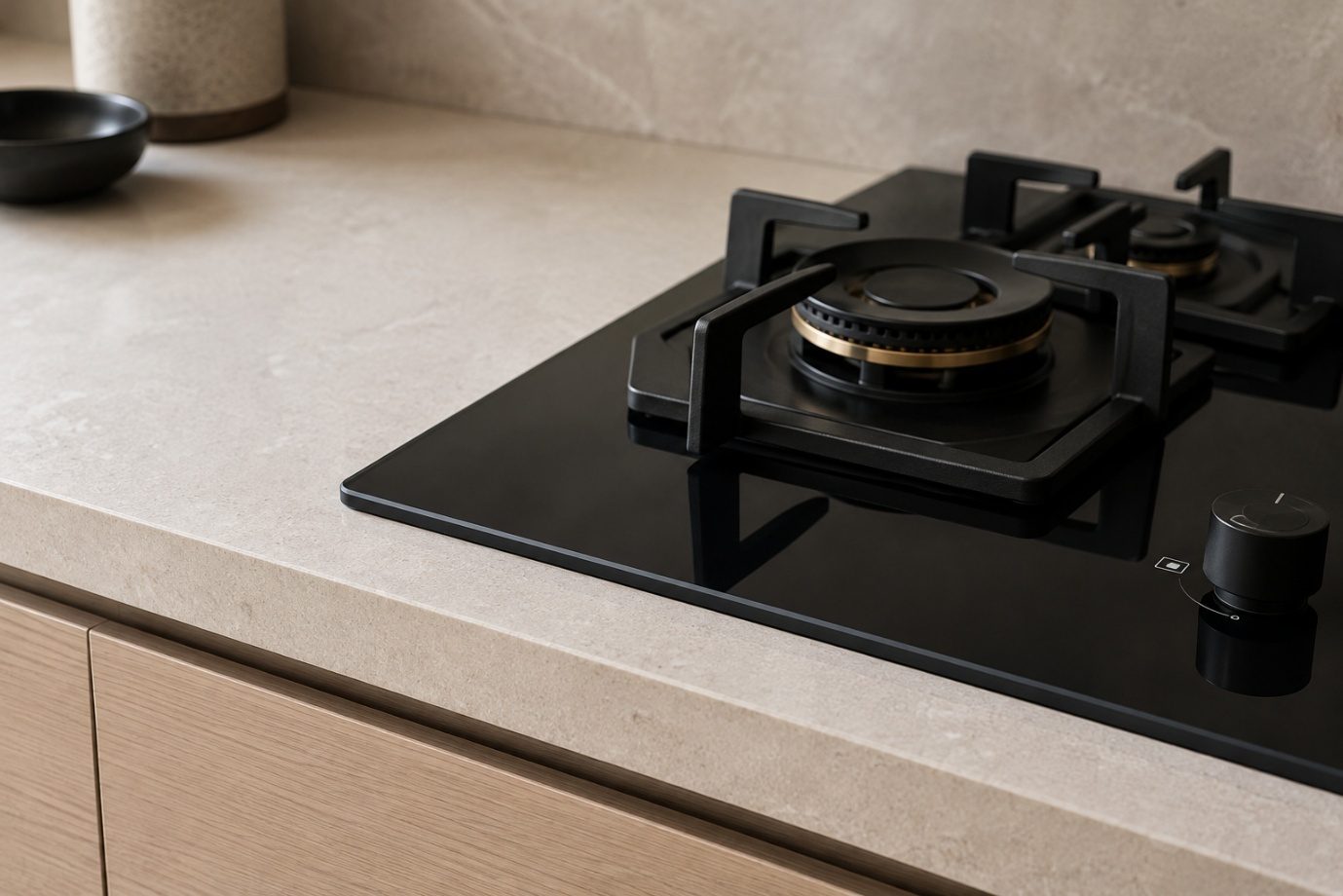
Something shifted right at the cooking surface. In June 2026, KAFF launched matt-finish hob tops in India, with auto ignition and brass burners. The old mirror-bright stainless top was built to catch the eye. This one is built to disappear into the counter — a low, matte plane with warm brass where the flame sits. That is not only a looks call. As kitchens open onto dining and living rooms, the hob is no longer a machine you tolerate in a working corner; it is a surface people see from the sofa, and it has to sit inside the same palette as the stone, the wood and the cabinet fronts. So specify the hob when you pick the materials, not after the joinery is signed off — otherwise you are matching a finish to a decision that is already closed.
02 — The chimney finally has a real job
Extraction has always mattered more in an Indian kitchen than the brochures admit. Deep frying, a tempering that spits mustard and curry leaf into hot oil, grilling, a spice-heavy pot going all afternoon — that is real smoke, real grease and a smell that gets into the curtains. The conversation has moved past treating the chimney as a fixture you bolt on last. It is now about suction, about whether the thing is a nightmare to clean, and about keeping the airflow honest. Häfele, for instance, makes the case for filter-free kitchen hoods precisely because they pull smoke, airborne grease and strong odour without a clogged mesh throttling them. Which is the whole point: match the extraction to how the house actually cooks. A chimney that looks clean on the wall does nothing for a kitchen that fries every night if its suction, placement and upkeep were never sized for that fire.
03 — The kitchen turns into an appliance ecosystem
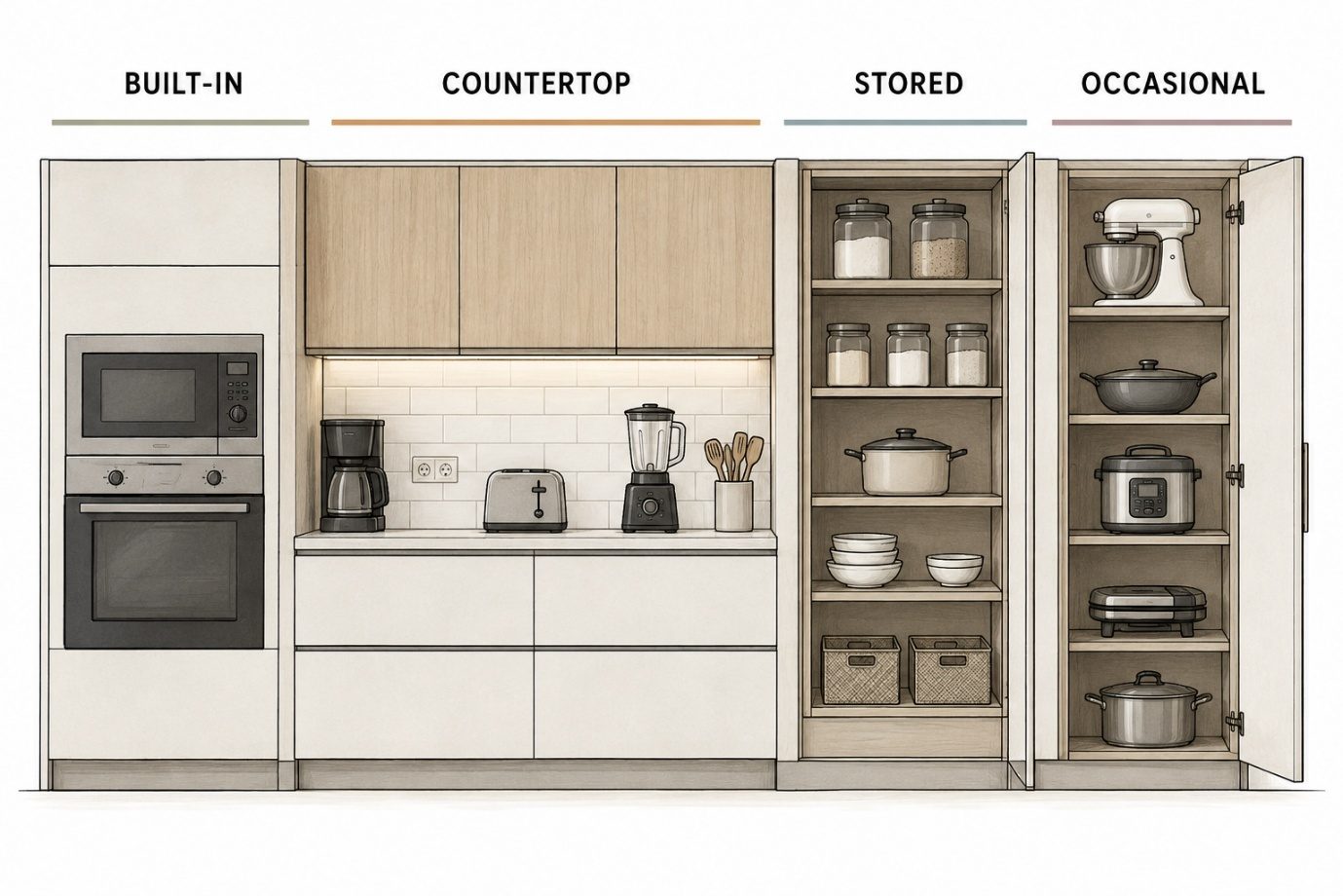
The count keeps climbing. A built-in hob and oven used to be the whole story; now they share the wall with air fryers, coffee machines, induction cooktops, blenders, kitchen machines and multifunction microwave ovens. Häfele's Indian range spans most of that list, which tells you how much a kitchen is now expected to hold. Every one of those devices wants something — a shelf, a socket, ventilation, or a stretch of counter it can live on. You cannot plan for it by adding a few more sockets and hoping. The real work is sorting the household's actual machines into what stays built in, what lives out on the counter, what gets put away between uses, and what has to be within arm's reach every morning. So before you draw a single cabinet, take an inventory of the appliances the family truly owns and uses. That list shapes the layout far more than any reference image ever will.
04 — The showroom becomes somewhere you go
The change is happening outside the home too. In July 2026, KAFF opened an Experience Centre in Bengaluru — a room built for handling products, not just displaying them. Kitchens are hard to buy from a catalogue, because they are physical to their core: the reach of a drawer, the weight of a handle, the throw of a tap, the true bulk of an oven all live in the body, not on a screen. A handle that photographs beautifully can feel wrong the second you close your hand around it, and the real scale of an appliance only lands when you are standing next to it. Samples and spec sheets take you part of the way. But the things you will open, touch and operate every single day are worth going and testing at full size before you commit.
The kitchen didn't get reinvented in 2026. It got quieter, better ventilated, more crowded with clever machines, and easier to try before you buy — tuned, at last, to how Indians actually cook.