
The house that lets the flood pass through
A representative home in river-plain flood country, raised on columns so the water can come and go without ending a life inside.
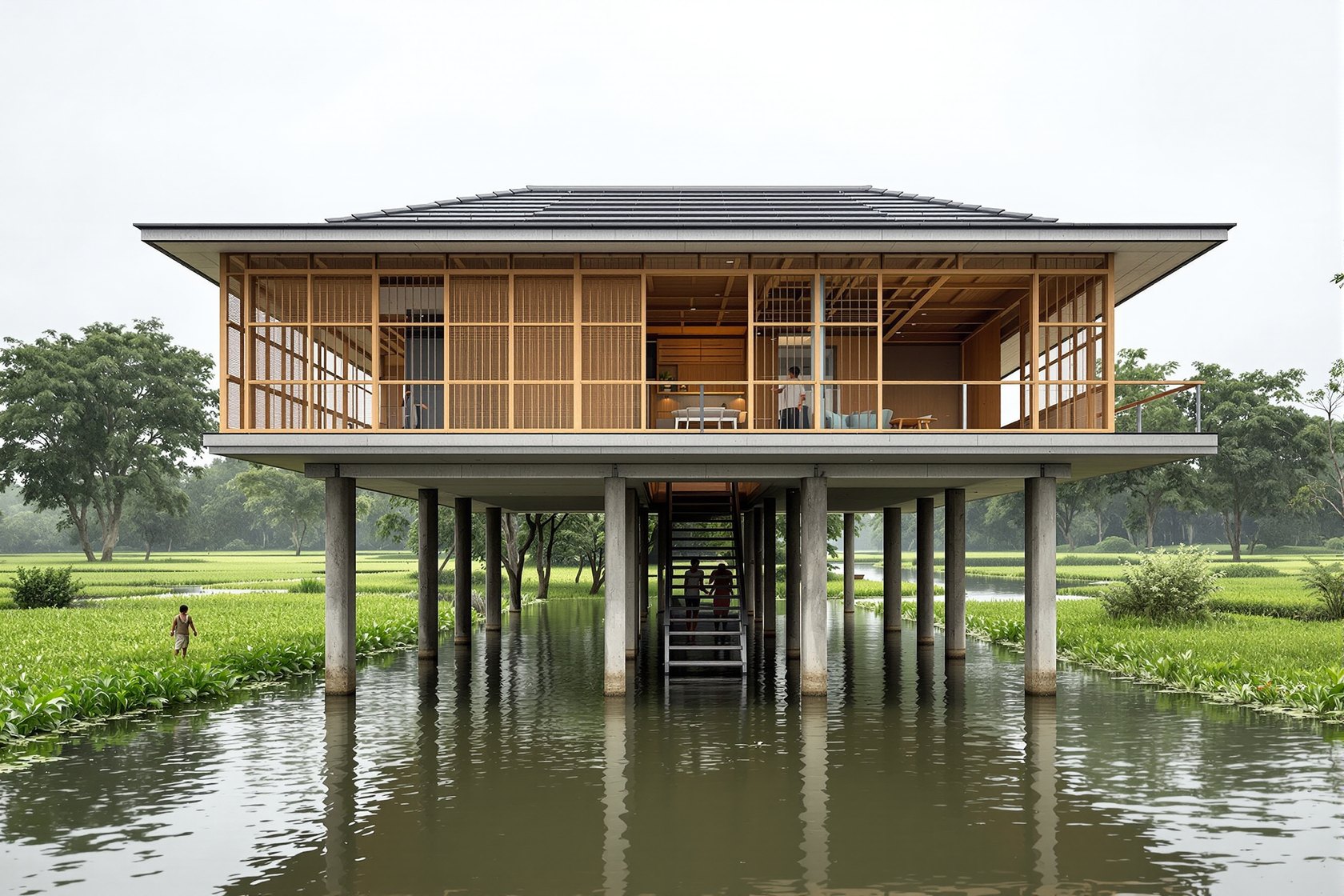
This house does not exist at one address, and that is the honest way to describe it. It is a composite, drawn from the kind of home you find again and again along the river plains of Assam and lower Bengal and at the edges of the Kerala backwaters, where the ground floods not as a disaster but as a season. Call it one family's house in flood country. The brief they gave, in effect, was the oldest brief in the wet parts of India: let us stay, and let the water come.
The problem, stated plainly
The site floods. Not every year to the same depth, but often enough that any design pretending otherwise is a design that will fail. A conventional house here fights the water and loses slowly: the plinth is overtopped, the floor silts, the plaster wicks damp to waist height, the wiring shorts, and every retreating flood leaves the family to scrape mud out of the rooms they live in. The real problem is not keeping water out — over a long enough life, you cannot. The problem is where the water goes when it wins, and whether it ruins your life on the way through.
The first move: get the living off the ground
So the house stands up. The living floor is lifted clear on a grid of columns, set above the level the water has historically reached, with a working margin on top of that for the flood that beats the record. Everything a family actually lives in — the sleeping rooms, the kitchen, the room where they keep what matters — sits on this raised deck. Below it, the flood is given a floor of its own to occupy. The design starts by conceding the ground, not defending it.
The sacrificial level, and why it is empty
The open ground level is the quiet genius of the type, and the hardest thing to explain to a client who sees empty covered space as waste. It is meant to be sacrificed. It is left open on the sides so a rising flood flows straight through instead of piling against a wall and pushing — which is what drowns solid ground floors and cracks them. In the dry months the family gets the space back, for the loom, the boat, the drying paddy, a place to sit out of the sun. When the water comes, it walks in one side and out the other, and takes nothing important with it, because nothing important was left down there.
The ground floor is not living space that flooded. It is flood space you borrow when it's dry.
Services high, materials light
The rest of the decisions follow from those two. The meter, the wiring runs, the switchboards and any pump or store worth saving are carried up above the flood datum, not tucked at ankle height where the first inches of water find them. The columns and the raised deck are built in durable materials that can take a soaking and dry out, while the walls and screens above go up in lighter local stock — timber, bamboo, woven panel — the things a region already knows how to raise fast and repair cheap after a hard year. Light above, strong below, services higher still.
The trade-offs, told straight
None of this is free, and a case study that pretends otherwise is selling something. Raising a house on columns costs more per square metre than pouring it on the ground, and the stair you climb every single day is the tax you pay for the flood you meet occasionally. The open underside needs discipline, because the temptation to wall it in and gain a room is enormous — and the day someone does, the type's whole logic breaks and the water has a wall to fight again. Getting the flood datum right is a judgement, and it is the one that carries the most risk, because you are betting the plinth height against a monsoon you have not seen yet.
How it performs when the water comes
The test is not the brochure day. It is the third night of a bad August, when the field road is gone and the neighbours are moving to the school roof. In a house of this type the water rises into the open ground level and stops there, below a floor the family is standing on — dry, with the light still working because the board is up high and the important things were never down low. The flood does what floods do. It passes through. When it drops it leaves silt on a level built to be hosed out, not on the bed. The house is not flood-proof — no honest house in this country is. It is flood-ready, which is a humbler and far more useful thing, and it is a shape worth studying rather than a firm worth naming.