
Six Weeks to Diwali — Should You Renovate the Kitchen?
A festival deadline forces decisions; it should never be the reason for bad ones.
Six weeks before a festival, a kitchen renovation can sound manageable. Forty-two days feels like enough time to replace cabinets, change the countertop, move a sink, install a new chimney and still have the house cleaned before guests arrive. But renovation time rarely equals construction time. Before a cabinet reaches the wall, someone must measure the room, resolve the layout, choose materials, confirm appliances, prepare drawings, approve a quotation, manufacture components and coordinate the site. After installation come plumbing and electrical connections, adjustments, finishing and the small corrections that appear only when everything is assembled.
That distinction matters because current industry timelines already consume much of a six-week window. HomeLane, for example, advertises a 45-day timeline for standard modular-kitchen delivery but notes that plumbing, electrical or additional civil work can extend it. Livspace describes its modular-interiors journey as including a design phase before manufacturing and installation, and its kitchen guidance says on-site installation may take only one to three days depending on size and complexity. In other words, the few days when cabinets appear are only the visible end of a much longer process.
The sequence matters as much as the number of days. Installation guidance assumes the room is prepared before cabinetry goes in: old work removed where necessary, plumbing and electrical changes completed, surfaces made ready, cabinets installed and aligned, followed by the worktop, sink, appliances and final service connections. Countertops can introduce dependencies, because some systems require specialist measurement, fabrication or installation after the cabinets are established. IKEA's installation information, for example, separates quartz worktop installation from its standard kitchen service and places custom countertop work after cabinet installation.
So the useful question six weeks before Diwali is not simply "Can a kitchen be renovated in 42 days?" Some can. A better question is how much uncertainty those 42 days can safely contain. A straightforward cabinet replacement with fixed dimensions, readily available finishes and no major service changes is very different from a renovation involving demolition, new flooring, relocated plumbing, electrical work, custom cabinetry, stone fabrication and appliances not yet selected.
Renovation time rarely equals construction time.
The deadline sets the scope
This is where pre-festival renovation needs a different rule. The deadline should determine the scope, not the other way around. As the festival gets closer, the intervention should become more controlled, more reversible and less dependent on multiple trades arriving in the right sequence.
For this six-week window, Studio Matrx is not going to promise a dream kitchen by Diwali. We are going to work backwards from the deadline and ask something more useful: what can you responsibly start — and still be confident you will have a functioning kitchen when the festival arrives?
Forty-two days sounds like a construction timeline. It is not. It is a sequence — measure, decide, specify, order, fabricate, prepare, install, connect, correct — and only the last few links happen inside the kitchen.
The scope test
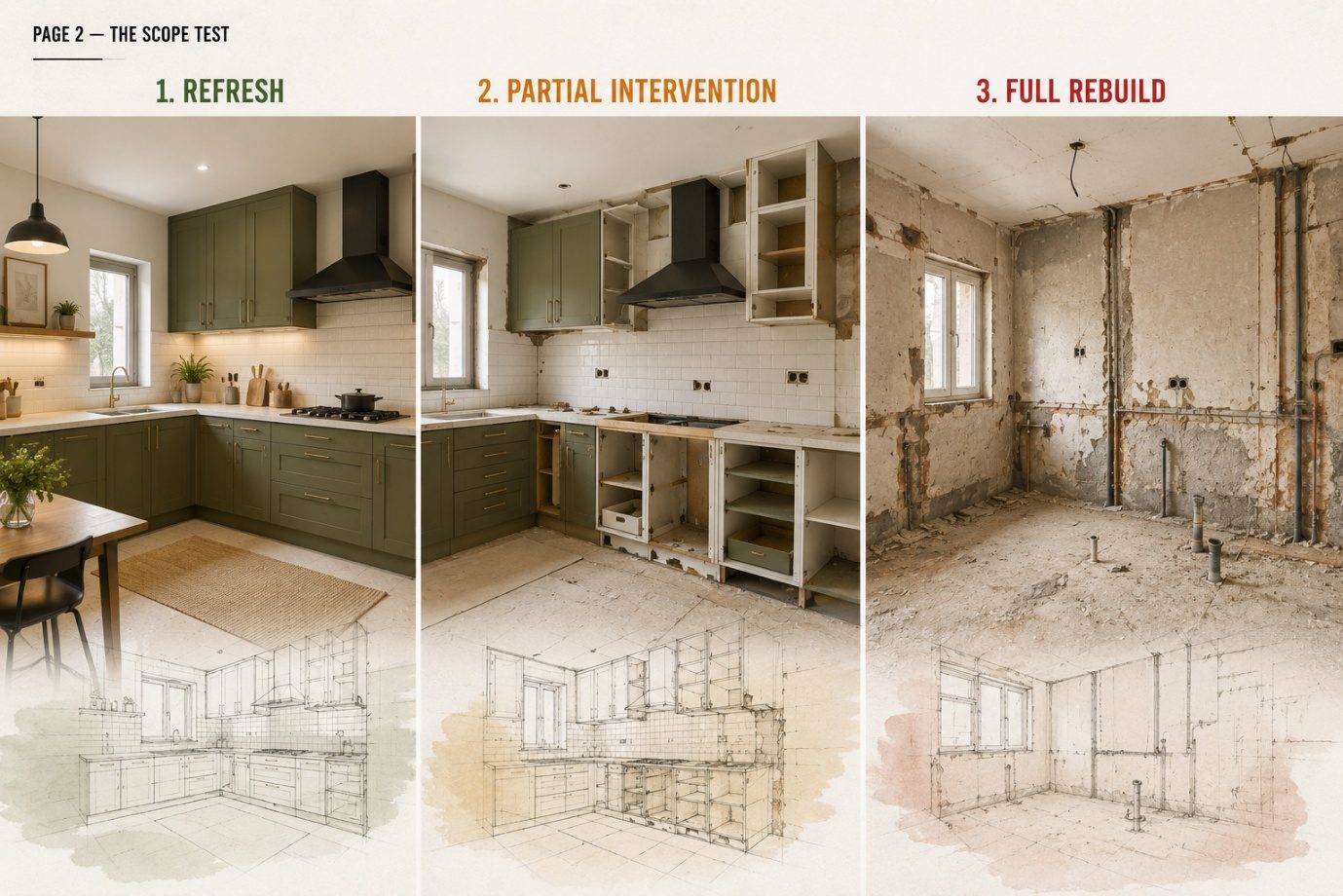
Six weeks is not automatically too short for a kitchen renovation. The problem is that "kitchen renovation" can mean anything from replacing shutters to rebuilding the entire room. These interventions may appear together on the same Pinterest board, but they carry very different scheduling risks. A useful pre-festival decision begins by separating what is relatively contained from what creates dependencies across several trades.
REALISTIC
With six weeks available, contained interventions with limited dependencies are the safest option. Repainting walls, changing light fittings, replacing handles or selected hardware, servicing or replacing an appliance where connections already exist, improving internal storage, repairing damaged components, or making other surface-level changes can often be planned without dismantling the kitchen's basic working system. Even here, product availability and site conditions matter, but one delayed item is less likely to prevent the kitchen from functioning.
Selected replacements can also be reasonable when the scope is clear. Replacing existing shutters while retaining sound carcasses, for example, removes much of the uncertainty of rebuilding cabinetry. Similarly, changing a sink or hob within an existing cut-out and service arrangement is different from relocating it. Keeping the kitchen's underlying geometry intact usually removes several dependencies from the programme.
POSSIBLE — BUT PLAN CAREFULLY
A partial cabinetry replacement, a new countertop, a new backsplash, a chimney upgrade, a significant shutter replacement or a limited modular intervention can fit within six weeks, but these projects become more sensitive to early decisions. Measurements must be correct, appliances confirmed, materials available, and the sequence between fabricator, plumber, electrician, countertop installer and cabinet installer understood before dismantling begins.
Countertops are a good example. A new surface can seem like a simple material change, yet the sink, hob, backsplash, plumbing and cabinetry all connect to it. If dimensions change or specialist fabrication is required, one replacement becomes a chain of dependent decisions. The closer the deadline, the fewer unresolved decisions the project can afford.
HIGH-RISK
A complete kitchen rebuild is a different proposition. Demolition followed by new flooring, relocated plumbing, changed electrical points, new cabinetry, custom finishes, countertops, appliances and several trades creates a sequence where one delay can hold up everything behind it. A late appliance can affect a cabinet opening. A plumbing change can affect the sink cabinet. An unfinished carcass can delay countertop measurement. A delayed countertop can postpone the sink connection. Suddenly, a few lost days are no longer isolated; they travel through the programme.
This does not mean a full kitchen cannot be completed within six weeks. Some coordinated systems and straightforward projects can move quickly. It means that promising the deadline without knowing the design status, material availability, fabrication route and site conditions would be irresponsible. The more customised the kitchen and the more existing services changed, the less contingency remains for the unexpected.
The simplest way to judge the scope is therefore not to ask "How big is the renovation?" Ask instead: how many things have to happen, in the correct order, before my kitchen works again? Every additional dependency is another place where your deadline can move.
How many things have to happen, in the correct order, before my kitchen works again?
Where the six weeks actually go
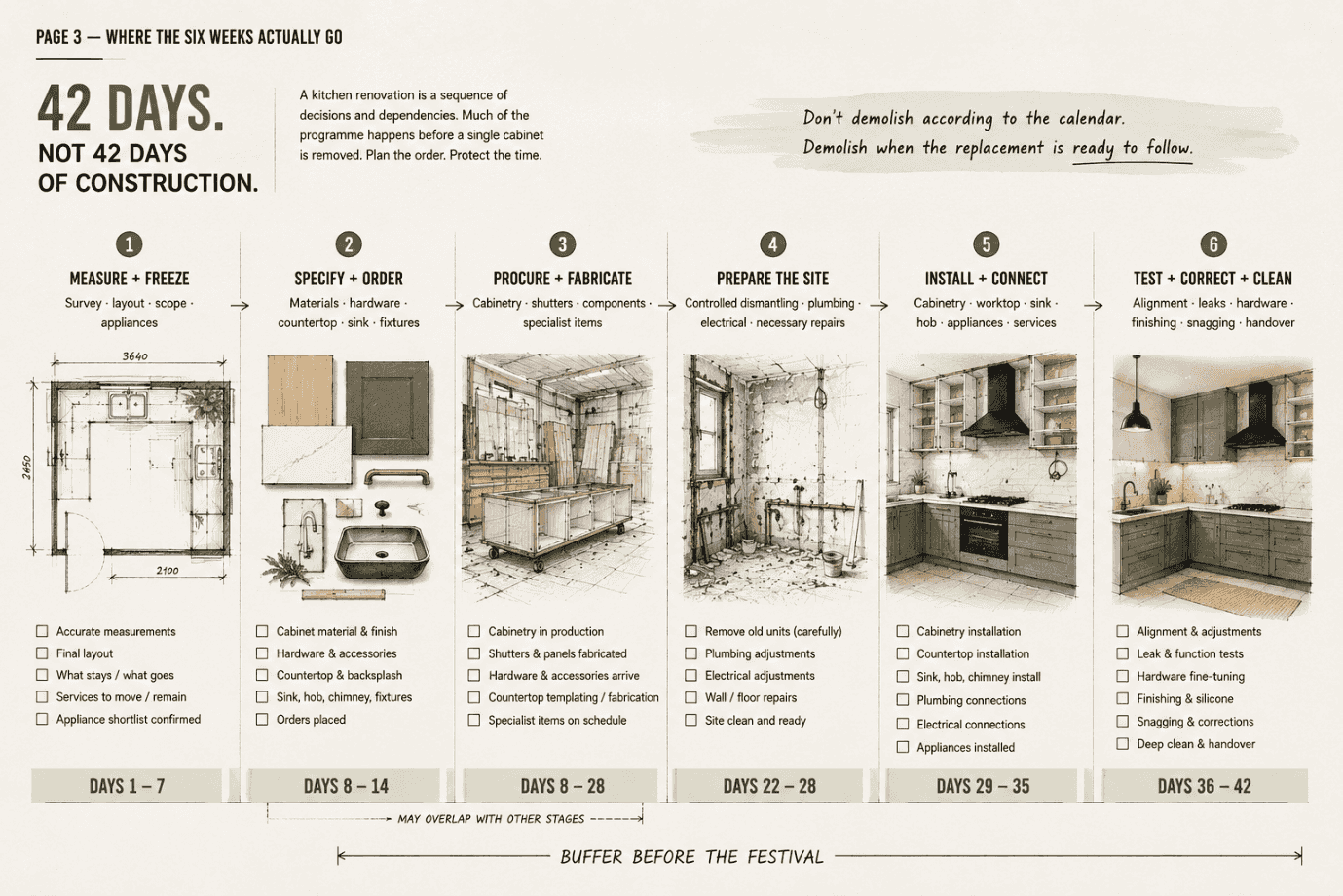
The most misleading part of a six-week renovation is the calendar itself. Forty-two days on paper does not mean forty-two days for construction. A kitchen is a sequence of decisions and dependencies, and much of the programme can pass before anything is removed from the room. Measurements become drawings; drawings become decisions; decisions become orders; and orders become components before installation can begin.
DEFINE, DON'T DEMOLISH
The first stage is therefore definition, not demolition. The existing kitchen needs to be measured accurately and the scope frozen: what stays, what goes, which services move and which remain. Appliances should also be confirmed early. A refrigerator, oven, dishwasher, hob or chimney is not something to choose casually after cabinetry has entered production; its dimensions, clearances and service requirements can directly affect the surrounding kitchen.
Specification follows. Carcass material, shutters, finish, hardware, countertop, sink, backsplash and accessories need to move from "we will decide later" to actual selections. This is when availability matters. A finish in a catalogue but with uncertain delivery introduces a risk that a readily available alternative does not. A deadline-driven renovation has less room for indecision disguised as choice.
PROCURE AND FABRICATE
Then comes the period homeowners often do not see: procurement and fabrication. Cabinet components may be manufactured off-site; shutters may have separate finishing; hardware and accessories must arrive; stone may require fabrication; and specialist items follow their own supply schedules. This is why a quiet kitchen mid-programme does not mean nothing is happening. Much of the renovation may temporarily exist elsewhere.
Only when critical components and dates are secure should the old kitchen be made unusable. Demolition too early creates no scheduling advantage if the replacement is still being fabricated. Instead, it turns manufacturing time into time without a functioning kitchen. For a deadline like Diwali, that distinction matters enormously.
PREPARE, INSTALL, CONNECT
Site preparation then brings together the trades that finished photographs hide. Plumbing and electrical changes must match the final layout. Walls and floors may need local repair. Chimney ducting or appliance services must be resolved. Cabinetry can then be installed and aligned, followed by countertops where applicable, sink and hob installation, plumbing and electrical connections, appliances, final hardware adjustments and finishing.
And then there should be something most optimistic schedules forget: time for things to be wrong. A shutter may need adjustment. A drawer may catch. Silicone may need correction. A fitting may be missing. An appliance may reveal a clearance problem. A leak may appear only when the sink is tested. These are not extraordinary disasters; they show why a programme needs snagging and contingency before the deadline, not on it.
The six-week kitchen works best when the festival is not treated as the completion date. The kitchen should be operational earlier, leaving the final days for correction, cleaning and returning the household to normal.
THE SIX-WEEK PROGRAMME
Treated as a planning model rather than a guaranteed schedule, the forty-two days run roughly like this. Week 1 — measure and freeze: survey, layout, scope, appliances. Week 2 — specify and order: materials, hardware, countertop, sink, fixtures. Weeks 2 to 4 — procure and fabricate: cabinetry, shutters, components, specialist items. Week 4 — prepare the site: controlled dismantling, plumbing, electrical, necessary repairs. Week 5 — install and connect: cabinetry, worktop, sink, hob, appliances, services. Week 6 — test, correct and clean: alignment, leaks, hardware, finishing, snagging, handover. Fabrication methods, project complexity, product availability and site conditions can shift individual stages or cause them to overlap. The rule underneath it is simple: do not demolish according to the calendar; demolish when the replacement is ready to follow.
Do not demolish according to the calendar; demolish when the replacement is ready to follow.
Where renovations actually lose time
Most delayed kitchen renovations are not delayed because installing a cabinet takes unexpectedly long. Time is usually lost between activities: waiting for a decision, waiting for material, waiting for one trade to finish before another can measure, or discovering something on site that should have been resolved earlier. In a six-week programme, these gaps matter because there is little time to absorb them.
THE HIDDEN DELAY LIST
One of the easiest delays to create is changing the design after fabrication has begun. Moving an appliance, changing a shutter finish, adding a drawer or reconsidering the sink position may feel like an isolated decision but can affect drawings, cabinet dimensions, hardware, service points and orders already placed. A short deadline rewards an unusual discipline: once the important decisions are resolved, stop redesigning.
Appliances create another common dependency, because cabinetry is often designed around them. A built-in oven, microwave, dishwasher, refrigerator, hob or chimney comes with dimensions and installation requirements that must be known before the surrounding work is finalised. Choosing the appliance late, or assuming all models occupy roughly the same space, can turn a product decision into a cabinetry problem. For a deadline kitchen, select the appliance before designing the opening, not the other way around.
The countertop can become another bottleneck. Its installation may depend on the base cabinetry being complete and correctly positioned, especially where final measurements or templates are required. The countertop then affects the sink, hob and sometimes the backsplash or plumbing sequence. If it arrives late, several unrelated tasks can wait with it. The lesson is not that countertops are inherently slow; it is that some elements sit at the centre of several dependencies and deserve more programme attention than their size suggests.
Existing homes add another kind of uncertainty: what cannot be fully understood until work begins. Removing old cabinetry may reveal damaged plaster, dampness, unsuitable wiring, leaking plumbing, uneven walls or floors, or service positions different from what was expected. A six-week programme cannot eliminate these discoveries. It can avoid consuming every available day before they occur.
Coordination is equally important. The cabinet installer, electrician, plumber, countertop fabricator, appliance technician and other trades may each require only a relatively short visit, but those visits have to happen in the right order. A plumber arriving before the sink is ready, or a countertop installer arriving before the base units are correctly positioned, does not make the programme faster. Availability is useful only when the preceding work is actually ready.
And finally there is delivery itself. A specified finish, fitting or accessory may be perfectly suitable for the kitchen but completely unsuitable for a six-week deadline if its availability is uncertain. Pre-festival renovation therefore requires a slightly different design mindset: the best theoretical option is not always the best project decision. Sometimes the better specification is the one whose performance is appropriate and whose availability can actually be confirmed.
None of this means the homeowner should expect things to go wrong. It means the programme should acknowledge that renovation contains uncertainty. The safest six-week kitchen is not necessarily the one where every activity has been compressed as tightly as possible. It is the one where fewer decisions remain capable of stopping everything else.
THE BUFFER RULE
This is why the schedule should not run installation straight into the festival. Do not schedule installation, then Diwali. Schedule installation, then test, then correct, then clean, then a buffer — and then Diwali. A contingency is not unused time. It is part of the renovation.
A contingency is not unused time. It is part of the renovation.
Six weeks. Four weeks. Two weeks.
The closer Diwali gets, the more the question itself should change. At six weeks, a homeowner may still be deciding what to renovate. At four weeks, the question becomes what can be simplified. At two weeks, it should be what can be improved without putting the kitchen out of action. The deadline stays fixed; the ambition has to move.
SIX WEEKS — CONTROL
Six weeks — renovate, but control the scope. Six weeks can still support meaningful work when the design is straightforward, decisions are made immediately, and material availability is confirmed. At this point, partial cabinetry, shutter replacement, countertop changes, backsplash work, storage improvements, lighting, selected appliance upgrades, and some service modifications may be considered. A complete kitchen may also be achievable under a tightly managed system, but it carries more risk and should not be treated as the default six-week promise.
The important condition is decision readiness. If the first two weeks are spent comparing twenty laminates, changing layouts and waiting to choose appliances, you no longer have a six-week renovation. You have a four-week renovation with two weeks already spent. At six weeks, ask: can the design be frozen now, and can every critical material and trade be confirmed?
FOUR WEEKS — REDUCE
Four weeks — reduce the number of dependencies. At four weeks, the strategy should become more conservative. This is not the moment to discover that the sink would work better on another wall, or that the entire floor should be replaced. Every change involving plumbing, electrical work, fabrication and another contractor adds a point where the schedule can stop.
Instead, look for high-impact interventions that preserve existing infrastructure. If the carcasses are sound, could shutters and hardware be improved rather than everything rebuilt? Could better lighting change how the worktop functions? Could an inefficient cabinet be reorganised internally? Could the chimney be serviced or upgraded without redesigning the cooking zone? Could one damaged section be rebuilt while the rest remains? At four weeks, editing the scope is not settling for less. It is protecting the deadline. At four weeks, ask: what can we keep exactly where it is?
TWO WEEKS — PREPARE
Two weeks — stop renovating, start preparing. Two weeks before Diwali, a functioning kitchen is more valuable than an unfinished transformation. Unless a small intervention is already designed, measured, ordered and ready to install, this is not the moment to begin disruptive work.
Shift the objective from renovation to readiness. Repair loose hinges and drawer runners. Fix leaks. Service the chimney. Replace failed lights. Declutter counters. Reorganise frequently used utensils and ingredients. Create room for festival groceries. Check whether the large vessels, trays and appliances that will soon be used are accessible. If extra preparation space is needed, consider a safe temporary surface rather than permanent cabinetry designed in a hurry.
There is value in postponement. Use these two weeks to observe the kitchen under its heaviest annual load. Where do two cooks collide? Where do finished sweets wait? Where do bulk ingredients land? What runs out of storage? Which counter becomes impossible to use? Those observations can become the brief for a better renovation after the festival. At two weeks, ask: how can this kitchen work better for the next fourteen days without dismantling it?
THE COUNTDOWN RULE
That is the countdown rule. At six weeks, control: meaningful renovation can still be considered, so freeze decisions, confirm availability and protect contingency. At four weeks, reduce: keep services and sound components where possible, and remove dependencies rather than adding them. At two weeks, prepare: prioritise repair, organisation and festival readiness, and do not create a construction site to solve a problem that can wait. In festival week, use: the kitchen should be cooking, not waiting for a contractor. As the deadline gets shorter, good planning does not mean working faster. It means attempting less.
Before you commit to the deadline
By this point, the question is no longer whether six weeks is enough. The more important question is whether your kitchen is ready to enter a six-week programme. A short renovation succeeds less because everyone works unusually fast and more because the important uncertainties have been removed before disruptive work begins.
Start with the design. If the layout is still changing, the project is not ready for a deadline. The positions of the refrigerator, sink, hob and major appliances should be resolved. Cabinet requirements should be understood, and decisions that affect dimensions should no longer change. A six-week programme can accommodate work but has far less capacity for continuous redesign.
Then look beyond the drawing to procurement. Have the actual materials been selected, or only the colours? Is the specified hardware available? Has the sink been chosen? Are the appliance models confirmed? Is the countertop material available locally? If a particular finish is unavailable, has an acceptable alternative been identified? "We can order it" and "it will be here when we need it" are not the same answer.
The site needs the same scrutiny. Existing plumbing and electrical positions should be understood before cabinetry is committed, wherever possible. If services are moving, someone should already know who will move them and when. If demolition is likely to expose uncertain conditions, the programme needs room to respond. And if the family remains in the house during renovation, there is another practical question drawings rarely answer: how will they cook while the kitchen is unavailable?
The people building the kitchen matter as much as the things being ordered. A contractor saying "we can finish in six weeks" is useful only when that promise corresponds with a sequence. Who measures? Who fabricates? Who dismantles? When does the electrician arrive? Who installs the countertop? Who connects the sink and appliances? Who is responsible for correcting defects? A credible deadline should be explained as a programme, not simply offered as reassurance.
Most importantly, resist the temptation to use every available day. If Diwali is forty-two days away, the construction programme should not require forty-two perfect days to succeed. Deliveries slip. Components arrive damaged. Site dimensions disagree with drawings. Something needs adjustment. A schedule with no contingency is not efficient; it assumes nothing will go wrong. Before beginning, therefore, the homeowner needs one final test.
THE DECISION
Score the ten checks below. Eight to ten yes: go, with control — the project appears reasonably prepared for a deadline-led programme, so continue monitoring availability and sequence. Five to seven yes: reduce the scope — too many variables remain, so remove dependencies before removing the kitchen. Zero to four yes: do not race the festival — repair what needs attention, prepare the existing kitchen for the season, and renovate properly afterwards. These are not guarantees; they are a decision framework. A simple project can still encounter unexpected problems, while an experienced, tightly coordinated team may execute a complicated project efficiently. The checklist's purpose is to expose uncertainty before the existing kitchen is dismantled, when changing course is still inexpensive.
Perhaps that is the most useful lesson of the six-week kitchen. A festival deadline can be valuable because it forces decisions, but it should never be the reason for poor ones. The objective is not to have a new kitchen for Diwali at any cost. It is to enter Diwali with a kitchen that works.
If the deadline requires you to compromise decisions that determine how the kitchen will perform for the next ten years, the renovation can wait six more weeks. The kitchen will have to live with those decisions much longer.
The objective is not to have a new kitchen for Diwali at any cost. It is to enter Diwali with a kitchen that works.