Sintered Stone
The surface built for the working kitchen.
A kitchen surface takes more abuse than almost anything else in the home. Heat off the hob, standing water, cooking oil, the knife, the kettle, and the cloth that wipes it all down twenty times a day — and it has to look composed while doing it. So choosing a countertop is never really about picking a colour. You are balancing looks against durability, hygiene, upkeep and the plain reality of how the household cooks.
Sintered stone is the surface more and more Indian kitchens are asking for. It isn't quarried and cut like natural stone. It is made — mineral particles compacted under high pressure and heat into dense slabs that barely absorb water, come in large formats, and arrive in a wide range of finishes.
Designers reach for it because it takes heavy use and still looks refined. Big slabs mean fewer joints, and a worktop that carries up the wall behind it can read as one calm, coordinated surface.
But popular isn't the same as right for your kitchen. Sintered stone comes with real fabrication demands, edges that need respect, particular installation conditions and a cost to weigh. To specify it well, you have to know it past the showroom sample.
What actually makes it different
Sintered stone starts as minerals that are processed, compacted under very high pressure and then fired at extreme temperatures. The process compresses in hours what nature does over ages, leaving a dense slab with a tightly consolidated surface and very low porosity.
That is where the kitchen advantages come from. Low water absorption means most spills sit on top rather than soak in, so oil, coffee, turmeric and sauce wipe away without a fight. On a worktop that meets food and water all day, that keeps the daily upkeep simple.
Heat resistance is the other big one. Because the slab is born at high temperature, it handles the heat of cooking — you can bring a hot vessel straight off the flame onto it. Sensible kitchen habits still matter, but it is genuinely at home next to the hob.
It is hard, too, so the surface shrugs off the scratches and abrasion of ordinary use. Hard is not the same as indestructible, though. Thin edges, corners, sink cut-outs and any poorly supported stretch stay vulnerable to a knock. A material can be superb across its face and still ask for far more care at its edges.
The advantage of scale
Sintered stone comes in large slabs, which cuts the number of joints across a counter, an island or a backsplash. Used well, that lets the worktop and the wall behind it read as one continuous plane.
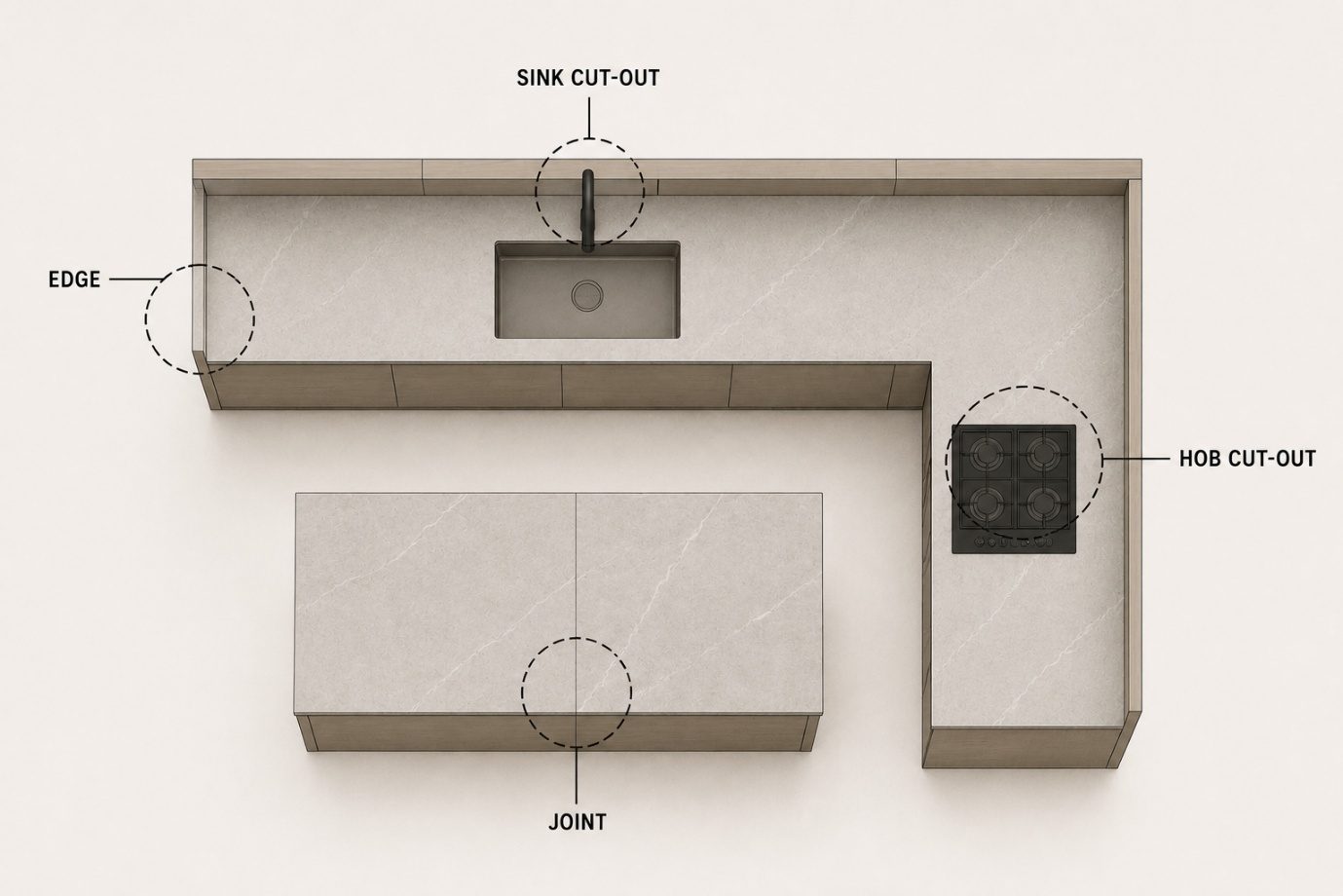
Large format doesn't hand you a jointless kitchen, though. Slab size, the route into the kitchen, the fabrication kit and the site conditions all decide where a joint has to land. So the detailing starts long before the slab reaches site: treat every cut-out, corner and joint as a design decision, not something to sort out on the day of installation.
Thin doesn't mean weak — but detailing does
The slabs also come in thin profiles, so a worktop or a clad wall can look lighter than traditional stone allows — slim counters, backsplashes, cabinet cladding, all visually weightless.
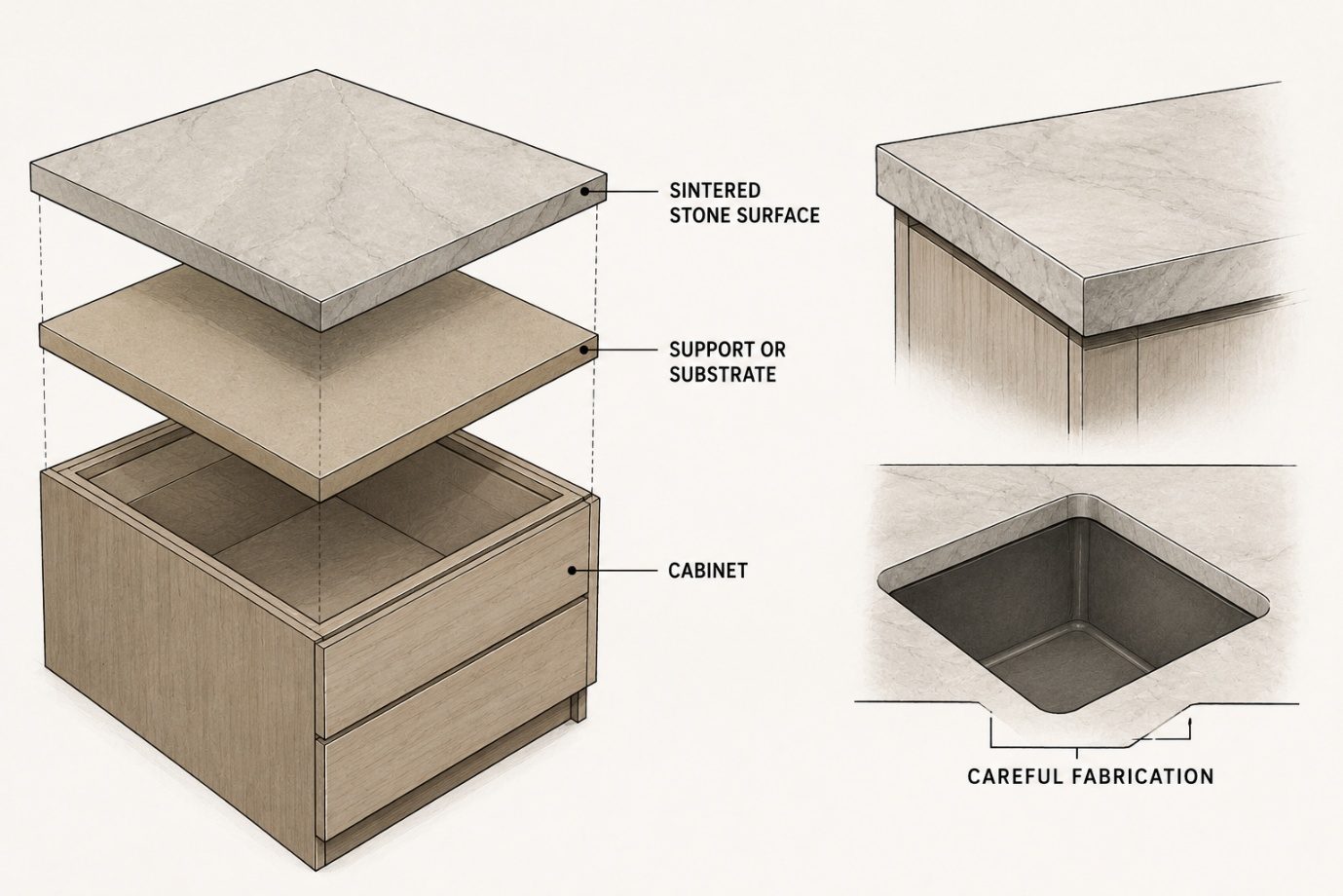
The thinner it gets, the more the construction underneath earns its keep. A worktop that looks effortless is holding that line through a proper substrate, aligned cabinets, support around every opening and careful edge work.
For an architect, the point is simple: the material's toughness doesn't let you off the detailing. If anything, going thin makes precise detailing matter more.
Where it works best
Sintered stone's real strength isn't that it goes anywhere — it is that several of its qualities line up unusually well with what a kitchen demands. Low porosity, heat and stain resistance, large slabs and a broad range of finishes let it step past the plain role of a countertop and become part of how the whole room is composed.
The worktop
The counter is the obvious place to start. It carries the heaviest concentration of daily work — chopping, prep, spills, hot vessels, small appliances and endless wiping. A dense, low-absorption surface answers that well, especially in a home where the kitchen is genuinely cooked in, not kept as a showpiece.
The gain shows most on a long run or an island. Large slabs can drop the number of visible joints and let the surface read calmer and more continuous — but where those joints fall still has to answer slab size, access, transport and the position of the sink and hob.
From countertop to backsplash
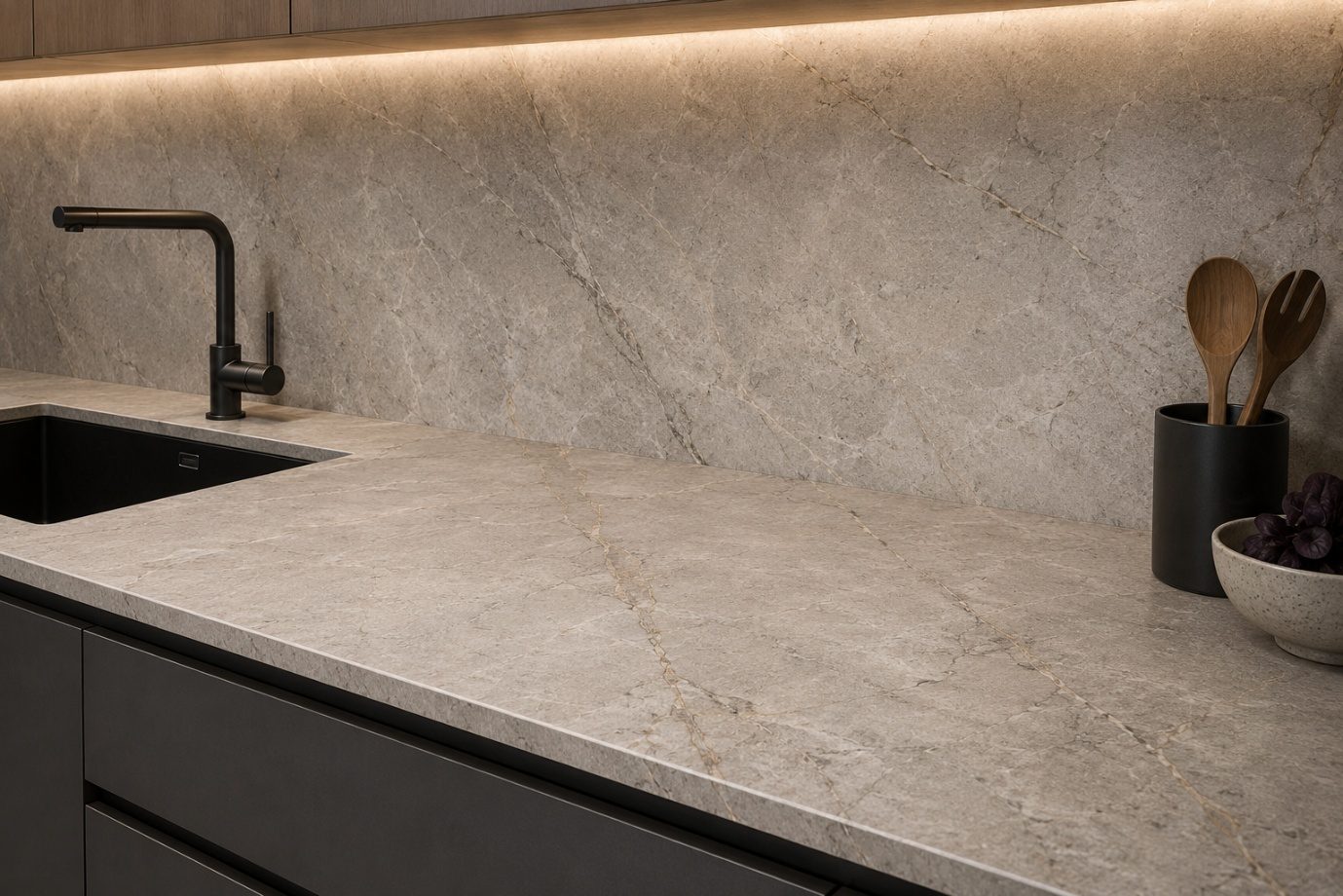
Carrying the same surface up the wall behind the counter is one of the material's strongest moves. Instead of switching to tile, grout and a contrasting finish, the worktop simply rises onto the wall — one material, one fewer transition to detail.
There is a practical payoff as well. A tiled backsplash brings grout lines that need scrubbing, right where you cook and wash. A single slab gives you one broad, uninterrupted face you can wipe clean. Not just a more minimal look, but an easier life for one of the kitchen's most-cleaned zones.
The kitchen island
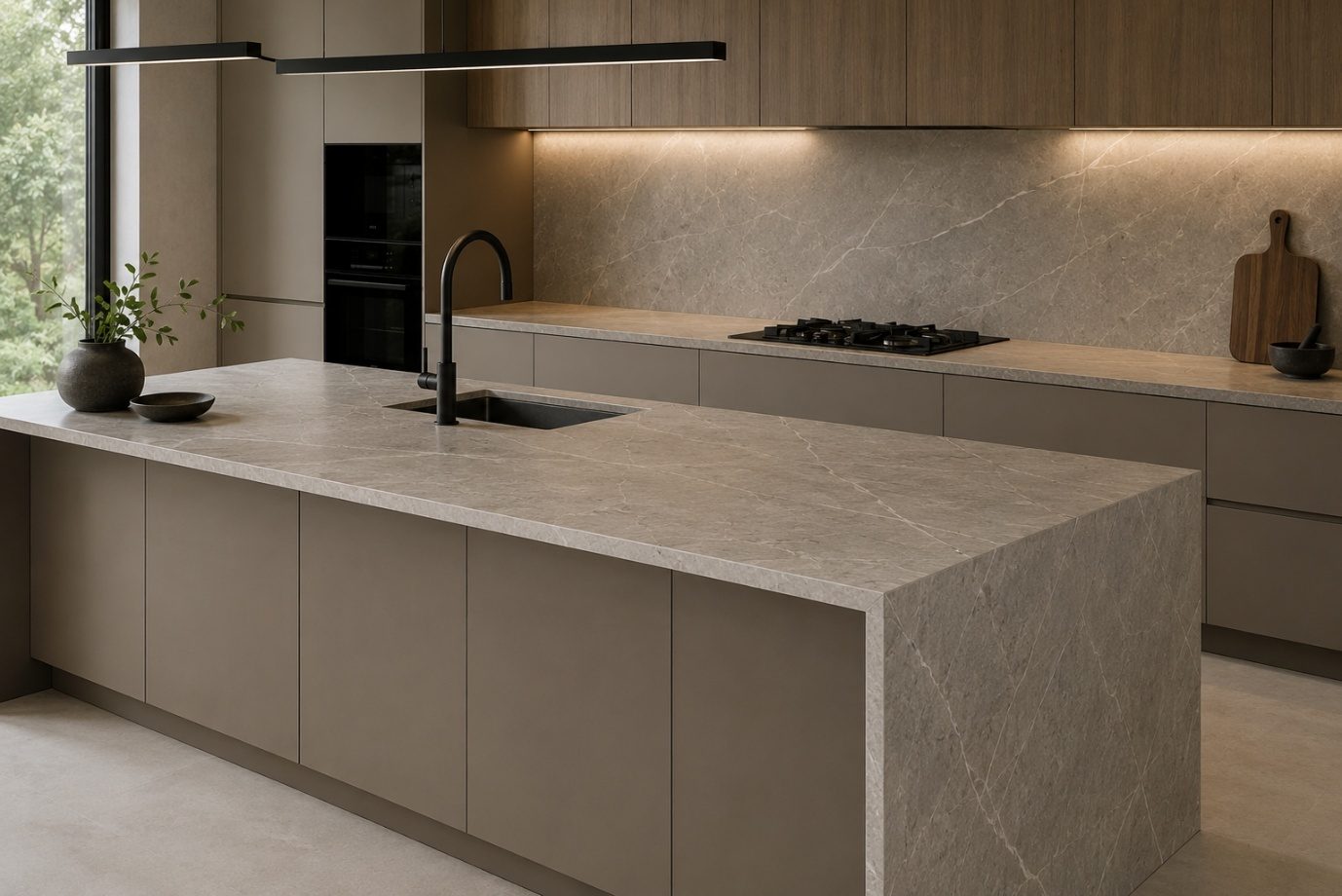
An island earns its own thought because you see it from every side, not just from above. The stone can run across the top and, depending on the design and the fabrication, down the sides to read as one solid volume.
This is where restraint counts. Wrap every plane in the same patterned surface and continuity tips over into too much. The material is at its best when its job is deliberate — a quiet worktop against timber cabinetry, a single monolithic island in an otherwise restrained room, a backsplash that ties two working zones together.
Vertical surfaces
The thinner slabs also open up selected vertical work. Cabinet fronts, end panels and wall cladding can carry the same material language beyond the counter without the heavy visual thickness stone usually brings.
More material doesn't automatically mean a better room, though. Kitchens still want contrast, texture and hierarchy. A good specification decides where the stone should stop as carefully as where it should begin.
One material, different roles
Maybe the most interesting thing about sintered stone isn't any single performance claim. It is that one surface family can play several architectural roles in the same room — counter, backsplash, island and chosen vertical planes all speaking the same language while doing very different jobs.
The opportunity is continuity. The responsibility is knowing when enough is enough.
Before you specify it
Sintered stone can look effortless once it is in, but that ease is bought before installation. The material is hard and resistant; fabrication is where the openings, edges and corners get introduced, and that is where trouble starts. Sloppy detailing at sink and hob cut-outs, internal corners, overhangs and narrow strips builds in weak points you never needed.
The fabricator is central to the design, not an afterthought at the end of it. A kitchen drawing should say a great deal more than "stone countertop", and it shouldn't leave the important calls to whoever is on site that week. Settle slab sizes, joint positions, cut-outs, edge profiles and support conditions early, so the cabinetry and the surface work as one system. And remember the large slab has to physically arrive — through doors, corridors, a lift or a staircase — before anyone can fit it.
The edge matters
A thin counter draws a clean horizontal line, and in a pared-back contemporary kitchen that line does a lot of work. But the edge is exactly where accidental knocks land. Pots, heavy vessels and appliances move across it every day, and a sharp hit on an exposed edge is a different event from ordinary wear on the face of the slab.
So the edge profile deserves as much attention as the colour or the pattern. The aim isn't always to make the material look as thin as possible; the best edge balances the look you want against how the kitchen actually gets used.
Sinks, hobs and cut-outs
Every opening breaks the run of the slab. Sink and hob cut-outs create corners and slim sections where fabrication quality is everything — accurate cutting, properly eased corners and enough support around the opening all keep stress off the material.
Which is why the appliances get chosen before anything is cut. Swap a hob or a sink after the slab is machined and a simple substitution becomes a site headache. Confirm the actual dimensions and fitting requirements up front, and the counter is cut for the equipment you are really installing.
Pattern is a detail too
Stone-look sintered surfaces often carry strong veins and a clear direction. On a small sample that reads as decoration; across a whole kitchen it becomes a design line in its own right. Wherever slabs meet, turn a corner or run up a wall, whether the pattern lines up is the first thing the eye catches.
So choose and lay out the slabs before cutting. A well-placed vein can reinforce the geometry of the kitchen; a misaligned one can make even an expensive surface look unresolved. The specification isn't finished when the colour is picked — where the slab sits is part of the design.
Low-maintenance isn't maintenance-free
Low porosity makes routine cleaning easy, but no kitchen surface is truly maintenance-free. Wipe spills before they sit, use products that suit the material, and keep abrasive or harsh chemicals away unless the manufacturer clears them. Look after it and the finish holds up through years of daily cooking.
Sintered stone rewards one kind of kitchen in particular: the one where specification, fabrication and installation are handled as a single continuous process. Its strengths only really show up when the supporting details are thought through.
Sintered stone vs the familiar alternatives
No surface exists on its own. Sintered stone lands in a market where granite and engineered quartz are already the familiar choices, and each answers a kitchen differently. The useful question isn't which material is best in the abstract — it is which set of traits fits a particular home, budget and intention.
Sintered stone
Sintered stone is the right call when low porosity, heat and stain resistance, large-format work and visual continuity are the priorities. It gives you slim, contemporary worktops and coordinated backsplashes or islands without leaning on the one-off look of natural stone.
Its difficulties tend to show up in fabrication and installation. You need specialist equipment and skill — especially for edges, cut-outs and moving large slabs — and depending on the product and the local market, the cost can run above more established surfaces.
Granite
Granite stays popular for good reason: it is durable, and every slab carries its own colour, grain and pattern. Plenty of homeowners want exactly that individuality. And because it has been the Indian default for so long, skilled installers are easy to find in most cities.
The flip side is that a natural material varies. Many granites need sealing and periodic care, porosity especially, and no two slabs can be made to match perfectly the way a manufactured surface can.
Engineered quartz
Engineered quartz caught on partly because it is consistent. You can pick a colour and pattern and know what you will get, far more predictably than with natural stone, and the low-porosity surface keeps everyday cleaning simple. For a homeowner who wants a controlled finish without granite's surprises, it is a sensible middle ground.
Heat is where it asks for more care. Engineered quartz usually contains resin binders, and sustained or excessive heat can damage or discolour it — so trivets and heat protection stay sensible around hot cookware. That matters most in the kind of Indian kitchen where a vessel comes straight off the flame onto the counter.
The choice isn't only about performance
The material also sets the character of the room. Granite brings geological variation. Quartz offers manufactured consistency. Sintered stone can give you large-format continuity and a particularly controlled architectural finish. None of those qualities makes one surface automatically better than the rest.
The better specification starts with the household. How hard is the kitchen actually used? How much maintenance is acceptable? Do hot vessels land on the worktop regularly? Is a highly consistent finish the point, or is natural variation welcome? Does the design lean on large slabs, slim edges or continuous cladding? And, crucially, what fabrication skill can you actually get locally?
Don't pick a countertop because it photographs well. Pick it because the way it behaves matches the life that is going to happen on it.
The material check
Sintered stone
Worth considering when large-format continuity, low porosity, heat resistance and a refined architectural finish are the priorities.
Granite
Worth considering when natural variation, proven durability, familiarity and access to established local fabrication are the priorities.
Engineered quartz
Worth considering when consistent colour and pattern, low porosity and straightforward everyday maintenance are the priorities.
The final call is rarely about finding the perfect surface. It is about being honest about which compromises you can live with — and which ones your kitchen simply can't afford.