Kinderdijk: nineteen windmills against the sea
A place Amogh walked — the flattest, wettest ground in Europe, where a row of windmills has kept a whole region from drowning for three centuries, and the clearest lesson this issue could ask for on living with water instead of walling it out.
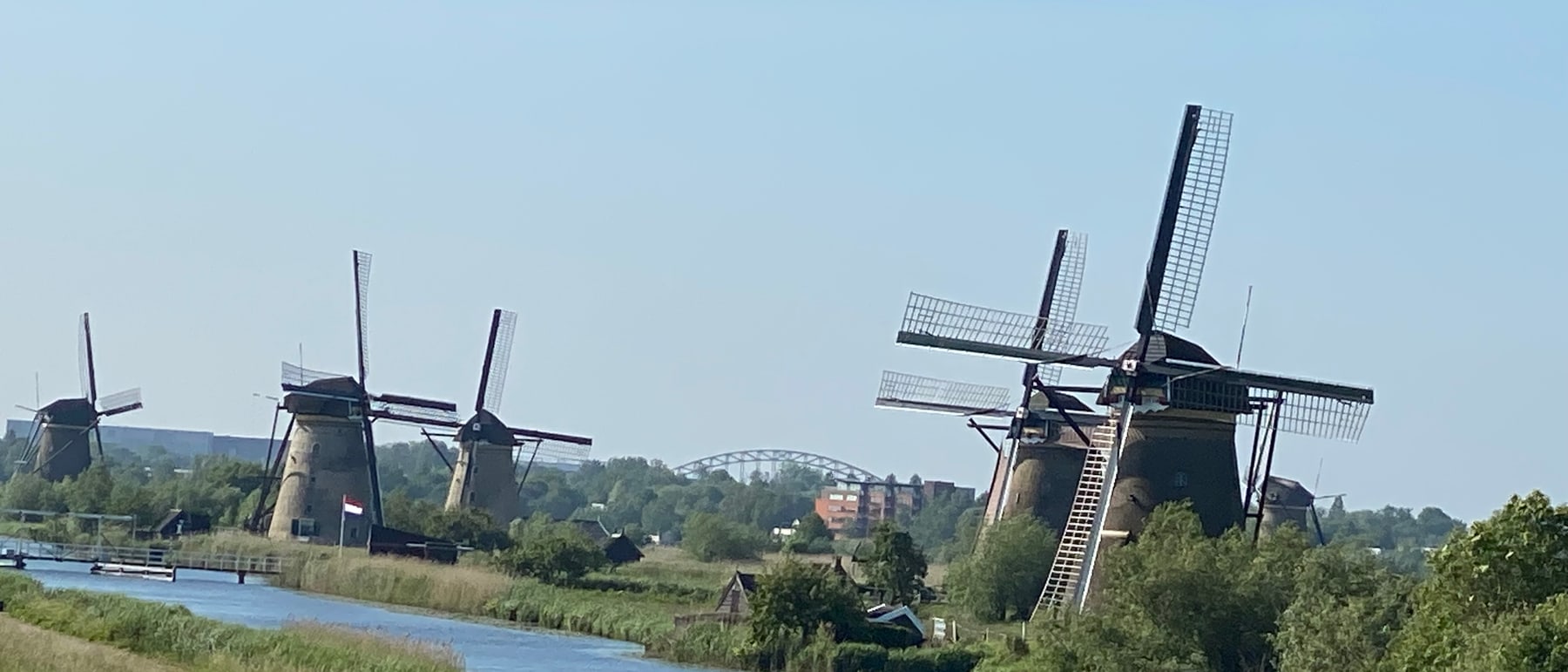
Leave the mountains and the marble behind, and the India this magazine usually reads. Come instead to the flattest, wettest ground imaginable — the grey-green river delta of Holland, where the wonder is not a temple or a tower but a row of nineteen windmills along a canal. And what they do is quietly astonishing: they keep an entire region from drowning.
Almost every great building is a single object. Kinderdijk is a different kind of marvel — not one building but a system, not a monument but a working machine the size of a landscape. It carries the most useful lesson an issue about resilience could ask for: how to live with water rather than wall it out. It is also, for us, a place with a particular hold, and we will come to that. But first, the machine.
A country below the sea
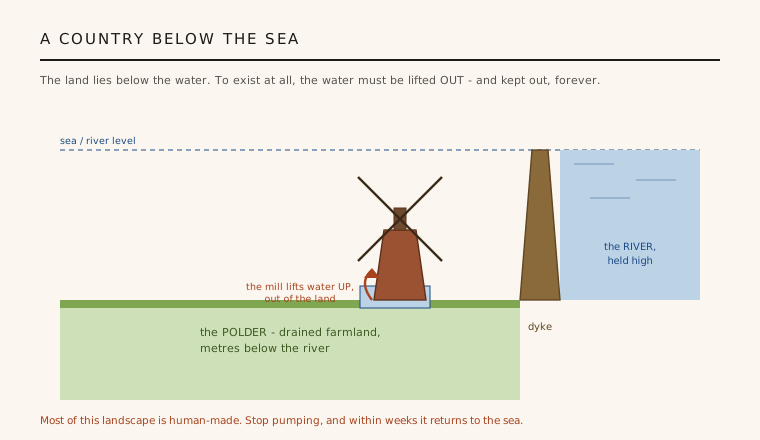
To understand the windmills you must understand the ground they stand on — because by rights it should not be dry land at all. Roughly a quarter of the Netherlands lies at or below sea level, and the Alblasserwaard, the polder Kinderdijk drains, is among the lowest of it: old peat bog that, once drained for farming, oxidises and sinks, settling year by year further below the rivers around it.
Because the polder floor sits lower than the rivers, rain and seepage cannot run away downhill — there is no downhill. The water has to be lifted up and out, mechanically, forever. Stop pumping for a few weeks and the fields return to marsh; stop for a season and they return to the sea. “God made the world,” the Dutch say, “but the Dutch made the Netherlands” — and it is barely an exaggeration.
A building that is a pump
So the purpose of a Kinderdijk windmill is not to grind grain but to move water uphill. Each mill is, quite literally, a building-sized pump. The wind fills the four great lattice sails; gearing carries that power down to a scoop wheel — a paddle wheel turning in a close-fitting channel that lifts water a metre or so into a higher canal. In some mills an Archimedes screw does the same work, walking a pocket of water up an inclined trough on every turn. There are no services hidden in a basement, no machine behind a façade. The architecture is the mechanism — a building you could not draw without drawing how it works.
A machine you live inside
Here is the detail that makes Kinderdijk unexpectedly human: these pumps were also homes. The miller and his family lived inside the working mill — slept, cooked and raised children in the cramped, dark, ceaselessly turning body of the machine. It was hard and genuinely dangerous, the sails sweeping down almost to the ground, the machinery running through the living space, the watch on wind and water never ending. That intimacy never really finished. Most of the nineteen mills are still inhabited today, several by resident millers who can run them if called upon — a house that is also a piece of national infrastructure, tended by a family who live inside the thing that keeps their country dry.
A staircase for water
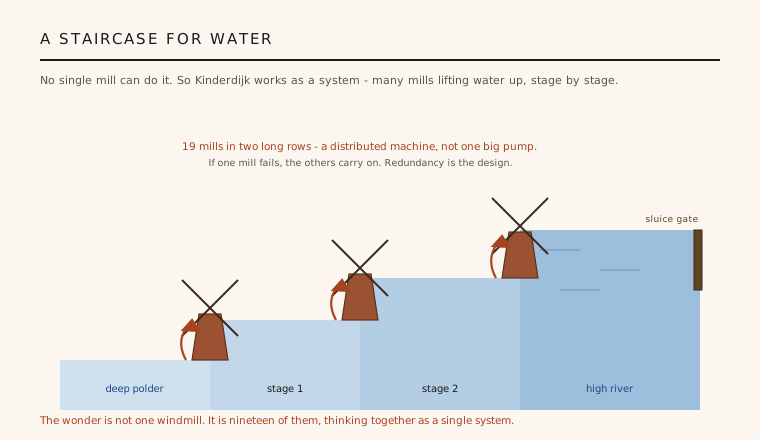
Why nineteen? Because one mill is nearly useless alone. A scoop wheel lifts water only about a metre to a metre and a half — nowhere near enough to raise it out of the deep polder and over the river dyke. So the mills raise it in stages, like a staircase: arranged in a row, a molengang, each one lifting the water a single step higher into the next canal, where the following mill picks it up. The water climbs into a raised storage basin and waits there until the river drops at low tide and sluice gates let it out by gravity. What makes it a wonder is that it is a distributed machine. There is no single great pump to fail; the load is shared across nineteen. One goes down for repair, the others carry on, and the polder stays dry.
Six centuries of keeping dry
The windmills are only one chapter in a much longer story, and that story is the real lesson. Draining the Alblasserwaard began in the 1200s, and by 1277 the local lords were compelled to elect water boards to manage it — institutions that survive today and count among the oldest continuously functioning democracies on earth. On that unbroken foundation one technology was layered after another, never ripping out the last: the windmills of 1738 and 1740, steam pumping from 1868, diesel and electric in the 1920s, quiet electric stations now. But the mills were never scrapped. They are kept in full working order as heritage and as emergency backup — and that is not sentiment. During the Second World War, when fuel ran out, the “obsolete” windmills were fired up again and pumped the polder dry.
The deepest lesson at Kinderdijk is therefore not mechanical but institutional: durable infrastructure needs a durable institution to tend it. For a country like India, facing harder monsoons and sinking coastal cities, the Dutch answer is worth hearing. The reply to too much water is rarely a taller wall. It is a patient, maintained, cooperative system, and the will to keep it running for eight hundred years.
The reply to too much water is rarely a taller wall.
In Amogh's frame
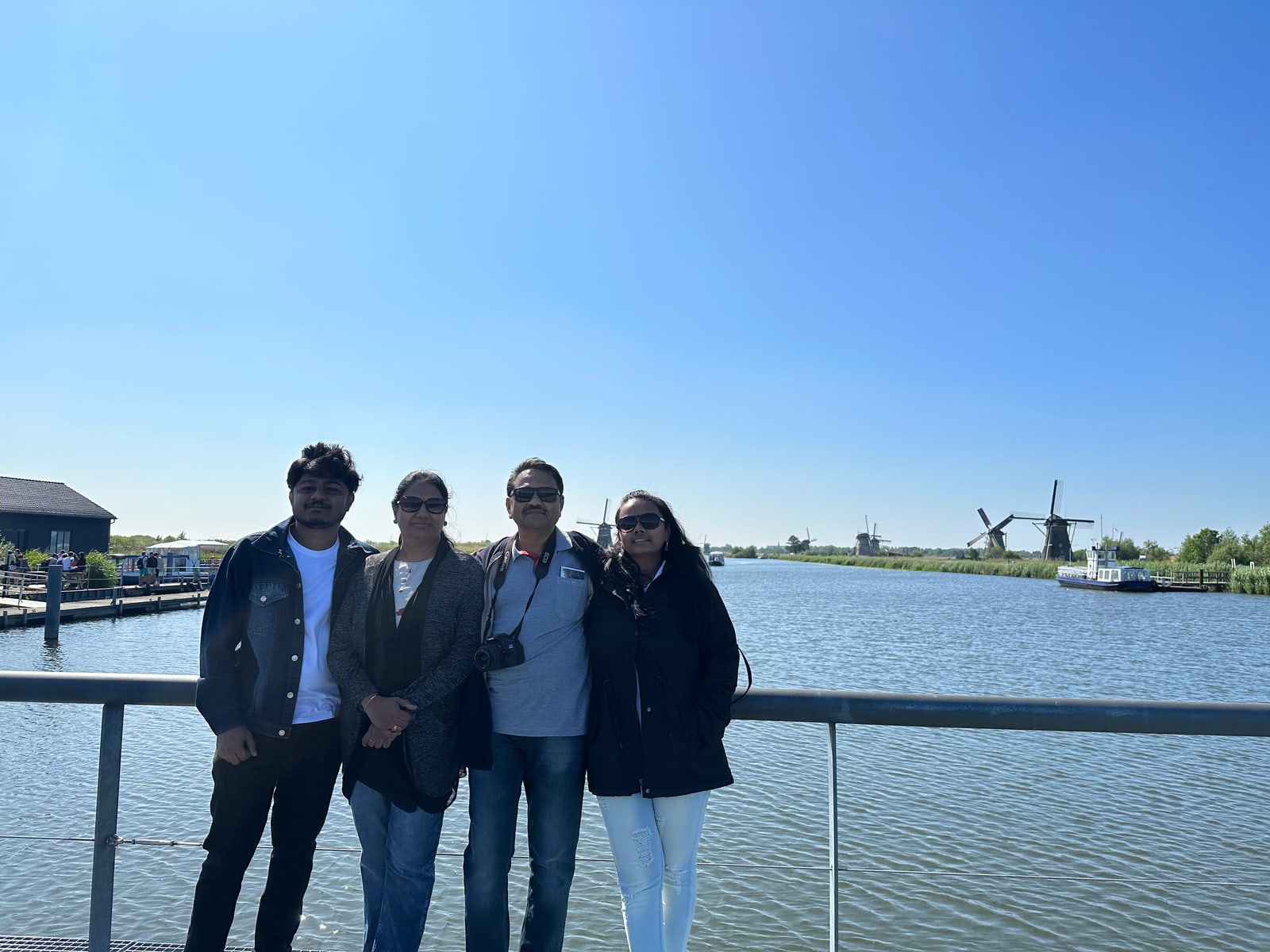
Kinderdijk is one of the places Amogh visited himself. Here he is with his family beside the canal, the great drainage windmills of the polder standing across the water behind them in the bright Dutch sunshine — the working landscape this whole piece is about, seen not as a diagram but on a clear blue-sky afternoon.
Studio Matrx is built in his memory. Some of these wonders he walked through himself; this is one of them.