
The claim
“A rainwater tank pays for itself.”
It is the line in every brochure and most of our own guides. So we costed it properly against Bengaluru's actual water tariff — and the answer is no, not remotely, and that is the most interesting thing about it.
False — on the bill. And the bill is the wrong test.
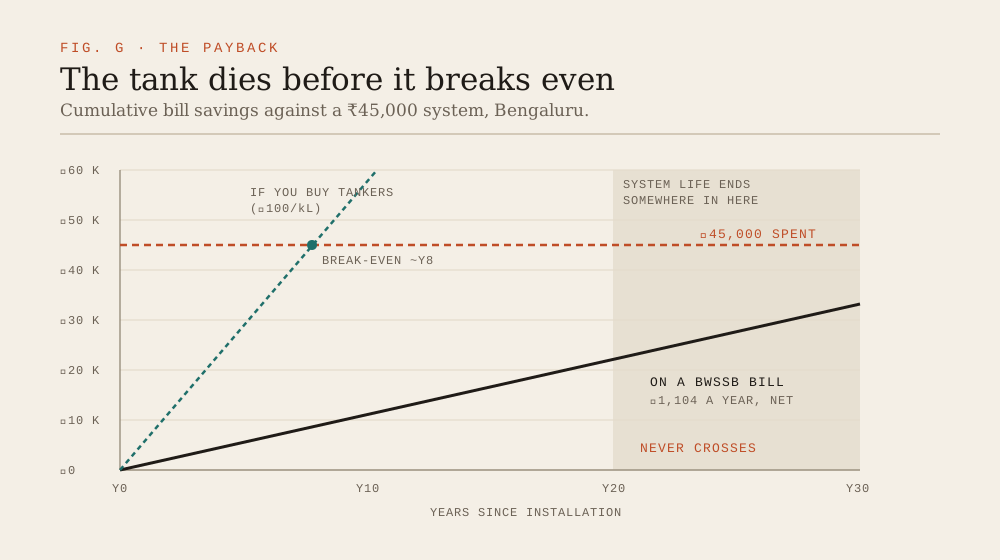
On Bengaluru's published tariff a rooftop system saves roughly ₹3,100 a year and takes about 40 years to repay ₹45,000 — longer than it will last. It only pays back if you are buying tanker water, which is to say: only when the tap has already failed you. Harvest for water security and for the aquifer. Do not harvest for the arithmetic.
The claim
It is the first line of every rainwater harvesting brochure, and it appears in our own guide: install a tank, watch it pay for itself, and after a few years the water is free.
It sounds obviously right. Rain is free. Municipal water is not. Collect enough of the first and you stop buying the second — so the only question seems to be how many years it takes.
That framing hides the number that decides everything, and almost nobody states it: what a litre of municipal water actually costs. Get that wrong and the whole calculation collapses. We got it wrong ourselves — see the caveats.
What we assumed
Honest math shows its inputs. Change these and the number moves — so here they are, in the open:
- 01One ordinary Bengaluru house: 100 m² of roof, four people.
- 02Bengaluru's annual rainfall: 970 mm — one of the lower figures among India's big cities.
- 03Runoff coefficient 0.8 — what a real roof delivers after wetting, splash and first-flush losses.
- 04Consumption at the CPHEEO norm of 135 litres per person per day.
- 05BWSSB domestic tariff, April 2025 revision: ₹15/kL to 8 kL a month, ₹40 to 25 kL, ₹80 to 50 kL, ₹100 above.
- 06System cost ₹45,000 — gutters, downpipes, first-flush filter, filter unit and connections on a house that already has a sump. Upkeep ₹2,000 a year.
- 07System life 20–30 years, the figure the trade quotes.
The math
- 1
What the roof yields
100 m² × 970 mm × 0.877,600 L a year77.6 kilolitres — about 6.5 kL a month, spread very unevenly across the year.
- 2
What the house uses
4 people × 135 L/day × 3016.2 kL a monthThe rain covers roughly 40% of it, and only in the months it falls.
- 3
The bill today
8 kL × ₹15 + 8.2 kL × ₹40₹448 a monthThe slabs are progressive, so the last litres are the expensive ones.
- 4
The bill with rain
metered use falls to 9.7 kL → 8 × ₹15 + 1.7 × ₹40₹189 a monthHarvesting shaves off the top of the slab — the ₹40 litres, not the ₹15 ones.
- 5
The saving
₹448 − ₹189₹259 a month · ₹3,104 a yearThat is the entire financial benefit. It is less than one dinner out a month.
- 6
The payback
₹45,000 ÷ (₹3,104 − ₹2,000 upkeep)≈ 41 yearsThe system is expected to last 20–30. It dies roughly a decade before it breaks even.
- 7
So what would water have to cost?
(₹45,000 ÷ 10 years + ₹2,000) ÷ 77.6 kL≈ ₹84 a kilolitreFor a ten-year payback. BWSSB charges this household ₹40 at the margin — less than half.
to repay ₹45,000 out of a Bengaluru water bill. The system is built to last 20 to 30.
What we found
The claim is false as stated, and not marginally. On Bengaluru's published tariff a rooftop system returns about ₹3,100 a year before upkeep and roughly ₹1,100 after it. Against ₹45,000 that is a payback of about four decades — longer than the system will physically last.
Nothing is wrong with the engineering. The problem is the price of the thing it replaces. BWSSB sells this household water at ₹15 to ₹40 a kilolitre. At those rates a litre saved is worth about four paise, and no amount of rain makes four paise add up to ₹45,000 quickly.
Turn the arithmetic around and it becomes clearer. Water would have to cost about ₹84 a kilolitre for the tank to repay inside ten years. That is not a fantasy number — it is roughly what a private tanker charges, and it is close to BWSSB's own top slab for the heaviest users. The tank does not become worthwhile because you install it better. It becomes worthwhile because water becomes expensive.
Which is exactly what A.R. Shivakumar told us in this issue: “When water is available at very low cost through public supply, many people see little reason to invest in rainwater harvesting. That is why policy also plays an important role.” He drafted Karnataka's mandate for the same reason our spreadsheet says he had to.
The honest caveats
- ▸We got this wrong ourselves. Our own rainwater harvesting guide states a tariff of “₹0.8–1.2 per litre” and reports a three-to-four-year break-even. That is ₹800–1,200 per kilolitre — between twenty and thirty times what BWSSB actually charges, and the guide's own savings figure contradicts it. The unit is being corrected.
- ▸The bill is not the only value, and we are not pretending otherwise. A tank that keeps water in the house when the mains fails is worth something no tariff captures — as is a recharge pit that stops the aquifer under your street from dropping another metre. Neither shows up in a payback period.
- ▸The figures move. A bigger roof, a wetter city, a tanker-dependent street or a household above the 50 kL slab all shift the answer sharply. Kochi's 3,100 mm on the same roof yields three times as much. Run your own numbers rather than ours.
- ▸₹45,000 assumes a sump already exists. Dig a new one and the cost — and the payback — roughly double. Build the system into the design from the start, as Shivakumar argues, and it falls.
So what should you do
Stop selling rainwater harvesting as an investment. It is not one, at Indian municipal tariffs, and anyone who runs the numbers will find that out and trust the rest of your advice less.
Sell it as what it is: insurance against the day the tap runs dry, and a deposit back into the groundwater everyone on the street is drawing from. Those are the honest reasons, and they survive contact with a spreadsheet.
And notice what the arithmetic says about policy. When water is priced at four paise a litre, no rational household harvests it. That is not apathy — it is arithmetic. Mandates exist precisely because the price signal is missing.