
The Surge Kitchen
The same room, suddenly asked to do much more.
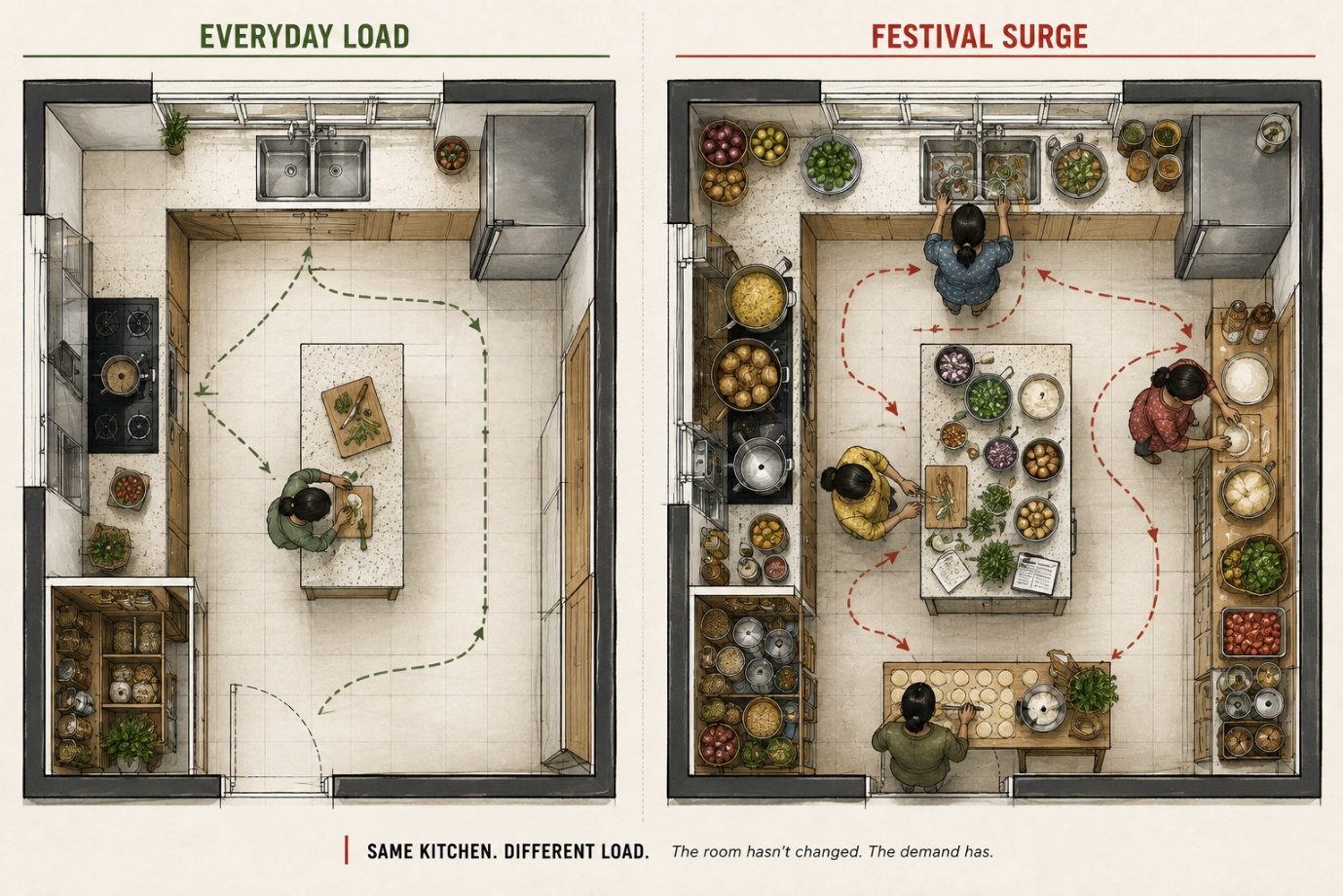
Most kitchens are planned around an ordinary day. Breakfast is prepared, lunch follows, and dinner comes later. Groceries enter the kitchen in familiar quantities, vessels move through a predictable cycle, and one or two people occupy the room. Festival cooking changes that rhythm without changing the kitchen's size. The room stays the same but is suddenly expected to do much more.
The difference is not just more cooking. It is more activity happening simultaneously. Batter may rest while another dish occupies the hob. Sweets or savouries may be prepared in batches while lunch still cooks. Ingredients bought in larger quantities need space to wait. Large kadais, pressure cookers, trays and containers not part of the everyday countertop suddenly enter use. Prepared food also needs space after leaving the hob, so the kitchen must accommodate preparation, cooking and temporary holding all at once.
Where the surge shows up
This creates what we call the surge kitchen: the same physical kitchen operating temporarily above its everyday workload. The first place this surge becomes visible is often the counter. A surface meant for preparation begins performing several jobs at once — ingredients waiting to be used, washed vegetables draining, appliances temporarily relocated, trays cooling, and finished food waiting to be packed or served. The counter has not shrunk, but its available working area has.
The counter has not shrunk, but its available working area has.
The sink undergoes a similar change. More preparation means more washing; larger vessels occupy more of the basin; ingredients may need repeated rinsing; and cookware can accumulate faster than it is cleared. This matters because a sink surrounded by waiting utensils does more than create clutter. It can interrupt preparation when the same zone is needed for washing vegetables, filling vessels or reaching water. The busiest workstation in an ordinary kitchen can become an even bigger bottleneck under surge conditions.
Then there are the people. Festival cooking is often collaborative: one person works at the hob while another rolls, cuts, washes, portions, packs or prepares the next batch. A kitchen that works comfortably with one cook can feel very different when a second person uses the same circulation path. The problem is not necessarily insufficient floor area. It may be that both people need the same sink, preparation counter or storage at the same time.
Everyday capacity and surge capacity
This changes how we should think about kitchen capacity. We normally measure a kitchen through permanent things — number of cabinets, metres of countertop, appliance capacity or floor area. But occasional intensive cooking introduces another measure: how much additional activity can the kitchen absorb before one function begins obstructing another?
A good festival kitchen does not have to be enormous, nor should an everyday kitchen be permanently oversized for a few high-intensity days. What matters is whether the room has enough flexibility to temporarily accommodate more ingredients, vessels, hands and finished food without sacrificing its essential working zones. That is the difference between everyday capacity and surge capacity.
On an everyday load the room carries one or two cooks, normal grocery quantities, a single primary preparation sequence, regular vessels and a normal washing load — and food moves relatively quickly from preparation to cooking to serving. The festival surge stacks these instead of spacing them: multiple simultaneous tasks, bulk ingredients, batch preparation, large or extra vessels, a higher washing load, more than one cook, finished food waiting between batches, and temporary storage occupying the work surfaces. So the design question is simple. When the kitchen gets busier, where does the extra work go? If the answer is onto the preparation counter, into the sink and into the circulation path, those three areas become the first places to examine.
Design for the surge, not around it
The answer to festival pressure is not necessarily a larger kitchen. Designing permanent cabinetry and oversized work surfaces for a few intense cooking days can leave the room inefficient for the other eleven months. A more useful approach is to protect the kitchen's essential everyday functions while giving it temporary capacity when demand rises.
The prep counter
The first priority is the preparation counter. During heavy cooking, useful worktop disappears quickly because ingredients, vessels, appliances and finished food compete for the same surface. The solution is not simply more counter. It is protecting a portion of the existing counter for active preparation while allowing secondary surfaces to absorb temporary tasks. A dining table, a movable trolley or a sturdy supplementary table can become a festival work surface for sorting ingredients, rolling, portioning or holding trays — provided it is stable, appropriately positioned and does not obstruct circulation.
Bulk storage
The same principle applies to storage. Festival groceries often arrive in quantities everyday cabinets were never intended to hold. Trying to permanently accommodate peak quantities can waste valuable storage most of the year. Instead, frequently used festival ingredients can be grouped temporarily in accessible containers or on a designated shelf away from the main preparation surface. The objective is simple: bulk storage should absorb excess ingredients without consuming the counter needed to turn those ingredients into food.
Finished food
Finished food needs its own territory too. In batch cooking, the workflow does not end when something leaves the hob. Sweets may need to cool, savouries may need draining, prepared dishes may wait for serving, and containers may need filling. Without a planned holding surface, finished food naturally occupies the nearest available counter and the next batch loses its workspace. Even a temporary table or a cleared dining surface can function as a holding zone, separating food being made from food already made.
Washing
Washing requires similar protection. When large vessels accumulate around the sink, it can stop functioning as a workstation and become storage for dirty cookware. Where possible, used vessels can wait in a separate tub, tray or designated area rather than occupying the basin itself. The sink then remains available for water, ingredient washing and immediate cleaning while the backlog waits elsewhere. It is a small behavioural change, but during intensive cooking it protects one of the kitchen's most frequently shared resources.
Multiple cooks
Multiple cooks introduce the final layer. Instead of everyone moving through every part of the kitchen, temporary task ownership can reduce unnecessary crossings: one person at the hob, another preparing or portioning, another handling finished food or washing. This is not about rigidly assigning people to stations. It is about recognising that shared kitchens work better when every task does not require every person to enter the same zone.
Return to normal
What all these strategies have in common is that they add capacity without permanently adding architecture. The kitchen expands through temporary surfaces, storage and task zones. When the festival ends, those additions disappear and the room returns to its everyday configuration.
Design an everyday kitchen that knows how to make room for them.
That gives us a different way to think about flexibility. A flexible kitchen is not one filled with complicated moving mechanisms. Sometimes it is simply a kitchen whose most important work zones remain protected when everything around them becomes busy. Everyday capacity absorbs the surge — through temporary surface, temporary storage, protected work zones and shared tasks — and then returns to normal. Do not build an oversized kitchen for five exceptional days. Design an everyday kitchen that knows how to make room for them.