Bologna
Where food becomes part of the city.
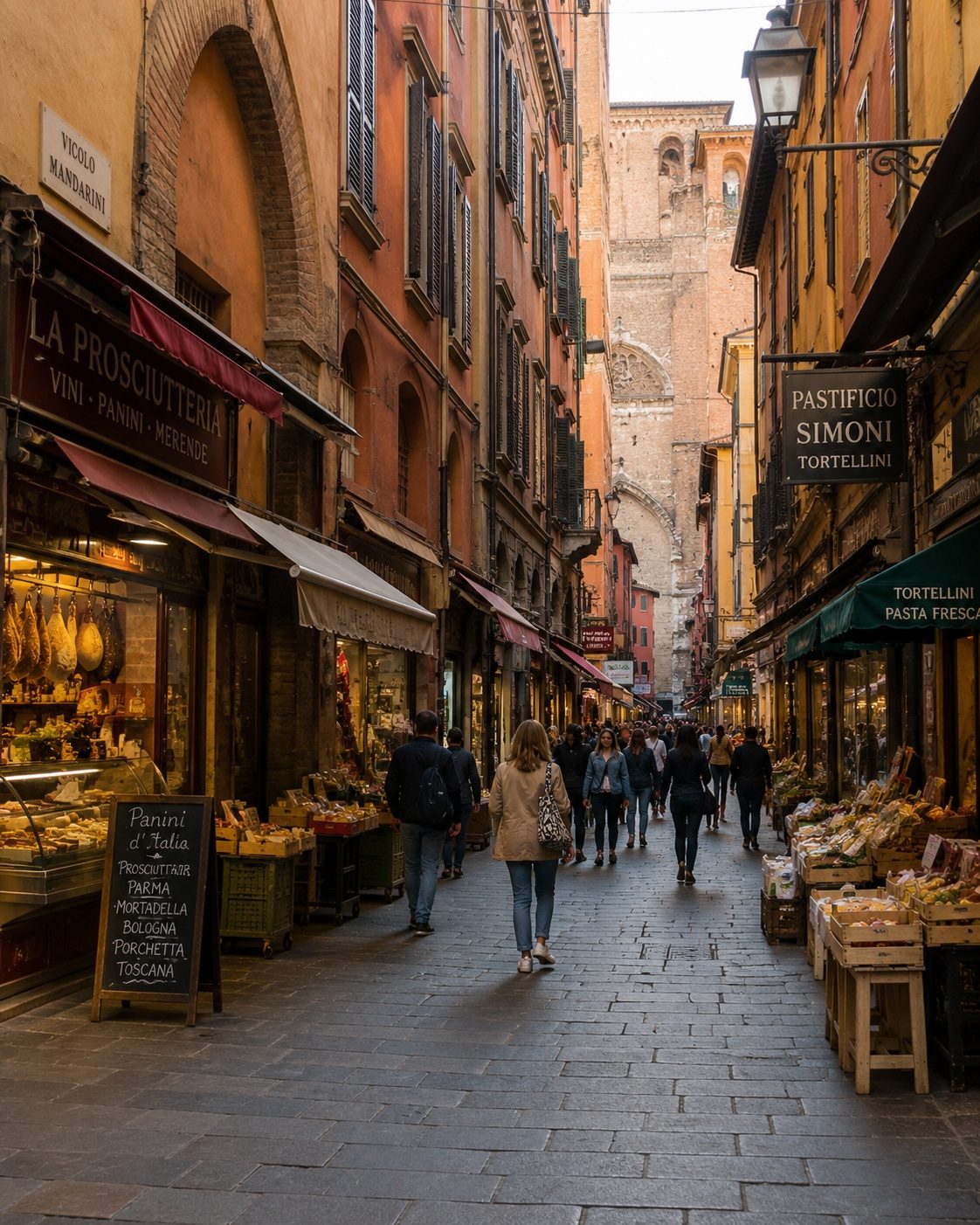
You notice Bologna's food before you have quite finished arriving. It does not wait behind a restaurant's walls or stay shut inside the domestic kitchen. It moves out into the streets, the shopfronts and the covered walkways until eating and the city become the same experience. We came, for this Kitchen Issue, to walk a place where food is not decoration laid over the architecture but a working part of it.
The market beside the square
The heart of it is the Quadrilatero, the old market district pressed up against Piazza Maggiore. Its narrow streets have carried craft, trade and commerce since the Middle Ages, and they still do — food shops, market activity and specialist businesses packed into a dense medieval grid, many of them keeping the historic architecture and interiors they have worn for centuries. You do not so much tour the Quadrilatero as get carried along by it.
Sixty-two kilometres of shelter
What makes Bologna worth a designer's time is the frame the architecture throws around all this public life. The city holds roughly 62 kilometres of porticoes — covered arcades that have grown, arch by arch, from the 12th century to the present day. UNESCO inscribed twelve representative groups on its World Heritage List in 2021, and the wording earns its place: it names the porticoes not only as an architectural model but as a social one, a setting for interaction and exchange stitched into ordinary city life.
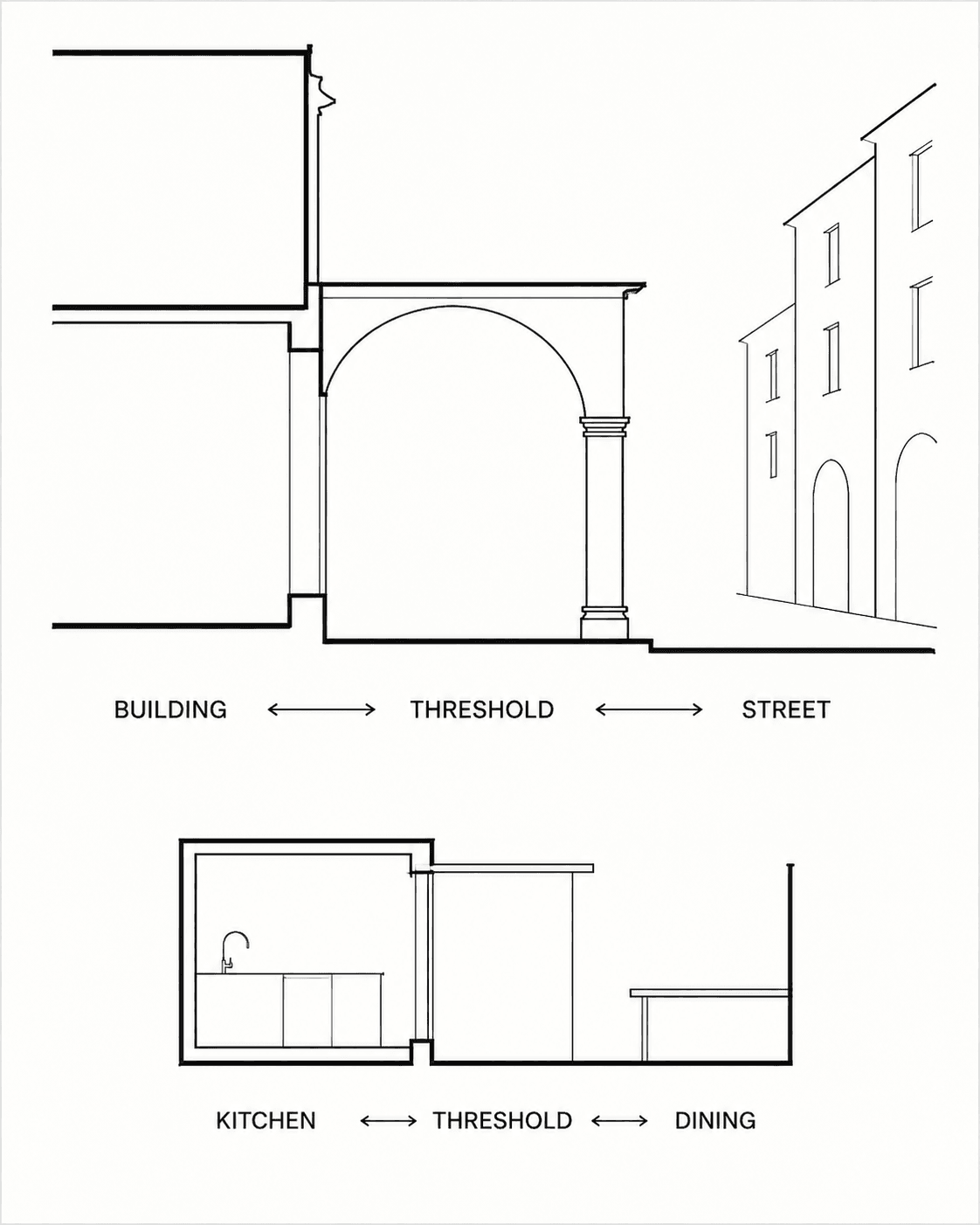
The portico sits in a curious, useful position, somewhere between building and street. It belongs physically to architecture yet works as public space. Shops open onto it, people walk beneath it, commerce and conversation carry on under cover whatever the sky is doing above. Bologna's answer to where the building ends and the city begins is simply this: not here, not yet.
A few steps on, Mercato di Mezzo takes the same idea indoors. It has been a place of trade and food since medieval times, became Bologna's first covered market after Italian unification, and following a 2014 redevelopment works again as somewhere to buy food, eat it on the spot and gather around it. The counter becomes the shopfront, the passage becomes the street, the gathering becomes the market — and food becomes part of the city's architecture.
The threshold that became a room
A kitchen runs on thresholds too: the line between preparing and serving, storage and work, the private act of cooking and the shared act of eating. Bologna simply builds that idea at the scale of a whole city. Its porticoes form one long intermediate space between the buildings and the streets — neither fully interior nor exterior. The buildings above are privately owned; the covered ground beneath them is used by everyone, and UNESCO treats that public use as fundamental to the entire system.
You feel it most sharply in the historic centre, where Piazza Maggiore opens into the tighter lanes of the Quadrilatero. Between the grand civic square and the market streets stands the Pavaglione, a portico that mediates the two — sheltering the walk, carrying the commerce, deciding quietly how one kind of space hands over to the next. The architecture does not merely hold the activity. It negotiates between one use and another.
Reduced to its bones, the city says one thing:
BUILDING → THRESHOLD → PUBLIC LIFE
A home says the same, an octave lower:
KITCHEN → THRESHOLD → SHARED LIFE
The scales could not be more different; the design question is identical. What happens at the edge? Good design does not always demand another sealed room. Sometimes it asks for a well-made in-between — a counter where preparing turns into serving, an opening that ties kitchen to dining, a passage wide enough to earn its keep, a threshold that lets the cook stay in the room with everyone else.
Do not copy the portico. Design the threshold.
What Bologna leaves us
Bologna is not a style to lift. Its value lies in showing how ordinary daily life — buying, cooking, eating, walking, meeting — shapes space over centuries, and how markets, shopfronts, porticoes and streets work as one connected network rather than a set of separate objects. Contemporary kitchens often chase visual completeness: unbroken cabinetry, hidden appliances, flawless surfaces. Bologna makes a quieter case for use, nearness and interaction. Architecture lays the frame; everyday life finishes it.
So the city sends us home with three questions for the kitchen.
Where does preparation meet people?
The handover between working and gathering deserves as much attention as either space on its own.
Can circulation become useful space?
Movement need not be banished to leftover corners. A well-drawn edge or threshold can earn its place in the day.
What happens beyond the room?
A kitchen's success rests partly on how it meets the dining, living and utility spaces around it, and the routes people take in and out.
None of these are rules handed down from a historic city. They are reminders that architecture works through relationships, and Bologna just makes those relationships unusually easy to see. A kitchen may be a single room. The food inside it builds a far larger architecture all around it.