
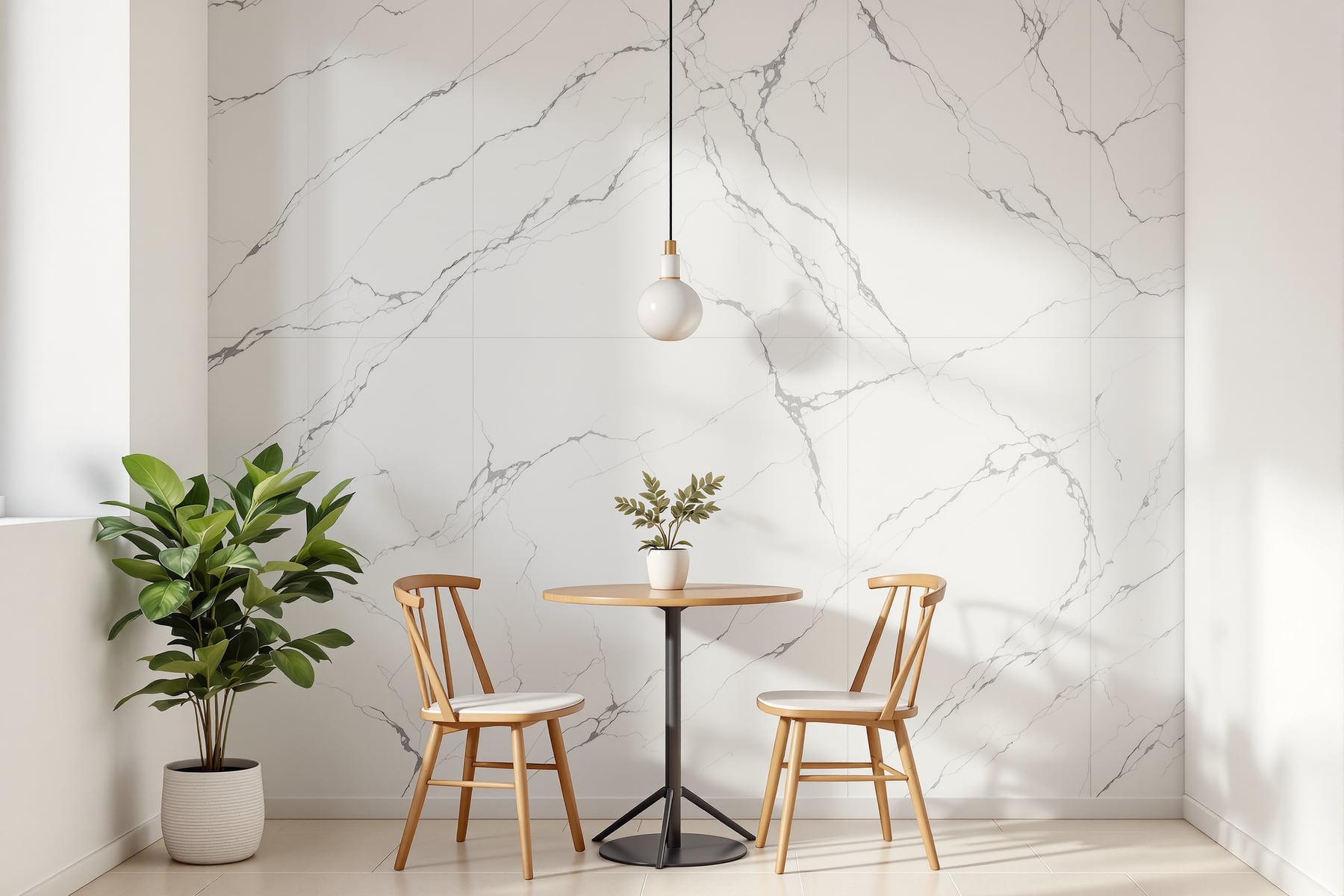
PVC Wall Panels: The Complete Guide for Indian Homes
The cheapest, lightest, fully waterproof cladding — what PVC panels are, the types, how they snap on in an afternoon, where they make sense, and honestly how they compare with WPC.
PVC wall panels are the budget workhorse of the cladding world. They are hollow, lightweight plastic boards — printed to look like marble, wood or a flat colour — that snap or glue onto a wall in an afternoon, cost less than almost any other cladding, and shrug off water completely. They will never be mistaken for solid wood or real stone up close, and they are not the finish for a showpiece living room. But for a false ceiling, a damp utility wall, a rental makeover or any job where budget and speed matter more than luxury, PVC is unbeatable value.
This is the complete guide to PVC wall panels for Indian homes — a deep dive under the wall cladding & panels guide and the master wall-finishes guide. We will explain what PVC panels are, show the types, walk through the quick install, map where they genuinely make sense, and give you an honest PVC-versus-WPC comparison so you know when to spend a little more.
What PVC wall panels are
PVC's strengths and its limits both come straight from what it is: thin, hollow, moulded plastic.
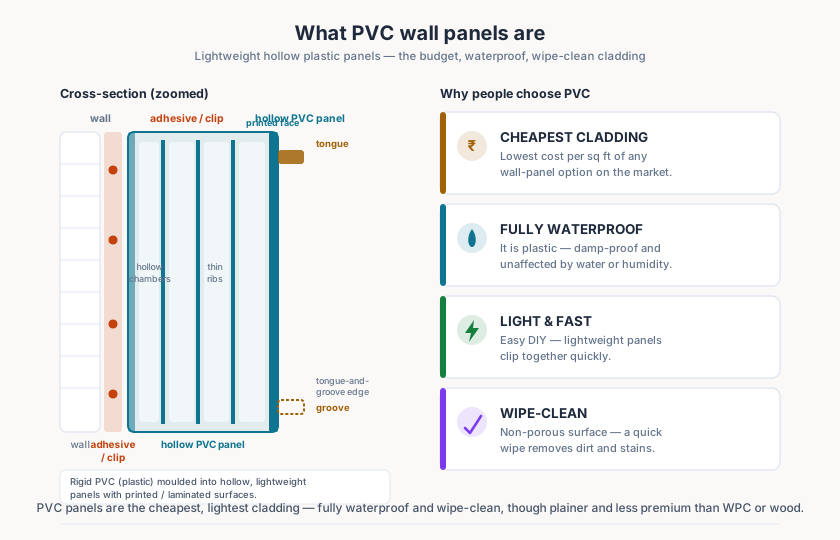
PVC wall panels are rigid PVC (plastic) moulded into hollow, lightweight boards with printed or laminated surfaces and tongue-and-groove edges. That makes them the cheapest cladding per square foot, fully waterproof (plastic simply does not absorb water), light and fast to install (easy enough for a confident DIYer), and wipe-clean (non-porous). The flip side of hollow and light is that they are plainer and less premium than WPC or wood, and they can dent under a knock — trade-offs worth knowing going in.
PVC panel types
PVC comes in a surprisingly wide range of printed looks, which is much of its budget appeal.
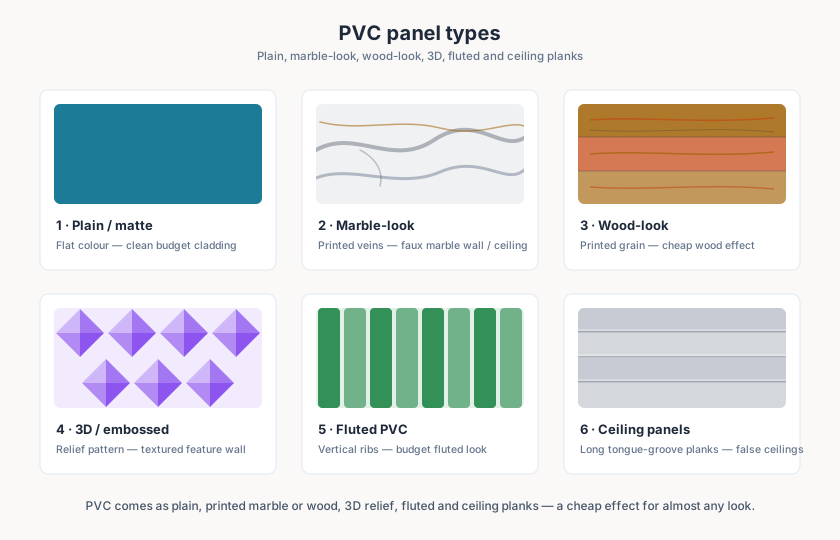
The common types: plain/matte (flat colour for clean budget cladding), marble-look (printed veins for a faux-marble wall or ceiling), wood-look (printed grain for a cheap wood effect), 3D/embossed (relief patterns for a textured feature), fluted PVC (vertical ribs for a budget fluted look), and ceiling panels (long tongue-and-groove planks for false ceilings). It is a cheap way to fake almost any look — just at arm's length rather than up close.
How PVC panels are installed
PVC is the fastest, most DIY-friendly cladding there is — its whole value proposition includes the easy fit.
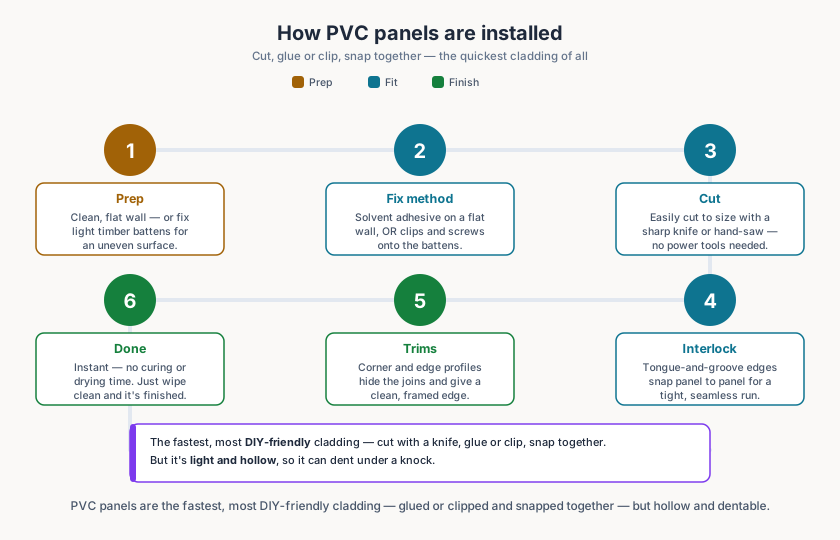
The steps: prep a clean flat wall (or add light battens); choose a fix method — solvent adhesive on a flat wall, or clips and screws on battens; cut the panels easily with a knife or hand-saw; interlock the tongue-and-groove boards so they snap together; add corner and edge trims to hide the joins; and it is done — instant, no curing, wipe-clean. It is genuinely the quickest cladding to fit, though because it is light and hollow it can dent under a hard knock.
Where PVC panels make sense
PVC is a value tool, not a luxury one, and using it in the right place is the whole art.
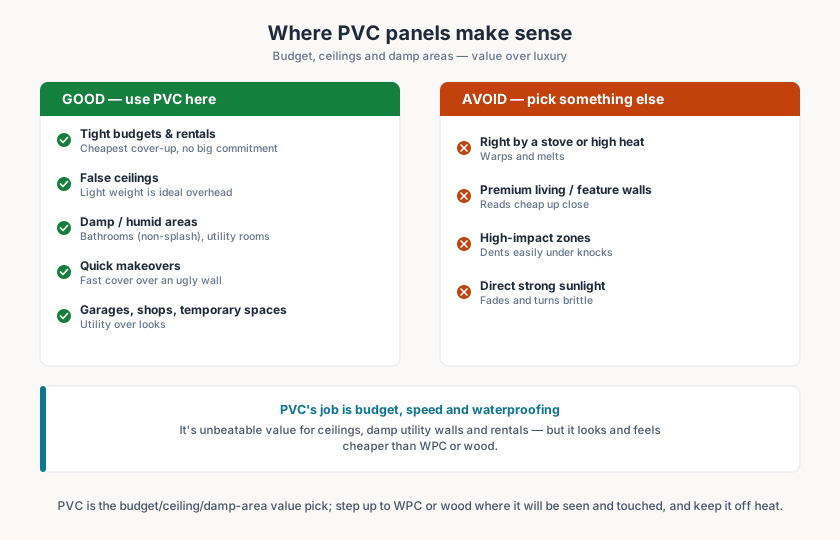
It is a strong choice for tight budgets and rentals, for false ceilings (its light weight is ideal), for damp and humid areas (non-splash bathroom and utility walls), for quick makeovers over an ugly wall, and for garages, shops and temporary spaces. Avoid it right by a stove or high heat (it warps or melts), on premium living and feature walls where it reads cheap up close, in high-impact zones (it dents), and in direct strong sunlight (it fades and grows brittle). Its job, in one line: budget, speed and waterproofing — unbeatable value for ceilings, damp utility walls and rentals, but it looks and feels cheaper than WPC or wood.
PVC versus WPC
PVC and WPC are constantly confused and cross-shopped, so it is worth drawing the line clearly.
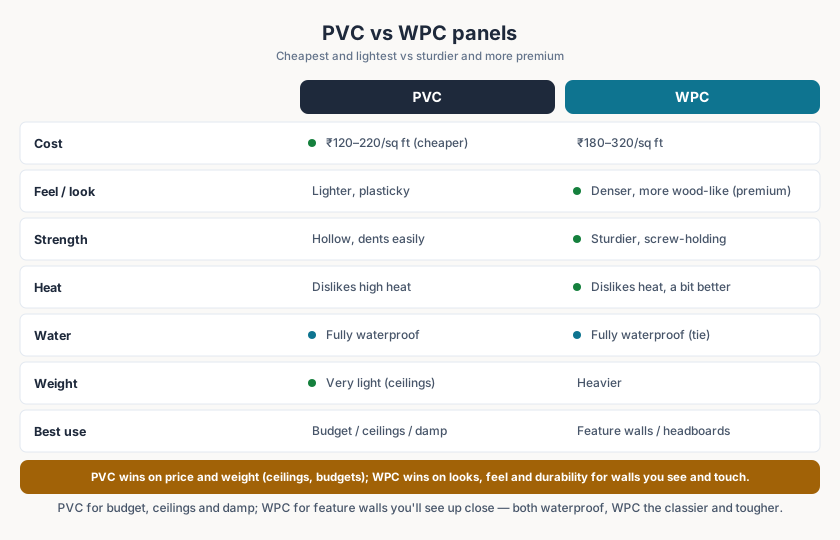
PVC (₹120–220/sq ft) is cheaper and lighter, but plasticky in feel, hollow and easy to dent. WPC (₹180–320) is denser, more wood-like, sturdier (it holds a screw), and altogether more premium. Both are fully waterproof and both dislike high heat (WPC slightly less). PVC's light weight makes it the natural pick for ceilings, damp areas and budgets; WPC is worth the step up for feature walls people see and touch. The rule: PVC for budget, ceilings and damp; WPC for the walls that are on show.
PVC wall panels are the honest budget option — cheap, waterproof, light and quick, and genuinely the right answer for a false ceiling, a damp utility wall or a rental refresh. Just be clear-eyed about where it belongs, keep it off the heat, and step up to WPC or the wider cladding family where the wall deserves more.
Export this guide
Related Guides — Deep-dive reading
PVC Wall Panels for Bathrooms in India: Waterproof Dry-Fix Cladding Over Old Walls
A brand-neutral guide to PVC wall panels and cladding for Indian bathrooms — how they dry-fix over existing tiles, hollow-core vs foam-core, the look vs real tiles, durability and heat limits, ₹/sq ft cost, install and where they beat (and lose to) WPC and tiles.
BathroomsUltimate Guide to Wall Finishes for Indian Homes
Paint, wallpaper, panels, stone, plaster, microcement and more — the whole family of wall finishes, a five-question way to choose, and the real cost, climate and maintenance trade-offs.
Wall FinishesHow to Choose Flooring for an Indian Home: A Step-by-Step Framework (2026)
A decision framework to pick the right floor for any room — weighing traffic, water, comfort, budget, maintenance, look, climate, durability and resale, with the key natural-stone vs tile vs wood vs resilient trade-offs.
Flooring & SurfacesRelated Tools — Try Free
False Ceiling Cost Estimator
Live ₹/sqft across 8 ceiling types — POP, gypsum, designer, metal, PVC, wooden — with cove and spot lighting for 20 Indian cities.
Cost CalculatorBathroom False Ceiling Calculator
False-ceiling area, material and cost for a bathroom across moisture-safe options — PVC, waterproof gypsum, ACP and aluminium grid.
Bathroom CalculatorBathroom Renovation Cost Calculator
Cost to renovate an existing bathroom with a replace-vs-keep model — demolition, re-waterproofing, tiles, fittings and the money saved by keeping items.
Bathroom Calculator