
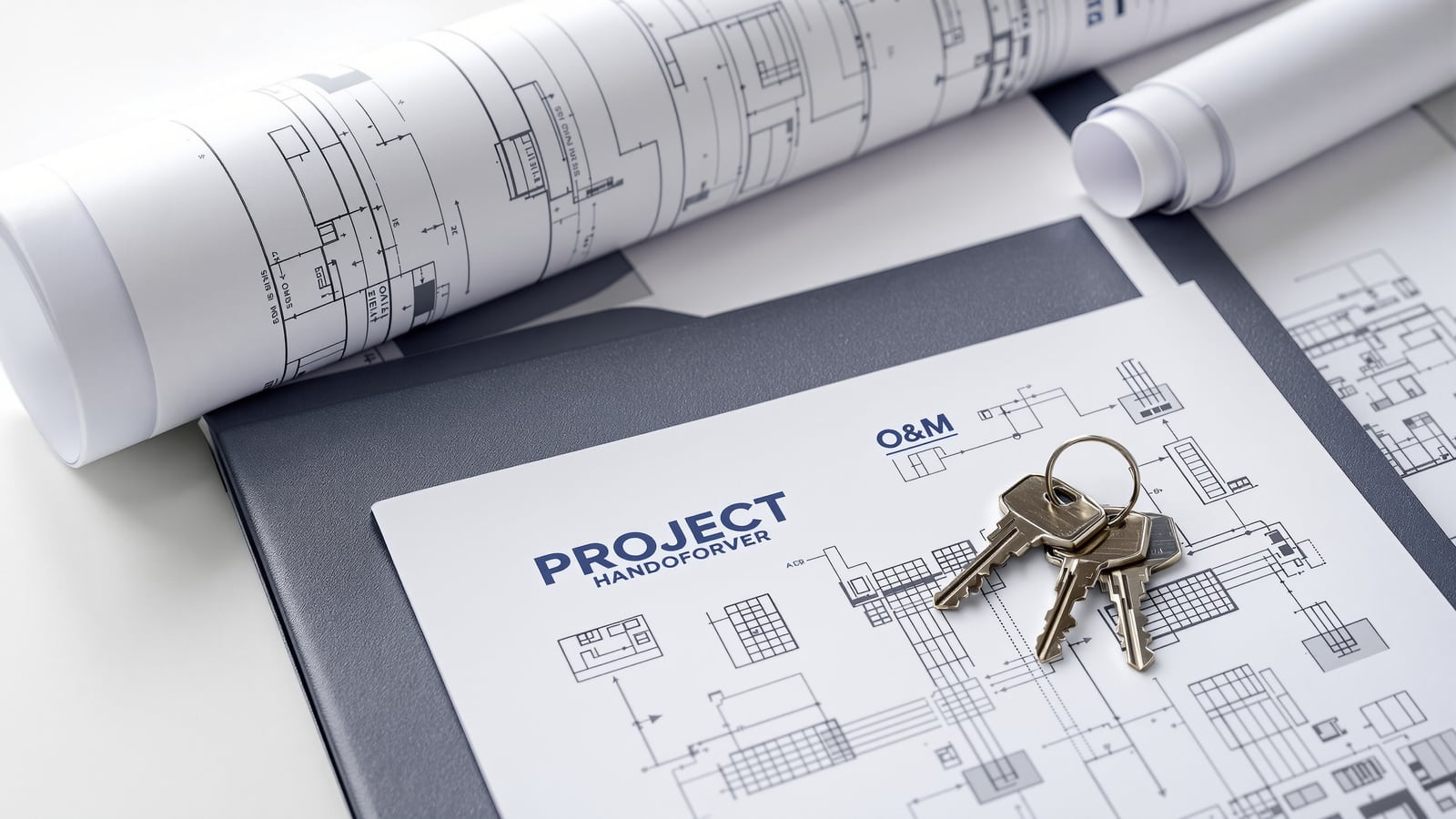
Plumbing Handover Checklist for Indian Buildings: Close-Out Documents & Deliverables
The project close-out toolkit for handing plumbing over to the owner and facility team — as-built drawings, O&M manual, warranties, testing records, spares and the owner walkthrough — as one copyable checklist.
A plumbing installation is only finished when the people who will run it can actually run it. That is what handover is for: the moment the contractor stops being the only person who knows where the isolation valves are, which pump is which, and what to do when the terrace tank overflows. This Studio Matrx guide is a practitioner's plumbing handover checklist — the documents and deliverables you assemble at close-out and physically hand to the owner or facility team, packaged so nobody is guessing at 2 a.m. six months later.
It is a process-and-document guide, not a theory guide. For how the systems themselves work, lean on the technical pillars — this piece is about what leaves your hands and lands in the owner's. It sits inside the Plumbing Professional Resources hub, and pairs with the inspection and testing checklist that generates many of the records you will hand over.
Why handover is a deliverable, not a formality
On most Indian projects, retention money and the final running bill are released against a clean handover — not against "the taps run." A thin handover creates predictable pain: the facility team can't trace a leak because there are no as-built drawings, a warranty lapses because nobody logged the commissioning date, and a pump failure becomes an emergency because the make and model are unknown and no spare impeller exists on site. A complete handover pack converts tacit site knowledge into an asset the building owns.
The test of a good handover: a new facility manager who has never seen the building should be able to isolate any zone, identify every major equipment item, and raise a valid warranty claim — using only the documents in the pack.
Handover is also the boundary where responsibility transfers. Until it is signed off, defects are the contractor's. After, routine operation and maintenance become the owner's — which is exactly why the pack must include the maintenance guidance the facility team will now live by.
The eight deliverables of a plumbing handover
A complete plumbing close-out pack has eight parts. Treat each as a line item you tick, not a vague "documentation" bucket.
1. As-built (red-line) drawings
The single most valuable deliverable. During construction the installed system drifts from the tender drawings — a riser moves to dodge a beam, a valve relocates, a route changes. As-built drawings capture what was actually installed, marked up in red on the construction set (hence "red-line") and then re-issued as a clean final set.
- Water supply layout — sources, tanks, pump room, risers, zone isolation valves.
- Drainage, soil, waste and vent layout — with actual invert routes and cleanout locations.
- Pump room and terrace tank schematics with valve tags.
- Buried and concealed service routes — the ones no one can see later.
2. Operation & maintenance (O&M) manual
The instruction book for the building's water systems: how to operate each system, start-up and shut-down sequences, routine maintenance tasks and frequencies, and troubleshooting notes. Bind it with the technical datasheets so operation and specification live together.
3. Equipment list with make, model & serial
A single register of every major item — pumps, pressure vessels, water heaters, purifiers, pressure-reducing valves, level controllers — with make, model, capacity, serial number and location. This is the spine the warranty log, the spares list and the AMC all reference.
4. Warranties & guarantee cards
Manufacturer warranties for equipment plus the contractor's workmanship guarantee. Each entry needs a start date (usually commissioning or handover), a duration, and the claim contact — a warranty you can't date is a warranty you can't claim.
5. Testing & commissioning (T&C) records
The evidence that the system was pressure-tested, flushed, disinfected and commissioned before handover. These records typically come out of the inspection and testing process; the handover pack simply collates and indexes them.
6. Spare parts & special tools
The physical handover, not just paper: commissioning spares (seals, a spare impeller, gaskets, a set of washers), any special tools the contractor used, and consumables the manufacturer recommends keeping on the shelf.
7. AMC recommendations
A recommended annual maintenance contract scope and schedule per equipment class — so the owner can procure maintenance instead of discovering the need after the first failure.
8. Owner walkthrough & demonstration
The live handover: a physical walk-through where the contractor demonstrates operation, points out every isolation valve and cleanout, and hands the pack over against a signed acknowledgement.
The copy-ready handover checklist
This is the core deliverable of this guide — a checklist organised by the eight deliverables, with what each line contains and who signs it off. Copy it into your close-out register, add project-specific rows, and tick as you go.
| # | Deliverable | What to include | Format | Owner sign-off |
|---|---|---|---|---|
| 1 | As-built (red-line) drawings | Water supply, drainage/soil/vent, pump room, terrace tank, concealed & buried routes — all reflecting actual install | PDF + editable CAD, hard set | Client / PMC |
| 2 | O&M manual | Operating sequences, start/stop, maintenance tasks & frequency, troubleshooting, datasheets | Bound hard copy + PDF | Facility team |
| 3 | Equipment list | Every major item: make, model, capacity, serial, location, warranty ref | Spreadsheet register | Facility team |
| 4 | Warranties & guarantees | Manufacturer warranties + contractor workmanship guarantee, with start date & claim contact | Folder + log sheet | Client |
| 5 | Testing & commissioning records | Pressure test, flushing, disinfection, commissioning sign-offs, snag closure | Signed record sheets | PMC / consultant |
| 6 | Spare parts & tools | Commissioning spares, recommended shelf spares, special tools, consumables | Physical + inventory list | Facility team |
| 7 | AMC recommendation | Suggested scope, frequency and vendor class per equipment | Note / schedule | Client |
| 8 | Owner walkthrough | Live demo, valve & cleanout tour, key handover, acknowledgement | Signed acceptance | Client + facility |
Keep testing figures honest: record the values that were actually witnessed and accepted per the approved specification, and reference NBC 2016 Part 9 and the project spec rather than quoting fixed pressures or durations here — the binding numbers belong on the signed T&C sheets, not in a generic checklist.
The equipment register: the spine of the pack
Warranties, spares and AMC all hang off one register, so build it once and reference it everywhere. A workable structure:
| Tag | Item | Make / model | Capacity | Serial no. | Location | Warranty until | AMC class |
|---|---|---|---|---|---|---|---|
| P-1 | Booster pump | Per approved submittal | Per design | On nameplate | Pump room | Commissioning + term | Annual |
| P-2 | Terrace transfer pump | Per approved submittal | Per design | On nameplate | Terrace | Commissioning + term | Annual |
| WH-1 | Water heater | Per approved submittal | Per design | On nameplate | Utility | Commissioning + term | On-call |
| PRV-1 | Pressure-reducing valve | Per approved submittal | Per design | — | Zone header | Per manufacturer | Inspection only |
Leave the make, model and serial columns to be filled from the actual installed nameplates — never from the tender assumption, because substitutions happen. The register is also what your maintenance guide tasks map onto, and what the AMC vendor prices against.
Sequencing the close-out
Handover is a mini-project of its own. A workable order:
1. Clear the snag list first. Handover is not the place to discover open defects — close them, and log the closure in the T&C records.
2. Assemble as-builts in parallel with commissioning, while the site knowledge is fresh and routes are still verifiable.
3. Populate the equipment register from nameplates, then attach warranties and date them to the commissioning event.
4. Bind the O&M manual around the finalised register and datasheets.
5. Stage the spares and tools physically, checked against the inventory list.
6. Run the walkthrough last, and only sign acceptance once the pack is complete — the signature is the boundary of responsibility.
For AMC and running-cost planning, point the owner at the maintenance guide; for the wider service picture and coordination context, the building plumbing services guide sets the frame. Any indicative rupee figures the owner asks for — a pump AMC in the ₹8,000 to ₹25,000 a year range, say — should be flagged as market-dependent and left to current rates, not fixed in the handover pack.
Copy-ready recap
Lift this straight onto your next close-out:
- As-built (red-line) drawings — water, drainage, pump room, concealed & buried routes; PDF + CAD + hard set.
- O&M manual — operate, maintain, troubleshoot; bound with datasheets.
- Equipment register — every major item with make, model, capacity, serial, location; the spine of the pack.
- Warranties & guarantees — manufacturer + workmanship, each dated to commissioning with a claim contact.
- Testing & commissioning records — pressure, flushing, disinfection, commissioning; witnessed and signed per the approved spec and NBC 2016 Part 9.
- Spares & special tools — commissioning and recommended shelf spares, staged and inventoried.
- AMC recommendation — scope and frequency per equipment class.
- Owner walkthrough — live demo, valve and cleanout tour, keys handed over, acceptance signed.
Hand over the knowledge, not just the pipes — and get the signature that says you did.
Export this guide
Related Guides — Deep-dive reading
Plumbing Inspection Checklist for Indian Sites: Stage Inspections, Pressure & Drainage Testing
A copy-ready plumbing inspection checklist for an Indian project — what to inspect at each stage before concealing or concreting, how supply lines are pressure-tested, how drainage and soil stacks are water/smoke/ball tested, tank and pump commissioning, flushing and disinfection, and the sign-off records that close each activity out.
PlumbingPlumbing Project Documents: The Practitioner's Toolkit (India)
The professional-resources pillar for the /guides/plumbing cluster — every plumbing project document across the lifecycle, who prepares and checks each, how design brief, calculations, drawings, specification, BOQ, schedules, inspection records, as-builts and O&M manuals fit together, and where to find the template for each stage.
PlumbingSTP Final Handover Checklist: Documents, Spares, Training & Defect Liability
The complete handover from contractor to owner: the drawings, O&M manuals, warranties and test reports you must collect, the spares and tools to count, the operator training to insist on, and the defect-liability terms that protect you for the next year.
Sewage Treatment PlantsRelated Tools — Try Free
CCTV Commissioning & Handover Checklist
An interactive go/no-go checklist to run at handover — cameras day and night, recording, alerts, passwords and documents — before you clear the final bill.
Handover ChecklistPlumbing Pressure-Test & Leak Checklist
Pre-closure pressure and leak test — 9 categories, 60+ checkpoints across water supply, drainage, fixtures, waterproofing, hot water, tanks.
Pre-Closure TestMonsoon-Readiness Checklist
Pre-rain home audit across 9 categories — terrace, drains, waterproofing, electrical, HVAC, pest, vehicles, documents.
Seasonal Audit