
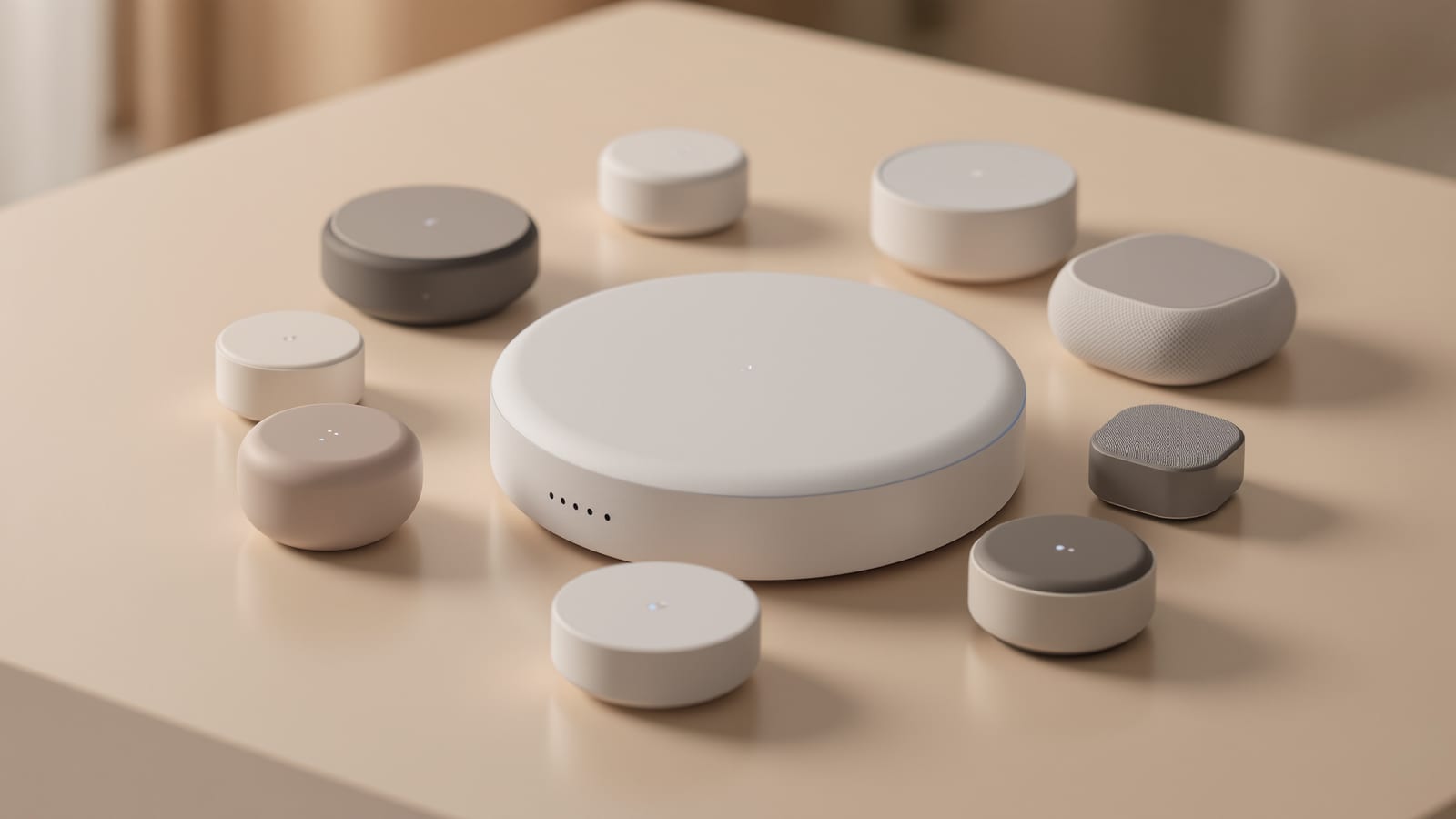
Matter Explained: The Standard Unifying Smart Homes (India Guide)
One app for everything, one device answering to Alexa, Google and Apple at once — that is the promise of Matter. Here is what it actually delivers in India in 2026.
For a decade the smart-home aisle has run on a quiet cruelty: you buy a lovely sensor, bring it home, and discover it works with Google but not Apple, or needs its own app that does not talk to the app running the rest of your house. Every brand built its own island. Matter is the industry's attempt to build bridges between those islands — a single standard, backed by Apple, Google, Amazon, Samsung and hundreds of others, that lets a device from any brand be understood by any platform. This guide explains what Matter is, how it actually works, and — honestly — how much of the promise it delivers in India in 2026.
If you have already read our Matter vs Zigbee comparison, this is the deeper companion to it: that guide untangles the layer confusion; this one is the full tour of Matter itself. Keep the smart home protocols guide and the ultimate guide to smart homes in India open alongside for the wider map.
Matter's promise is not a new gadget — it is the end of asking "will this work with my system?" every time you buy one. Judge it by that yardstick, not by hype.
Why Matter exists: the fragmentation problem
Before Matter, the smart home was a tower of Babel. Zigbee devices needed a Zigbee hub; Z-Wave needed a Z-Wave one; Wi-Fi gadgets each phoned home to a different cloud; and the phone apps for Apple HomeKit, Google Home and Amazon Alexa each supported a different subset of devices. A bulb might work with two of them and not the third. A sensor might need a bridge from one brand that refused to talk to another. Households with mixed phones — an iPhone here, an Android there — were forever hitting walls.
This fragmentation was not an accident; it was the natural result of every big platform wanting its own ecosystem. But it made shopping miserable and stranded people's investments whenever they switched phones or platforms. In 2019 the major players — under the Connectivity Standards Alliance (CSA) — agreed to fix it together. The result, launched in late 2022 and maturing since, is Matter: a common language every certified device and every major platform agrees to speak.
What Matter actually is: an application layer
The single most important thing to understand is that Matter is not a radio. It does not replace Wi-Fi, Zigbee or Bluetooth. Matter is an application-layer standard — it defines a shared data model and command set, so that "a light", "a lock" or "a thermostat" means the same thing to every app. It rides on top of existing IP transports rather than inventing a new one.
Matter runs over three transports:
| Transport | Best for | Notes |
|---|---|---|
| Wi-Fi | Mains-powered, higher-bandwidth devices — plugs, cameras, TVs | Uses your existing home Wi-Fi |
| Ethernet | Fixed devices — bridges, controllers, wired hubs | Wired reliability |
| Thread | Battery devices — locks, sensors, small bulbs | Low-power self-healing IP mesh |
Bluetooth is used only briefly, for the initial setup handshake when you commission a device. After that, the device settles onto Wi-Fi, Ethernet or Thread for its normal life. Because all three are IP networks, a Matter device gets a proper network identity and can be spoken to locally, on your own network, without a mandatory trip through a vendor's cloud — a genuine reliability and privacy gain we explore in local vs cloud smart home in India.
The architecture below shows Matter sitting above the transports, with the three big platforms all reading the same shared model.
Thread and border routers
Thread deserves its own note because it is the piece most people find confusing. Thread is a low-power, self-healing mesh network — similar in spirit to Zigbee, but with one crucial difference: Thread devices carry IP addresses, so Matter can talk to them directly. It is ideal for battery devices that must sip power: door locks, contact sensors, small bulbs.
But a Thread mesh needs an on-ramp to the rest of your home network, and that is the job of a Thread Border Router. This is a mains-powered device that bridges the Thread mesh to your Wi-Fi/Ethernet, so your phone and platforms can reach Thread devices. The convenient part for Indian buyers: you probably already own one without realising. Recent Apple HomePod and Apple TV 4K, several Amazon Echo models, and Google Nest Hub units act as Thread border routers. Having two or three of them scattered around the house actually strengthens the mesh. The Alexa vs Google vs Apple comparison covers which hubs double as border routers.
Multi-admin: one device in Alexa AND Apple at once
Here is the feature that best captures why Matter is different. In the old world a device belonged to one ecosystem. With Matter's multi-admin capability, a single physical device can be shared into several platforms simultaneously. The same smart plug can appear in Apple Home for one family member, Google Home for another, and Alexa for voice control — all controlling the one device, all seeing its live state.
This is transformative for real Indian households, which are rarely single-brand. One person has an iPhone, another an Android, the drawing room has an Echo, the study has a Nest. Multi-admin means you stop forcing everyone onto one app. You commission the device once, then share it into each platform with a code. No more "sorry, that light only works on my phone."
| Old world (pre-Matter) | With Matter multi-admin |
|---|---|
| Device belongs to one ecosystem | Device shared into several at once |
| Mixed-phone homes hit walls | iPhone + Android + Echo all control it |
| Switching platform = re-buy or strand devices | Add a new platform without losing devices |
| Each app supports a different device list | One certified device works across all |
What "Matter certified" means
When you see the Matter logo on a box, it means the device passed the CSA's certification testing and is registered in a distributed compliance ledger. Certification is not a vague promise — it verifies the device implements the Matter data model correctly and will interoperate with any Matter controller. Practically, "Matter certified" is your assurance that the device will join Apple, Google, Amazon and Samsung platforms without a brand-specific bridge.
A caution worth stating: watch for "Works with Matter via a hub" versus natively certified. Some products need a manufacturer bridge to speak Matter, while others are Matter-native out of the box. Both are legitimate, but they set up differently — the native device pairs straight into your platform, while the bridged one comes in through its hub. Neither is wrong; just know which you are buying.
Bringing older Zigbee and Z-Wave devices in
Matter did not orphan the huge installed base of Zigbee and Z-Wave gear, and this matters enormously in India where affordable Zigbee devices dominate. The mechanism is bridging: a hub that speaks Zigbee (or Z-Wave) on one side re-presents those devices to your home as standard Matter devices on the other. Aqara, SmartThings, Hubitat and Philips Hue hubs increasingly offer a Matter bridge, so a whole existing Zigbee mesh can be lifted into Matter at once — no re-buying every sensor.
The consequence is a sensible buying strategy: keep buying inexpensive Zigbee devices, but choose a hub that bridges them into Matter, and layer native Matter-over-Thread devices on top over time. For the layer mechanics behind this, Matter vs Zigbee is the detailed companion. The diagram below shows how brands from different ecosystems all converge into one Matter home through native support and bridging.
Does Matter deliver on the promise yet? An honest read
This is where honesty matters more than enthusiasm. Matter's core promise — a certified device joining any platform, multi-admin sharing, local control — genuinely works in 2026, and it works well for the mainstream device types: lights, plugs, switches, sensors, locks and thermostats. If your needs sit in that mainstream, Matter delivers.
But it is still maturing, and there are real caveats:
- Feature exposure gaps. Matter surfaces a device's standard capabilities, but a manufacturer's fancier extras — a bulb's special effects, a lock's granular access logs — may still only appear in that brand's own app. Basics come through Matter; niche features sometimes do not.
- Device-type coverage is still expanding. Cameras, robot vacuums and some appliance categories were added later and support is uneven across platforms. Check that your specific platform supports that specific device type before buying.
- Setup can still be fiddly. Commissioning, Thread credential sharing and multi-admin codes occasionally need patience, especially across brands.
So the fair verdict: Matter delivers reliably as the common denominator for mainstream devices, and it is the right foundation to build on — but it is not yet a place where every advanced feature of every device lives. Treat it as the dependable base layer, and keep the manufacturer app around for the extras.
Buying advice: should you wait for Matter?
The most common question is whether to pause purchases and wait for Matter to "arrive". The answer for India in 2026 is: do not wait — buy Matter-ready, but keep buying.
- Buy Matter-capable controllers and hubs now. Insist that any new hub, speaker or bridge supports Matter and, ideally, acts as a Thread border router. This is the future-proofing decision that matters most.
- Keep buying affordable Zigbee devices, but through a bridging hub, so they appear as Matter devices. You get today's low prices and tomorrow's interoperability.
- Add native Matter-over-Thread devices for new battery sensors and locks as their prices settle.
- Do not rip out working gear to chase a Matter logo. Bridge what you own; go native on what you add.
Model this mixed approach in the smart home cost calculator to see how bridging existing Zigbee compares with going all-native today — the bridged path is usually markedly cheaper.
India availability in 2026
The pieces are arriving in a sensible order for India. Controllers and border routers are here: recent Amazon Echo, Google Nest and Apple HomePod / Apple TV units act as Matter controllers, and several double as Thread border routers. Zigbee is everywhere — Aqara, Xiaomi, Philips Hue, Wipro, Havells and more — which is exactly why bridging is the pragmatic route for most Indian homes. Native Matter device selection is growing but still narrower and often pricier than equivalent Zigbee hardware, so paying an early-adopter premium for a native-only setup rarely makes sense yet.
The takeaway is steady rather than dramatic: Matter is real, it works for the mainstream, and it is the right foundation for a new build or a serious upgrade in India. Build on Matter-capable controllers, bridge your affordable Zigbee gear in, and add native devices as the market fills out. For the platform choice that sits above all this, read Alexa vs Google vs Apple in India, and set the whole plan in the context of the smart home networking guide.
References
- Connectivity Standards Alliance — Matter — the official Matter standard, certification programme and device categories.
- Connectivity Standards Alliance — Build with Matter — the Matter data model, bridge device type and multi-admin specification.
- Thread Group — the Thread low-power IP mesh and the border-router concept underpinning Matter-over-Thread.
- Connectivity Standards Alliance — Certified Products — the searchable directory of Matter-certified devices to verify a product's certification.
- Bureau of Indian Standards (BIS) — Indian standards and safety norms relevant to imported smart-home electronics.
Export this guide
Related Guides — Deep-dive reading
Alexa vs Google Home vs Apple Home in India: Which Ecosystem?
An honest, India-first comparison of the three smart-home ecosystems — cost, Indian-language support, privacy, automation and lock-in — plus how Matter quietly changes the whole decision.
Smart HomeMatter vs Zigbee: What's the Difference (and Do You Need Both)?
Untangling the most common smart-home mix-up in India — one is a language for apps, the other is a radio for devices, and they are not rivals.
Smart HomeHow to Choose a Security System (2026): The Master Buying Guide for Indian Homes and Buildings
The mental model that ties the whole buying decision together: start from your own risk, not a product; build the layers your situation actually needs; make the big architecture choices (wired vs wireless, local vs cloud, DIY vs professional); tell real product quality from marketing; and choose a vendor you can trust.
SecurityRelated Tools — Try Free
Smart Home Cost Calculator
13 device categories across 5 ecosystems (Apple HomeKit, Alexa, Google Home, Mi, Wipro). Live floor-plan that lights up as you add devices, per-room and per-category breakdown.
Smart Home CalculatorSmart Home Ecosystem Selector
Answer 5 questions and get a ranked recommendation for the smart-home ecosystem that fits your Indian household — Amazon Alexa, Google Home, Apple Home, Samsung SmartThings, or Home Assistant — with pros, caveats and a rough starter cost.
SelectorSmart Curtain Compatibility Checker
Check whether a motorised curtain will work with Alexa, Google, Apple Home, SmartThings or Home Assistant — and what you need.
Checker