
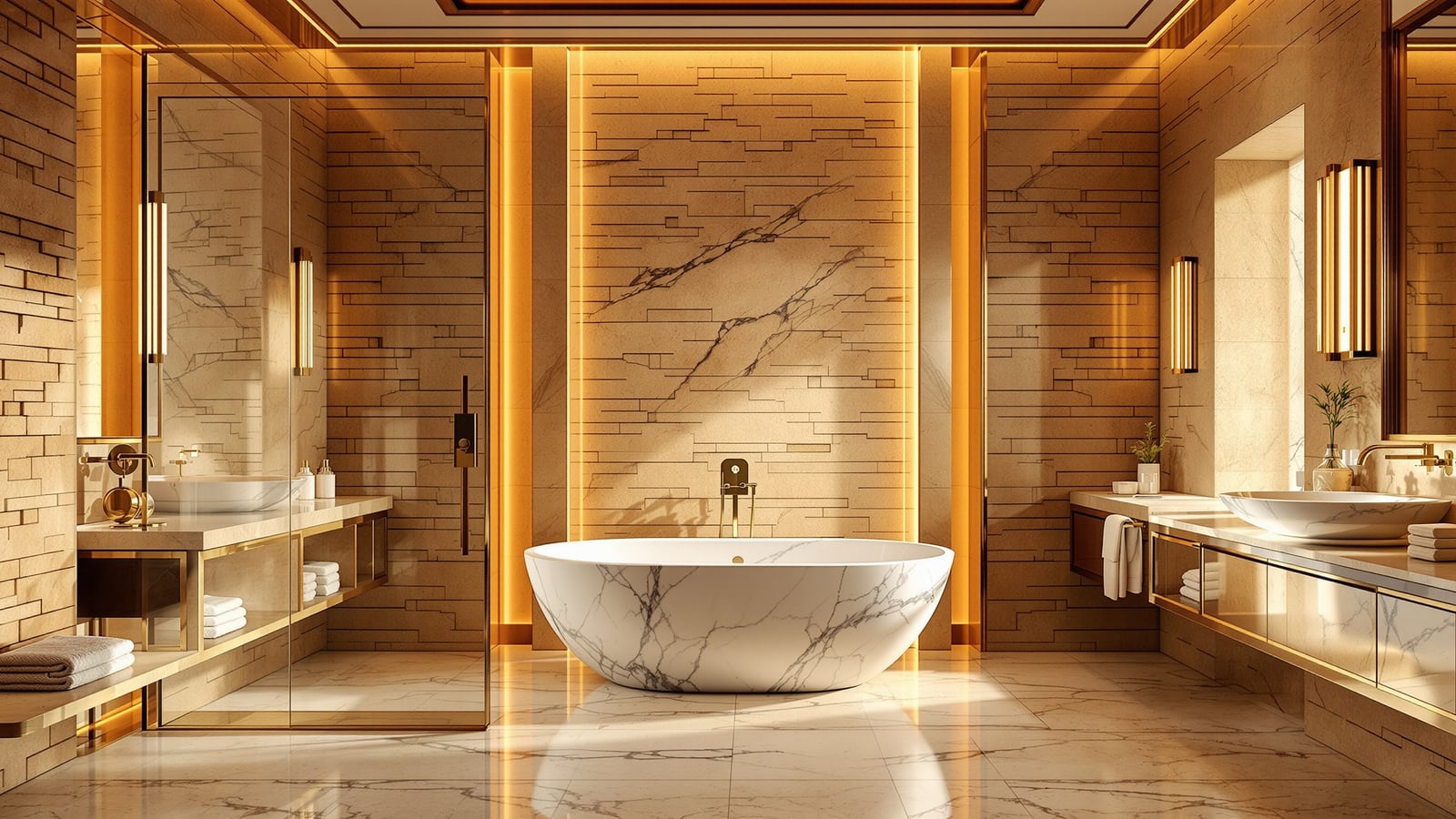
Luxury Bathroom Cost in India (2026): Per-Item Prices & ₹8–40 Lakh Ranges
What a genuinely luxurious spa bathroom costs in India — the rupee line items that drive premium spend, a per-item premium table, honest ₹8 lakh to ₹40 lakh-plus per-bathroom ranges, and where the money actually goes.
A luxury bathroom in India can cost anywhere from ₹8 lakh to ₹40 lakh and beyond for a single room — a ten-times spread that confuses almost everyone pricing one for the first time. The confusion is fair, because "luxury" is not one specification. It is a stack of choices — imported stone instead of ceramic, a freestanding tub instead of a shower, a smart WC instead of a floor-mounted one — and each choice adds a knowable rupee premium on top of a normal bathroom. This guide breaks that stack down item by item so you can see exactly where a luxury budget goes, and build your own number from the parts.
This is a cost companion to two design guides worth reading alongside it: the luxury bathroom design guide for India, which covers how to plan the room, and the spa bathroom design guide for the wellness detail. For the ground-up numbers a standard bathroom starts from, see the cost pillar, the bathroom construction cost guide for India. Prices here are indicative for 2026, at the premium end of the market — always get local quotes, because city, brand and imported content move every figure.
Luxury cost is not one price. It is a normal bathroom plus a series of deliberate upgrades, each with its own rupee premium. Price the upgrades, not the mystique.
Where the money actually goes
Start with the shape of the spend. In a standard ₹2–4 lakh bathroom, tiling, plumbing and basic sanitaryware dominate. In a luxury bathroom the proportions shift hard toward stone, the tub-or-steam centrepiece, premium brassware and automation — the four categories that separate a spa bathroom from a nice one. Labour and waterproofing stay roughly constant in rupees but shrink as a share, because the finishes above them balloon.
The lesson from that split is that the money follows the surfaces you see and touch every day. So the smart way to read the rest of this guide is item by item: decide which premiums you genuinely want, and the total builds itself.
The per-item luxury premium table
This is the heart of the guide. For each feature that defines a luxury bathroom, the table shows a realistic standard price, the luxury price, and the premium — the extra rupees the upgrade actually costs over a decent normal fitting. Read down it and tick the ones you want.
| Luxury item | Standard version (₹) | Luxury version (₹) | The premium you pay |
|---|---|---|---|
| Floor + wall stone / tile | 80,000–1,50,000 (ceramic) | 3,00,000–10,00,000 (imported marble) | 2,00,000–8,50,000 |
| Freestanding / soaking tub | not fitted | 1,20,000–6,00,000 | full item |
| Steam shower + generator | not fitted | 1,50,000–4,50,000 | full item |
| Body jets + rain + thermostatic | 15,000–40,000 (mixer) | 1,20,000–5,00,000 | 90,000–4,60,000 |
| Smart WC / bidet | 12,000–25,000 (floor WC) | 90,000–3,50,000 | 70,000–3,25,000 |
| Designer CP + brassware (PVD, brass, matte black) | 30,000–60,000 | 1,50,000–4,00,000 | 1,00,000–3,40,000 |
| Underfloor heating | not fitted | 60,000–2,00,000 | full item |
| Custom vanity + solid surface top | 40,000–90,000 | 2,00,000–6,00,000 | 1,10,000–5,10,000 |
| Backlit mirror + mood / scene lighting | 20,000–50,000 | 1,20,000–4,00,000 | 70,000–3,50,000 |
| Water softener / treatment | not fitted | 40,000–1,50,000 | full item |
A few numbers deserve a note. Imported marble — Statuario, Michelangelo, Botticino — is the single biggest swing item, because it is priced per square foot and a master bath has a lot of surface; book-matched slabs and skilled fixing push it higher still. The freestanding tub and steam shower are "full item" premiums because a standard bathroom simply does not have them — they are pure additions. And designer CP hides a trap: the same-looking brass or matte-black tap can cost ₹8,000 or ₹80,000 depending on whether the finish is genuine PVD coating that survives hard water, or cheap electroplating that pits in a year.
Budget, standard and ultra-luxury tiers
Not every luxury bathroom aims for the same ceiling. Most fall into three tiers. The table below shows a full per-bathroom total for each, so you can locate your ambition and your wallet on the same map.
| Element | Entry luxury (₹) | Mid luxury (₹) | Ultra luxury (₹) |
|---|---|---|---|
| Stone / tiling | 1,50,000 | 3,50,000 | 9,00,000 |
| Sanitaryware + CP | 1,20,000 | 2,80,000 | 7,50,000 |
| Tub / steam / shower system | 1,00,000 | 3,20,000 | 9,00,000 |
| Vanity + joinery | 90,000 | 2,20,000 | 5,50,000 |
| Lighting + automation | 80,000 | 1,80,000 | 5,00,000 |
| Waterproofing + civil + labour | 1,00,000 | 1,60,000 | 3,00,000 |
| Design + PM + contingency | 60,000 | 1,90,000 | 4,00,000 |
| Indicative total | ₹7,00,000–9,00,000 | ₹16,00,000–20,00,000 | ₹40,00,000–45,00,000+ |
- Entry luxury (₹7–9 lakh). One statement material (a marble feature wall, ceramic elsewhere), a good rain-and-thermostatic shower, quality PVD brassware, a backlit mirror and a smart-seat WC. No tub, no steam. Reads unmistakably premium without the wellness centrepiece.
- Mid luxury (₹16–20 lakh). A freestanding tub or a steam wet room, imported stone on the key walls, a full designer CP suite, custom vanity, layered scene lighting and a smart WC. This is where most genuine luxury master baths in metro homes land.
- Ultra luxury (₹40 lakh-plus). Book-matched imported marble throughout, steam plus a soaking tub, body jets, complete automation, underfloor heating, and bespoke joinery. Villa-scale, and effectively uncapped at the top.
What drives the cost up or down
Two identical-size bathrooms can differ by ₹15 lakh. These are the levers, roughly in order of impact:
- Imported vs domestic stone. Italian marble can cost 3–6 times Indian granite or engineered quartz per square foot, and a master bath is large. This single choice moves a budget more than any other.
- The wellness centrepiece. A steam wet room or freestanding tub adds ₹1.5–6 lakh outright, plus the plumbing, drainage and waterproofing to support it. Skipping it is the fastest way to halve a luxury budget.
- Brand tier of CP and sanitaryware. Domestic premium (Jaquar, Cera, Hindware Italian Collection) versus imported (Kohler, Grohe, Hansgrohe, Duravit, TOTO) can double the fittings line.
- Concealed vs exposed plumbing. Concealed cisterns, in-wall thermostatic valves and hidden pipe runs cost more in fittings and labour than exposed equivalents — but define the clean luxury look.
- City and labour rate. Skilled stone-fixing and CP-installation labour in Mumbai, Delhi and Bengaluru runs well above tier-2 and tier-3 towns; metro projects also carry higher designer and PM fees.
- Automation depth. A smart seat is ₹15,000; a full digital-shower, sensor-tap, scene-lighting and underfloor-heating package is ₹3–5 lakh.
A worked ultra-luxury example
Take a generous 60 sq ft (roughly 6 x 10 ft) villa master bath at the mid-to-upper luxury level, in a metro. A realistic build-up:
- Imported marble feature wall + large-format porcelain floor and remaining walls: ₹4,20,000
- Freestanding acrylic soaking tub + floor-mounted spout: ₹2,40,000
- Steam wet room with generator, glass and drainage: ₹2,80,000
- Designer CP suite (rain head, hand shower, thermostatic, body jets, basin mixers) in PVD finish: ₹3,10,000
- Smart WC with bidet, plus a wall-hung basin and concealed cistern: ₹1,80,000
- Custom vanity with solid-surface top and backlit mirror: ₹2,50,000
- Underfloor heating, scene lighting and automation: ₹2,20,000
- Waterproofing, tanking, civil, plumbing and labour: ₹2,60,000
- Water softener, design fee, PM and contingency: ₹2,40,000
- Indicative total: ₹24,00,000 (about ₹40,000 per sq ft)
Change three lines — Indian stone instead of imported, drop the steam, domestic CP instead of imported — and the same room lands near ₹12–13 lakh. The room is identical; the specification stack is not.
The biggest luxe-per-rupee wins
Some upgrades deliver far more perceived luxury than they cost. If the budget is finite, spend here first:
- A backlit mirror and layered scene lighting (₹1–2 lakh). Nothing transforms the feel of a bathroom faster than good light, and it is cheap relative to stone or a tub.
- A thermostatic shower valve (₹25,000–60,000). Water at exactly the right temperature, every time, is a daily luxury you feel — far more than an occasional soak.
- One imported-marble feature wall, ceramic or porcelain elsewhere. You capture the drama of natural stone at a fraction of a fully-clad room.
- A smart-seat / bidet WC (₹70,000–1,20,000). High daily use, distinctly premium, and modest against the tub-and-steam line items.
- A water softener (₹40,000–1,50,000). Unglamorous, but it protects every chrome, glass and stone surface in the room, so the luxury still looks luxurious in five years.
The features you touch every morning — the light, the shower temperature, the seat — return more luxury per rupee than the ones you use occasionally. Fund the daily ritual before the showpiece.
How to spend less without it feeling cheap
- Concentrate, do not spread. One superbly finished luxury bathroom beats two half-luxury ones. Give the master bath the marble and the tub; keep the others clean and mid-range.
- Swap imported for engineered. Large-format porcelain and quartz give the seamless, near-stone look at a fraction of imported-marble cost, with better stain resistance.
- Buy the finish that lasts, not the logo. Genuine PVD-coated domestic CP outperforms cheap imported-look plating; you are paying for the coating, not the brand.
- Skip the tub if you shower. The freestanding tub is the most expensive item that gets the least use in most Indian homes. A beautiful wet room often delivers more daily luxury for less.
- Never value-engineer the invisible layers. Waterproofing, tanking, drainage falls and service access are the cheapest insurance in the room. Cutting them is the one saving that turns luxury into an expensive repair.
For the calculator-style build-up of a base bathroom that these premiums sit on top of, work from the bathroom construction cost guide, then layer the design decisions from the luxury bathroom design guide and the spa bathroom design guide.
The honest bottom line
A luxury bathroom in India is priced by its specification stack, not by a single luxury number. Entry luxury sits around ₹7–9 lakh, mid luxury around ₹16–20 lakh, and ultra luxury from ₹40 lakh upward. Decide which premiums — imported stone, a tub, steam, designer CP, automation — you genuinely value, concentrate the spend on one exceptional room, and fund the light, the shower valve and the waterproofing before the showpiece. All figures are indicative for 2026 and move with city, brand and imported content, so treat them as a map and get local quotes before you commit.
References
- National Building Code of India (NBC 2016), Bureau of Indian Standards — Part 9 Plumbing Services and bathroom space provisions.
- IS 2556: Vitreous China Sanitary Appliances — specification for WCs and basins, Bureau of Indian Standards.
- IS 15622: Pressed Ceramic Tiles — classification and specification, Bureau of Indian Standards.
- IS 1172: Code of Basic Requirements for Water Supply, Drainage and Sanitation, Bureau of Indian Standards.
- CPWD Delhi Schedule of Rates (DSR) and plinth-area rates — indicative labour and finishing-rate context for premium interior work.
- Market pricing surveyed from Indian premium sanitaryware and CP brands (Jaquar, Cera, Hindware, Kohler, Grohe, Hansgrohe, Duravit, TOTO) and natural-stone suppliers, 2026 indicative retail ranges.
Export this guide
Related Guides — Deep-dive reading
Luxury Bathroom Design India: Spa Bathrooms, Wellness & Automation
A grounded guide to designing a genuinely luxurious bathroom in India — spa and wellness zones, natural stone and premium fittings, layered lighting, automation and long-life engineering — with real per-bathroom rupee budgets from ₹8 lakh to ₹40 lakh and up.
BathroomsThe Design Decisions With the Biggest Cost Consequences
A cost-leverage map of Indian home interiors — the handful of decisions that swing your total budget the most, so you spend your attention where a single choice has an outsized rupee impact.
Cost & MoneyBathroom Faucets India: The Complete Guide to Taps, Cartridges, Finishes & Flow (2026)
Every faucet type explained for Indian bathrooms — pillar taps, basin mixers, single-lever vs two-handle, wall vs deck vs concealed, sensor and thermostatic — plus the ceramic-disc cartridge that survives hard water, CP-fitting quality to IS standards, finishes, aerators and honest rupee ranges.
BathroomsRelated Tools — Try Free
Material Schedule Generator
Generate a room-wise finish schedule — walls, floors, ceilings, trim, and joinery by location.
Material ScheduleFalse Ceiling Cost Estimator
Live ₹/sqft across 8 ceiling types — POP, gypsum, designer, metal, PVC, wooden — with cove and spot lighting for 20 Indian cities.
Cost CalculatorBathroom Cost Calculator
Estimate the all-in cost of building or renovating a bathroom — by size, quality tier and city, with a category-wise breakdown.
Bathroom Calculator