
Curtains vs Zebra Blinds: Day-Night in One vs Layered (India 2026)
Zebra blinds give stepless day-night control from a single compact fitting; curtains give true blackout, night privacy, softness and quiet. Here is which wins for each room, what each costs in India, the night-privacy catch, and the combo that beats both.
These are the two treatments most Indian homeowners actually choose between today. Zebra blinds are the new default in urban apartments: compact, modern, and clever enough to swing from clear glass to a privacy screen with one pull. Curtains are the long-standing answer: soft, warm, and the only thing that truly blacks out a bedroom and hides you after dark. They are not really competitors so much as two different tools, and picking the wrong one for a room is the most common window mistake people make. This guide compares them honestly — job by job, room by room, rupee by rupee — and ends with the setup that quietly beats either one on its own.
A zebra blind does day-and-evening light control in one slim fitting. A curtain does darkness, night privacy, softness and quiet. The smartest Indian homes do not choose — they put a zebra blind on the glass and a dress curtain in front of it.
The one-line difference
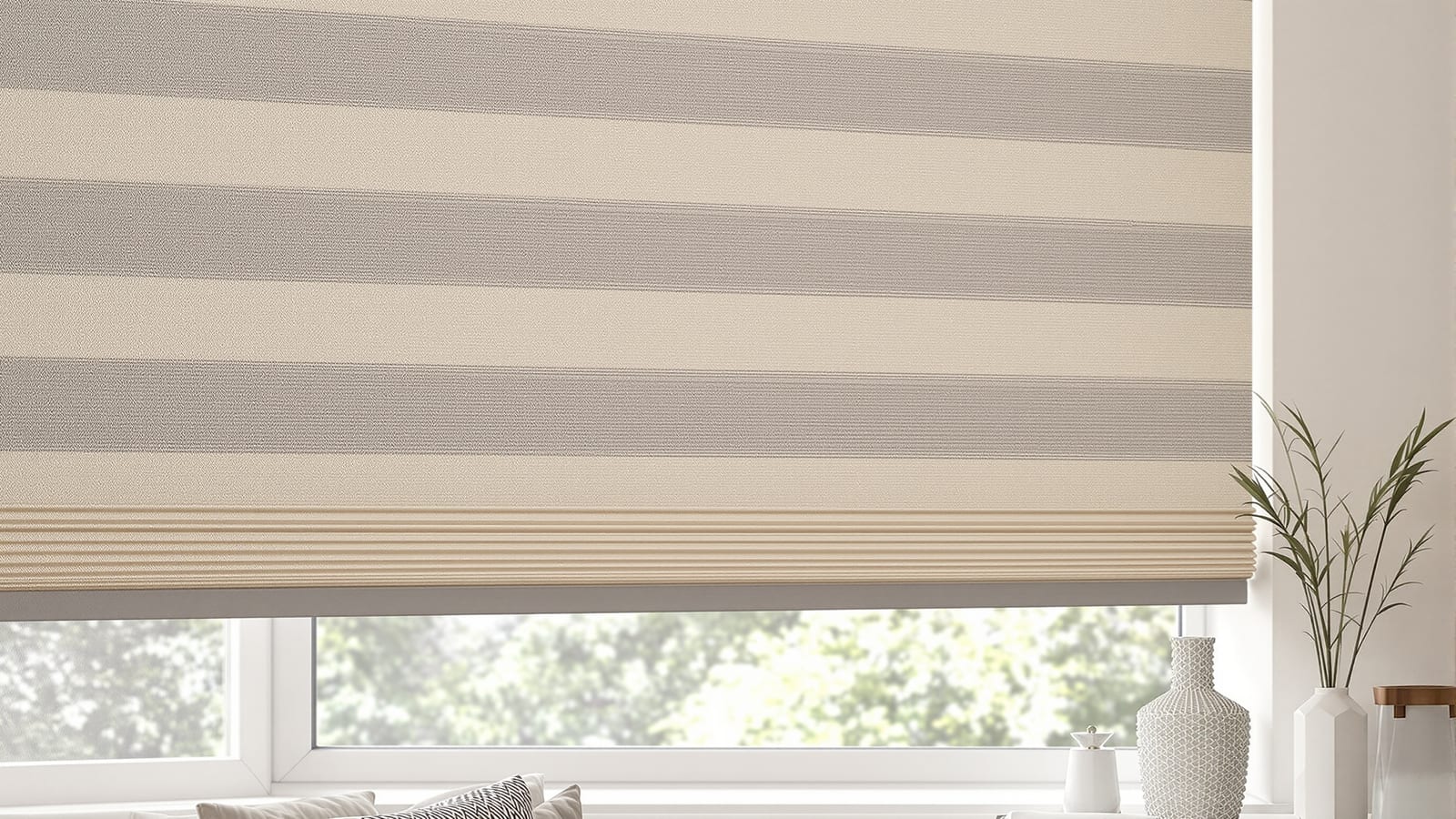
A zebra blind is two roller blinds printed onto one fabric loop — alternating sheer and solid bands that you slide into or out of line for stepless light, all from a tube at the top of the window. A curtain is fabric on a track or rod that you draw across the window, available in everything from gauzy sheer to total blackout.
The honest split: zebra blinds win on modern looks, compactness and stepless daytime control; curtains win on darkness, night privacy, softness and acoustics. Everything below is the detail behind that sentence.
Head to head
| What matters | Zebra blinds | Curtains |
|---|---|---|
| Daytime light control | Excellent, stepless dimmer | Good, but two states (open/drawn) |
| True blackout for sleep | No — light leaks at band joins and edges | Yes, with a blackout fabric and overlap |
| Night privacy | Lost through sheer bands if opened for light | Total when drawn |
| Look | Clean, minimal, modern lines | Soft, warm, can be grand or casual |
| Acoustics / softening noise | Minimal | Heavy, full curtains genuinely soften sound |
| Compactness | Very slim, sits in the recess | Needs stack space and track depth |
| Heat control | Decent on the glass | Strong with lined or thermal fabric |
| Cleaning | Wipe or light vacuum, no washing | Periodic vacuum, occasional wash or dry-clean |
| Indicative cost (avg window) | around 2,000 to 7,000 manual | around 1,500 to 8,000+ depending on fabric and pleat |
Where zebra blinds win
Zebra blinds suit how new Indian flats are built and lived in:
- Stepless daytime dimmer. Most windows need bright filtered light by day and a screen by evening. A zebra blind dials any blend between clear and closed from one fitting — no separate sheer-plus-blind layering.
- Compact and modern. The slim roll tucks into shallow apartment reveals and matches the hard, contemporary finish of new homes far better than heavy drapes.
- Glare control for screens. In a work-from-home corner you can knock harsh daylight off a monitor without working in the dark.
- Almost no upkeep. A dry microfibre wipe or a light vacuum handles the dust that settles fast in Indian cities — no washing, ironing or re-hanging.
For the full mechanism, fabric grades and motorisation options, the zebra blinds guide goes deep.
Where curtains win
Curtains do the jobs zebra blinds physically cannot:
- True blackout. A lined or blackout curtain with a centre overlap is the only one of the two that genuinely darkens a bedroom for sleep or a shift-worker's day rest. A zebra blind leaks light at every band join — it is not a sleep solution alone.
- Night privacy. Draw a solid curtain and you are completely hidden after dark. This is the single biggest reason curtains still belong in every bedroom.
- Softness and warmth. Cloth softens a hard-finished room, frames a view, and reads as more finished and inviting than any blind.
- Acoustics. Heavy, full curtains measurably soften traffic noise and echo; blinds do almost nothing here.
The complete curtain guide covers fabrics, pleats, fullness and tracks; for the night problem specifically, the privacy curtains guide is the one to read.
The honest caveat: the zebra night-privacy limit
This is the catch showrooms skip, and it decides whether a zebra blind belongs in a given room. When the bands are offset (closed), a zebra blind gives good privacy. But the moment you open the bands even partway for light or a view, the sheer stripes become see-through — and after dark, with your room lit and the street dark outside, anyone outside can see in through those bands. The same physics that makes a sheer curtain a "stage at night" applies here.
So the real behaviour is:
- Day, bands open — privacy is fine (it is brighter outside than in).
- Night, bands closed — privacy is fine, but the window is also dark.
- Night, bands open for light or view — privacy is lost.
A drawn curtain has no such failure mode: closed is closed, day or night. This is exactly why bedrooms lean curtain and living rooms lean zebra. The wider trade-off across all blind types is mapped in the curtains versus blinds guide.
Room by room
- Living and dining — zebra blinds shine. You want bright filtered daylight and an evening screen, you are awake and present, and the night-privacy limit rarely bites. A pair of dress curtains beside them adds softness if the room feels too hard.
- Master and kids' bedrooms — curtains, specifically blackout. Sleep needs darkness and after-dark privacy that a zebra blind cannot guarantee. If you love the blind's look, use the combo below rather than the blind alone.
- Home office / study — zebra blinds, for stepless glare control on a screen without darkness.
- Kitchen — zebra blinds suit the high, narrow windows above counters; pick a wipe-clean, grease-tolerant fabric.
- Pooja room, guest room, balcony — depends on the room's real job: privacy-first leans curtain, light-control-first leans blind.
To match a specific window's light, privacy and heat needs to the right answer, run it through the window treatment selector — it asks the two questions that actually decide it.
What each costs in India
Treat these as honest 2026 ranges, not quotes — both swing with fabric, size and city.
- Zebra blinds — custom-made and fitted is the norm, roughly 90 to 600 per sq ft by fabric and mechanism. An average living-room window (about 20 sq ft) lands around 2,000 to 7,000 for a good manual blind; motorisation adds roughly 4,000 to 12,000 per window.
- Curtains — priced by fabric per metre × fullness × drop, plus lining and stitching. A single well-made custom window commonly lands in the low-to-mid thousands; sheer-plus-blackout layering and premium fabrics climb from there.
The cost driver people underestimate is mechanism and fabric grade on blinds, and fullness and lining on curtains — never the colour or print. To size and price a full set of windows and compare a zebra quote against a layered-curtain alternative on the same window, use the curtain cost calculator; it works out fabric metres and a per-window price from your dimensions.
The combo that beats both: zebra blind behind a dress curtain
Here is what experienced Indian designers actually specify on important windows, and it sidesteps every weakness above: a zebra blind on the glass for daytime light control, with a pair of curtains (sheer, blackout, or both) in front for night privacy, darkness, softness and quiet.
- By day, leave the curtains parked at the sides and work the zebra blind alone — stepless light, clean lines, full glass.
- By evening, draw the curtains for total privacy and, if blackout, a dark room for sleep.
- The curtain adds the softness, acoustics and warmth a bare blind lacks; the blind adds the precise daytime dimmer a curtain lacks.
It costs more than either alone, so reserve it for the rooms you use daily — the master bedroom and the main living room. The guest room or a utility window rarely justifies it. This layering logic, and how to mount a slim track in front of a recessed blind, is covered in the window treatments pillar guide.
The honest verdict
Neither wins outright, because they are built for different jobs. Choose zebra blinds for living rooms, dining rooms, studies and kitchens where you want a compact, modern, stepless daytime dimmer and upkeep is near zero. Choose curtains for bedrooms and any window where darkness, after-dark privacy, softness or quiet matter — the blind physically cannot deliver those. And on the windows that matter most, stop choosing: a zebra blind behind a dress curtain gives you the best of each, and it is the setup that quietly makes a home feel both modern and finished.
Find the right treatment for every window with Studio Matrx. Answer two quick questions in the window treatment selector, price and compare your windows in the curtain cost calculator, and see the full range of options in the window treatments pillar guide.
Export this guide
Related Guides — Deep-dive reading
Curtains vs Blinds: The Complete Comparison for Indian Homes (2026)
Light, privacy, heat, noise, cleaning, cost and looks — a head-to-head verdict on curtains and blinds, plus the under-rated answer most good designers actually use: both.
Window TreatmentsZebra Blinds Explained: Day-Night Control in One Blind (India 2026)
How the dual-layer sheer-and-solid mechanism works, why Indian apartments love them, manual versus motorised, real rupee costs, the night-privacy caveat nobody mentions, and the rooms they suit best.
Window TreatmentsThe Complete Home Curtain & Window Treatment Guide for Indian Homes (2026)
Types, fabrics, pleats, tracks, motorisation and real Indian costs — the one guide that turns a confusing purchase into a confident decision.
Window TreatmentsRelated Tools — Try Free
Curtain Cost Calculator
Get the fabric metres you need plus the total curtain cost by window size, fabric, pleat, lining and hardware.
Curtain CalculatorWindow Treatment Selector
Curtains, blinds or a layered system? Answer five questions about your room and get a specific recommendation.
SelectorBlackout Level Estimator
Estimate how dark a room will actually get from a fabric, lining and fit — and why edge gaps matter most.
Estimator