
Curtain Styling Guide: Tiebacks, Holdbacks & the Finishing Touches (India 2026)
Dress your curtains like a stylist — hang high and wide, train the folds, band the leading edge, set the floor break, and choose between a soft tieback and a structured holdback. The small touches that lift the whole window.
Two homes can buy the exact same fabric, the same pleat and the same rod — and one window looks tailored while the other looks like a bedsheet on a wire. The difference is almost never money. It is styling: where you hang the rod, how the folds are trained, where the hem meets the floor, and the small accessories that hold it all in place. This is the part a good interior stylist does in the last hour of a shoot, and the part most homeowners skip entirely. This guide hands you those moves.
Beautiful curtains are 70% styling and 30% fabric. You can dress a modest cotton panel to look custom, or hang expensive silk so badly it looks cheap. The hanging is the design.
If you want the full picture first — fabrics, pleats, tracks and motors — start with the complete curtain guide for Indian homes. This page is purely about the finishing.
Hang high and wide — the single biggest move
Nothing transforms a window more than where you mount the rod. The instinct is to fix the rod just above the window frame and just as wide as the glass. That is exactly what makes curtains look short and stingy. Do the opposite:
- Hang high. Mount the rod close to the ceiling, or two-thirds of the way up the gap between the frame and the ceiling — not on the frame. This draws the eye up and makes the wall, and the room, read taller.
- Hang wide. Extend the rod 15 to 25 cm beyond the glass on each side, so the stacked-back curtain sits on the wall, not over the window. The window then looks wider, and you get full daylight when the curtains are open.
These two moves cost nothing and fix the most common Indian curtain mistake — short panels mounted tight to a small window, which only makes the window look smaller. Plan the drop from the new high rod, not the frame, so the hem still reaches the floor.
The floor break — where the hem meets the ground
How the bottom of the curtain meets the floor sets the entire mood. There are three honest choices:
| Hem style | Look | Best for |
|---|---|---|
| Float (kiss) | Hem just clears or grazes the floor, hangs straight | Everyday rooms, easy to clean, hides dust |
| Break | Hem sits 1 to 2 cm long, a soft fold at the floor | Living and bedrooms, slightly dressier |
| Puddle | Extra 10 to 20 cm pools on the floor | Formal, low-traffic, photo-ready only |
For most Indian homes a float or a small break is the right answer — it looks intentional and stays clean. Puddling looks lavish but collects dust, trips toddlers and snags the broom, so save it for a formal living room you do not walk past hourly. Whatever you choose, be consistent across a room: one window floating and the next puddling reads as a measuring error, not a style.
Train the folds — the trick nobody tells you
A brand-new curtain remembers nothing. Hang it and it falls into random bulges. Training the folds teaches the fabric to fall in even, vertical pleats — and it is the difference between "rumpled" and "tailored".
1. Hang the curtain and draw it fully open into its stacked position.
2. Run your hands down each pleat to set a crisp front-to-back fold, so the fabric concertinas neatly rather than billowing.
3. Tie the whole stack loosely with soft fabric strips or ribbon at the top, middle and bottom — three or four ties down the height.
4. Leave it tied for 3 to 7 days (longer for stiff or new fabric). Then untie.
The curtain now "remembers" the folds and falls into them every time you draw it. This single afternoon of effort is what makes pinch-pleat and wave curtains look like the showroom. It works on almost everything except very light sheers, which fall softly by nature. If your folds matter, get the heading right first — see curtain pleats and headings, because the pleat type decides how trainable the folds are.
Tiebacks vs holdbacks — and exactly where to place them
This is the choice the angle of this guide turns on, and people use the words interchangeably when they are genuinely different tools.
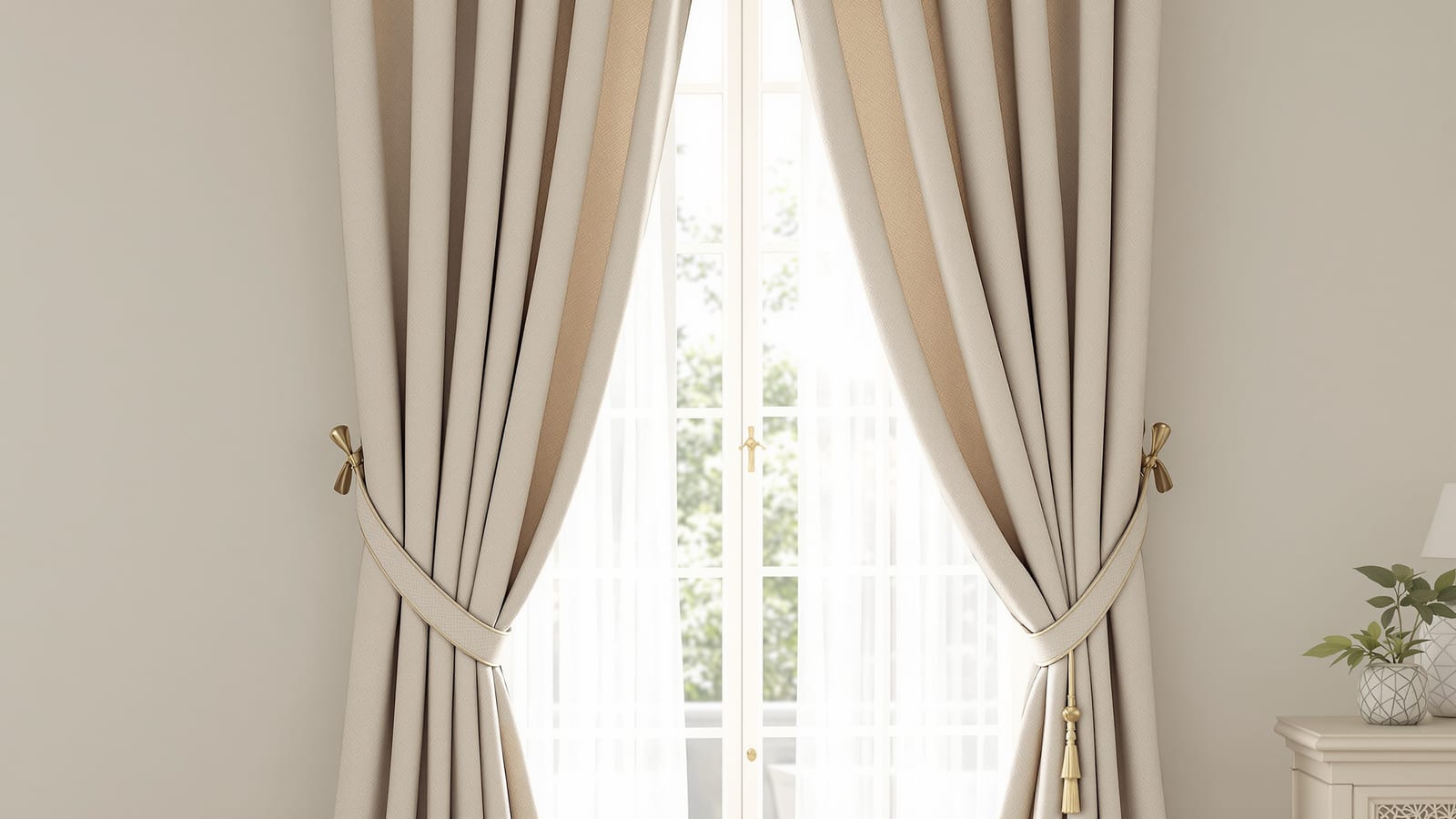
- A tieback is soft — a fabric band, a cord, a tassel or rope that loops around the gathered curtain and hooks onto a small wall hook. It cinches the curtain into a soft, rounded shape. Romantic, traditional, cheap, and easy to change.
- A holdback is hard — a metal or wooden arm, hook or knob fixed to the wall, behind which you simply tuck the curtain. It sweeps the curtain back in a clean, architectural curve. Modern, sturdier, holds heavy curtains, and needs no tying each time.
| Tieback (soft) | Holdback (hard) | |
|---|---|---|
| Material | Fabric, cord, tassel | Metal, wood, resin arm |
| Look | Soft, gathered, romantic | Clean, swept, structural |
| Best with | Sheers, light cotton, classic rooms | Velvet, blackout, heavy or modern curtains |
| Effort | Re-tie each time | Tuck and go |
Placement decides whether it looks deliberate or accidental. The rule stylists use: never place it at the dead centre of the height. Set the hook at roughly one-third up from the floor for a long, elegant sweep, or two-thirds up (around eye level) for a higher, more dramatic cinch that shows more glass below. Place both windows in a room at the same height, and on a holdback, mount it so the arm clears the wall enough to gather the curtain without crushing it. A holdback set too low or off-level is one of those small wrong notes the eye catches without knowing why.
Banding the leading edge — the custom-look detail
The leading edge is the vertical inner edge of the curtain — the part that meets in the middle when closed and frames the glass when open. Adding a contrast band or border down this edge (and sometimes along the hem) is the trick that makes a plain panel look bespoke:
- A 5 to 10 cm contrast band in a deeper or accent tone draws a clean line down each side and frames the window like a painting.
- It also hides the stitching and any unevenness on the most visible edge.
- It lets a plain, affordable main fabric carry a small amount of a richer, pricier accent fabric — luxury on a budget.
Keep the band tonal and restrained — a charcoal edge on oatmeal linen, a terracotta edge on cream cotton — rather than a loud clash. For more of these elevated detailing ideas, see the luxury curtain design guide for Indian homes. If you are choosing the two tones, the curtain colour selection guide helps you pick a band that reads as intentional, not random.
How the curtain stacks back
"Stack-back" is how much wall the open curtain covers when bunched to the side. People forget it and end up with a curtain that swallows a quarter of the glass even when fully open. Two fixes:
- Hang wide (as above) so the stack lands on the wall, not the window — the single biggest stack-back fix.
- Account for fullness and fabric thickness. A heavy, 2.5× fullness velvet stacks far fatter than a thin cotton; the heavier the curtain, the wider you must extend the rod to clear the glass.
A well-stacked curtain disappears against the wall by day and closes to a full, generous sweep by night. That is the goal — maximum light open, maximum cover closed.
Hardware finish — the accessory layer
The metal you choose ties the window to the room. Match the finish of your rod, rings, finials and holdbacks to the other metals in the space — taps, handles, light fittings, the bed frame.
- Black / gunmetal — modern, graphic, hides dust; the safe contemporary default in Indian homes.
- Brushed brass / antique gold — warm and dressy; beautiful with creams, greens and traditional rooms.
- Brushed nickel / chrome — cool and clean; suits minimal and monochrome schemes.
Pick one metal story and stick to it across the room. Mixing a chrome rod with brass holdbacks and black finials reads as three different shopping trips. The full hardware decision — brackets, supports, weight ratings — lives in the curtain hardware guide for Indian homes.
A quick caveat and the order of moves
Two honest notes. First, pelmets and valances are a different finishing layer — a cornice across the top that hides the rod and the stack — and they change how all of the above reads; if you are considering one, read pelmets and valances for Indian homes before you finalise the rod height. Second, none of this fixes the wrong curtain — a too-short, too-thin panel cannot be styled into looking right, so get the size and weight correct first.
The order that works:
1. Mount the rod high and wide.
2. Set the drop and floor break (float or small break for most homes).
3. Train the folds for a week.
4. Add the leading-edge band if you want the custom look.
5. Fit tiebacks or holdbacks at one-third or two-thirds height, level across the room.
6. Tie the hardware finish to the room's other metals.
Style your windows with Studio Matrx. Find the right treatment and weight for each room with the window treatment selector, size your fabric and stack-back with the curtain cost calculator, and read the full picture in the complete curtain guide for Indian homes. The fabric is the easy part — the hanging is where the room is won.
Export this guide
Related Guides — Deep-dive reading
Luxury Curtain Design Trends for Indian Homes (2026)
What actually makes a curtain read expensive — generous fullness, floor-length drops, premium fabrics, tailored headings, layering, concealed tracks and motorisation — plus the honest cost reality for Indian villas and penthouses.
Window TreatmentsCurtain Hardware Guide: Brackets, Supports & Heavy-Duty Fittings (India 2026)
The bits that hold it all up — brackets, centre supports, finials, rings, hooks, glides and holdbacks. How to choose hardware for the weight of your curtains and the type of wall behind them, so nothing ever sags or pulls out.
Window TreatmentsFloor-to-Ceiling Curtains: The Height Illusion Done Right (India 2026)
Why hanging high and dropping to the floor makes a room look taller and more expensive, where to mount, how to measure the drop, and the fabric, hardware and costs that make long curtains work in Indian homes.
Window TreatmentsRelated Tools — Try Free
Curtain Cost Calculator
Get the fabric metres you need plus the total curtain cost by window size, fabric, pleat, lining and hardware.
Curtain CalculatorWindow Treatment Selector
Curtains, blinds or a layered system? Answer five questions about your room and get a specific recommendation.
SelectorCurtain Fabric Comparison
Compare curtain fabrics side by side — drape, opacity, care, durability and cost — and get a quick recommendation.
Comparison Tool