
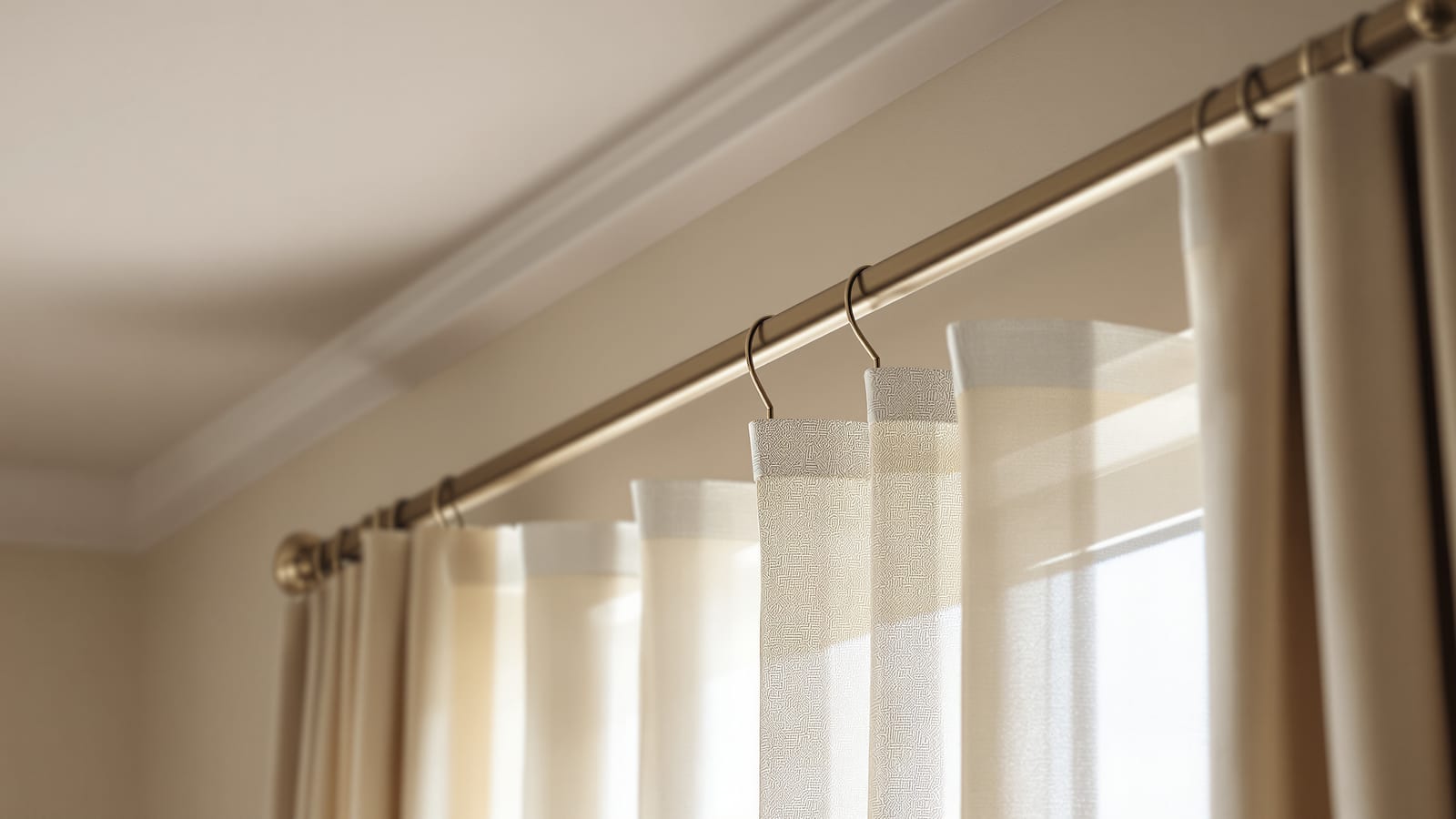
Pelmets, Valances & Cornices: The Curtain Top Treatment (India 2026)
The finishing band that runs across the top of the curtain — hiding the track, the motor and the hooks, adding height and formality. Hard pelmet vs soft fabric valance vs timber cornice, when to use each, when to skip them, and what they cost in India.
Look at the top of a beautifully dressed window and you often will not see the rail, the hooks or the motor at all — just a clean horizontal band where the curtain seems to disappear into the wall. That band is the top treatment: a pelmet, a valance or a cornice. It is the most overlooked finishing move in window dressing, and the one that most reliably separates a window that looks "done" from one that looks like curtains were simply hung on a rod. This guide explains the three kinds, what each is for, when to skip them, and how they pair with a false-ceiling pocket.
A pelmet is the picture frame of a window. The curtain is the painting; the band across the top is what stops the eye at a clean edge and tells you the whole thing was designed, not just bought.
If you want the full window picture first — fabrics, pleats, tracks and motors — start with the complete curtain guide for Indian homes. This page goes deep on the part that finishes the top.
What a top treatment actually does
A top treatment is the band that runs horizontally across the top of the curtain, above or in front of the heading. It earns its place by doing four quiet jobs:
- Hides the hardware. Tracks, gliders, hooks, the messy top of the pleats — and increasingly the motor and its housing — all vanish behind the band. This is the number-one reason designers specify one.
- Adds apparent height. A pelmet mounted high, near the ceiling, draws the eye up and makes the window (and the room) read taller, especially with floor-length curtains beneath.
- Adds formality and finish. A defined top edge reads as deliberate and tailored; an exposed rod reads casual. You choose the register.
- Blocks light leak and draught at the top. A boxed pelmet closes the gap above the curtain, cutting the halo of light and the warm-air leak that an open-topped curtain lets through — a small but real comfort gain on a bedroom or a west window.
Name which of these you actually need before you choose a style. If you only want to hide a motor, a slim modern pelmet does it; if you want grandeur, a deep upholstered or timber treatment is the move.
The three families, compared honestly
"Top treatment" covers three quite different things. People use the words loosely, so here is the honest distinction:
| Feature | Hard pelmet (box) | Soft valance | Timber cornice |
|---|---|---|---|
| What it is | Rigid board, usually upholstered or painted | Short length of gathered/pleated fabric on its own track | Shaped wood or moulding board, painted or polished |
| Look | Tailored, architectural, clean-edged | Soft, traditional, draped | Crisp, joinery-grade, can be ornate or minimal |
| Hides motor/track | Best — fully boxed | Partly — fabric can swing and gap | Best — fully boxed |
| Style fit | Modern to formal | Traditional, classic, cosy | Modern minimal to grand traditional |
| Indian cost | Medium | Low | Medium to high |
| Best for | Living, bedroom, motorised windows | Kitchens, kids rooms, traditional decor | Formal rooms, villas, joinery-led interiors |
The hard pelmet (a "pelmet box") is the workhorse: a rigid front board, often padded and wrapped in the curtain fabric or a contrast cloth, sometimes just painted to match the wall. A valance is the soft cousin — a short gathered or pleated skirt of fabric on its own little track, no rigid board, so it drapes. A cornice in the curtain sense is a hard pelmet built from timber or moulding rather than upholstery — the joinery-led version, equally at home as a sleek painted minimal box or an ornate carved band.
The fabric-wrapped pelmet board: the easy middle path
There is a simple fourth option that sits between the three families and suits most Indian homes: a fabric-wrapped pelmet board. It is a plain MDF or plywood board cut to size, lightly padded, and wrapped in the same fabric as the curtains (or a contrast). It is cheaper than ornate joinery, cleaner than a soft valance, and it hides the track and motor completely.
This is the pragmatic choice when you want the boxed, finished look without commissioning a carpenter for shaped timber or paying for an upholstered build. A carpenter or curtain maker assembles it on site, mounted on small angle brackets above the window or fixed to the wall. Match the fabric to the curtain for a quiet, tall, modern result, or pick a contrast band for a more decorative one.
Height, depth and proportion — the numbers that make it look right
A top treatment that is the wrong size looks worse than none at all. The rules designers use:
- Mount high. Fix the pelmet near the ceiling, well above the window, not tight to the frame. The higher it sits, the taller the window reads. Floor-length curtains beneath complete the effect.
- Depth (the drop of the band). As a rough guide, a hard pelmet's face is around one-sixth of the curtain drop, or a hand's span to a little more — deep enough to fully cover the track and heading, not so deep it crushes the window. Tall, double-height rooms carry deeper bands; standard rooms want a slimmer one.
- Projection. The band must stand off the wall far enough to clear the curtain stack, any second layer (a sheer behind a blackout) and a motor housing — confirm the deepest thing it has to hide before you set the depth.
- Return the ends. A hard pelmet should wrap back to the wall at each end (a "return") so you never see the track end from the side.
For working out the fabric your curtains and a wrapped pelmet will need, the curtain cost calculator sizes the metres from your window width and drop, and the window treatment selector helps you decide whether a hard, soft or no top treatment suits the room before you commit.
How it pairs with a false-ceiling pocket
This is the single most important planning point, and the one most often missed. If you have a false ceiling, the cleanest possible top treatment is a recessed curtain pocket: a slot built into the false ceiling that the curtain falls out of, so there is no visible band at all — the curtain appears to drop straight from the ceiling.
The catch is timing. The pocket must be designed into the false ceiling before it is built. A pocket is simply a gap left between the false ceiling edge and the wall, deep enough for the track (and motor) and wide enough for the curtain stack to clear. Retrofitting one after the ceiling is up means cutting and patching — the most common avoidable regret in this whole category.
So the rule is: if a false ceiling is in your plans, decide the top treatment now. Either leave a recessed pocket (no pelmet needed — the cleanest, most modern look), or plan the wall and power for a surface pelmet. The detailing for the recessed and ceiling-drop look is covered in ceiling-mounted curtains for Indian homes, and the track and motor that sit inside the pocket in curtain rods vs tracks for Indian homes.
When to skip the top treatment entirely
A pelmet is not compulsory, and modern interiors often deliberately leave it off. Skip it when:
- You want a minimal, contemporary look and a clean ceiling-drop track or a recessed pocket already hides the hardware — adding a band would only clutter it.
- The window is short or the ceiling is low. A deep pelmet on a low ceiling eats height and makes the room feel boxed in.
- You have a beautiful decorative rod and finials you actually want to show — eyelet or pinch-pleat curtains on a handsome rod are a finished look in their own right, covered in the curtain styling guide for Indian homes.
- Budget is tight and the hardware is tidy — a clean track read from below needs no hiding.
The honest position: a top treatment is a finishing flourish, not a structural necessity. Use it to hide messy hardware, add height or add formality. If none of those apply, a well-chosen rod or a recessed pocket is enough.
What it costs in India
Top treatments swing widely with material, size and whether a carpenter, upholsterer or curtain maker builds them. Honest ranges, not quotes:
- Soft fabric valance — the cheapest; it is just extra fabric on a small track, so it adds modestly to the curtain bill, mostly in cloth and stitching.
- Fabric-wrapped pelmet board — low to medium; an MDF/ply board plus padding, fabric and a carpenter's labour, per window.
- Upholstered hard pelmet — medium; the wrapped board plus upholstery work and a contrast or detailed finish.
- Timber cornice / joinery — medium to high; carpentry, the wood itself, and paint or polish, climbing fast for shaped or carved work.
- Recessed false-ceiling pocket — costs almost nothing extra if planned into the ceiling work, and a lot if retrofitted later — which is exactly why timing matters.
The cost driver is the build method, not the fabric: joinery and upholstery labour dominate. A wrapped board is the value sweet spot for most homes. The full picture of where curtain rupees go sits in the curtain hardware guide for Indian homes.
Honest caveats
A few truths worth stating plainly:
- Soft valances can look dated. Heavily gathered, swagged valances read as 1990s in a contemporary room — keep them flat and tailored, or choose a hard pelmet, if your interior is modern.
- A pelmet is permanent-ish. Unlike curtains you can swap, a fixed pelmet ties you to a width and a fabric; choose a neutral wrap or paint if you expect to re-curtain later.
- Low ceilings punish deep bands. In a standard apartment, a slim pelmet or a recessed pocket flatters; a deep one steals the height you were trying to add.
- Plan around the motor. A motorised track needs the pelmet or pocket deep enough to house the motor and let it run — confirm the housing dimensions before you set the depth.
- Everything here is indicative. Measure your own window, confirm your ceiling height, and price the joinery locally before committing.
Finish your windows properly with Studio Matrx. Decide whether a hard pelmet, a soft valance or no top treatment suits your room with the window treatment selector, size the fabric with the curtain cost calculator, and read the full picture in the complete curtain guide for Indian homes. Plan the top treatment before the false ceiling goes up — it is the one detail you cannot easily add later.
Export this guide
Related Guides — Deep-dive reading
Ceiling-Mounted & Hidden Curtain Tracks: The Floor-to-Ceiling Look (India 2026)
How ceiling-fixed and recessed curtain tracks make a room read taller, why you must design the pocket before the false ceiling, the wall-vs-ceiling trade-offs, depths, costs and the one retrofit regret to avoid.
Window TreatmentsThe Complete Home Curtain & Window Treatment Guide for Indian Homes (2026)
Types, fabrics, pleats, tracks, motorisation and real Indian costs — the one guide that turns a confusing purchase into a confident decision.
Window TreatmentsFloor-to-Ceiling Curtains: The Height Illusion Done Right (India 2026)
Why hanging high and dropping to the floor makes a room look taller and more expensive, where to mount, how to measure the drop, and the fabric, hardware and costs that make long curtains work in Indian homes.
Window TreatmentsRelated Tools — Try Free
Curtain Cost Calculator
Get the fabric metres you need plus the total curtain cost by window size, fabric, pleat, lining and hardware.
Curtain CalculatorWindow Treatment Selector
Curtains, blinds or a layered system? Answer five questions about your room and get a specific recommendation.
SelectorWindow Hardware Cost Calculator
Estimate window hardware cost — hinges, handles, locks, rollers and multipoint gears.
Window Calculator