
Motorized Curtain Tracks Explained: Motors, Wiring & Fit (India 2026)
The hardware behind motorised curtains — track profiles, AC vs battery vs solar motors, load and span limits, what to wire and pocket during construction, hubs, noise, retrofit kits and honest rupee costs for Indian homes.
If the motorised curtains overview answered "should I motorise this window?", this guide answers the harder question underneath it: "what hardware actually does the work, and what do I have to plan before the walls close?" The motor and track are the parts no showroom photo shows and the parts that decide whether your motorised curtain glides for a decade or strains, stalls and sags within a year. This is the brand-agnostic hardware deep-dive — track profiles, motor types, load and span limits, the wiring you bury during construction, and honest rupee ranges for Indian homes.
Buy the cloth for the window and the motor for the weight. A track and motor matched to a heavy lined drape will outlive three sets of curtains; an under-sized one will announce its mistake every morning.
The track: profiles that actually matter
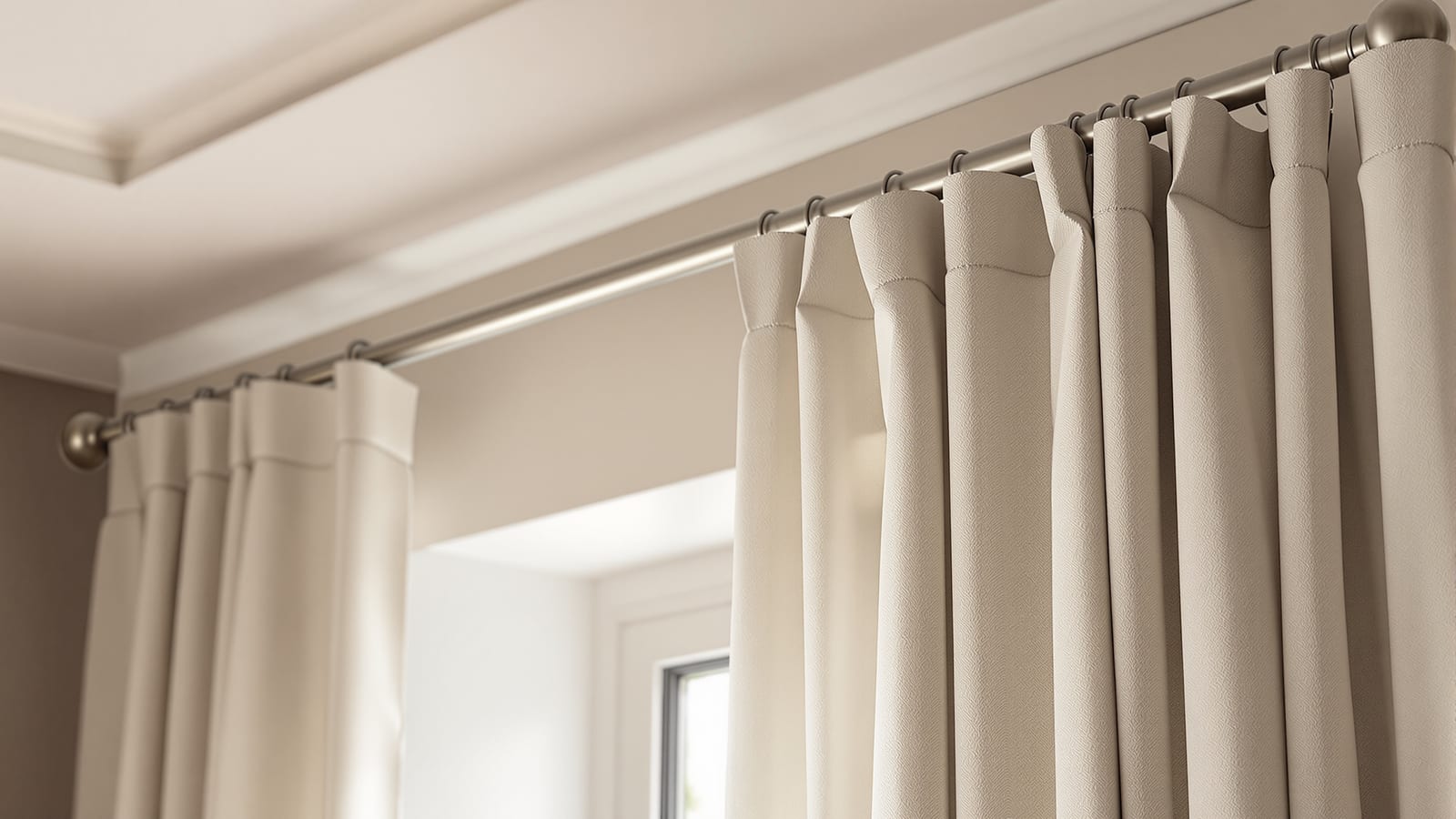
A motorised track is a slim aluminium channel with a toothed belt running inside it. The carriers that hold your curtain clip to that belt, and the motor drives the belt. The profile — the cross-section shape of that channel — is the first real choice:
- I-profile — the slimmest, lowest-clearance section, designed to disappear into a ceiling slot or a shallow pelmet. The default for the recessed, falls-from-the-sky look.
- U-profile (box section) — a deeper, stronger channel that carries more weight and runs longer spans without flexing. The choice for wide windows and heavy lined or blackout drapes.
- Bendable / curved track — a flexible extrusion that follows a bay window, a curved wall or an L-shaped corner in one continuous run, so the curtain wraps the glass with no break. Confirm the motor is rated for curves; tight radii increase belt friction and load.
- Recessed / ceiling track — any profile set into a slot or pocket so only the curtain is visible. This is a mounting choice, not a separate profile, but it must be designed into a false ceiling before it is built.
Two practical rules. Wider is better: extend the track 15-20 cm past the glass on each side so open curtains stack off the window. And the track does the structural work, so size the profile to the curtain weight and span.
Motor types: AC wired, DC battery, solar
The motor is where most of the money and most of the regret live. There are three honest families, and they suit very different homes:
| AC wired (mains) | DC battery / rechargeable | Solar-assisted DC | |
|---|---|---|---|
| Power | Permanent 230 V mains to the track | Built-in Li-ion, recharged every few months | Battery topped up by a small PV panel |
| Pull strength | Strongest — heavy lined drapes, long spans | Good — light to medium curtains | Same as the battery it charges |
| Noise | Quiet to very quiet (better gearing) | Quiet, occasionally a touch louder | As the battery motor |
| When to fit | New build / renovation (cable ahead) | Anytime — true retrofit | Anytime, if the window gets sun |
| Maintenance | Effectively none | Recharge / eventual battery swap | Less recharging, panel needs light |
| Best for | Living room, main bedroom, wide windows | Rentals, existing homes, hard-to-cable windows | Bright windows you would rather never recharge |
| Caveat | Cabling is hard to add later | Charge habit; weaker on heavy drapes | Panel placement; weaker in shaded/north rooms |
The honest summary: the real fork is mains versus battery, because nearly every modern motor is wireless in control regardless of how it is powered. An AC wired motor never runs flat and pulls the heaviest curtains without strain, but it needs a power point planned at the track during construction. A DC battery motor charges off a USB or hidden point every two to six months and retrofits into any home with zero civil work, at the cost of a charging habit and slightly less muscle. A solar panel clipped to the battery motor stretches the recharge interval dramatically on a sunny window — genuinely useful in much of India — but does little on a shaded or north-facing one.
Load and span limits — the numbers that prevent regret
This is the section that separates a system that glides from one that grinds. Every motor and track carries two ratings you must respect:
- Load (kg) — how much curtain weight the motor can pull and the track can hold. Heavy cotton, velvet and fully-lined blackout panels are far heavier than sheers, and a wide window doubles the cloth. A motor rated for, say, a light 8 kg panel will labour, overheat and wear early on a 15 kg lined drape.
- Span (running length) — how far the track can run before it needs an intermediate support or a stronger profile. Long single runs on a slim I-profile will bow in the middle; a U-profile or a centre bracket fixes it.
The practical method: estimate the curtain weight before you choose the motor. Fabric weight per metre times your fullness times the drop gives a rough kilogram figure; add lining. Then pick a motor rated comfortably above it — never at the limit. For wide living-room windows, size up to a U-profile track and an AC motor; reserve slim battery kits for lighter sheers and modest windows. The relationship between track, weight and pleat is the same one the curtain rods vs tracks comparison explains for manual hardware — motorisation simply makes getting it wrong more expensive.
What to wire and pocket during construction
This is the most valuable part of the guide, because everything here is hard or impossible to add once the false ceiling is closed and the walls are painted. If any civil or false-ceiling work is happening, do these now:
- Power at the track. Run a concealed 230 V point (or the low-voltage line your motor system specifies) to the leading end of every window you intend to motorise. Adding a wire above a finished false ceiling later means cutting it open.
- A curtain pocket in the false ceiling. A recessed slot sized to hide the track and the motor housing creates the falls-from-the-ceiling look. It must be drawn into the false-ceiling design before it is built — confirm the slot is deep and wide enough for the motor box, not just the track.
- Depth and clearance. A motorised track plus motor needs more depth than a manual rod. Check the pocket or pelmet hides the housing and the curtain still clears the glass and any handles.
- A neutral wire at the switch if you want a smart wall switch rather than only a remote — the same rule as smart lighting.
- Wi-Fi reach. App, schedules and voice lean on your network; make sure a router or mesh node covers that wall.
Get these right and a wired install is invisible. Skip them and you are forced onto battery motors or surface conduit later — exactly the detail planned up front in the curtain hardware guide and the ceiling-mounted curtains guide.
Remote, app, hub — and the ecosystem rule
A motorised track is controlled in several overlapping ways, and a good setup uses more than one:
- Handheld remote — works the day it is installed, needs no internet; multi-channel handsets run several curtains.
- Wall switch / scene controller — a fixed point so family and guests need no phone.
- Phone app — adds schedules (open at dawn, close against the afternoon sun), precise positions and control from outside the house.
- Hub / bridge — the box that joins the motor to voice and whole-home scenes.
The brand-agnostic rule that matters most: the motor has to speak a standard your home already runs. The common ones are Amazon Alexa, Google Home, and the hub protocols Zigbee and the cross-brand Matter (often over Thread). Pick the ecosystem you already use for lights or speakers and buy a motor that lists support for it. A motor tied only to its own proprietary app is fine today and a headache the day that brand changes its cloud. The smart curtains guide covers whole-home scenes in depth.
Noise, reliability and maintenance
Curtain motors are mechanically simple, but a few things separate a pleasant system from an irritating one:
- Noise is mostly about gearing and soft start/stop. Better motors ramp speed up and down so the curtain neither jerks nor swings, and they hum rather than whine. Ask for the decibel figure or, better, hear one run before buying — a motor over the bed is one you will notice at 6 a.m.
- Keep the rail clean and aligned. Dust and a bent track are the usual cause of a motor stalling or sounding strained.
- Mind the battery. A rechargeable motor that stops mid-travel is almost always just flat; build a charge-it-every-Diwali-and-every-monsoon habit, or wire the windows you cannot bear to fail.
- Confirm a manual override so a panel can still be pulled by hand during a power cut — most have it, but check.
- Match motor to weight so a light motor never labours on heavy drapes.
Retrofit kits — motorising what you already have
You do not always need to rip out a manual track. Retrofit kits come in two forms. A drop-in motor replaces the end cap of a compatible existing track and drives its belt — neat, but only works if your track matches the kit. A rod-driver / hook robot is a small battery motor that grips an existing rod or track and walks the curtain along, attaching with no tools and no wiring; it is the true rental-friendly, zero-civil-work option, though it suits lighter curtains and modest spans. For most existing Indian homes a battery retrofit kit is the realistic path; a full AC track is for new builds and renovations where you can cable ahead.
What it costs in India
Treat these as honest planning ranges, not quotes — they move with track length, profile, motor type, brand and city. The motorisation cost sits on top of the curtain itself; you still pay for cloth, fullness, lining and stitching as for any manual curtain.
- Motor plus motorised track is the big add-on. Per window it typically lands in the mid-thousands to low-tens-of-thousands of rupees, with battery kits usually cheaper per unit and premium AC systems for wide or heavy windows at the top.
- A hub or bridge for app, schedules and voice is a one-time household cost, often in the low thousands of rupees, shared across every motor.
- Wiring and labour add to an AC install, especially if cabling is chased into walls; a battery retrofit avoids almost all of it.
- Solar panels are a small per-window add-on that pays back in fewer recharges, not rupees.
Budget by pricing the curtain first, then adding the track, motor and a hub share per window. The Curtain Cost Calculator sizes the fabric and base curtain price; the smart-window ROI calculator puts the comfort-and-energy payoff in numbers, and the window treatment selector helps confirm a motorised curtain is the right call for the room before you spend.
The five-move hardware plan
1. Match the track profile to the curtain weight and span — slim I-profile for sheers in a recess, stronger U-profile for wide, heavy drapes.
2. Choose the motor family — AC wired for daily-use heavy windows (cable during construction), DC battery for retrofits, solar where the window gets real sun.
3. Estimate the curtain weight and pick a motor rated comfortably above it — never at the limit.
4. Plan the civil work now — power at the track, a deep enough pocket, Wi-Fi reach.
5. Pick the ecosystem you already run and a motor that supports it; for an existing home, a battery retrofit kit avoids all the civil work.
Plan the hardware with Studio Matrx. Start from the motorised curtains overview and the complete curtain guide to fix the cloth and layering, then size and price your windows with the Curtain Cost Calculator and weigh the automation payoff with the smart-window ROI calculator. For the hardware around the track, read the curtain hardware guide; for the recessed look, the ceiling-mounted curtains guide.
Export this guide
Related Guides — Deep-dive reading
Motorized Curtains Explained: How They Work, Cost & Setup (India, 2026)
How motorised tracks and motors actually work, wired vs wireless vs battery, what to plan during construction, and what it really costs in rupees — a plain-language guide for Indian homes.
Window TreatmentsBattery & Rechargeable Motorised Curtains: The Retrofit Option (India 2026)
Rechargeable curtain motors that need no wiring — how the battery, recharge cycles and solar top-up work, what they can and cannot pull, and how to retrofit one onto your existing track in an afternoon.
Window TreatmentsAutomated Window Treatments: The Complete Guide (India 2026)
The umbrella overview of every motorised covering — curtains, roller, zebra and honeycomb shades — the motor and ecosystem stack, the real benefits versus the hype, planning during construction or as a retrofit, honest costs, and how to start small.
Window TreatmentsRelated Tools — Try Free
Curtain Cost Calculator
Get the fabric metres you need plus the total curtain cost by window size, fabric, pleat, lining and hardware.
Curtain CalculatorMotorized Curtain Cost Calculator
Estimate the all-in cost to motorise curtains — motors, tracks, hub and installation.
Cost CalculatorWindow Treatment Selector
Curtains, blinds or a layered system? Answer five questions about your room and get a specific recommendation.
Selector