
Arched, Corner & Odd-Shaped Window Treatments (India 2026)
Arched and round-top windows, corner windows that meet at the wall, skylights, gable and angled glass, plus very small or very tall narrows — the honest options for the awkward windows, including when to leave the architecture bare.
Some windows do not cooperate. An arch curves where a curtain wants to run straight. A corner window turns ninety degrees and there is nowhere to stack the fabric. A skylight sits flat in the ceiling, a gable window leans, and a tall narrow slot is too thin for a sensible panel. Standard curtains are designed for a standard rectangle on a vertical wall, and the moment a window stops being that, the usual advice falls apart. The good news is that every awkward window has a genuine, well-understood solution — and for some of them, the best solution is to dress the straight part and leave the shape itself bare. This guide walks the four families of difficult window and the honest trade-offs of each.
An odd-shaped window is often the most beautiful thing in the room. Before you spend on custom fabrication to cover it, ask whether the architecture is the feature you should be framing, not hiding.
For the fundamentals these all build on — fullness, drop, hardware and cost — start with the complete curtain and window treatment guide. This page is only about the windows that break the rules.
Why odd windows defeat standard curtains
A normal curtain works because three things are true: the top edge is horizontal, the rail can extend past the glass on both sides, and the open curtain has a flat stretch of wall to stack against. Arched, corner, skylight and very-narrow windows each break at least one of those. An arch has no horizontal top. A corner has no outside edge to extend past. A skylight has gravity working against the cloth. A narrow slot has no room to stack. Once you see which assumption a window breaks, the right fix becomes obvious.
Arched and round-top windows
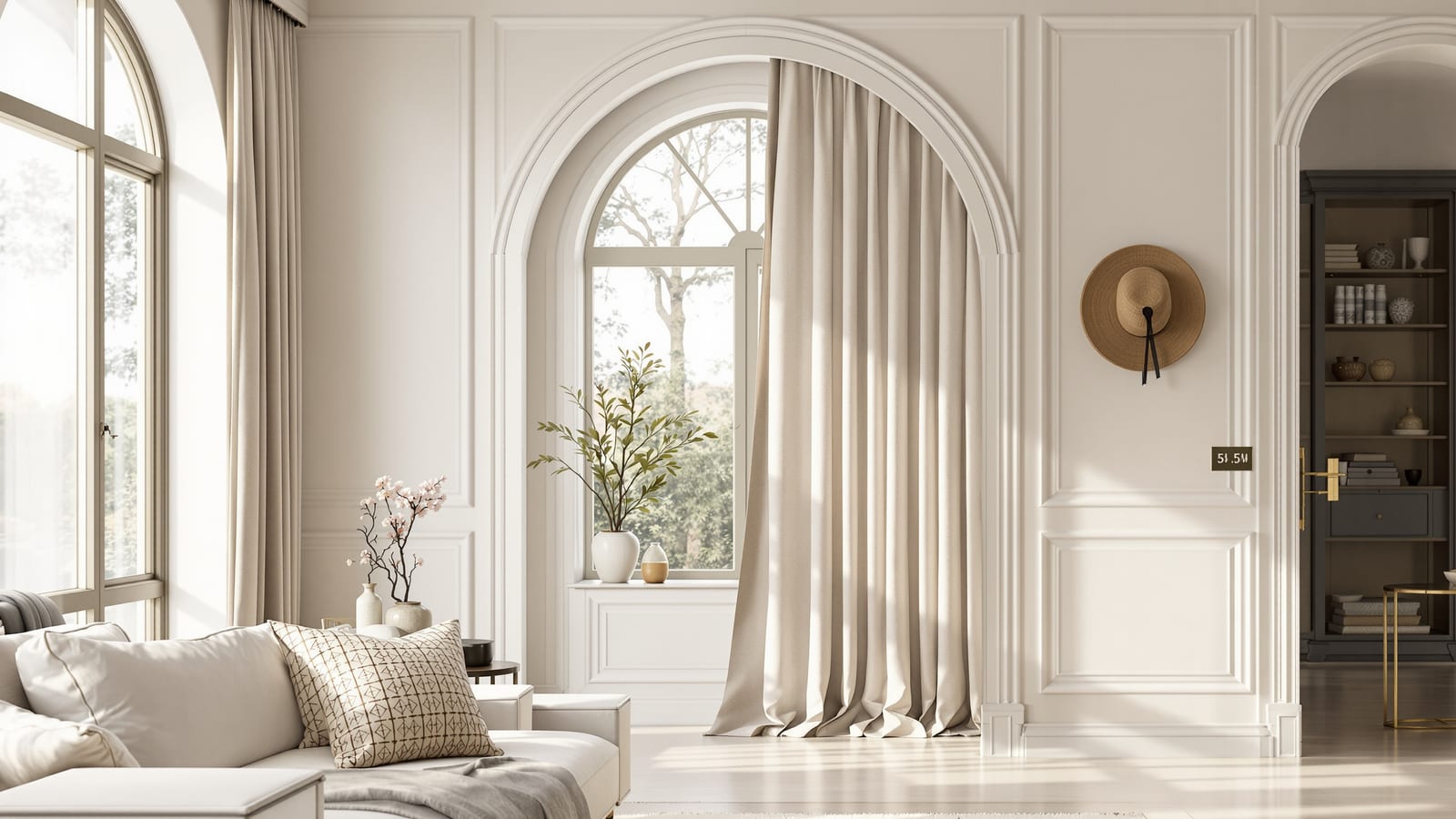
The arch — full semicircle, segmental (a shallow curve), or a Palladian arch over a rectangular window — is the most common odd shape in Indian villas, duplexes and older homes. You have three honest routes:
1. Leave the arch bare, dress the straight part. Run a normal straight rod or track across the springline (where the curve begins) and hang ordinary curtains below it. The arch above stays uncovered, glowing with daylight. This is the cleanest, cheapest, and usually the best-looking option, and it is what most designers quietly recommend. You lose the ability to darken the arch — fine for a stairwell or double-height living room, a problem for a bedroom.
2. A flexible / arched rod that follows the curve. Bendable rods (or a custom-curved track) trace the arch so a sheer can be gathered along it as a fixed sunburst or fan. It looks decorative but it is largely non-operable — the fabric over the curve usually cannot draw, so it is a permanent screen, not a working curtain.
3. A custom-shaped shade. A made-to-measure arched Roman shade, a fan-folded shade, or a cellular shade cut to the curve gives real light control across the whole opening. This is the only route that truly darkens an arch — and the most expensive, because the panel is bespoke.
If darkening the arch is not essential, leave it bare and put a straight track at the springline. It is the option you will be happiest with in five years.
Corner windows
Corner windows — two windows meeting at an internal or external corner — are common in modern Indian apartments for the light and the view. The problem is the join: the fabric has to turn the corner without a gap of bare glass and without two panels colliding.
- Two separate tracks meeting at the corner. The simplest, most affordable approach: a track on each wall, each with its own curtains drawing outward toward the far ends, so the closed panels meet in the corner. Works well; the only compromise is a slim visible seam where they meet.
- A continuous bent track. A single track curved or angled around the corner lets one run of fabric flow around the bend without a break — the premium, seamless look. It needs a custom bay/bend track and careful measuring, and it is best for sheers and wave-fold panels that glide.
- Blinds on each window. Sometimes cleaner than curtains: a roller or zebra blind on each pane sidesteps the corner-join problem entirely.
For the hardware choices behind both — and why tracks (not rods) bend around corners — see curtain rods vs tracks and the curtain hardware guide. The related geometry of bay window curtains overlaps closely with corner windows and is worth a read.
Skylights, gable and angled windows
These break the rule that gravity helps the curtain hang flat. A skylight is horizontal in the ceiling; a gable or clerestory window leans with the roof pitch.
- Skylights are best handled with a tensioned or guided blind that runs in side channels, so the fabric stays taut against the glass instead of sagging. Honeycomb (cellular) blinds excel here because they also cut the fierce heat a skylight gains under the Indian sun. Operate them by a long pole, a crank, or a motor — motorisation earns its keep on anything out of arm's reach.
- Gable / angled / triangular windows usually take a fixed or custom-shaped shade cut to the angle. As with arches, leaving a high triangular gable window bare is often the right call — it is rarely a privacy concern and it is doing useful daylighting work.
Heat, not light, is usually the real issue with overhead glass. A bare skylight can turn a room into an oven from March to June; that is where a heat-blocking cellular blind pays for itself.
Very small and very tall narrow windows
- Very small windows (kitchen vents, toilet slots, landing windows) look silly with full curtains. Use a cafe curtain on a slim rod, a small roller or Roman blind sized to the opening, or frosted film and no fabric at all.
- Very tall, narrow windows (slot windows beside doors, stairwell strips) have no room to stack a panel. A single narrow panel drawn fully to one side, a roller blind, or — again — leaving it bare and relying on the glazing for privacy usually beats forcing curtains into the slot.
The shape-to-solution table
| Window shape | Best solution | Honest caveat |
|---|---|---|
| Full / segmental arch | Straight track at springline, arch left bare | No darkening of the arch |
| Arch you must darken | Custom arched Roman or cellular shade | Bespoke, most expensive route |
| Palladian (arch over rectangle) | Standard curtains below, bare arch above | Treat the two parts separately |
| Internal/external corner | Two tracks meeting, or one bent track | Bent track is custom and pricier |
| Skylight | Tensioned cellular blind in side channels | Motorise if out of reach; heat is the real job |
| Gable / angled / triangular | Custom-shaped fixed shade, or leave bare | Often best left undressed |
| Very small window | Cafe curtain, small blind, or film | Full curtains look out of scale |
| Tall narrow slot | Single side-draw panel, roller, or bare | No room to stack a pair |
Not sure which row is yours? The window treatment selector walks you from the window's shape and job to a shortlist of solutions.
What the custom work costs in India
The honest headline: standard rectangular curtains are cheap because they are mass-made; anything shaped is bespoke, and bespoke costs more. Treat these as indicative ranges, not quotes — measure and price locally.
- Straight track across an arch springline uses ordinary curtains, so it costs the same as a normal window — by far the most economical arch solution.
- A flexible / bendable arched rod adds a modest hardware premium over a straight rod, but the fabric over it is decorative-only.
- A custom-shaped Roman, fan or cellular shade for an arch, gable or skylight is the real spend: priced per bespoke unit, it commonly lands in the mid-to-upper thousands of rupees for a single window, more for large or motorised pieces, because each one is cut and fabricated to your exact template.
- A continuous bent corner track costs more than two straight tracks because the rail is custom-bent and installation is fiddlier.
Use the curtain cost calculator to price the straight curtains in these schemes (the part below an arch springline, the panels on a corner window), then add a fabricator's quote for any shaped piece on top. And before you order anything, measure carefully — odd windows are exactly where guesswork is most expensive. The measuring guide covers how to template a curve and an angle.
The honest verdict: sometimes, leave it bare
Across all four families, the same theme keeps returning. The arch, the gable, the high corner of glass — these are often the reason the room is beautiful. A bare arched window flooding a stairwell with light, a clear triangular gable framing the sky, a corner window dissolving the room's edge: covering these to satisfy a habit of dressing every window is usually a mistake. Dress what needs privacy and darkness — the bedroom, the bathroom, the windows at eye level — and let the architecture above and beyond do its job undressed. The cheapest, best-looking treatment for an odd window is frequently no treatment at all.
When a shape does need covering — a bedroom arch, a hot skylight, a corner window facing a neighbour — go bespoke with eyes open: get a fabricator who has done the shape before, template it precisely, and accept that you are paying for craftsmanship, not cloth.
Plan your awkward windows with Studio Matrx. Start with the complete curtain and window treatment guide for the fundamentals, narrow your shape to a shortlist with the window treatment selector, and price the straight portions with the curtain cost calculator. The full Window Treatments cluster — including bay window curtains, the hardware guide and the broader window treatments hub — covers every other window in the house.
Export this guide
Related Guides — Deep-dive reading
Curtains vs Blinds: The Complete Comparison for Indian Homes (2026)
Light, privacy, heat, noise, cleaning, cost and looks — a head-to-head verdict on curtains and blinds, plus the under-rated answer most good designers actually use: both.
Window TreatmentsDouble-Height & Tall Window Curtains (India 2026)
How to dress the very-tall windows in duplexes, villa living-room voids, stairwells and atriums — fabric weight and seams, why motorisation is near-essential, ceiling tracks and structural fixing, cleaning access, the heat and acoustics of a tall void, and the real Indian cost.
Window TreatmentsFloor-to-Ceiling Curtains: The Height Illusion Done Right (India 2026)
Why hanging high and dropping to the floor makes a room look taller and more expensive, where to mount, how to measure the drop, and the fabric, hardware and costs that make long curtains work in Indian homes.
Window TreatmentsRelated Tools — Try Free
Window Treatment Selector
Curtains, blinds or a layered system? Answer five questions about your room and get a specific recommendation.
SelectorCross-Ventilation Analyzer
Estimate airflow and air changes per hour (ACH) from room size, window areas, layout, and local wind — with NBC 2016 Part 8 compliance check.
Ventilation CalculatorCurtain Cost Calculator
Get the fabric metres you need plus the total curtain cost by window size, fabric, pleat, lining and hardware.
Curtain Calculator