
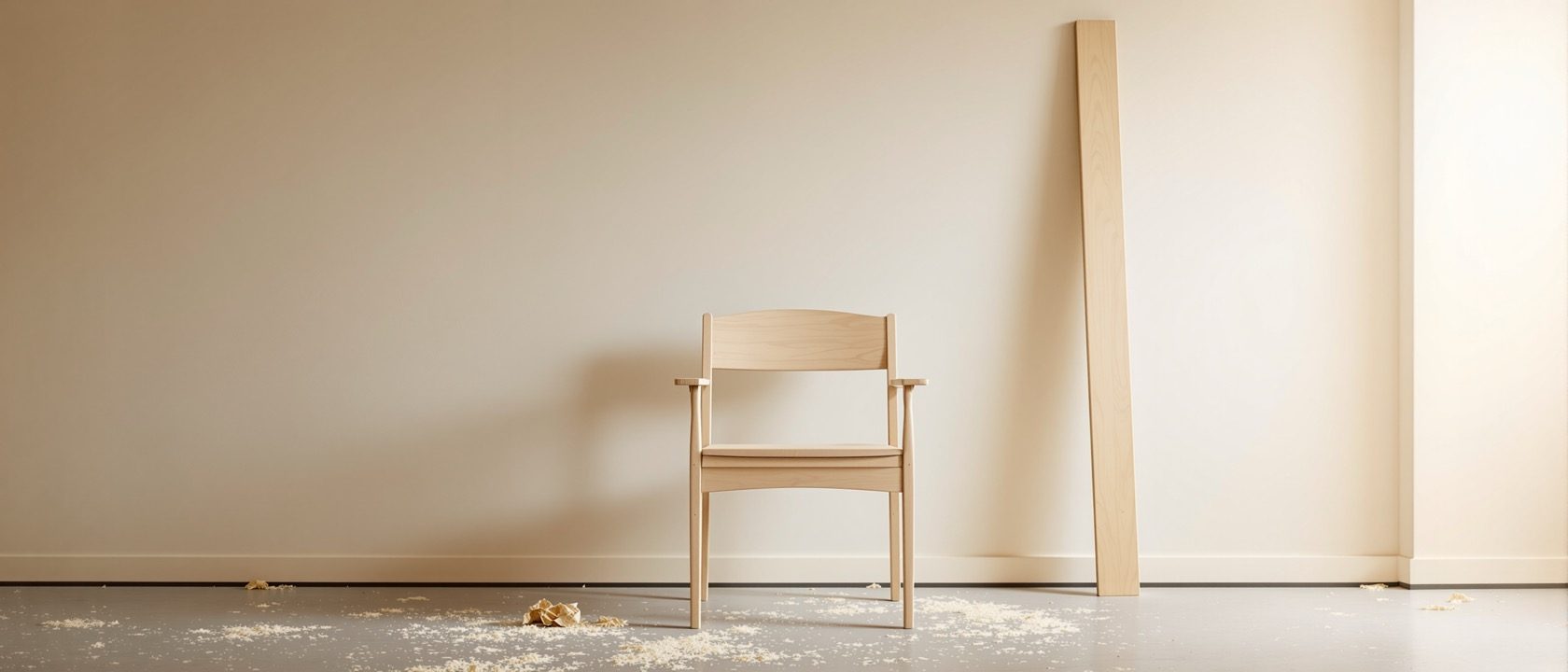
Scales — Making at Full Size
Why a chair is prototyped at 1:1, and the story-stick that gets it there
A chair that reads beautifully as a one-fifth model can be unsittable at full size. This short unit is about the discipline that closes that gap: prototyping at one-to-one, setting out full size on a story-stick, and treating the drawing as a proposal the full-size build either confirms or refutes.
Learning objectives
By the end of this lesson, you will be able to — mapped to the course outcomes for the Wood, Cane & Bamboo Workshop:
Explain why furniture must be judged at full size, not from a scaled model.
Set out a piece full size on a story-stick or rod and work to real tolerances.
Use a full-size mock-up to confirm or refute a detail drawn at scale.
Name what a scaled model hides — ergonomics, sightlines, joint clearances, material behaviour.
Why one-to-one
Ergonomics, proportion, sightlines and joint clearances only appear at real size — and the story-stick is how the workshop gets there without accumulating error.[1]
A 1:5 chair is unsittable
A chair that reads beautifully as a one-fifth model can be unsittable at full size, because the things that decide whether furniture works — ergonomics, proportion in the hand and the eye, sightlines, the clearance a joint actually needs, the way the real material flexes and holds — cannot be judged from a scaled model. They only appear at real size. This is why furniture is prototyped at one-to-one: the full-size mock-up is the first honest test of the design, and it is routine for a piece that looked resolved on the drawing board to need real changes once it stands at full height.[1]
The drawing is a proposal
A scaled drawing can hold a proportion that collapses and a clearance that does not exist. The full-size build is what corrects it — and learning to trust that verdict is the point.[1]
The drawing is a proposal
A scaled drawing is a proposal, not a proof. It can hold a proportion that collapses at full size, a joint clearance that does not exist, a reach that no arm has, a sightline blocked by a rail you drew thin. None of these are visible at 1:5. The value of making elements at various scales — and then at full size — is to close the gap between the object as drawn and the object as built. The full-size mock-up either confirms the drawing or refutes it, and a designer learns to trust that verdict over the elevation.[1]
At a glance
| Aspect | At full size | At scale |
|---|---|---|
| Ergonomics & comfort | FULL SIZE: the only honest test — you can sit, reach, see | SCALED MODEL: looks resolved, tells you nothing about fit |
| Joint clearances | Appear at 1:1 — the real gap a drawer or hinge needs | Invisible at 1:5 — the drawing can hide a clearance that isn't there |
| Setting out | Story-stick: one full-size master, no accumulated error | Part-by-part measuring: errors add up |
| The drawing | A PROPOSAL the full-size build confirms or refutes | MYTH: a resolved elevation means a resolved object |
Key terms
The real dimensions of the object. The only scale at which ergonomics, proportion and joint clearances can be honestly judged.
A full-size master drawing of the piece on a stick or board, against which every part is measured — removing accumulated measuring errors.
A full-size trial of the design, made to test it before committing to the finished piece. The first honest test of whether it works.
The allowable deviation in a dimension — the clearance a drawer or hinge actually needs. Real tolerances only show up at full size.
The fit of the object to the human body. A scaled model cannot test it; a full-size mock-up can.
Study task
Take a small piece you have drawn — a stool, a side table, a shelf — and set it out full size on a length of board or paper: draw the piece at 1:1, mark the real joint positions, and measure your parts against that master rather than off the scale drawing. Then note honestly what changed: a proportion that looked right at 1:5 but felt heavy at full size, a clearance you had not left, a height that was wrong for the body. Write one sentence on each. That gap between the drawn object and the full-size one — and your willingness to let the build correct the drawing — is the whole lesson.
Self-assessment
1. Why is furniture prototyped at full size (1:1) rather than judged from a scaled model?
2. What is a story-stick (setting-out rod) for?
Recap
References & further reading
- [1]Korn, Peter — Woodworking Basics: Mastering the Essentials of Craftsmanship. Taunton Press, 2003. On setting out, story-sticks and the discipline of building to real tolerances. (Full-size prototyping is standard furniture-making practice.)
Further reading
- Korn, Peter — Woodworking Basics: Mastering the Essentials of Craftsmanship. Taunton Press, 2003.
- Bird, L., Jewitt, J., Lie-Nielsen, T. et al. — Taunton's Complete Illustrated Guide to Woodworking. Taunton Press, 2005.
- Jackson, Albert & Day, David — The Complete Manual of Woodworking. Alfred A. Knopf.
Sources gathered and fact-checked June 2026. Published values vary by source, sample and method — treat as indicative and confirm against the cited standard before structural use.
The author
Amogh N P
Architect, interior designer, and creative polymath. Studio Matrx began in his notebooks — his vision of design made honest, useful, and open to everyone. Its Academy is written and taught in his memory, and free, forever.
More about Amogh →