
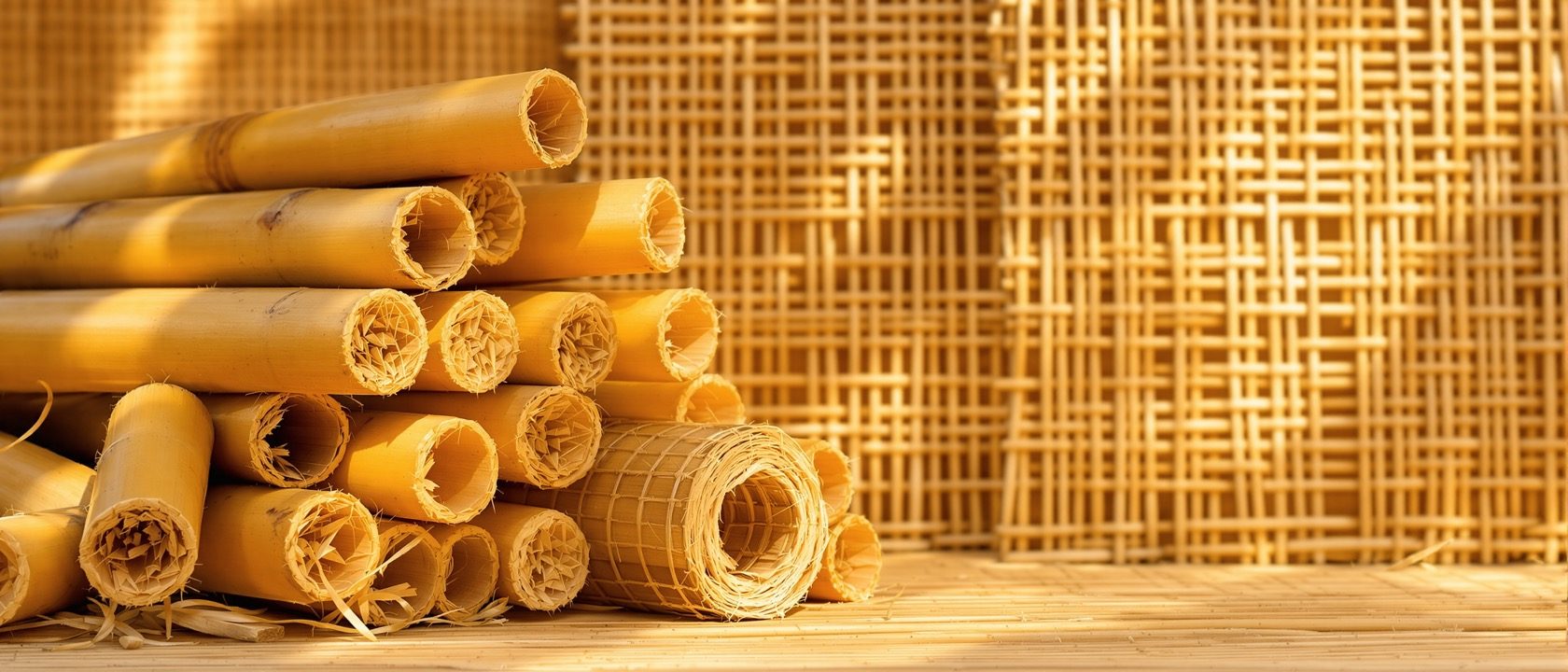
Cane & Bamboo — the Alternative Materials
Cane is a solid palm, bamboo a hollow grass — and both are beetle food untreated
Before anything else, a confusion has to be cleared: cane is not bamboo. One is the solid stem of a climbing palm, the other a hollow woody grass, and they are botanically unrelated. Everything else in this unit — how you treat it, how you joint it, how it fails — follows from that single difference, and from the honest truth about bamboo’s strength and its appetite for a beetle when left untreated.
Learning objectives
By the end of this lesson, you will be able to — mapped to the course outcomes for the Wood, Cane & Bamboo Workshop:
Explain why cane and bamboo are botanically unrelated — a solid palm versus a hollow grass.
State what India's 2017 Forest Amendment did for bamboo — and what it did NOT do for cane.
Judge the 'bamboo is as strong as steel' claim honestly — absolute versus specific strength.
Explain why treatment is non-negotiable, and name the boron treatment and IS codes.
Explain why a hollow, splitting culm cannot be jointed like solid timber, and the joints it allows.
Describe cane's signature interior use — webbing and rattan weaving.
Cane is not bamboo
A solid palm versus a hollow grass; a grass India legally stopped calling a tree in 2017; and a strength that rivals steel only per unit weight.[1, 2, 3]
A solid palm versus a hollow grass
This is the confusion to clear before anything else, because the two words are used interchangeably and they are botanically unrelated. Cane is rattan — the SOLID stem of a climbing palm (family Arecaceae, genera like Calamus). Bamboo is a HOLLOW woody GRASS (family Poaceae). One is a palm, the other a grass; one is solid, the other hollow. Everything that follows — how you cut it, how you joint it, how it fails — comes from that single difference. When someone calls a rattan chair 'bamboo', they have named the wrong plant kingdom.[1]
Treat first, then joint
Untreated bamboo and cane are beetle food; boron treatment comes first, always. And because a hollow culm splits, you cannot mortise it — you lash, pin and joint at the solid nodes.[4, 5, 6]
Why hollow, splitting stock needs its own joints
Because a bamboo culm is hollow and splits so readily, you cannot cut a mortise-and-tenon into it as you would in solid timber — the wall is thin, and any joint that relies on removing material weakens it toward the split. So bamboo joinery works differently: lashing (binding with rope or cane), pinned and pegged joints (a dowel driven through), and fishmouth or scarf cuts that seat one culm against the curve of another. The key move is to work WITH the culm's anatomy — place joints at or near the NODES, the solid diaphragms that are the strongest, least split-prone points, and fill the hollow or plug the end so a fastener bears on solid material.[6]
At a glance
| Aspect | The fact | The other side |
|---|---|---|
| What it is | CANE: a solid climbing-palm stem (Arecaceae) | BAMBOO: a hollow woody grass (Poaceae) — unrelated |
| 'Bamboo is a tree' | MYTH: it's a grass — India struck it from the 'tree' definition in 2017 | The 2017 Act freed bamboo on non-forest land; cane was NOT freed |
| 'As strong as steel' | Only per unit WEIGHT (specific strength) — ~10× lighter | MYTH in absolute terms: ~140–200 MPa vs steel's ~400 MPa |
| Untreated | MYTH: weak and temporary. Treated, it performs | Untreated, Dinoderus beetles and fungi destroy it — boron first |
| Joinery | Bamboo: lash, pin, fishmouth, joint AT the nodes | You cannot mortise a hollow, splitting culm like solid timber |
| Cane's signature | Woven surfaces — webbing and hand rattan weaving | Solid, flexible rattan bends and weaves where a culm cannot |
| Standards | IS 6874 (test), IS 9096 (preservation), IS 15912 (structural) | Treat to IS 9096 before it goes into any interior |
Key terms
The SOLID stem of a climbing palm (Arecaceae). Flexible, weavable — the material of caned seats and webbing. NOT bamboo.
A HOLLOW woody grass (Poaceae). Light, strong along the grain, fast-growing. Botanically unrelated to cane.
The hollow, jointed stem of a bamboo plant. Its nodes (the solid cross-walls) are the strong points where joints belong.
The node is the solid diaphragm across a culm; the internode is the hollow length between. Joints go at nodes; splits run in internodes.
Strength per unit weight. The honest sense in which bamboo 'rivals steel' — it is ~10× lighter, so it competes by weight, not in absolute strength.
The borer that destroys untreated bamboo and cane, feeding on their starch. The reason treatment is non-negotiable.
Borax-boric acid, water-borne — the standard preservative against borers, termites and fungi in bamboo and cane. Done before any finish.
A pre-woven sheet of split rattan set into a grooved frame and locked with a spline — the fast method behind most modern caned panels.
Struck 'bamboos' from the legal definition of a tree, so bamboo on non-forest land needs no permit. It did NOT free cane.
Bamboo joints that bind or pin rather than cut into the culm — because a hollow, splitting stem cannot take a mortise.
Study task
Find a cane or bamboo piece — a chair, a screen, a basket — and identify it honestly: is the material solid (cane/rattan) or hollow (bamboo)? Look at how it is jointed and woven, and note whether the joints sit at the nodes. Then write a short specification for a new piece of your own in one of the two materials: name the treatment it must have before anything else (and the IS code), the joinery its form allows, the finish, and where in a home it can honestly live given how both weather. Getting the identity, the treatment and the joinery right — not the styling — is what separates a piece that lasts from one a beetle finds.
Self-assessment
1. A supplier offers you a 'bamboo' woven chair seat. What's the botanical correction?
2. Is 'bamboo is as strong as steel' true?
3. Why can't you cut a mortise-and-tenon into a bamboo culm?
4. What did the Indian Forest (Amendment) Act 2017 do for bamboo?
Recap
References & further reading
- [1]Botanical distinction: rattan (cane) is the solid stem of climbing palms (Arecaceae, e.g. Calamus); bamboo is a hollow woody grass (Poaceae, subtribe Bambusoideae). 'While rattan is solid, bamboo is hollow inside.' (Rattan/bamboo trade and botanical references.)
- [2]The Indian Forest (Amendment) Act, 2017 — omitted the word 'bamboos' from the definition of 'tree' in Section 2(7) of the Indian Forest Act, 1927; bamboo on non-forest land exempt from felling/transit permits. Press Information Bureau & PRS Legislative Research. https://prsindia.org/billtrack/the-indian-forest-amendment-bill-2017
- [3]Zhou, Y., Tian, G., Liu, X. & Zhang, W. (2021). Test and prediction of mechanical properties of Moso bamboo. Advances in Mechanical Engineering. DOI: 10.1177/15589250211066802. Moso tensile ≈ 139.5 MPa avg; bamboo competes with steel by SPECIFIC strength, not absolute. https://doi.org/10.1177/15589250211066802
- [4]Bamboo borer (Dinoderus spp., powder-post beetle) attacks untreated bamboo/cane via starch content; boron (borax-boric acid) is the standard water-borne preservative against borers, termites and fungi. (CABI/Plantwise; Guadua Bamboo.)
- [5]IS 9096:2006, Preservation of Bamboo for Structural Purposes — Code of Practice; IS 6874:2008, Method of Tests for Bamboo; IS 15912:2018, Structural Design Using Bamboo — Code of Practice. Bureau of Indian Standards. https://archive.org/details/gov.in.is.9096.2006
- [6]Bamboo joinery — lashing, pinned/pegged, fishmouth/scarf, and node-based joints — because a hollow, split-prone culm cannot take a solid-timber mortise. INBAR, Bamboo Construction Manual. International Bamboo and Rattan Organisation. https://www.inbar.int/
- [7]Stangler, Carol — The Craft and Art of Bamboo (rev. ed.), Lark Books, 2009; Taschen, Angelika (ed.) — Bamboo Style, Taschen. On cane webbing, rattan weaving and finishing.
Further reading
- Stangler, Carol — The Craft and Art of Bamboo. Lark Books, 2009.
- Taschen, Angelika (ed.) — Bamboo Style: Exteriors, Interiors, Details. Taschen (photography by Reto Guntli).
- INBAR — Bamboo Construction Manual and technical reports. International Bamboo and Rattan Organisation, Beijing.
- Indian Standards: IS 6874 (test), IS 9096 (preservation), IS 15912 (structural design). Bureau of Indian Standards.
Sources gathered and fact-checked June 2026. Published values vary by source, sample and method — treat as indicative and confirm against the cited standard before structural use.
The author
Amogh N P
Architect, interior designer, and creative polymath. Studio Matrx began in his notebooks — his vision of design made honest, useful, and open to everyone. Its Academy is written and taught in his memory, and free, forever.
More about Amogh →